

Affiliate & Media Buying
Bid Adjustments by Device & Geo: Modifiers That Move ROAS
A flat bid across every device and geo is subsidizing your worst segments with your best. Here's how to build device and geo modifiers that actually move ROAS.

We build OpenAdLibrary, the open ad-transparency platform. Every day our systems capture live native ads across Taboola, Outbrain, MGID, Revcontent, Teads, Yahoo and MSN, identify the real advertiser behind each one, and follow the click to its landing page. These guides distill what we see in that data so you can research the market faster.
A flat bid across every device and geo is subsidizing your worst segments with your best. Here's how to build device and geo modifiers that actually move ROAS.

Native costs have generally risen, but the pressure concentrates heavily in a few verticals and Tier-1 geos. Here's what's actually driving the trend and how to check if it applies to you.

70/20/10 gets repeated as gospel, but the right testing vs scaling split depends on your winner inventory and fatigue rate, not a fixed percentage. Here's the framework instead.

There's no single native ad CPM. Here's the rough ordering across major networks, the four factors that actually move your rate, and how to sanity-check it against live data.

Performance across publishers in the same native campaign can vary 5x or more. Publisher-level bidding is the underused lever that turns that variance into profit instead of waste.

Q4 pushes native ad CPCs up across most verticals as holiday and year-end budgets compete for the same inventory. Ecommerce and finance advertisers feel it hardest.

The CPC on your network dashboard is only one line item. Landing pages, creative refresh cycles, tracking tools and research time all add up to the real cost of running native ads.

Ten dollars a day on native ads buys a small trickle of clicks, enough to check your tracking and rough CPC, but not enough to declare an offer dead or profitable on day one.

News sites sell ad inventory through at least two channels with completely different price floors: negotiated direct or programmatic display, and self-serve native feed placements.

Automated CPA bidding can work on native networks, but native auctions are thinner than search or social, so the volume threshold for it to work is higher than most media buyers expect.

Most bid mistakes come from moving too often on too little data. Here's the cadence, thresholds and signals that separate a real trend from normal auction noise.

Native ad pricing isn't your bid amount, it's a live auction shaped by predicted CTR, floor prices and competing demand. Here's the mechanics behind why your CPC moves.

The learning phase is when a native campaign's delivery is least predictable, and also when media buyers do the most damage by touching it too much. Here's how to survive it.

CPC and CPM solve different problems. Here's how to pick the right one for a native campaign, plus how eCPC and smart bidding blend the two.

PAS and AIDA still work on native, but only once you compress them into a headline and hand the rest to the landing page. Here's how, with real headline patterns.

One look at a competitor's ad is a photograph. Watching it change over weeks is a video, and the video is what actually shows you their test results.

A UGC-style native ad has to earn its keep differently than a social one. Here's where the format actually wins, where it backfires, and how to test it fairly.

Optimization has a ceiling; fresh creative supply doesn't. Here's what a creative volume strategy actually looks like, and how much volume is enough.

Judging a creative test too early is the most expensive mistake in native media buying. Here's how to size your testing budget around conversions, not guesswork.

There's no magic number, but live captures show winning native headlines cluster in a fairly tight band. Here's the data and the rules worth following.

Native readers aren't in a shopping mindset, so the CTAs that work aren't the ones you'd use in a shopping ad. Here's what actually recurs across live native creative, by funnel stage.

Health, finance and insurance are native advertising's biggest verticals, and its core audience skews 55+. Here's the copy that resonates with that reader, and what reads as inauthentic.

Before/after imagery is permitted on every major native network in principle, but enforcement against exaggerated results is real. Here's what's allowed, what gets rejected, and safer alternatives.

Curiosity-driven headlines lift click-through rate on native placements, but the gain isn't free. Here's where clickbait pays off and where it turns into a policy problem.

Translation alone rarely works on native creative. Here's what actually carries across geos, what predictably flops, and a checklist for localizing hooks, imagery and pricing.

Fear angles can outperform on native, but the same urgency that earns the click is what draws network compliance review. Here's how to use loss and risk framing without losing the account.

A plain, almost boring native ad regularly outlasts a polished one. It isn't an accident of taste, it's a mismatch between what a native feed rewards and what a brand designer optimizes for.

Coming up with a new angle isn't a creativity problem, it's a framework problem. These nine repeatable structures, each with a live example, cover most of what actually runs on native.

A native ad that suddenly stops converting almost never means the offer died. It usually means the creative wore out, the market caught up, or something downstream quietly changed.

Both styles show up among the longest-running native ads in the index. The split that matters isn't curiosity versus clarity, it's which one fits the vertical and the reader's intent.

Faces in ad images help CTR in some verticals and do nothing (or hurt) in others. Here's where the pattern holds across live native creative, and how to test it for your own offer.

The timer itself isn't the legal issue. What draws enforcement is a countdown that resets or doesn't match a real deadline, a pattern regulators treat as deceptive design.

A translated page still reads as foreign if the currency, payment methods, imagery and trust signals don't match the market. Here's what real localization covers, geo by geo.

A missing privacy policy or a buried disclosure is one of the cheapest ways to get an ad account suspended. Here's the minimum legal footprint a landing page needs, and where geo rules diverge.

Pageviews and bounce rate are the wrong numbers to watch on a pre-lander. Here's what actually predicts whether one is converting, and how to set up tracking that separates the pre-lander event from the offer event.

Fabricated comment sections on pre-landers fail the FTC's endorsement test and get rejected by native network compliance independently of the law. Here is why the pattern isn't worth the risk.

Native traffic is a phone-first audience, so a pre-lander adapted down from desktop will underperform one built mobile-first. Here are the design rules that actually move conversion.

Long-form advertorials and short bridge pages both win, just for different offers. Here is how offer complexity and traffic temperature decide which format fits.

Native traffic is cold and budgets are limited, so testing the wrong variables first wastes both. Here is the order experienced buyers actually test pre-landers in.

The domain hosting your pre-lander is a risk container. Here is how a dedicated root domain, a subdomain and a tracker redirect domain differ in blast radius, reputation and compliance risk.

A visitor who clicked a native ad has zero patience for a slow page, and a bounce before your pixel fires means the lost visitor never even shows up in your data.

Most prelander builds fail on tracking wiring and compliance, not copy. Here's a practical hour-by-hour workflow to get a first version tested in a single day.
Quiz funnels trade volume for qualification. Here's when the extra interactive step actually helps on native traffic and when it just adds friction.

Forget the benchmark number you saw in a forum post. Here's how to separate ad CTR, prelander CTR and full-funnel CVR, and build a baseline from your own traffic.

Rented agency ad accounts solve a real access problem, but they shift ownership, appeal rights and payment risk onto you while the agency keeps control. Here's what actually goes wrong.

Crypto advertising is allowed on every major native network, but all of them gate it behind pre-approval and stricter creative rules. Here's what to expect and how to stay compliant.

Insurance and finance dominate native ad inventory because the format is built for lead gen. Here's the volume data by network, how the funnel works, and where compliance gets strict.

CPA marketing isn't a rival to affiliate marketing, it's a payout structure inside it. Here's how CPA, CPL and revshare actually differ, and which one fits native ad traffic best.

Media buying is one of the few marketing careers you can start without a job offer. Here are the two real paths in, the skills that matter, and how to build proof of skill on a small budget.

Should a new media buyer start in Tier 1 or Tier 3? Here's the budget-based framework experienced buyers actually use, plus how to scale between tiers once an angle proves out.

The channel isn't saturated, but plenty of specific vertical-geo-angle combinations are. Here's how to tell which situation you're actually in before you spend a testing budget finding out.

Native ad affiliate income spans a huge range, from steady losses during testing to real full-time revenue for a small top tier. Here's what actually separates those outcomes.

Buying cheap native traffic and monetizing it with AdSense display ads still works for a narrower set of buyers than it used to. Here's what changed, what still holds up, and the alternative most media buyers moved to.

You don't need to own or build a website to run native ads for affiliate offers, but every click still needs somewhere compliant to land. Here's what actually satisfies that requirement.

Whitelisting locks your native campaign to publisher placements you've already proven convert, instead of letting the algorithm spread budget across untested inventory. Here's when that trade-off pays off.

There's no fixed number of campaigns that guarantees profitability, but there is a realistic range and a way to test that actually produces usable signal. Here's the framework.

Sweepstakes offers are legal almost everywhere, provided they're structured correctly. Here's the legal test behind that rule and where affiliate campaigns actually go wrong.

Most ad network bans trace back to one of six avoidable triggers. Here's what actually gets affiliate accounts suspended, and the pre-launch checks that prevent it.

Not every affiliate network fits native traffic. Here's what actually separates a network worth joining for Taboola, Outbrain or MGID campaigns from one that will waste your time.

Paid traffic pays off in affiliate marketing only when the payout, conversion rate and testing budget line up on paper first. Here's the framework for checking your own numbers before you spend.

Native ads don't live in one searchable place the way Meta or Google ads do. Here's how keyword search actually works across networks, and what it can and can't tell you.

Every ad spend estimate you've seen from a competitive intelligence tool is a model's guess, not an observed fact. Here's how that guess is built, and what to trust instead.

Not seeing an ad this week doesn't mean a competitor stopped running it. Here's how to check last-seen dates and creative volume properly, and what a confirmed stop usually signals.

Reading ten competitor ads one at a time gives you ten opinions. Pulling hundreds and tagging by hook type gives you an actual market signal. Here's the method.

Most swipe files die within a month because they're just screenshots with no context. Here's how to build one organized by pattern, with metadata attached, that you'll actually reopen.

Knowing your competitor runs an ad tells you nothing about why it works. Creative intelligence breaks the ad apart to find the mechanic actually driving performance.

Finding out about a new competitor by accident means you're already weeks behind. A fixed weekly check on your category's ad inventory closes that gap.

There's no master archive of native ads going back years. Historical ad data is only as deep as a tool's own continuous capture, and knowing that changes how you should research.

Search volume tells you people are curious. Ad intelligence tells you whether anyone has found a profitable way to advertise into that curiosity. Here's how to check before you spend.

Copying a competitor's ad word for word teaches you nothing and can get you flagged. Here's how to extract the angle that's working and rebuild it in your own voice.

A competitor's landing page usually changes more often than the ad pointing to it. Here's a practical way to capture, diff, and get alerted to those changes without manually revisiting URLs.

You can't see a competitor's real conversion data, but longevity, angle reuse, and placement spread reliably indicate which of their ads are actually winning. Here's how to read the signals.

ads.txt and sellers.json are two free, publicly hosted files that let you verify who's actually authorized to sell a publisher's inventory. Here's a practical workflow for using them in ad research.

A single visit to a competitor's ad or landing page won't identify you. Here's what actually shows up in their analytics, what does tip advertisers off, and how professional research tools avoid it.

Nobody publishes real competitor ad spend, on any channel. Here's what Google Ads, Meta's Ads Library, and native networks actually show you instead, and how to build a defensible estimate from the proxies that remain.

The Meta Ad Library is free and requires no login, but it hides spend and targeting for ordinary commercial ads. Here's how to search it properly and where its real limits are.

Google's Ads Transparency Center is the free, official way to see a competitor's Google ads. Here's how to search it properly, and the entire ad category it doesn't cover at all.

Tier-2 native networks carry a fraction of Taboola or Outbrain's inventory, which cuts both ways. Here's the real size gap, when smaller networks pay off, and how to test one without wasting budget.

Microsoft Advertising blends native placements into Search campaigns by default. Here's exactly where the exclusion setting lives, why advertisers use it, and when Audience Network is worth keeping as its own channel.

There's no fixed CPC for the Microsoft Audience Network. Here's how its auction actually prices your ads, and what the live data shows about demand.

Yahoo doesn't publish one universal DSP minimum spend figure. Here's what actually determines it and how to get a real answer before you budget.

Teads and Taboola both get called native advertising, but they sell very different products to very different buyers. Here's how they actually compare.

MediaGo's supply leans heavily on MSN-affiliated placements. Here's what that means for traffic quality, by vertical, and how to check it yourself.
MediaGo and Taboola draw from very different supply. Here's how their inventory, cost and targeting compare, and which advertisers fit each one.

No published minimum, but direct and agency access carry very different practical floors. Here's how to budget a real test on MediaGo.

Two ways in: direct self-serve signup or an agency relationship. Here's what each requires and which one actually suits your budget and vertical.

MediaGo runs like Taboola or Outbrain but with its own publisher footprint and vertical mix. Here's what advertisers need to know before testing it.

There's no published Revcontent rate card. Here's how the bid auction, floors and geo tiers actually shape what you pay, with realistic ranges to plan around.

Revcontent isn't a smaller Taboola. It's a different audience with its own winning verticals, its own review quirks, and its own budget math for affiliates.
Most Revcontent ad rejections come down to a small set of recurring problems, exaggerated before/after imagery, missing disclosure language, or a landing page that doesn't match the ad. Here is how to fix them.

Revcontent traffic quality is inconsistent by design, some placements convert as well as any premium native network, others are pure volume filler. Here is how to tell them apart before you spend.

MGID ads show up on entertainment sites, content-discovery publishers and international news sites far more than on the recognizable premium mastheads people expect from native advertising.

MGID and Outbrain get lumped together as native networks, but the inventory, the verticals and the cost structure behind each one are genuinely different. Here is what the data shows.

Scaling an Outbrain campaign by just raising the daily budget is the fastest way to blow up your CPA. Here is the sequence that holds performance while spend goes up.
Outbrain can work for B2B, but as a top-of-funnel awareness channel, not a direct lead engine. Here's what content angles convert, realistic cost expectations, and where it fits alongside other B2B channels.

Outbrain is a legitimate, publicly traded ad platform running on major publisher sites. The confusion almost always comes from a specific advertiser's ad, not the platform itself. Here's how to tell the two apart.
Outbrain conversion tracking is simple to set up and easy to quietly break. Here's pixel vs postback tracking, a step-by-step setup, and the redirect and attribution mistakes that hide real performance.

Outbrain can work for ecommerce, but it's a discovery channel built for curiosity-driven creative, not purchase-intent traffic. Here's what formats, angles, and tracking setups actually hold up.

Section blocking stops future spend on Outbrain publishers that never convert. Here's how to find the data, build a block list without guessing, and know when whitelisting is worth the reach you'll lose.

Outbrain ranks ads on predicted value, not bid alone, so creative and section-level cuts move your CPC more than the bid field does. Here is the order of operations that works.

A working reference for Outbrain's image ratio, headline length, ad formats, and the moderation rules that decide whether a creative gets approved or rejected.

Outbrain's bidding runs on manual CPC, Conversion Bid Strategy (three modes), and Engagement Bid Strategy. Here is how each works and which one fits your account's data volume.

Outbrain manufactures curiosity on publisher pages; Google Ads captures intent that already exists. Here is where each channel wins, and how performance buyers sequence the two together.

Outbrain Amplify is the self-serve side of Outbrain's ad platform, where any advertiser can fund a budget and bid on native placements without a sales rep. Here is how it works end to end.

Scale a winning Taboola campaign the wrong way and CPC climbs fast. Here's the staged budget-increase method, horizontal vs vertical scaling, and the signs you're pushing too hard.

Taboola's dynamic keyword insertion can lift relevance on location-sensitive offers, or produce broken, low-trust headlines if the fallback text and character limits aren't handled carefully.

Taboola retargeting works through a site-wide pixel and audience segments, best used to warm up cart abandoners rather than as a cold prospecting substitute. Here's the setup and the tradeoffs.

Taboola has no platform minimum, which makes it look cheap. The real cost for a small business is the testing budget needed before creative and targeting find a profitable combination.

Taboola offers two ways in: self-serve Backstage with no fixed minimum, or a managed account with a dedicated strategist and a higher budget commitment. Here's how to pick based on your spend and goals.

The most common reasons a Taboola account gets suspended, how to write an appeal that actually gets reviewed, and the prevention checklist for your next campaign.

Pixel versus server-to-server tracking on Taboola, how click IDs connect a click to a downstream conversion, and the silent failures that make working funnels look dead.

Whether Taboola fits a lead-gen model, how to set up a campaign for it, realistic cost expectations, and what to do about lead quality being colder than search traffic.

Character limits, five headline formulas pulled from real long-running Taboola creative, and how to test angles without writing clickbait that bounces on the landing page.

The recommended dimensions, format and text rules for Taboola images, plus how the same creative crops differently on mobile vs desktop and what actually gets flagged in review.

Taboola ads look spammy for structural reasons: the auction rewards clicks over polish, and the marketplace mixes premium brands with thin-margin resellers in the same feed.

Taboola Smart Bid predicts conversion likelihood per impression and bids accordingly, but it needs real conversion volume to work. Here's when to trust it and when to stay manual.

Ad blockers catch a real share of native ad traffic, but not all of it. Here's why widget domains get filtered while publisher-rendered native content often doesn't.

Native ad targeting isn't one mechanism, it's five or six overlapping layers: contextual, interest, retargeting, geo, device and schedule. Here's how each one actually works.

A native ad and an advertorial aren't competing formats, they're two links in the same chain: one earns the click, the other converts it. Here's how media buyers actually use both.

CTR alone will mislead you. Here's the full metric stack for measuring native advertising, plus the one signal, ad longevity, that doesn't exist in search or social reporting.

Merger headlines and a shuttered Yahoo brand read like decline, but the live advertiser and creative data across 49 native networks tells a very different, and much healthier, story.
The ad you see in a "you may also like" widget wasn't chosen by the highest bidder alone. It won a real-time auction that weighs bid against how likely you specifically are to click it.

Native CPCs run lower than Facebook or Google because you're bidding on attention instead of intent, across far more inventory. That's also exactly why a cheap click can still be a wasted one.

Native ads are more forgiving to start with than Facebook or Google, but the format's simplicity hides real work in angle testing, compliance, and patience.

Native buys you cheap, context-driven reach at the cost of targeting precision and creative consistency. Here's a practical checklist for when that trade is worth making, and when it isn't.

Native is strong for broad, cost-efficient reach across publisher content and weak for building a consistent visual brand identity. Knowing which awareness job you actually need decides whether it fits.

CTR benchmarks vary too much by context to answer this honestly. Observed run length is the better proof: advertisers don't keep funding creative that isn't converting, and plenty of native ads run for weeks.

The thumbnail-plus-headline tile under every news article isn't disguised by accident, it's built from the same content-recommendation components the publisher uses for its own stories. Here's the mechanic and where disclosure is supposed to sit.

Native advertising isn't inherently deceptive, but the format's biggest strength, blending into content, is also what makes bad actors gravitate toward it. Here's the real ethical line and how regulators actually draw it.

Generative Engine Optimization (GEO) is writing and structuring content so AI systems like ChatGPT and Google's AI Overviews cite or quote it directly, instead of only ranking it in a list of links.

Retargeting (also called remarketing) shows ads to people who already visited a site, app, or landing page, using that prior behavior to bring them back and push them toward converting.

AI-generated ad creative refers to ad images, video, or copy produced using generative AI models instead of a traditional designer, photographer, or copywriter.

Native advertising gets you lower CPCs, format resilience and platform diversification, but weaker targeting, slower testing and a real brand-perception issue come with it. Here's the honest tradeoff.

Native ads borrow the visual grammar of content to avoid banner blindness, then rely on curiosity-gap headlines to do the actual persuading. Here's the full mechanism, and where it breaks down.

MFA sites are built to generate ad revenue rather than serve readers, typically thin on content and heavy on ad units and cheap paid traffic.

Incrementality testing isolates how much of a reported conversion an ad channel actually caused, using a holdout group as the baseline for comparison.

Neither Taboola nor Outbrain publishes a hard pageview minimum, but real-world approval patterns cluster around a rough threshold, and content quality matters as much as volume.

The position of a native ad widget moves RPM more than the network behind it. Here's the placement hierarchy, sizing guidance and how to test changes properly.

Content recommendation RPM swings from under a dollar to well over $15 per thousand pageviews, and the network you pick matters far less than your geo, vertical and device mix.

Taboola sells native recommendation widget space; AdSense sells programmatic display. Which earns more depends on your content vertical and traffic, not on which network is better.

Publishers earn native ad revenue through a network revenue share, not a fixed rate card. Here's how the auction, the RPM math, and multi-network fill actually work.

Analyzing one competitor ad with AI tells you almost nothing. Here's the batch-based prompt sequence that actually surfaces which hooks and claims a competitor is leaning on.

There's no single best AI ad creative tool, because the job splits into image, video, copy, and research. Here's how media buyers should actually split the stack.

AI-generated ads are genuinely useful for production speed and genuinely bad at inventing a hook from nothing. Here's where they actually help, where they fail, and how to test them fairly.

What the State of Native Advertising report covers, its five headline findings — from MSN's surprising scale to the health–finance–insurance demand triopoly — and how to cite the data.

Eighteen real questions marketers ask about native advertising — what it is, what it costs, whether Taboola works, the labeling rules, and how to research competitors — answered without fluff.

Ten standout native ads from this month's live index — picked by longevity, not taste — with the headline patterns behind each one and how to run the same analysis yourself.

Taboola pays publishers a negotiated share of widget click revenue — there is no flat rate. Here is the RPM math, the levers that actually move it, and how to inspect the demand that will fill your slots before you sign.

Yahoo DSP, StackAdapt, Zemanta, The Trade Desk, DV360 — the DSPs that genuinely buy native inventory, and a straight decision framework for when a self-serve network is the smarter buy.

The per-impression auction behind programmatic, end to end: SSPs, DSPs, exchanges, first-price clearing, header bidding, OpenRTB — and why native networks play by different rules.

What native ad agencies actually do, the four types you'll meet, how pricing models tilt incentives — and the one-hour ad-library audit that verifies an agency's real work.

Real SaaS ads captured live from native networks: the hooks, the networks they run on, the funnels behind them — and a 20-minute workflow for building your own swipe file.
Four ad library APIs matter in 2026 — Meta's, TikTok's, Google's political dataset and OpenAdLibrary's. How they compare on access friction, coverage, fields and cost.

The Meta Ad Library is free, official — and silent on performance, spend, history, targeting and the entire open web. The seven limitations that matter, and the workaround for each.

Google's Transparency Center shows every verified advertiser's ads across Search, YouTube and Display — but no spend, no keywords, no landing pages, and none of the native ads on news sites. Here is how to use it, and where to look when it goes quiet.

TikTok actually has two ad libraries — a regulator-mandated archive and a marketing showcase — and they answer different questions. How to use each, where the data stops, and how to see the rest of an advertiser's playbook.

Every ad library link you bookmark is on a timer: when the campaign stops, the ad usually vanishes. Here are the saving methods that survive — screenshots done properly, metadata capture, and libraries with permanent boards.

That ad you half-remember is findable. Work out which system served it, search the matching ad library, then fall back to browser history and reverse image search — here is the full method, in order of success rate.

Agencies need different things from an ad spy tool than solo buyers: multi-vertical coverage, client-ready evidence, shared boards and sane seat pricing. Here are the five workflows where the tool earns its fee, and the checklist to buy against.

Adbeat still owns the deepest display supply-path data in the category — but it's enterprise-priced, native feeds sit outside its center of gravity, and the research output that built its reputation has gone dormant. Who it's still for.

BigSpy wins on price and loses on noise. Where the budget multi-platform ad spy genuinely earns its cost, where the database-size marketing misleads, and a 20-minute protocol to test it in your own niche.

Minea answers one question well: which product should I sell next? If your question is which advertiser is scaling, on what placements, into what funnel — you need a different tool. The alternatives, grouped by job.

Nearly every PowerAdSpy review online carries an affiliate link. This one doesn't. What the social-first ad spy tool genuinely does well, where it falls short for performance buyers, and how to pressure-test it in thirty minutes.

Bot traffic doesn't spread evenly across a native campaign — it concentrates in a handful of placements. Here are the placement-level red flags, a weekly detection workflow, and the campaign structure that keeps invalid clicks from mattering.

The FTC requires clinical-grade evidence behind health claims before the ad runs — and native advertorials are a favorite enforcement target. The rules in plain English, illustrated with real captured headlines.

Article 39 of the DSA forces Meta, Google and TikTok to publish every EU ad with targeting and reach data. Here is how to use those repositories — and why the entire native advertising channel sits outside them.

Taboola and Microsoft gate what MGID and Revcontent tolerate. A practitioner's comparison of eight native networks' content policies across nutra, crypto, dating, CBD and gambling — with the captured-ad evidence.

Connect Claude or ChatGPT to a live native ad index over MCP and competitor research becomes a conversation: teardowns, angle mining, geo scouting and watchlist monitoring — five workflows, with the prompts.

AI Overviews are ending the search contract: your content feeds the answer, the click never comes. Here is why native advertising is the natural hedge for search-dependent businesses, and a 30-day plan to build it.
OpenAI has the leadership, commerce rails and audience for an ads business. What advertisers can verify today, why the ad unit will likely look native, and five ways to prepare.

The ad headline sells the click; the advertorial headline sells the read. Six formulas drawn from live traced funnels, plus the compliance boundaries that end runs early.

A five-step hook-analysis method: sample at scale, classify with an eight-type taxonomy, score with longevity data, and extract mechanisms instead of copying copy.

Power words aren't a magic list — they're seven recurring categories. Real captured headlines show which words the five-week survivors lean on, and which age badly.

Most native creatives die within days; a thin band survives five weeks. How to tell fatigue from a losing creative, and the refresh cadence that keeps winners alive.

Eight image rules that hold up across 725,000+ live native creatives: match the feed, one subject, no text overlays, curiosity pairing, and rotation that beats fatigue.

Where working media buyers actually get native ad images — and the visual patterns that separate creatives that run for weeks from the ones that die in days.

A swipe file only works if every saved ad carries proof and context. The entry criteria, nine capture fields, angle-first taxonomy, and weekly routine that keep one alive.

Direct linking is faster; a landing page converts cold native traffic. When each one wins, what traced funnels show by vertical, and the math a pre-lander has to beat.

Five advertorial templates dominate live native ad funnels. Here is each one broken down — structure, live examples, and the seven-step writing process practitioners actually use.

Native networks reject landers off a short, stable list of triggers: claims language, missing trust pages, disruptive behavior, ad mismatch. The full checklist, the fix for each, and why month-old live landers are your best compliance spec.

The numbered pre-lander is native advertising's most durable format because inside a content widget it reads as content. The three listicle types, item-by-item anatomy, and what month-long live runs reveal about what converts.

Native clicks arrive with near-zero intent — quiz funnels convert that curiosity into micro-commitments and segmentation. Question sequencing, the analytics that matter at every step, and how to find live quiz landers worth modeling.

Downloading a competitor's landing page takes two minutes. What separates professionals from cloners is what happens next: an honest look at ripping tools, the legal line, and the rip-to-learn workflow that actually produces winners.

Payout tables don't tell you which CPA networks work on native traffic — redirect-chain evidence does. The affiliate networks whose offers keep running behind live native campaigns, and how to vet an offer before funding it.

Finance is native advertising's #2 vertical; crypto is its most restricted corner. Where crypto and trading offers actually run, and the compliance frame that decides who gets to scale.

Roofing, gutter, solar and remodel offers are a natural native vertical. The live angle library, the zip-code funnel that converts, and the seasonality that times it all.

Insurance is the #3 vertical in our index, and Medicare lead gen drives much of it. The AEP/OEP media calendar, the live senior-benefit creatives, and the CMS rules that govern them.

Five angle families dominate live supplement creative on native feeds. The taxonomy, the live headlines behind it, and the claim patterns that get nutra creatives rejected in review.

Casino and betting offers do run on native networks — inside a strict geo-licensing frame. Where iGaming native advertising actually happens, and the compliance rails that keep accounts alive.

Yes, $500 buys a real native ads test — on the right network, in one geo, on one device, measured as data rather than profit. Here is the network-by-network viability call and the phase-by-phase plan.

A stage-gate framework for scaling native campaigns: what each budget level must prove before the next, which levers to pull vertically and horizontally, and the spend signals that say a winner can absorb more.

Buy cheap native clicks, monetize them at a higher RPM — the arbitrage model has shifted from display listicles to RSOC search feeds. Live examples from the ad index show who is running it and how.

Native, search, social, push, pop — ranked for affiliates on the five criteria that matter: scale, click economics, intent, funnel tolerance, and whether you can see the competition before you spend.

On native networks, the placement report moves CPA more than any bid or creative change. Here are the placement-quality signals that matter and a weekly blacklisting workflow that compounds.

One campaign per offer, geo, and device; five to ten creatives built as angle clusters; whitelist campaigns for proven publishers. The working default, plus what creative-count patterns among long-running advertisers reveal.

The click-ID round trip that makes native conversion data trustworthy: setting up S2S postbacks on Taboola, Outbrain, MGID, and Revcontent, testing the loop before you spend, and the failure modes that silently eat conversions.

Voluum, RedTrack, Binom, and Keitaro from a native buyer's seat: cloud versus self-hosted economics, cost sync with Taboola and MGID, redirect latency, and the setup decisions that determine whether your data is trustworthy.

Taboola offers Smart Bid Max Conversions, Smart Bid Target CPA, and Fixed CPC. An independent guide to how each behaves, the data each one needs, and the campaign types where automation fights you instead of helping.

Native ad units are a thumbnail and a headline, so testing order decides how fast you learn. What to test first, how to split traffic on networks that won't do it for you, and what the index shows top advertisers actually rotating.

The Q4 buyers who win test in September, lock funnels by early November, harvest through Black Friday and pivot after Christmas. The week-by-week calendar and the creative angles that recur every holiday season.

From December 26 to mid-January, ad auctions get cheap while attention peaks — the fifth quarter. What drives the window, which offers convert, and the launch plan that has to be ready before Christmas.

Native auction prices climb through Q4, cliff-drop after Christmas, and reset through the year — with Medicare enrollment, tax season and resolution season layered on top. A month-by-month planning map for media buyers.

The headline ad-fraud numbers measure bots, not native's real problems: dead landings, cloaking and brand impersonation. Here is what placement-quality capture actually shows, and how to audit the inventory you buy.

MSN's native feed runs on the Microsoft Audience Network — but resold partner demand fills a slice of it too. Here is the click-chain evidence, plus the five-step method for profiling any publisher's ad networks.

Ten ads have survived every single day of our current observation window. Who they are, why seniors dominate the list, and how to mine proven longevity for your own campaigns.

No universal native CVR benchmark survives contact with real funnels. Compute your breakeven conversion rate, sanity-check it against funnel-type patterns, and verify with live longevity data.

MGID and Revcontent will take your $500 seriously; Taboola mostly won't notice it. Where starter budgets actually go furthest in native — and how to spend one without burning it.

Revenue-share percentages are the headline; demand depth is the paycheck. A sell-side ranking of native ad networks built from the live advertiser activity we observe on each one.

The join key between your ad spend and your conversions is a macro. Here is the full Taboola set, the Outbrain, MGID and Revcontent equivalents, and the template mistakes that quietly break tracking.

Server-to-server tracking is the highest-leverage plumbing in an Outbrain account. Capture the click ID, fire the postback, verify the chain — the full setup with the macros table and the failure modes that actually bite.

Taboola's Backstage API automates everything in your own account — campaigns, creatives, reports. Here is the auth flow, the endpoints that matter, what buyers actually automate, and where to get the competitive data Backstage will never show you.

MGID optimization is a cutting exercise: launch wide, cut widgets on a spend rule, whitelist what converts, then scale through bids and geo clones. The full loop, with the launch settings that make it possible.

Yahoo's native inventory now transacts through the Yahoo DSP, not the old Gemini console. Here is how access, campaign structure, creative, and tracking actually work — and what the live feed says about the competition.

Most native ad rejections happen at the landing page, not the creative. Here is what reviewers on Taboola, Outbrain, MGID and Revcontent actually check, and the checklist that gets funnels approved the first time.

Outbrain reviews the ad and the landing page as one unit. What each review layer checks, the rejection causes behind most failures, and how to fix and resubmit without damaging your account standing.

The image sizes, aspect ratios and headline limits for eight native ad networks in one table — plus the crop, thumbnail and composition realities the official spec pages leave out.

Five categories of AI tooling genuinely save media buyers time in 2026 — research copilots on live ad data, variant generation, translation, threshold rules and creative clustering. The rest is a chat box on a dashboard.

No vendor PR, no unverifiable ROAS: 12 live native campaigns — Domain.com.au, Flight Centre, Fisher Investments, search-arbitrage farms and more — decoded from observable capture data: longevity, creative sets, networks and funnels.

25 real advertorial teasers captured live from Taboola, Outbrain, MGID, Revcontent and the Microsoft Audience Network — sorted into the five formats that dominate native feeds, with run times and the patterns underneath.

Real weight loss ad examples captured live from Taboola, Outbrain and MGID — the authority hooks, "do this instead" formulas and advertorial funnels behind native’s biggest vertical, and how to research them before you spend.

Two of the longest-running creatives in the entire index are hearing aid ads. Why the niche fits native feeds so well — demographics, economics, stigma — and what its five recurring angles teach any media buyer.

The DTC ads that survive native feeds cluster into four patterns — plain-benefit sentences, discovery stories, retail urgency, and identity offers. Live examples of each, with run times and the funnel each one needs.

Travel is the only native vertical where the price does the selling from inside the headline. Live examples — including a $5,299 vs $5,999 split test caught mid-flight — and how to read a vertical built on creative churn.

Home & garden holds 11,032 live creatives in the index, and three of its ads have run 37+ days. The three angles that dominate the vertical, with live examples and what each teaches.

Eight live nutra creatives from the index, reduced to a six-family hook taxonomy — plus the advertorial funnel anatomy and the compliance line that decides how long an account survives.

Medicare Advantage is the highest-stakes lead-gen vertical on native: huge payouts, CMS marketing rules and annual enrollment seasonality. Here is the compliant playbook and the angle patterns running live.

SmartNews sells native ads inside one of the most-downloaded news apps in the US and Japan. Here is what the platform offers, what it costs in practice, and who should actually test it.

Seedtag reads the page, not the reader: AI contextual placements inside images and articles, no cookies required. How neuro-contextual works, what it costs, and who should use it.

Sharethrough pioneered in-feed native programmatic and now operates inside Equativ. How enhanced ads work, how buyers and publishers plug in, and where it fits in 2026.

TripleLift sells in-feed native programmatically: you buy through a DSP, not a dashboard. How component-based creative works, what inventory costs, and who it actually suits.

Nativo distributes full sponsored articles into premium publisher feeds — content distribution, not click buying. What it does well, what it costs, and who should walk away.

Dianomi has spent two decades selling one thing: native ads in front of finance readers. Here is how the network works, what clicks really cost, and when the premium beats Taboola-scale volume.

NewsBreak runs a CPC auction with a $10/day minimum. Here is what buyers report paying, the budget a real test requires, and how costs compare with Taboola and Meta.

Ten real creatives from the Microsoft Audience Network — advertisers, observed run times, and the headline mechanics that keep each one spending.

Microsoft Audience ads run on a CPC auction where clicks cost a fraction of Bing search. What buyers report paying, how much a fair test needs, and the bid settings that matter.

Yahoo folded native advertising into its omnichannel DSP after Gemini's sunset. What that means for buyers, what the platform actually offers, and what 5,926 live Yahoo native ads show.

The Outbrain–Teads merger produced one omnichannel platform under the Teads name. What advertisers actually get, how it compares with the feed networks, and who should buy it.

Teads sells premium in-article attention on a CPM model. Here is how its pricing actually works, what minimums to expect on each buying route, and the cost ranges buyers report.

Baidu's MediaGo hands your budget to a deep-learning bidder on premium portal feeds. We reviewed it against 6,571 live MediaGo creatives: who runs there, what it costs, and who should skip it.

Revcontent promises cheaper native clicks and lighter competition. We judged it against 15,789 live Revcontent ads in our index — the advertiser mix, reported costs, and where the network breaks.

Revcontent publishes no rate card — your CPC comes out of an auction that rewards creative CTR. Here are the ranges buyers commonly report, deposit mechanics, and the budget math for a test that actually concludes.

Ten real MGID ads pulled from a live index of 62,765 MGID creatives: exact headlines, the advertisers behind them, how long each has run, and the angle patterns worth stealing.

Realize is Taboola's 2025 rebrand of its advertiser platform — a strategic repositioning from 'content discovery' to performance advertising. Here is what genuinely changed, what didn't, and how to evaluate it.

Taboola ads live in sponsored feeds on publisher sites — below articles, mid-article, on homepages — and extend into Yahoo and Apple supply. Here is the placement map, and how to see exactly where any advertiser runs.

Taboola and Outbrain are graduation targets, not starting points. Here are the native ad networks that realistically accept small publishers, what demand you'll actually serve, and the checks to run before you embed a widget.

Payout math, traffic permissions and payment terms matter more than any ranking. How the major CPA networks stack up for advertorial-driven native campaigns — and how to actually get approved.

Site-level reporting, postbacks and cost sync decide whether native campaigns scale or stall. How the major hosted and self-hosted ad trackers compare for native buying.
Advertorial-ready templates, sub-second loads and tracker tokens beat drag-and-drop polish. How eight landing page builders stack up for native and affiliate funnels.

Sixty ad angles organized by vertical, each with the psychological mechanism behind it and a live native ad example captured from the OpenAdLibrary index. Steal the mechanism, not the headline.

Native ads compliance has three layers — FTC rules, network policies, and vertical-specific traps. This checklist audits all three across the ad unit, the pre-lander and the landing page.

Most native campaigns that die in week one fail on tracking or economics, not creative. This seven-phase pre-flight checklist catches those failures before the first dollar is spent.
Nearly every profitable native pre-lander is built on one of six structures. Here is the block-by-block skeleton for each — hook, mechanism, proof, CTA — plus decision criteria for matching template to offer.

Same articles, opposite economics. How native advertising and content marketing actually differ in speed, cost and control — and how the best teams run them as one discipline with two throttles.

Search captures demand people already have; native creates demand they didn't know they had. The cost economics, creative demands, and funnel roles of each — and the playbook for running them together.

Outbrain sells premium Tier-1 editorial reach under strict policies; MGID sells flexible, affiliate-friendly traffic across Tier-2/3 geos. What 171,000+ live creatives reveal about which network fits your offer.

Taboola sells performance clicks from content feeds; Teads — the merged Outbrain-Teads company — sells premium in-article attention. How the two differ on formats, cost, advertiser mix, and when each is the right buy.

Meta finds your buyer fast and burns creative in days; Taboola's cheaper clicks feed advertorial funnels that run for weeks. How the two channels differ on cost, intent, creative, and risk — and the playbook for running both.

Same-looking native ad unit, completely different machinery: Taboola's open-web publisher network versus Microsoft's own surfaces powered by Bing intent and LinkedIn profile targeting. Live index data on both feeds.

Taboola is the scale play; MediaGo is Baidu's algorithm-first native platform riding premium Microsoft-weighted supply. Live index data on both networks, and a sequencing playbook for using each where it wins.

Every native network bans miracle cures on paper; they differ wildly in enforcement. A tolerance-ranked guide to choosing nutra networks, grounded in where live health creatives actually concentrate.

Insurance is the third-largest vertical in our live native index. Where its 22,000+ creatives concentrate is a working map of which networks insurance advertisers should buy first.

The GLP-1 wave split weight loss into two games: compliant telehealth funnels on the big feeds and aggressive supplement angles on tolerant networks. Here is the full offer, angle and rules map.

Most native networks accept crypto advertising — conditionally. A practitioner's map of how Taboola, Outbrain, MGID, MediaGo and MSN treat the four crypto offer classes, why geo is the real policy layer, and the compliance checklist that keeps campaigns alive.

Native networks drive app installs as a web-to-store funnel, not a store-direct channel. Live examples — a fitness app on a 30-day run, a AAA game publisher tying the index longevity record — plus the attribution plumbing and the math.

The longest-running ads in the native ecosystem overwhelmingly target the 55+ audience. Here is why native is the senior channel, the headline and funnel patterns behind the 38-day runners, and the compliance lines you cannot cross.

Native feeds don't sell job-title targeting — the B2B advertisers who win make the headline and the funnel do the qualifying. Live examples from the index, the three plays that keep working, and how to pick a network.

Live campaigns — from enterprise content programs to $950-audit lead gen — show how software companies make native feeds produce B2B pipeline without LinkedIn's CPCs.

Travel is one of native advertising's biggest verticals, and 13,793 live creatives show exactly how it runs — including Flight Centre's captured price tests, a free masterclass in travel ad copy.

Game advertisers are quietly running month-long native campaigns while most UA teams never look outside the walled gardens. Who the feed audience really is, what live game ads teach, and how to build the funnel.

Legal lead generation quietly became one of native advertising's most technical verticals. How the mass tort funnel works end to end, what claimant leads cost, and the compliance rules that decide who survives.

Solar is native's highest-payout, highest-scrutiny lead vertical. Funnel mechanics, angles that survived the 2025 federal credit sunset, lead economics, geo strategy and the compliance bar for 2026.

Home-services lead gen is native's most reliable qualification play. The angles running 38 days straight, the ad-to-sold-lead funnel, network mix, and the compliance rails that keep accounts alive.

Beauty advertorials are among the most durable ads in native. The five angles running 20–30+ days right now, the funnel behind them, and the creative and network choices that make the economics work.

Nutra lives or dies by traffic-source choice. A native-first ranking of Taboola, Outbrain, MGID, Revcontent, Meta, push and search — grounded in what 24,000+ live health creatives show is actually running.

Written policies say one thing; the live index shows another. What actually gets health ads approved, rejected or banned on Taboola, Outbrain, MGID and Revcontent — and how to build funnels that survive all three enforcement layers.

Finance is the second-largest native ad vertical, with 24,068 live creatives in the index. Where the money runs, the five angles that dominate, and how to build a funnel that survives compliance.

Ranked by evidence, not opinion: which traffic sources actually carry insurance lead generation, based on 22,427 live insurance creatives across 49 networks — with per-source economics and a budget sequencing plan.

NewsBreak's self-serve Ad Manager puts native ads inside the biggest US local-news feed. Here is the full setup — account review, structure, local targeting, bids, creatives and tracking — from a native buyer's perspective.

The full build for standalone Microsoft Audience campaigns — UET tracking, campaign settings, ad-group targeting, multi-ratio image ads and the first two weeks of management — in the order that actually matters.

The Microsoft Audience Network is the only native channel with LinkedIn profile targeting. Here is how every targeting family works — in-market, remarketing, customer match, demographics — and how buyers layer them without choking volume.

Since the Outbrain merger, Teads is one buying point for outstream video, display and the native feed. Here is how access, formats, targeting, pricing and your first campaign actually work.

MediaGo pairs premium portal feed inventory with deep-learning bidding. Here is the full setup — account, tracking, targeting, creatives and Smart Bid discipline — the way a working media buyer runs it.

Revcontent is the selective mid-tier native network: harder to join than MGID, cleaner than the bottom tier. The requirements publishers actually report, RPM drivers, and the health-heavy demand mix from 15,789 live ads.
Taboola, Outbrain (Teads), Revcontent, MediaGo, Microsoft Audience Network, Yahoo, Dianomi and TripleLift — eight MGID alternatives compared with live ad counts, entry bars and honest fit guidance.

A practitioner's walkthrough of launching on MGID: account funding, campaign targeting, the moderation rules that trip up new buyers, and a day-by-day first-week playbook.

Outbrain enforces the strictest creative and landing-page policies in native advertising. Here is why ads get rejected, how the review process actually works, and the checklist that gets you approved.

Outbrain monetizes publisher sites with sponsored-content feeds. Here is what it takes to get accepted, what actually drives RPM, and the contract terms to check before signing.

Outbrain targeting in four layers — environment, audience, context, and supply — with the launch-day defaults, the options to earn with data, and the bid strategy pairings that keep the algorithm fed.

Account, pixel, structure, bids, creatives, review, section optimization — the complete Outbrain campaign setup walkthrough, with the practitioner details the official onboarding skips.

Taboola reviews every ad and landing page as a pair. Here are the policies that matter in practice, the eight rejection reasons behind most failures, and the checklist that passes review the first time.

What it really takes to run Taboola as a publisher: the acceptance bar, the RPM drivers nobody quotes, the exclusivity trade-offs, and how to inspect the actual ads before you sign.

Taboola targeting is a different animal from social: geo, device, audiences, publisher controls and SmartBid. Here is what each lever does and the campaign structure practitioners actually run.
AI ad creative works when it's grounded in live market data and filtered hard. A five-step production pipeline from angle research to launch cadence.

AI has already taken the mechanical middle of media buying. What's genuinely automated, what structurally isn't, and how the role is being reshaped.

Evidence first, traffic second, takedowns third. The exact order of operations when scammers clone your site, with the levers that actually move fast.

A practical 20-minute check across Meta, Google and the native ad networks that publish no libraries at all — plus how to monitor continuously and escalate.

Ad review is a snapshot; scam campaigns are moving targets. The four techniques scammers use to pass review — and the tells that expose them after approval.

You don't need a fraud vendor to catch most bot clicks — you need your tracker, your analytics and a placement-level report read the right way. Here is the full detection stack, from cheap signals to hard proof.

There is no single honest number for bot traffic in native advertising — it ranges from negligible to campaign-killing depending on where in the supply chain you buy. Here is how the risk actually distributes, and how to measure yours.

There is no single 'deepfake ad law' — but a deepfake ad that fakes an endorsement almost always breaks several existing ones. Here is the actual legal landscape, jurisdiction by jurisdiction, and why enforcement still lags.

That ad claiming a TV host was arrested for revealing a money secret is not an accident of moderation — it is an industrialized fraud funnel. Here is who runs fake celebrity ads, how they beat review, and why they keep finding you.

The sticker minimum and the real minimum are different numbers. Here is what each major native network commonly requires to open an account — and what you actually need to run a test that produces a decision.

Break-even ROAS is 1 ÷ margin — everything else is context. Realistic native ROAS targets by business model, plus the six levers to pull when you're short.

Your first native bid should buy data, not margin. Commonly reported starting ranges for Taboola, Outbrain, MGID and Revcontent by geo and device — and the adjustment playbook that follows.

Test budgets are a formula: target CPA × conversions per cell × cells, plus buffer. Here is how to compute yours — and how research shrinks it before you spend a dollar.

CPC increases have nine common causes across three buckets — your account, the auction, and measurement. Here is the telltale signal for each and the fix that actually works.

A/B test duration is arithmetic, not folklore: required sample divided by daily volume. Here is the sample-size math made usable, plus the floors, ceilings, and kill rules that keep tests affordable.

Winners get killed by calendars and zombies survive them. The trigger system that tells you when a creative actually needs replacing, cadences by buying context, and what live native run-duration data shows.

Half of what buyers treat as fatigue is something else. How to confirm the diagnosis, the cheapest-first refresh ladder that fixes it, and the pipeline habit that keeps it from becoming an emergency.

The number that matters is not how many ads you launch but how many real angles you test. The working counts by scenario, the budget math behind them, and the kill rules that keep testing honest.
Rejection notices are vague; the reasons behind them are not. The ten things reviewers actually reject landing pages for, the fix for each, and how to resubmit without hurting your account.

Networks review the whole click path, not just the creative. Here are the landing page rules every major native network enforces, how the review actually works, and where each network sets the bar.

Pre-landers usually lift cold-traffic conversions — but not always, and never for free. The arithmetic that decides it, and the split-test discipline that proves it.

One warms cold traffic, one closes it. When your native funnel needs an advertorial, when it should go straight to the landing page, and how to test the choice honestly.

Tier-1 payouts, Tier-2 margins, Tier-3 volume: how to pick native ad geos on the payout-to-click-cost spread, and how to validate a market before spending a dollar.

The business model hiding behind every cost-question headline in your news feed: how search arbitrage buys native clicks low and resells them to search advertisers high.

Campaigns die from indecision, not bad luck. The stop-loss framework native buyers use to decide — before launch — exactly when a creative, placement or campaign gets killed.

Breakeven CPC converts an offer's terms into a maximum bid: payout × conversion rate. The formula, worked examples across funnel types, the pre-lander multiplication, and the per-segment discipline that separates scaling from donating.

Trackers are join engines, not magic. Here is the honest threshold for when a spreadsheet and sub-IDs are enough, the five signs you've outgrown them, and what native networks specifically demand from your tracking setup.

Cloaking sits in a legal grey zone — but the deception it conceals usually doesn't. What the law actually says, why every ad network bans it, how it gets detected, and what the ban-cycle economics really look like.

Whitehat and blackhat affiliate marketing differ less in ethics than in risk profile: one compounds into a business, the other runs on borrowed time. Here is what each actually looks like, the grey zone between, and the economics the course screenshots leave out.

Direct linking is a validation tool; landing pages are a scaling tool. Here is the math that separates them, what live native funnels actually do, and a five-question test to pick the right setup for your campaign.

A native ad networks list with receipts: the seven major networks of 2026 — Taboola, Outbrain (Teads), MGID, RevContent, the Microsoft Audience Network, MediaGo and Yahoo — each with live creative counts from OpenAdLibrary's million-creative capture corpus, who each network suits, and the churn data that governs them all.

Nobody publishes their native ROI, so most benchmarks are fiction. The breakeven math, per-model margin profiles, and public spend signals that show what profitable really looks like.

The easy-arbitrage era is dead; the market isn't. What live capture data says about who still profits from native ads in 2026 — and the math that separates them from everyone else.

Minimum deposits say hundreds; reality says more. The click-level math behind a real native ads starting budget, where the money goes, and how research cuts the number.

Ideas, angles, and offers are free to borrow; expression is not. Where the legal lines sit when you copy a competitor's ad — and the workflow that beats copying anyway.

Regulators hold brands responsible for what their affiliates run. Here is the monitoring program that catches non-compliant affiliate ads before customers, networks, or the FTC do.

Run time is the closest thing public ad data has to a profitability signal. Where each major ad library hides its dates, and the five caveats that keep the number honest.

Every paid channel leaves fingerprints. Work through four evidence layers — landing URLs, official libraries, redirect chains, observed placements — and a competitor's channel mix falls out in under an hour.

A spy tool competes against your testing budget, not your software budget. Here is the break-even math, the cases where it clearly pays, and the cases where you should keep your money.

Official ad libraries won't tell you when a competitor launches something new — you have to keep checking. Alerts flip that: continuous observation, diffed daily, delivered to you.

MSN feed traffic is Tier-1, older, desktop-heavy and cheap — and most of its bad reputation is a setup problem. What 281,000+ live MSN creatives say about who actually makes it pay.

The Microsoft Audience Network holds the largest live native footprint we track — bigger than Taboola's. Who its older, wealthier audience actually converts for, and who should pass.

The $100/day rule is a filter, not a fee. What Revcontent's minimum really covers, the arithmetic of a meaningful test, and when to start on a cheaper network instead.

Revcontent is a tenth of Taboola's size and proud of it. What 15,789 live creatives reveal about who profits on the network — and who is funding them.

MGID has no rate card — geo floors, vertical competition and your CTR set the price. Commonly reported ranges by tier, plus the levers that actually move your click cost.

MGID rewards a specific affiliate operating model: cheap Tier-2/3 clicks, wide creative testing and real moderation. Here is what 62,000+ live MGID ads say about running it profitably.

MGID traffic is mostly real humans — but placement quality varies wildly. The signals that expose junk widgets and the 7-step framework profitable buyers use to build whitelists.

The $100 MGID minimum deposit buys you an account, not an answer. Here's the budget math that actually validates an offer — and the cost stack around the platform spend.

MGID is a real, 18-year-old ad network — not a scam. But the reviews aren't wrong about variance. What the complaints actually describe, and the checklist that keeps your budget safe.

Outbrain has no rate card — geo sets the price. Practitioner-reported CPC ranges by country tier, what actually drives the differences, and a one-week method to find your real number.

Insurance, finance and health dominate Outbrain — 108,000+ live creatives say so. What the live vertical data shows, why the ranking holds, and how to pick a vertical you can win.

Outbrain rewards affiliates who run compliant advertorial funnels for lead-gen and considered purchases. The rules, the verticals that convert, and the math to run before you spend.

From premium news anchors to the long tail: where Outbrain placements actually live, how the Teads merger widened the map, and how to check any site in under a minute.

Feed CTRs that look tiny next to social are normal on Outbrain. What practitioners actually report, why CTR is a pricing lever rather than a goal, and how to read a healthy campaign.

Outbrain permits affiliate marketing but rejects bare affiliate links. Here is what the policy actually blocks, the compliant funnel that passes review, and the shortcuts that end accounts.

Outbrain built its name on premium news placements, but its exchange spans a long tail where quality varies wildly. What actually determines the traffic you get — and how to audit it.

The platform will accept the minimum; it just won't teach you anything at that spend. How to size an Outbrain test from your CPA instead of from the floor.

Health, finance and insurance carry Taboola's demand — the live creative counts prove it. The full ranking, what actually runs in each vertical, and how to pick your lane.

Placement waste is the quiet killer of Taboola accounts. Here's the block-list workflow practitioners actually use: spend-based thresholds, block vs bid-down, and graduating winners to whitelists.

Taboola doesn't publish its publisher list — but the network is mappable. The site tiers, the page placements, and three ways to check any website in under a minute.

Ecommerce is the fourth-largest vertical on Taboola. The live data shows exactly which product archetypes sustain spend on native feeds — and the advertorial funnel they all share.

Cutting your Taboola bid starves delivery. The levers that actually lower CPC: creative CTR, surgical site-level cuts, honest campaign splits, and Smart Bid fed with real conversion data.

There is no official Taboola CTR benchmark — but there are working bands buyers rely on, auction math that makes CTR your main cost lever, and a way to benchmark against live ads instead of hearsay.

Taboola the company is real, public and embedded in major news sites. The ads are a mixed marketplace. Here is how to judge the platform, the ads, and whether your money is safe there.

Google Ads captures demand; Taboola creates it. Here is how the two platforms differ on cost, creative and funnel fit — and a sequencing playbook for running both without wasting budget.
The affiliate model is welcome on Taboola; the raw affiliate link mostly is not. What review actually checks, what earns permanent bans, and the owned-lander setup that clears it.

Taboola offers affiliates premium-publisher scale in exchange for media-buyer discipline: owned advertorials, compliant claims, server-side tracking and real budgets. Here is the full operating manual.

Taboola sends real human clicks from mainstream publisher sites — cold ones, with huge variance between placements. What quality actually means on the network, and how the buyers who stay profitable handle it.

The platform's enforced minimum and the budget you actually need are two very different numbers. Here is the arithmetic that sets the real one, and how to stretch a small budget without starving the test.

Taboola has no rate card — every click clears in an auction. Here is what buyers commonly report by geo, device and vertical, and the math that decides what a click is worth to you.

Insurance and finance dominate native because lead gen works there. The ad-to-form funnel, backward CPL math, quality controls and compliance lines for native lead generation.

Mobile owns native volume; desktop often owns conversion quality. How to split campaigns, bids, creative and landers by device — and read competitors' device strategy before spending.

Forget the mythical average. Stage-by-stage native conversion benchmarks, the levers that actually move CVR, and how to benchmark against competitors whose long-running ads prove their funnels convert.

GDN buys cheap banner reach; native buys deliberate editorial clicks. A practitioner's comparison of cost, click quality, targeting and creative — with decision rules for choosing.

Native ads work — conditionally. The evidence from 725,000+ live creatives across 49 networks, where the channel wins and fails, and a 20-minute check to run before you spend.

Taboola has no official ad library, but any brand's Taboola ads are still findable. The exact lookup workflow, the five signals in a brand's footprint, and what to do when a search comes up empty.

What a live index of 725,000+ native creatives shows about the channel right now: network volume, vertical concentration, platform consolidation, and a repeatable routine for tracking trends yourself.

A corpus-backed way to score native ad headlines: the structural patterns behind long-running ads, a two-minute rubric, and how to check any draft against 725,000+ live creatives.

Six calculations cover almost every native ads budgeting question: break-even CPC, click volume, campaign budget, test spend, break-even ROAS and CPA forecasting — with worked examples you can copy.

SOFTWARE is a top-six vertical on almost every major native network we track. Who actually runs B2B native, which networks fit, and the playbook that makes the lead economics work.

SpyOver is one of the longer-standing native ad spy tools. A competing ad library reviews what it does well, where it falls short, and the 20-minute trial test to run before you pay.

There is no audited statistic for how much native ad creative is AI-generated. Here is what observing 725,000+ live native ads suggests, and a defensible method for measuring the share in your own vertical.

Image generators, copy models, remix engines and the research layer that feeds them — how the AI creative stack actually fits together for native ads, from a team that ships one.

A swipe file is only as good as its evidence. Real native creatives organized by vertical — each with observed run time — plus the tagging and refresh system that keeps a swipe file useful.

Health is native advertising's biggest vertical and its most policed. Real captured weight-loss creatives, the formulas behind them, and the FTC and network rules that separate durable ads from banned ones.

SOI, DOI or CC-submit — sweeps economics are decided by which user action the advertiser pays for. A practitioner's guide to running sweepstakes offers on native traffic without burning accounts.

Search arbitrage is a spread trade on click prices: buy cheap native clicks, monetize them with search-feed ads. Here is how RSOC funnels actually work, with live examples captured from Yahoo and MediaGo.

Health direct response dominates the affiliate inventory on Taboola, MGID and Revcontent. Here is how to see which ClickBank and BuyGoods offers are live right now — and how to validate one before you spend.

Conversion rates are private, but sustained ad spend isn't. How 1.3 million landing captures reveal the best-converting page anatomy in health, finance, lead-gen and ecommerce.

Network share of 725,882 live native creatives across 49 networks: Microsoft, Taboola and Outbrain hold roughly 82% of observed volume. Full table, methodology and caveats inside.

The honest version of native CTR benchmarks: practitioner-reported bands by device and placement, the factors that genuinely move click-through rate, and the market signals you can verify.

What it really costs to start on each native ad network — entry models, commonly reported deposits and daily floors, and the test-budget math that actually matters.

Live capture data on the advertiser mix across MGID, Revcontent and MediaGo: the verticals, the named advertisers, and the five archetypes that dominate mid-tier native networks.

Brands, performance advertisers and arbitrage players: the three layers of Outbrain's advertiser base, mapped with live index data and real running creatives.
The policy triggers behind most Taboola rejections, the fix for each, and how to tell a routine creative rejection from the account review that precedes suspension.

How to go from broad Taboola buys to a proven-site whitelist in three phases — and how to shortcut the expensive discovery phase with observation data.

An independent Outbrain optimization playbook: platform splits, headline testing, section pruning and conversion bidding — illustrated with live, long-running Outbrain creatives.
The five levers that actually move Taboola performance — structure, creative rotation, site pruning, bidding and conversion feedback — benchmarked against what 30-day advertisers visibly do.

The same skincare advertiser is running 'Koreans Do This Instead' on two networks at once — because the formula works. A breakdown of that headline family and four other live skincare creatives, with run times.

Health is native advertising's biggest vertical: 24,472 live creatives in the index. These 12 captured ads show the authority, contrarian, curiosity and avoid-list hooks that keep winning.

Insurance is the third-largest native vertical, with 22,427 live creatives in the index. These seven captured ads — and the five angles behind them — show what actually survives.

NewsBreak sells in-feed native ads inside a US local-news app read mostly by the over-45 crowd. An honest look at formats, targeting, strengths and hard limits.

The Microsoft Audience Network is the largest native channel in OpenAdLibrary's index — 281,839 live creatives. Here is what that corpus says about whether it deserves your budget.

MGID is the definitive mid-tier native network: cheap, global and tolerant — with traffic quality that demands active management. We grade it against the 62,765 live MGID creatives in our index.

MGID has no rate card — your CPC is set by auction, geo and creative CTR. Here are the ranges media buyers commonly report by tier, the deposit mechanics, and how to size a test budget that actually produces a verdict.

An evidence-backed verdict on who advertises with Outbrain, what it costs, where it shines, and where it can waste your budget after the Teads merger.

Outbrain prices clicks by auction, not rate card. Here are the CPC ranges buyers actually report, the real cost of a decision-grade test, and how the network's premium-editorial skew and Teads merger shape what you pay.

An evidence-backed verdict on where Taboola genuinely delivers, where it will frustrate you, and which advertisers should skip it entirely.

Taboola runs a cost-per-click auction with no rate card. Here are the CPC ranges media buyers actually report, what a decision-grade test really costs, and the five variables that move your price most.

The seven advertorial skeletons that keep converting on native traffic — each with its full section structure, when to use it, where it fails, and the disclosure rules that keep it legal.

One master image, four crops, every major native network covered. The working image-size defaults for Taboola, Outbrain, MGID, Revcontent, MediaGo, MSN and Yahoo — plus the crop-survival rules that matter more than pixels.

Native ads earn engagement by looking like content; display ads buy visibility in banner slots. How the two formats differ on cost, creative, attention, and funnel role — and when each one is the right buy.

GDN is the broadest cheap-reach machine in advertising; Taboola is a native feed that supports advertorial funnels banners cannot. A practitioner framework — backed by live ad data — for deciding which job to give each channel.

One is an open-web recommendation network spanning thousands of publisher sites; the other is a single US local-news app. That structural difference decides which channel performs for you.

Insurance is the #3 native advertising vertical, with 22,427 live creatives in our index. This playbook maps where the volume runs, the funnel that converts, the angles that survive, and the compliance lines that end accounts.

MGID says yes to publishers the premium native networks turn away. What approval takes, what actually moves RPM, and the entertainment-heavy demand mix you'll be running — with live data from 62,765 MGID ads.

Taboola, MGID, Revcontent, MediaGo, Microsoft, Yahoo, Google Demand Gen, Nativo, TripleLift: nine real Outbrain alternatives sized with live index data instead of vendor marketing.

Outbrain, MGID, Revcontent, MediaGo, the Microsoft Audience Network and five more Taboola alternatives, compared by what advertisers actually run on each network — not by sales-page claims.

The 'adbeat alternatives' SERP is G2 clones and coupon blogs that have never run a campaign. Here's an honest roundup from a competitor: seven alternatives judged on price, channel coverage, data depth, free access and APIs, with every price verified in July 2026.

Foreplay claimed the ad library MCP for Meta ads. Native networks now have theirs: a hosted MCP server exposing 43 tools over 1,041,637 native creatives across 50 networks — here's what agents can do with it and how to set it up.

Of the major ad spy tools, almost none offers an API you can sign up for and call the same day. We verified who actually ships one in 2026 — and show what to build with it, from competitor dashboards to creative-fatigue alerts.

BigSpy wins on price, but it barely sees Taboola, Outbrain or MGID. We priced and compared 7 alternatives — from $29.99 to $249/month — on native depth, landing-page tracing and API access.

AdPlexity is the premium incumbent of ad spy tools — six products, carrier-level data, deep history, and a $249/month native tier with no free trial. A competing ad library reviews it honestly, with every price verified in July 2026.

Every Anstrex review in the SERP is affiliate-monetized. This one is written by a competitor instead — bias disclosed up front, pricing verified July 2026, and full credit given to what Anstrex genuinely does better than us.

AdPlexity Native costs $249/month with no free trial. A competitor compares the six real alternatives — Anstrex, SpyOver, BigSpy, Adbeat, AdClarity, and OpenAdLibrary — with verified July 2026 pricing and an honest account of what AdPlexity still does best.

The 'anstrex alternatives' SERP is coupon sites and G2 clones. Here's an honest comparison from a competitor: seven alternatives judged on price, native coverage, database size, free tiers and API access, with every price verified in July 2026.

Meta's Ad Library hides spend, targeting and performance outside the EU, and commercial ads vanish when campaigns end. Here are the 8 alternatives that patch each gap — priced, verified, and matched to the job.

No tool can hand you a competitor's exact native ad budget, but ad volume, placement breadth, creative longevity and geo spread are observable proxies that get you to a defensible spend tier.

Cloaking shows ad reviewers a clean page while real users land somewhere else, and only residential-grade click-trace evidence proves the two versions exist.

Reporting a scam ad rarely fails on intent, it fails on evidence, so here is the workflow that actually moves networks and regulators: what to capture, where to send it, and how to preserve the ad and its landing page before they disappear.

Trademark abuse rarely hides in the ad copy; it hides in the creative, the real advertiser behind the reseller name, and the landing page after the click, so here is how brand teams capture evidence that survives a takedown or a legal review.

Most native ad intelligence is locked behind a dashboard, so here is how analysts and data teams pull live creatives, the real advertiser, supply-chain hops, and landing pages as structured records over an API.

Native ad fraud hides in the gap between the widget you see and the advertiser you don't, so here are the fraud types that matter and the supply-chain and landing-page signals that surface them.

The "Sponsored" widget hides a real roster of advertisers; here's how to surface who actually buys placements on any site, and what their longevity tells you.

Every native ad leaves fingerprints in its click URL, loader script, and tracker domains that name the network serving it, and here's how to read them by hand or at scale.
Follow one native impression from a publisher's "you may also like" box to the advertiser's checkout, reading the SSP, the auction macros, the click trackers, and the redirect chain straight off the captured data.

Ad intelligence turns the public ads running across the web into structured competitive data: the creative, the network behind it, the advertiser, the landing page, and the spend signals, and here's the full pipeline plus why native is the hard part.

Ad transparency tools let anyone see who is running which ads and where, and here is how the category works, why native ads were the blind spot, and what separates an open ad library from a $300-a-month spy tool.

Meta and Google run public ad libraries; Taboola, Outbrain and MGID never did, so here is what an open native ad library has to capture, and why that gap sat empty for a decade.

The image and headline patterns that actually move click-through on Taboola, Outbrain and the rest of the native feed, pulled from the 589,000+ live creatives we've captured and sorted by the verticals where each one wins.

Most ecommerce ads fail at the angle, not the artwork, so here's a practical library of the hooks that convert on native traffic and a simple way to tell a proven angle from a hopeful guess.
The FTC's rule on advertorials and native ads is one line, ads must look like ads, and here is what that means in practice, the labels that pass, and real disclosed versus undisclosed patterns from live native traffic.

Studying a competitor's ads one at a time tells you almost nothing; cluster them by the landing page each one points at and the whole offer strategy, the winners they keep alive and the tests they quietly kill, reads straight off the page.

The hard part of competitor research isn't seeing the ad, it's finding where the click lands, so here's how to trace a native ad to the real landing page, capture the evidence, and read the funnel.

Native traffic doesn't convert on the click, it converts on the chain, so here's how the ad, pre-lander, and offer fit together and why message continuity decides your margins.

The six pre-lander formats that actually convert cold native clicks, mapped to traffic temperature and offer complexity, with real captured ads showing each one in the wild.

Advertorials convert when the page resolves the exact tension the ad created, so here's the seven-section anatomy with teardowns pulled from live native captures, not stale swipe files.

If Meta is 90% of your spend, you don't have a marketing channel, you have a single point of failure; here's how to add native as a second engine and use competitive recon to de-risk every step.

Native advertising wins for a narrow slice of dropshipping products, and here's the data-backed case for when it beats social, drawn from live native ad captures.

Native traffic arrives cold and curious, so the brands that win ecommerce on Taboola and Outbrain sell the next click, not the product, and route every visitor through an advertorial before the cart.

Nutra is the loudest, most heavily policed vertical on native, and this is how its winning offers, angles, networks, and click destinations actually work in 2026, shown through real captured creatives.

Geo expansion is the cheapest scaling lever in native media buying, and here is how to duplicate a proven campaign into a new market using geo-tagged capture that shows where offers already run and where the whitespace sits.

Vertical scaling pushes more budget into a proven ad set while horizontal scaling clones the winner across new geos, networks, and angles, and reading competitor expansion patterns tells you the exact order to do it in.

Scaling is where most affiliate ROI dies, so here's a disciplined framework (gentle budget steps, horizontal duplication, and new-geo expansion) plus how to use live native-ad spy data to find proven demand before you spend.
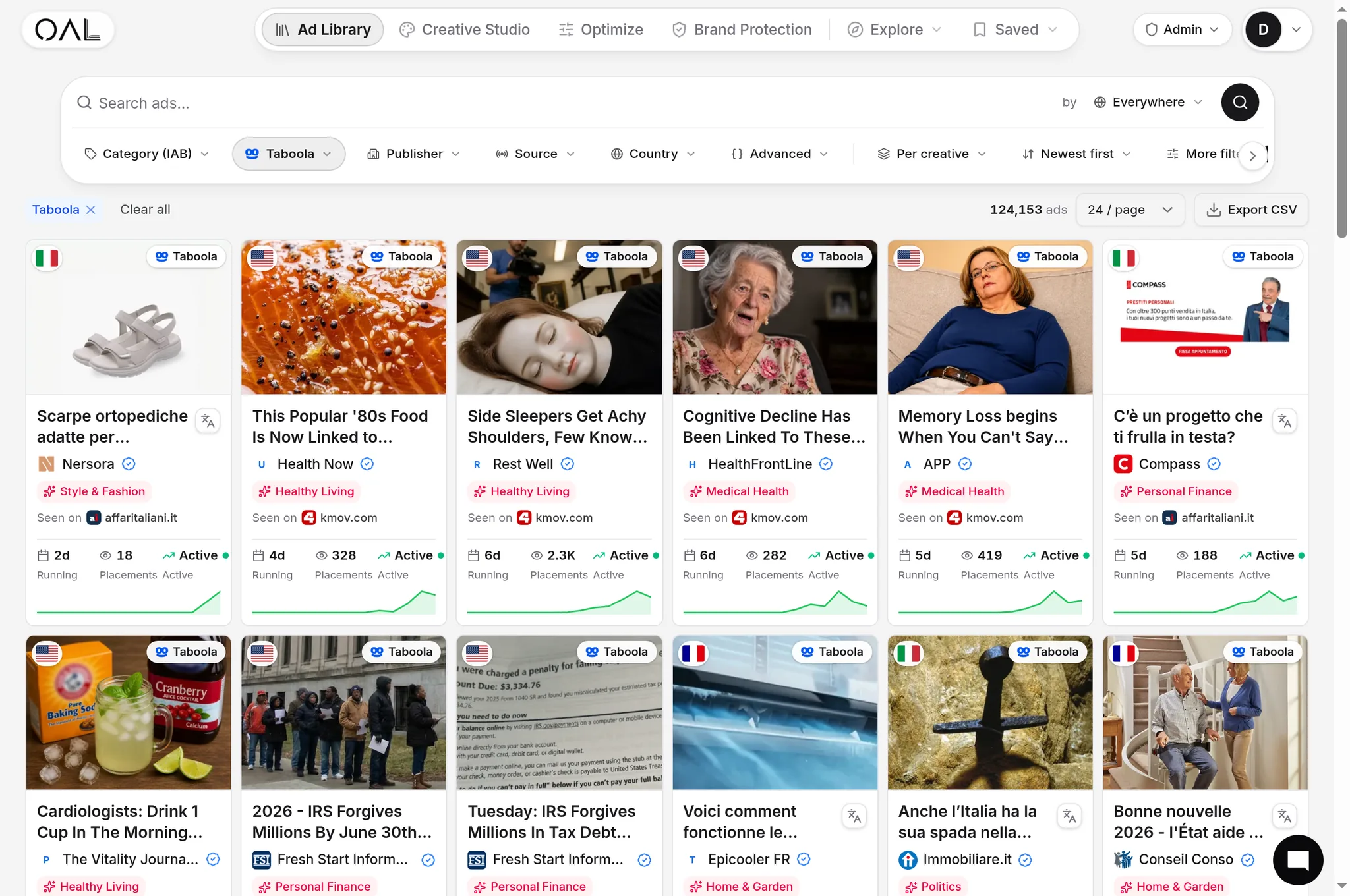
Most Taboola guides stop at "write a curiosity headline." This one walks the full Realize setup, budget math, Maximize Conversions, targeting, tracking, then shows what winning native creatives actually look like using live captured ads.

Native media buying is a four-part loop (offer, creative, bid, scale), and this 2026 playbook walks each step with concrete settings, live cross-network examples, and the metrics that actually move money.

Native networks are where advertisers test products first, so reading new entrants, creative ramps, and persistent offers there spots winners weeks before they saturate the Meta libraries everyone else watches.

Twelve native ad headline formulas, each matched to a real ad running right now across Taboola, Outbrain and the Microsoft Audience Network, so you can see the structure work before you swipe it.
Hook, angle, and claim get used interchangeably and it quietly wrecks your tests; here's the creative ladder that separates them, why the angle is the unit that scales, and how to read one advertiser running a single angle across a stack of hooks in live native-ad data.

A repeatable scoring rubric for hook, angle, proof, format and CTA, applied to real native ads we captured this month, so you copy the method instead of the creative.

A repeatable five-step method for tearing down native ad creatives, from hook and angle to advertorial, using real captured ads and longevity data instead of guesswork.
You can't see another affiliate's ROI, but you can see what they keep paying to run; here is how to turn ad longevity and creative saturation into a repeatable offer-validation checklist.

Winning products leave a trail in native ad data: ads that keep running for weeks, multiple affiliates piling onto one offer, and creatives that get refreshed instead of killed. Here is how to read those signals and trace the click to the offer page.

The angle is the strategic bet your whole campaign rides on, not the headline, and here's how to reverse-engineer the recurring angles that scale in nutra and finance from live native ad captures.

An ad that keeps running is an ad that keeps paying, and our first-seen/last-seen data on the live index shows just how few native creatives survive long enough to count.
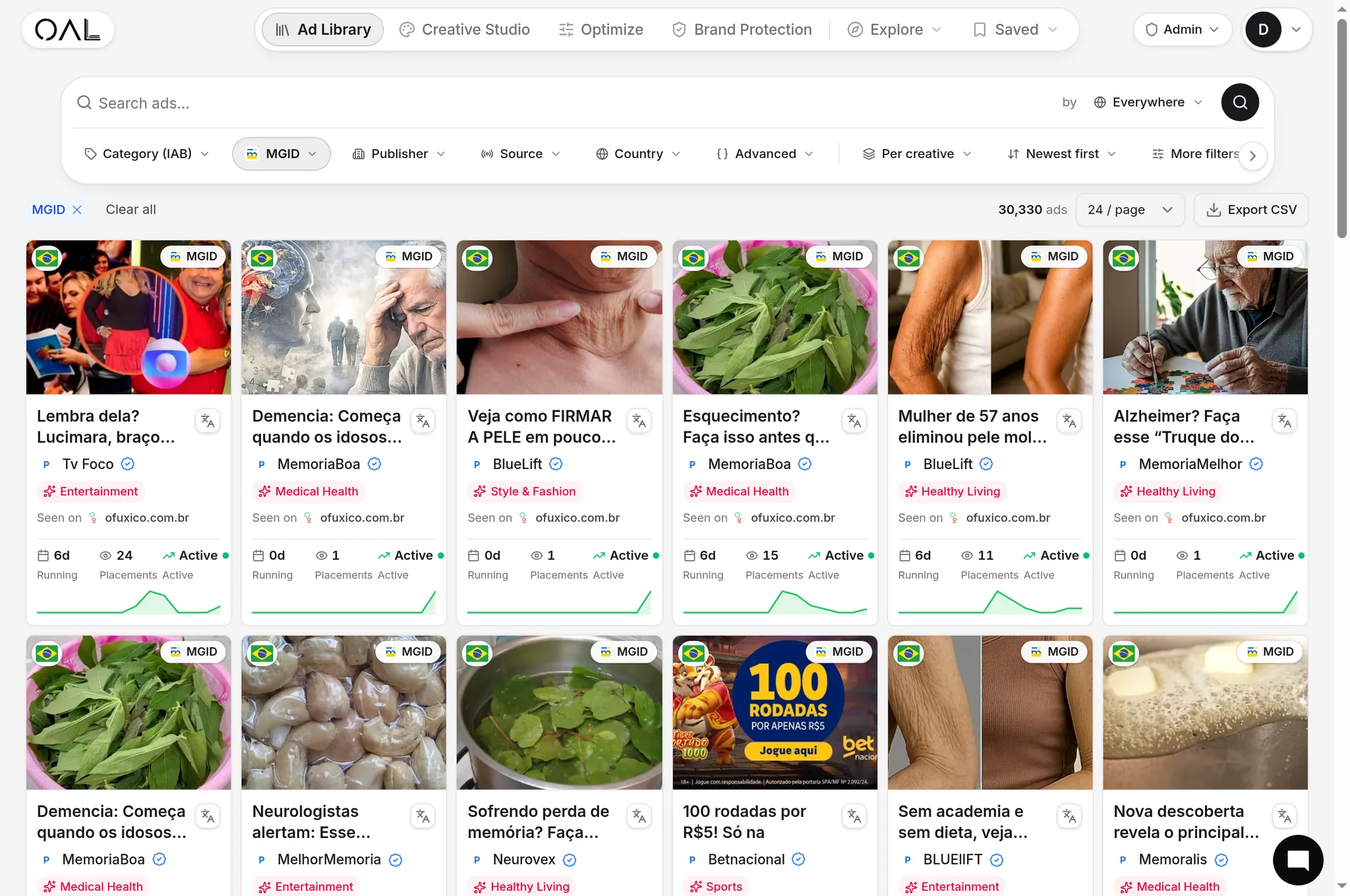
MGID and Revcontent are where smart media buyers diversify after Taboola and Outbrain, and here is how to spy on both properly using real captured longevity, geo, and advertiser data.
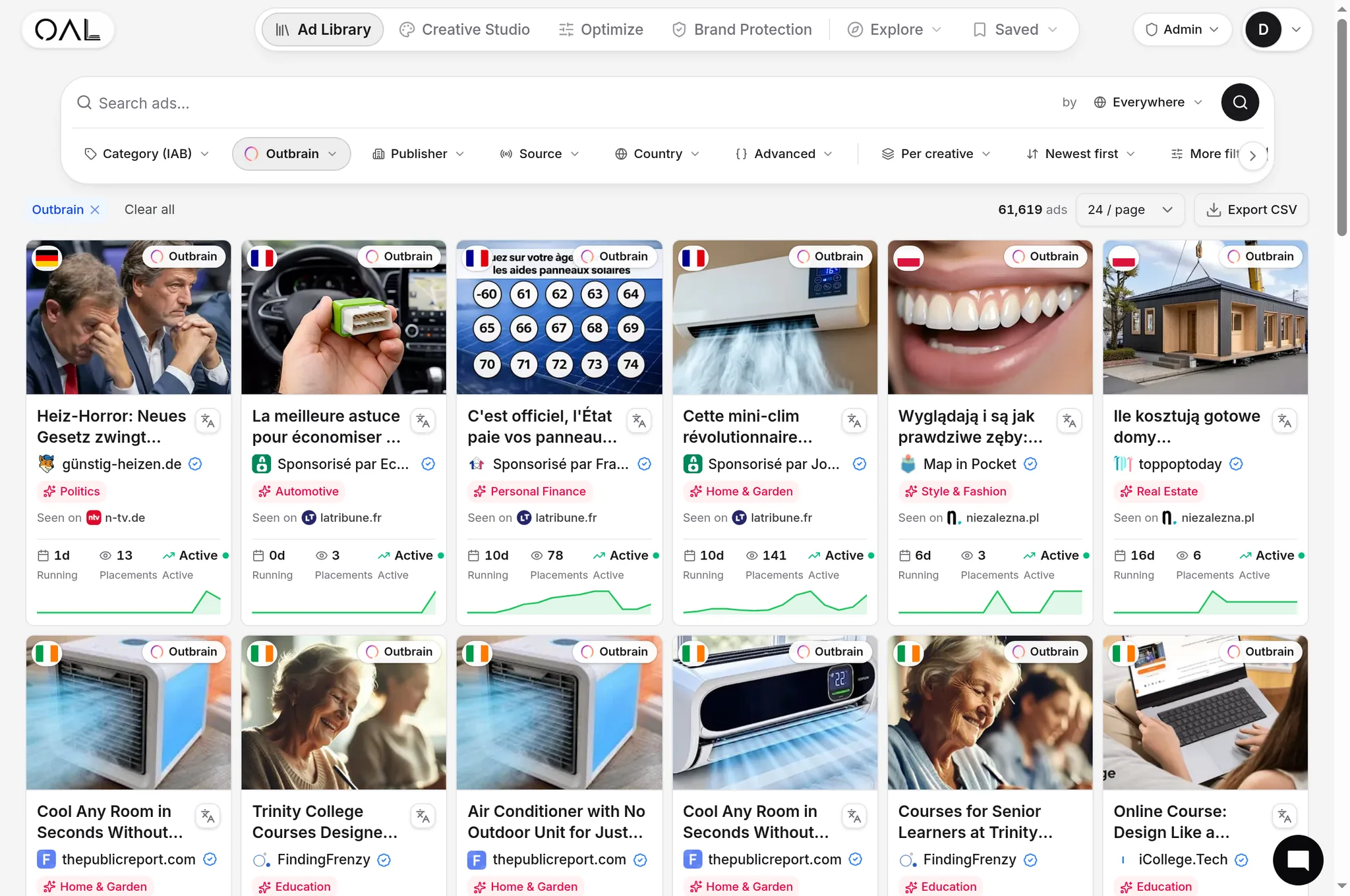
The Teads merger killed off Outbrain's per-creative competitive data, so here is how to capture live Outbrain/Teads ads from publisher pages instead: find rivals' creatives, trace each click to its landing page, and read longevity instead of fake spend numbers.
Taboola has no public ad library, so here's how to reconstruct one: filter live captures by network, vertical and geo, rank advertisers by volume and days live, then pull the full creative and the click-to-landing trace.

Taboola, Teads (Outbrain), MGID, and Revcontent each reward different ecommerce categories and margins, and our June 2026 capture data shows exactly where your product type actually has demand before you spend a dollar.
A practitioner's breakdown of what native advertising really costs in 2026: minimum deposits, CPC ranges and the test budgets that actually decide whether you win, grounded in live ad data from Taboola, Teads, MGID and Revcontent.
MGID lets you test from $100; Taboola realistically needs ~$300/day to clear its learning phase, and our capture index shows Taboola running three times the creatives MGID does.
Taboola is the scale incumbent and Revcontent the lower-floor challenger; we compare reach, entry cost, and the real advertiser mix on each using ads captured live (157,727 Taboola creatives vs 11,478 on Revcontent in our June 2026 index).

A media buyer's honest comparison of native ads and Facebook ads for DTC in 2026, covering CPC, iOS signal loss, creative, and intent, backed by the live native volume OpenAdLibrary tracks across Taboola, Outbrain, MGID, and Revcontent.
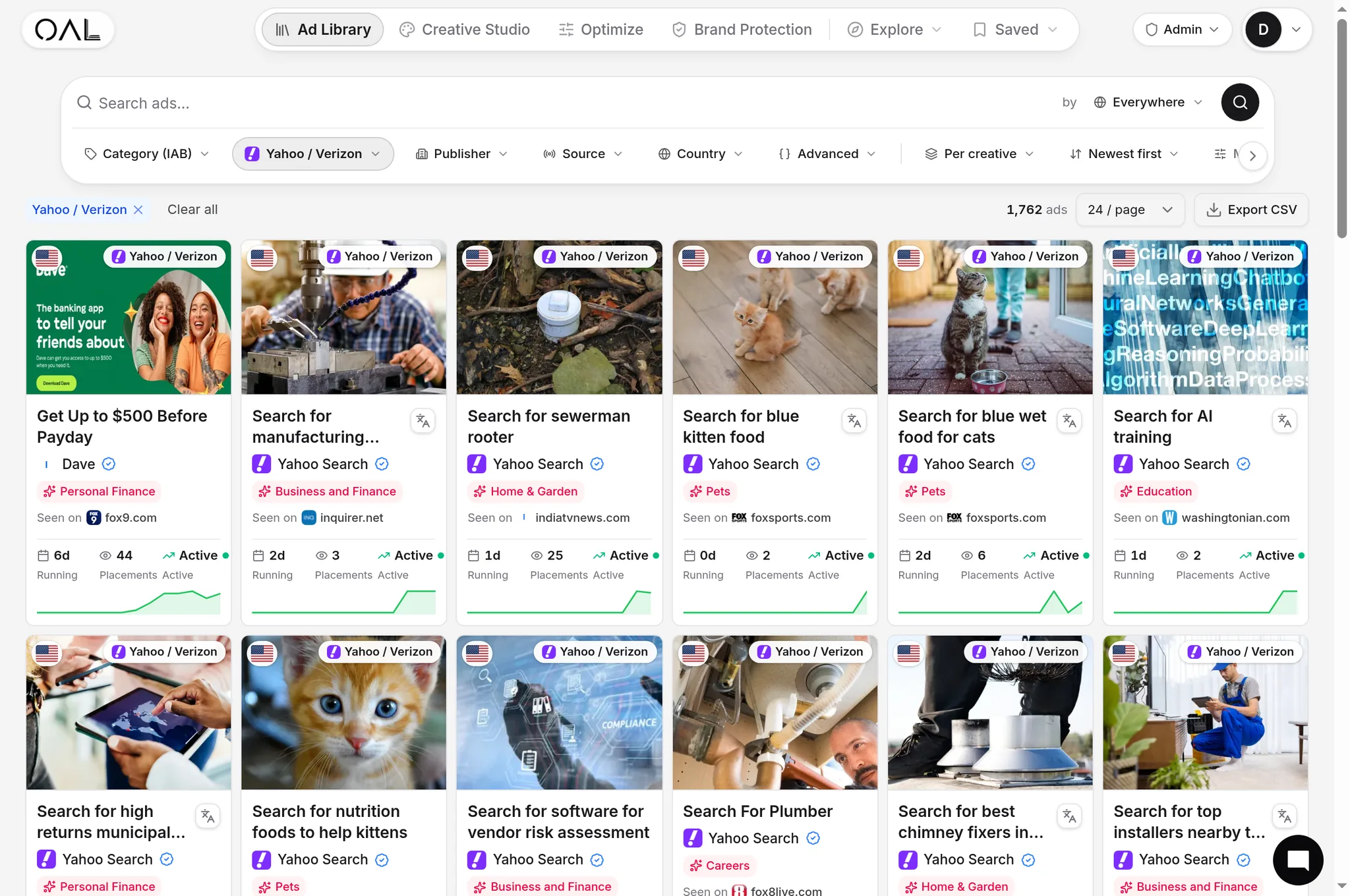
Yahoo Gemini was retired in 2023, and Yahoo native didn't die with it: demand moved to the Yahoo DSP and the supply is now run exclusively by Taboola, so here's the timeline and how to spy on live Yahoo creatives today.
Outbrain bought Teads, then took its name and Nasdaq ticker, and our live capture data shows the Outbrain engine still serves nearly all the volume.
Thirty real native ads captured live off Taboola, Outbrain and MGID in June 2026, each labeled with the actual advertiser, the network, and how long it has been running.
Yahoo Gemini is gone, but "Yahoo native" still trips up buyers: here is who really serves the ads in 2026, how to buy them, where MSN fits, and how to study live creatives.
Outbrain bought Teads in 2025 and rebranded the combined company as Teads; here is what the merged native, video, and CTV platform actually looks like, and how to study live inventory before you spend.
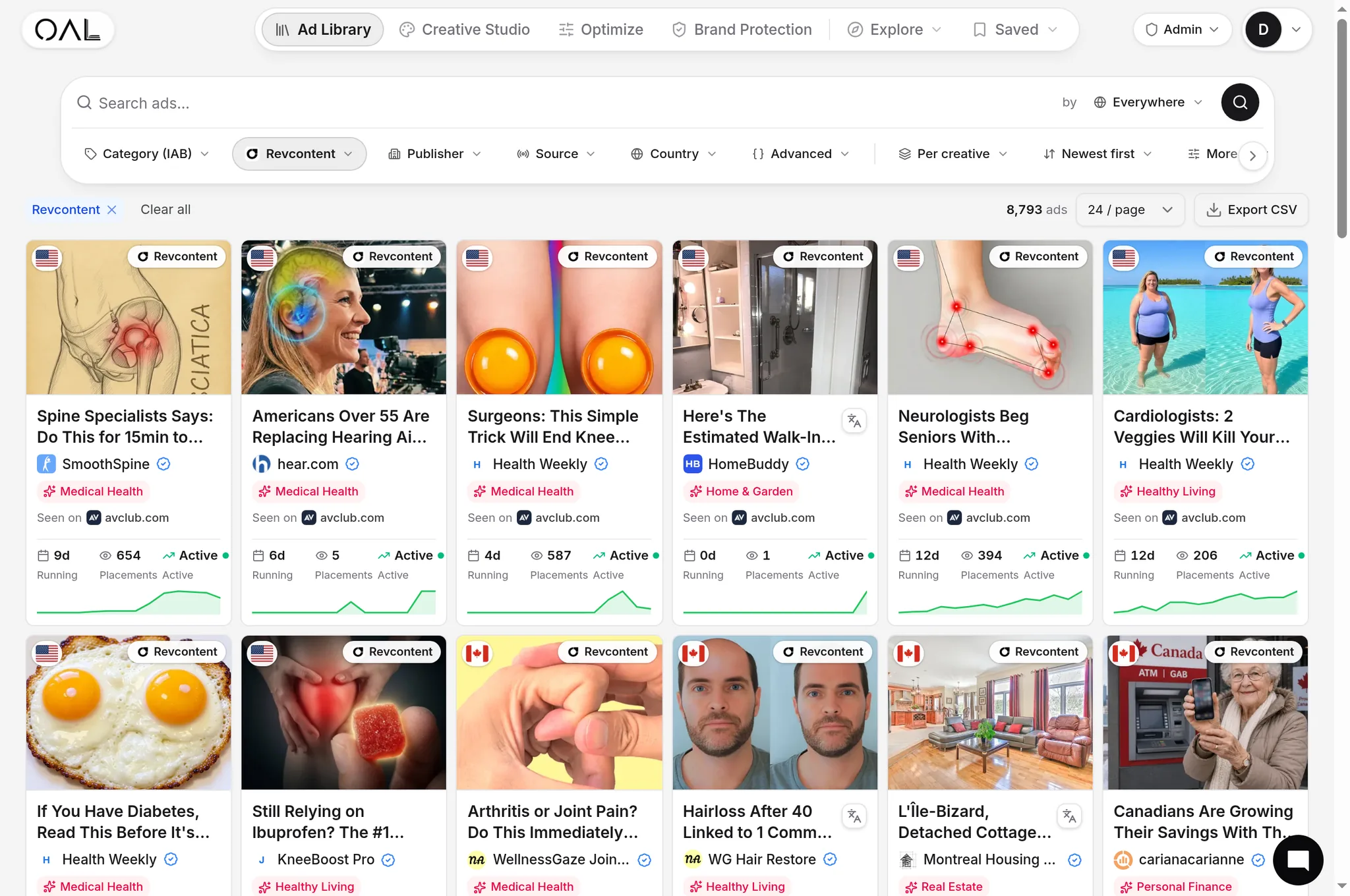
Revcontent serves native ads through publisher widgets you bid on one by one, and here is how its delivery, site-level targeting, CPC bidding and optimization levers actually work, with real captured ads.
A media buyer's walkthrough of MGID's native formats, contextual targeting and low entry CPCs, backed by the real creatives and tracker stacks we capture on live MGID placements.
Outbrain is now Teads on paper, but the native engine underneath is the same auction, and here is how its bidding, formats, pricing, and live creatives actually work for advertisers in 2026.
A working media buyer's breakdown of how Taboola native ads actually run in 2026: the auction, the widget, CPC pricing, and the tracker chain behind every click, shown with live creatives we captured instead of vendor mockups.

Watching the ads your competitors run in public is legal, and regulators are forcing platforms to make those ads even easier to see; the legal line is copying the creative, not researching it.
A practitioner's four-stage framework for turning a competitor's live native ads into a ranked list of winning angles, a relative-spend estimate, and a creative backlog you can test next week.

A watchlist is only useful if it tiers competitors by threat and feeds continuous monitoring, so here is how to build one and wire every advertiser into native-ad tracking and alerts.

The buyers who consistently find winners do not spy when they are stuck, they run a 45-minute weekly routine that turns scattered ad-checking into pattern recognition you can act on.

Most teams check competitor ads once a quarter and call it research; a real intelligence workflow runs every week with a scoped watchlist, a fixed cadence, a creative scoring rubric, and a clean handoff into media buying.

A native ad is just the doorway; here is how to walk the full chain behind it, from creative to SSP to click tracker to pre-lander to offer page, and read what each link reveals about a competitor's strategy.

A practitioner's walkthrough for finding the ads a competitor is actively running: search by brand or domain to surface live native creatives, the networks behind them, and the landing page each ad points to, plus exactly where Meta and TikTok go dark.
Native ads hide in plain sight at the bottom of every article, and here is how to find who is really buying them, read the creative and supply chain behind each placement, and trace the click to the landing page without ever firing a live ad.

Most ad intelligence platforms look identical on a feature grid, so score them on what actually matters: freshness, coverage, auditable evidence, click-to-landing capture, and pricing.

Adbeat and Anstrex both get called "ad spy tools," but one maps enterprise display spend and the other rips native landers for affiliates; here's the honest head-to-head, plus where an open native-first index changes the math.

A practitioner's head-to-head on AdPlexity, Anstrex, SpyOver and OpenAdLibrary, judged on price, network coverage, geos, landing-page capture, history and the supply-chain data each one actually exposes.

Most "free ad spy tools" are seven-day trials with a card form attached; here are seven that are genuinely free, including the only one that covers Taboola and Outbrain with click-traced landing-page evidence.

We ranked the ad spy tools DTC and ecommerce teams actually use in 2026 on the three things that decide outcomes, data freshness, native coverage, and price, including a $29.99/mo option that traces every click to the landing page.

A working media buyer's ranking of the best native ad spy tools for affiliate marketers in 2026, scored on landing-page access, network filters, geo, and price, with the real captured creatives to prove the point.

The best native ad spy tools don't screenshot pages; they read the same JSON feed the widget calls, store the full-quality creative, and trace the click to the landing page without ever spending an advertiser's budget. Here's exactly how.

"Free native ad spy tool" gets searched far more than it gets answered honestly, so here is what is genuinely free for researching Taboola, Outbrain, MGID and Revcontent ads, and exactly where the limits bite.

A native ad spy tool turns the scattered, public-but-invisible world of Taboola and Outbrain into a searchable record: the real creative, the advertiser behind it, and the landing page the click actually leads to.

A media buyer's guide to native advertising: what it is, the formats and supply chain behind it, real captured examples, FTC disclosure rules, and how to spy on the native ads actually winning right now.

A practitioner's read on native advertising in 2026, built from 589,000+ live-captured creatives: who is advertising, which verticals dominate, and what ad longevity really tells you about the winners.
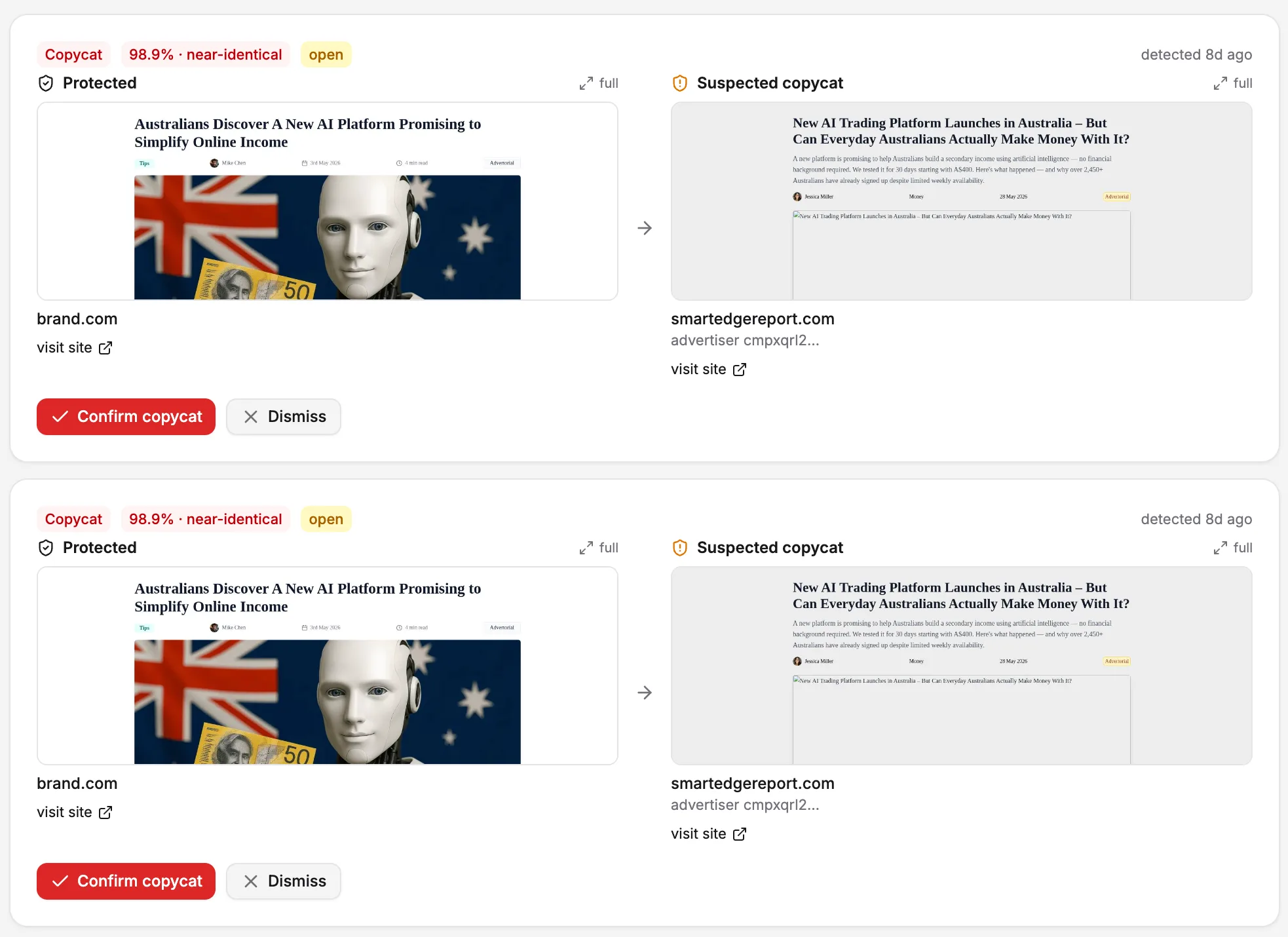
Native ad networks are where brand impersonation, copycat landing pages, and cloaked offers thrive, because the creative blends into the article and the real advertiser hides behind redirect chains; here is how to monitor, detect, document, and escalate brand abuse with evidence that holds up.

Ad transparency means anyone can see which ads are running, who paid for them, and where they appear, and here is how the libraries work, the laws that built them, and the native blind spot none of them fill.

The pre-lander is the page between a native ad and the offer, and on cold traffic it does the persuasion the ad can't: here's how advertorial funnels work and how to reverse-engineer the ones that win.
A practitioner's playbook for running native profitably as an affiliate in 2026: offer selection, creative angles, pre-landers, the test loop, and using live competitor ads to find proven winners and new geos.

A winning ad isn't the prettiest one in the feed, it's the one an advertiser keeps paying to run, and this is the framework for reading the signals that prove it.

We ranked the major native ad networks by the only metric that predicts where your money goes: how many live ads each one is actually running right now, pulled straight from OpenAdLibrary's index of 589,000+ captured creatives.

A practitioner's guide to native advertising in 2026: the formats, the networks, how the auction really works, and how to read winning ads straight off the live market.
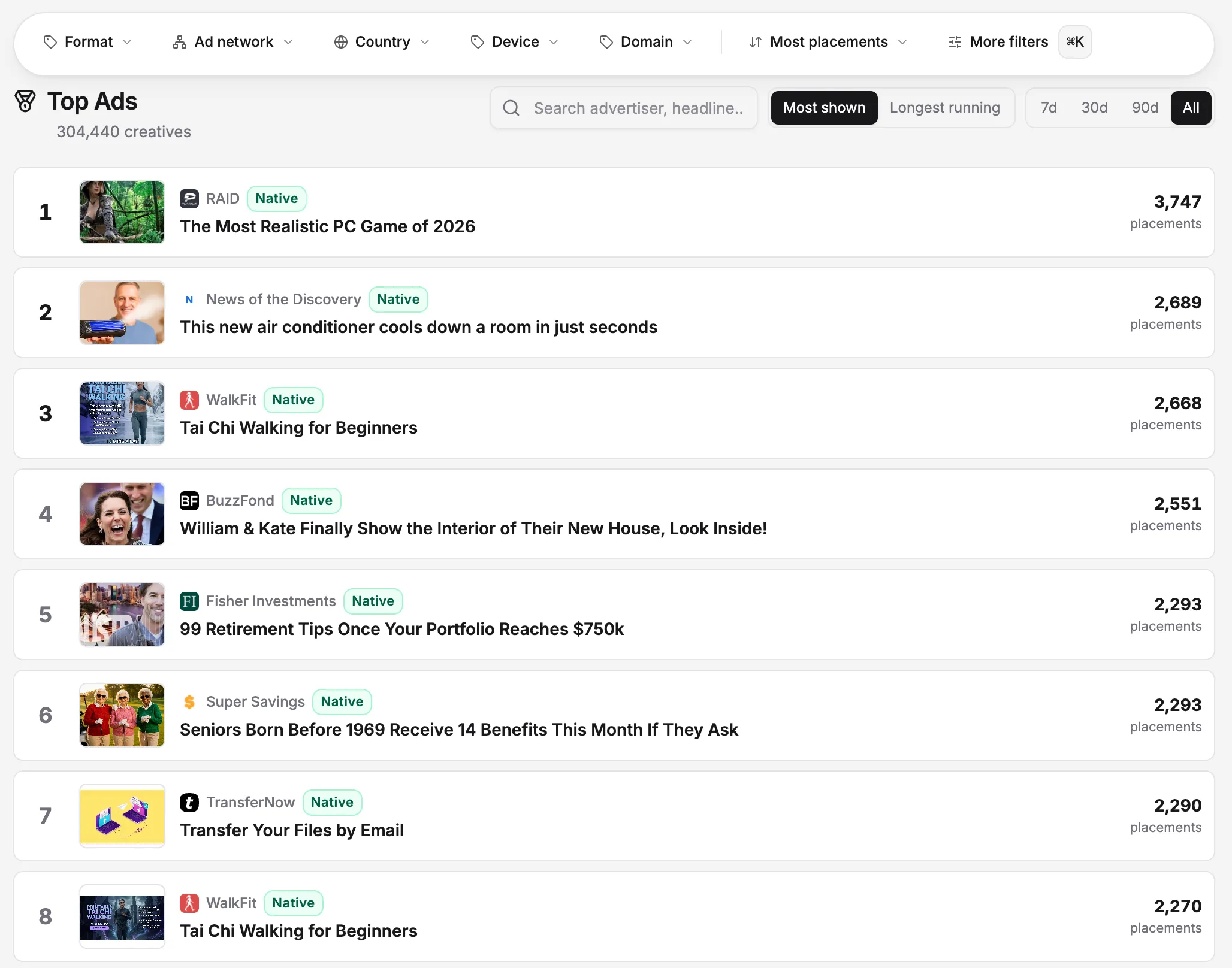
A practitioner's guide to spying on competitor ads across native, display and social: what to capture, how to tell real winners from noise, where the legal lines sit, and a weekly workflow that turns scattered screenshots into decisions.

We priced and ranked the native ad spy tools that matter in 2026, from $29.99 to $249-plus, on what actually wins campaigns: real coverage depth, full-quality creatives, and where the click goes.

Competitive intelligence in advertising is gathering and analyzing rivals' ads, channels, and spend signals to sharpen your own creative and media strategy.
In advertising, a spy tool, or ad spy, is software that captures competitors' live ads and landing pages so marketers can research winning creatives and offers.
An ad spy tool captures and archives competitors' live ads across networks so you can study their creatives, offers, and landing pages in one searchable database.
Ad intelligence is the collection and analysis of competitors' live ads, creatives, and landing pages to inform creative and media-buying decisions.
Ad transparency is the practice of making the ads an advertiser runs, and who is behind them, publicly visible through searchable libraries and disclosures.
The Google Ads Transparency Center is Google's free public tool for viewing ads any verified advertiser has run across Search, Display, YouTube, and Gmail.
The Meta Ad Library is Facebook and Instagram's free public database of currently running ads, searchable by advertiser, keyword, and country.
An ad library is a searchable, public database of ads that have run on a platform or network, showing the creative, advertiser, and run details.

Share of voice (SOV) is a brand's portion of total advertising presence in a market relative to all competitors.
Ad longevity, or run duration, is how long an ad stays continuously live in market, a strong proxy for whether it's profitable.
Ad spend is the total amount of money an advertiser pays to run its ads across channels over a given period.

Scaling in media buying means increasing spend on a proven-profitable campaign while keeping its cost-per-result and margins intact.
A media buyer is the person who plans, launches, and optimizes paid ad campaigns to hit performance targets at the lowest possible cost.
Media buying is the process of purchasing ad placements across networks and platforms to reach a target audience at the lowest effective cost.
Affiliate marketing is a performance model where partners earn a commission for each sale or lead they drive to an advertiser's offer.
An affiliate network is a marketplace that connects advertisers and affiliates, hosting offers, tracking conversions, and handling payouts.
An affiliate offer is a product or service an advertiser pays affiliates to promote, with a set payout per defined action, geo, and terms.
A sweepstakes offer pays an affiliate when a user enters a prize giveaway, usually by submitting contact details or completing a short form.
Nutra is the affiliate vertical covering nutraceuticals: supplements, weight-loss, beauty, and health products sold via direct-response ads.
A vertical is a category of affiliate offers grouped by product type and audience, such as nutra, sweepstakes, finance, or dating.
A traffic source is the ad platform a media buyer buys clicks or impressions from to send visitors to an offer or landing page.
Ad arbitrage is buying traffic through paid ads and monetizing it with higher-paying ads, profiting on the gap between acquisition cost and ad revenue.
Traffic arbitrage is buying web traffic cheaply and monetizing it for more than you paid, profiting on the spread between acquisition cost and revenue.
A copycat landing page mimics a legitimate brand's website to capture conversions, payments, or data by impersonating a trusted company.
Cloaking in affiliate marketing is serving one page to ad networks and a different page to real traffic, often to run offers networks would reject.
Ad cloaking is a deceptive technique that shows ad reviewers a compliant page while serving real users a different, often non-compliant destination.
Brand protection in advertising is the practice of defending a brand against impersonation, trademark misuse, cloaked ads, and copycat campaigns.
Brand safety is the set of measures advertisers use to keep their ads from appearing next to harmful, offensive, or off-brand content.
First-party data is information a business collects directly from its own customers and audience, such as purchases, site behavior, sign-ups, and email lists.
Contextual targeting places ads based on the content of the page being viewed, matching ads to page topics and keywords rather than to user identity.
In affiliate marketing, a GEO is the target country or region a campaign or offer is run in, the core variable for matching offers, payouts, and traffic.
Geo tiers group countries by purchasing power and ad cost: Tier 1 is wealthy and expensive, Tier 2 mid-range, Tier 3 cheap with low payouts.
Geo targeting restricts ad delivery to users in specific geographic locations, from whole countries down to cities, postal codes, or radius zones.
Dynamic Product Ads (DPA) auto-generate ad creatives from a product catalog feed, matching each user to the specific items most relevant to them.
A native ad spec is the set of format rules a native network requires for creatives, covering image size, headline length, file size, and asset types.
A carousel ad is a single ad unit containing multiple swipeable cards, each with its own image, headline, and destination link.
A motion ad is a native ad creative that uses short looping video or animation instead of a static image to stand out in feeds and recommendation widgets.
Outstream video is a video ad that plays within article text or feeds rather than inside a video player, appearing as the user scrolls it into view.
Display advertising is visual banner, image, and rich-media ads placed on websites and apps, typically sold by standard sizes and bought programmatically.
Resold inventory is ad space one company buys from a publisher and sells to advertisers, often sourced from a separate demand partner.

Supply Path Optimization (SPO) is the practice of choosing the shortest, cheapest, and most transparent route to buy a given ad impression.
The ad supply chain is the chain of intermediaries an ad passes through between the advertiser who pays and the publisher page where it appears.
The SupplyChain Object (schain) is an OpenRTB field that lists, in order, every intermediary an impression passed through before reaching the buyer.
sellers.json is a public file that exchanges and SSPs publish to reveal the sellers and intermediaries authorized to sell inventory through them.
ads.txt is a public file publishers host to declare exactly which companies are authorized to sell their ad inventory.

Click fraud is the deliberate generation of fake or invalid ad clicks, by bots or humans, to drain budgets or earn illegitimate payouts.
View-through attribution credits a conversion to an ad a user saw but never clicked, as long as it happens within a set window.
An attribution window is the set time period after an ad click or view during which a conversion is credited back to that ad.
A tracker is software that records every ad click, ties conversions back to the exact ad and placement, and routes traffic to the right offer.
Click-trace follows an ad's click through every redirect to its final landing page, revealing the real advertiser and offer behind it.
A redirect chain is the series of intermediate URLs a click passes through before reaching the final landing page.
A click tracking domain is the dedicated domain a tracker uses to log and redirect ad clicks before the user reaches the landing page.
Click tracking records every click on an ad by routing it through a tracking server before the user reaches the landing page.
A click ID is a unique identifier assigned to each ad click so a later conversion can be matched back to the exact click that caused it.
A postback URL is a server-to-server callback that reports a conversion back to the ad network or tracker without using a browser pixel.
Conversion tracking records when an ad click leads to a sale, lead, or signup, and ties that result back to the ad that drove it.
A conversion pixel is a tracking snippet placed on a goal page that fires when a user completes a valued action, attributing it back to the ad that drove it.
A tracking pixel is a tiny, often invisible image or code snippet that fires when a page loads, recording user activity for measurement and attribution.
A whitelist allows ads to run only on chosen publisher sites; a blacklist blocks specific sites, both are core site-targeting controls in native campaigns.

A publisher or site ID is the unique code an ad network assigns to each website or property in its supply, used to track and target inventory by source.
An ad placement is the specific location or slot on a publisher's page or app where an ad is displayed to a user.
An advertiser ID is the unique identifier an ad network assigns to each advertiser account, tying every campaign and creative back to one entity.
An advertiser is the brand, business, or marketer that pays to place ads in front of an audience to drive awareness, clicks, leads, or sales.
In advertising, a publisher is the owner of a website, app, or media property that sells ad space to advertisers to monetize its audience.
MSN native ads are sponsored image-and-headline units shown in Microsoft's MSN content feed, much of it sold as resold demand through partner platforms.
Yahoo Gemini was Yahoo's native and search ad marketplace, now folded into Yahoo Native and the Yahoo DSP for buying native inventory at scale.
MediaGo is Baidu's native advertising platform that connects advertisers to MSN and other premium open-web supply outside China.
Teads is a global media platform best known for pioneering outstream video ads that play inside the editorial content of premium publishers.
Revcontent is a native advertising network that serves content-recommendation widgets on publisher sites, known for its selective, higher-quality supply.
MGID is a global native advertising network that distributes content-recommendation ads across thousands of mid-tier publisher sites worldwide.
Outbrain is a major native advertising network that serves content-recommendation ads across premium publisher sites, often as "recommended" link widgets.
Taboola is a leading native advertising network that serves content-recommendation widgets across thousands of publisher sites worldwide.
A native ad network connects advertisers to native, content-style ad placements across a large pool of publisher sites, usually as recommendation widgets.
An ad network is an intermediary that aggregates unsold ad inventory from many publishers and packages it for sale to advertisers.
Smart bidding is automated bidding where the platform's machine learning sets each bid in real time to hit a target cost, conversion, or ROAS goal.
A native ad auction is the real-time process a native ad network runs to pick which ad fills a recommendation slot and what the advertiser pays.
An ad tag is a snippet of HTML or JavaScript code on a web page that requests an ad from an ad server and renders it in a specific slot.
An ad server is technology that stores, selects, delivers, and measures ads, deciding which creative to show each impression and tracking the outcome.
A data management platform (DMP) collects and organizes audience data into segments, then activates them for ad targeting across platforms.
A private marketplace (PMP) is an invite-only programmatic auction where publishers offer premium inventory to selected buyers via deal IDs.
Direct buy vs programmatic contrasts manually negotiated, fixed-price ad deals with automated, auction-driven inventory buying.
Programmatic direct buys reserved ad inventory at a fixed, pre-negotiated price through automated workflows rather than an open auction.
Programmatic native advertising is the automated, auction-based buying of native ad placements that match the look and feel of their host content.
Programmatic advertising is the automated buying and selling of digital ad inventory through software, usually settled in real-time auctions.
Header Bidding lets publishers offer inventory to multiple exchanges at once before the ad server call, increasing competition and yield.
OpenRTB is the open IAB protocol that standardizes the structure of bid requests and responses in real-time bidding auctions.
Real-Time Bidding (RTB) is the per-impression auction in which advertisers bid on a single ad impression in milliseconds as a page loads.
An Ad Exchange is a digital marketplace that matches publisher inventory with advertiser demand through real-time auctions.
A Demand-Side Platform (DSP) is software advertisers use to buy ad inventory programmatically across many exchanges from one interface.
A Supply-Side Platform (SSP) is software publishers use to sell ad inventory programmatically and maximize yield across exchanges and buyers.

Impression share is the percentage of eligible ad impressions your ads actually won out of the total available for your targeting and budget.
Viewability measures whether a served ad was actually in view, based on how much of it entered the screen and for how long.
An ad impression is a single instance of an ad being served and rendered on a page or app where a user could see it.
AOV (average order value) is the average amount spent per order, calculated as total revenue divided by the number of orders.
ROAS (return on ad spend) is the revenue generated for every dollar spent on advertising, calculated as revenue divided by ad spend.
A conversion is any valuable action a user completes after seeing or clicking an ad, such as a purchase, signup, lead, or app install.
Conversion rate (CVR) is the percentage of clicks or visitors that complete a desired action, such as a purchase, signup, or lead.
CTR (click-through rate) is the percentage of ad impressions that result in a click, calculated as clicks divided by impressions times 100.
RPM (revenue per mille) is the revenue a publisher earns per one thousand ad impressions or page views, the monetization mirror of CPM.
EPC (earnings per click) is the average revenue an affiliate or media buyer earns for each click sent to an offer, calculated as earnings divided by clicks.
eCPC (effective cost per click) is the blended average cost of a click across a campaign, even when the campaign was not priced per click.
CPL (cost per lead) is the average advertising cost to capture one lead, such as a form fill, email signup, or quote request.
CPA (cost per acquisition) is the average advertising cost to win one conversion, calculated as total spend divided by conversions.
CPM (cost per mille) is the price an advertiser pays per one thousand ad impressions, regardless of whether anyone clicks.
CPC (cost per click) is the amount an advertiser pays each time a user clicks their ad, calculated as total spend divided by total clicks.
UGC ads are advertisements styled to look like authentic user-generated content, casual reviews, testimonials, and selfie-style clips, to feel native and credible.
Creative fatigue is the decline in an ad's performance over time as the audience sees it too often and stops responding.
Clickbait is sensational or misleading content engineered to maximize clicks while underdelivering on the promise it makes.
A curiosity gap is a copywriting technique that withholds a key piece of information, creating an itch the reader resolves by clicking.
Ad copy is the written text of an advertisement, headline, description, and call to action, written to persuade a reader to click or buy.
A creative angle is the specific argument, perspective, or emotional appeal an ad uses to position an offer for a particular audience.
An ad hook is the opening element of an ad, a headline, image, or idea, engineered to seize attention in the first second and compel the click.
An ad creative is the visible content of an ad, image or video, headline, and copy, that the user sees, and the primary driver of native ad performance.
A landing page is the standalone destination a visitor lands on after clicking an ad, built around one conversion goal such as a purchase or sign-up.
A bridge page is an intermediate page that connects a traffic source to an offer, pre-selling the visitor before handing them to the final landing page.
A pre-lander is an intermediate page between the ad click and the offer that warms up and qualifies the visitor before the final landing page.
An in-feed ad is a native ad placed inside a content stream, a feed, article list, or timeline, and styled to match the organic items around it.
A teaser ad is a native ad that deliberately withholds key information, using a curiosity-driven headline and image to compel the click-through.
A discovery ad is a native ad shown inside content-discovery feeds and recommendation widgets, styled to match editorial content as a headline plus thumbnail.
A content discovery ad is a native placement that surfaces sponsored content as a suggested read, helping users discover articles, videos, or offers.
A native ad widget is the on-page unit, often a JavaScript-injected block, that renders native ads styled to match the host publisher's layout.
A content recommendation widget is the box of suggested article and ad links placed below or beside publisher content, mixing organic and paid links.
Branded content is brand-produced, story-driven media that entertains or informs rather than pitching a product directly, building affinity over time.
Sponsored content is editorial-style material a publisher creates or hosts in exchange for payment from a brand, clearly disclosed as paid.
An advertorial is a paid page written in editorial style that pre-sells a product or offer before sending the reader to the sales page.
Native advertising is paid media designed to match the look, feel, and function of the platform it appears on, so it blends with surrounding content.