Español
 Português (Brasil)
 Français
 Deutsch
 Italiano
 Nederlands
 Polski
 Svenska
 Türkçe
 Русский
 日本語
日本語 한국어
한국어 简体中文
简体中文 Tiếng Việt
 Bahasa Indonesia
 繁體中文
繁體中文 Čeština
 Dansk
Dansk Suomi
Suomi Ελληνικά
 Română
 Magyar
 Українська
 ไทย
ไทย हिन्दी
 العربية
 עברית
עבריתBest Geos for Native Ads: Where Affiliates Are Scaling Now
Tier-1 payouts, Tier-2 margins, Tier-3 volume: how to pick native ad geos on the payout-to-click-cost spread, and how to validate a market before spending a dollar.


There is no single best geo for native ads — the best geo is the one where the spread between what a conversion pays and what a click costs is widest for your offer. Tier-1 English markets (the US, UK, Canada, Australia) carry the deepest native inventory and the highest payouts, but also the most expensive clicks and the heaviest competition. That is why many affiliates report better margins in Tier-2 Europe — DACH, France, Italy, Spain, the Nordics — and in selected Tier-3 markets across LATAM and Southeast Asia, where clicks cost a fraction of US rates and far fewer buyers compete for the same widget slots.
What actually makes a geo "good"#
Cheap clicks alone don't make a geo good — cheap clicks with nothing to sell against them are just cheap losses. Evaluate five factors together:
- Payout depth. What do offers in your vertical actually pay in that market? A geo with one mediocre offer is a dead end regardless of traffic price.
- Click cost. Native CPCs vary enormously by market and auction density. Our native CPC benchmarks and budgeting guide cover how to reason about the ranges without trusting anyone's fixed numbers.
- Volume ceiling. Small wealthy markets cap out fast. A campaign that prints in Denmark may never spend more than a modest daily budget there.
- Competition density. The fewer sophisticated buyers in an auction, the longer angles stay fresh and the cheaper testing runs.
- Operating cost. Translation, local compliance, payment methods and customer-service expectations all tax margin — and they differ wildly between, say, Germany and the Philippines.
Native geo tiers at a glance#
The standard shorthand — Tier 1, Tier 2, Tier 3 — sorts markets by purchasing power and traffic price:
| Tier | Example markets | Traits | Commonly used for |
|---|---|---|---|
| Tier 1 | US, UK, CA, AU, NZ, DE, FR | Highest payouts, highest CPCs, most competition | Finance, insurance, health, high-AOV ecommerce |
| Tier 2 | IT, ES, NL, Nordics, PL, CZ, JP, KR | Solid purchasing power, moderate CPCs, thinner competition | Nutra, ecommerce, lead-gen |
| Tier 3 | LATAM, SEA, India, South Africa, balance of CEE | Cheap clicks, lower payouts, volatile inventory quality | Sweeps, mobile offers, cheap angle testing |
The boundaries are conventions, not physics — DE and FR get classed Tier 1 by some buyers and "Tier 1.5" by others. What matters is the payout-to-CPC spread, not the label.
Where affiliates commonly scale — and why#
These are patterns practitioners consistently report, not guarantees:
- United States. Still the money geo for the payout-rich categories. The concentration is visible in OpenAdLibrary's index, where health (
24,500 creatives), finance (24,000) and insurance (~22,400) are the largest verticals across all networks (June 2026). US auctions are the most contested in native; enter with a proven funnel, not a first test. - DACH (Germany, Austria, Switzerland). High purchasing power, strong ecommerce and nutra demand, and a market that punishes sloppy translation harder than almost any other. Buyers who invest in real German localization report unusually durable campaigns.
- France, Italy, Spain. Nutra and ecommerce staples with deep native inventory. Local-language advertorials dominate; literal translations of English funnels underperform.
- The Nordics. Wealthy, small, quick to saturate — best treated as a basket: run the same funnel across several small geos rather than expecting one to scale alone.
- Central & Eastern Europe. Cheap testing labs with real conversion volume. Many buyers prove angles in PL/RO/CZ before paying Tier-1 rates for the same lesson.
- LATAM (Mexico, Brazil, Colombia, Argentina). Mobile-heavy and low-CPC, strong for sweepstakes, nutra and finance-lite offers. Payment-method friction shapes what converts.
- Southeast Asia. Mobile-first with very low CPCs; offer availability is uneven, so validate payouts before spending.
Which verticals travel to which geos is its own topic — see the best affiliate verticals for native ads and the nutra playbook for the vertical-side view.
Match the geo to the network#
Networks are not evenly strong everywhere. Broad strokes that practitioners commonly report: Taboola and Outbrain concentrate premium Tier-1 and global publisher inventory; MGID runs deep in Tier-2/Tier-3 Europe, LATAM and Asia; Revcontent skews toward US mid-tier inventory; MediaGo has notable APAC reach. The index's live-creative counts are a rough proxy for where demand actually sits: Taboola 206,000+, Outbrain 108,000+, MGID 62,000+, Revcontent roughly 15,800, and the Microsoft Audience Network feed — the single largest slice of the index at 281,000+ creatives (June 2026) — reaching MSN audiences across dozens of countries. Weighing the two most different options against each other? See MGID vs Taboola.
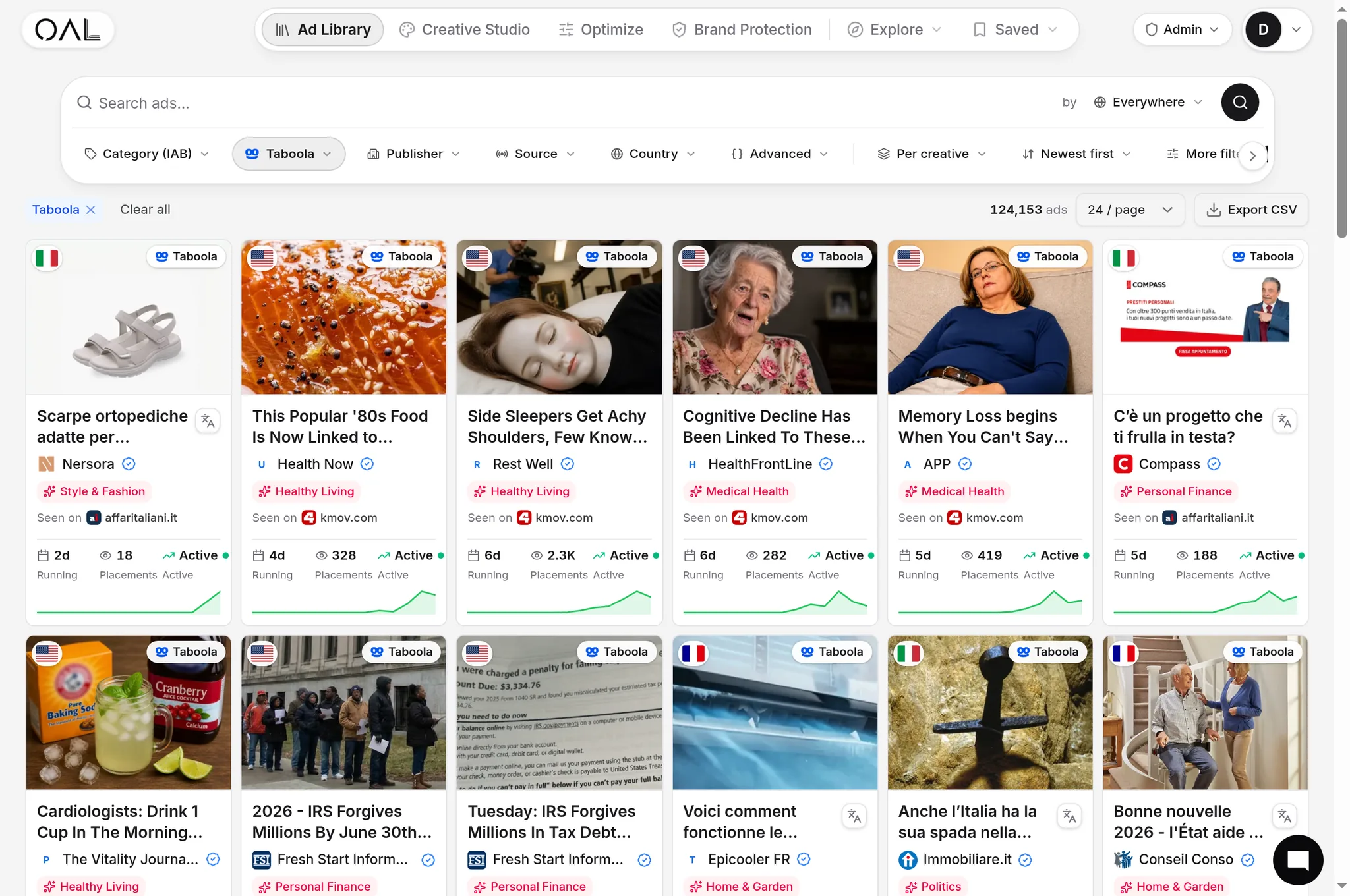
A practical consequence: the "best geo" question is partly a "best network for that geo" question. The same offer in Poland can be unbuyable on one network and comfortably profitable on another purely because of publisher coverage. So check coverage the empirical way rather than by reputation: filter a network's live ads by geo in the Taboola library or the MGID library and count active advertisers in your vertical. Ten minutes of counting beats any coverage map.
Validate a geo before you commit budget#
The cheapest geo research is watching who already spends there:
- Count advertiser density. Filter your vertical and target geo in a live index. A healthy set of active advertisers is proven demand; an empty result is either an untapped market or a graveyard — longevity data tells you which.
- Sort by longevity. Ads that keep running keep paying. A geo where competitors sustain creatives for weeks is a geo where the economics close.
- Trace the funnels. Captured landing pages show how winners localize: funnel shape, translation quality, proof elements, price framing. OpenAdLibrary's index holds 1.3 million+ traced landing captures across 49 networks (June 2026).
- Check the device split. Tier-3 traffic skews heavily mobile; a desktop-built funnel will quietly bleed there.
- Confirm payouts. Ask your network or affiliate manager what the offer actually pays in that geo before falling in love with cheap clicks.
A geo-expansion sequence that keeps ROI intact#
- Prove unit economics in one geo first. One profitable market teaches you the funnel's real numbers; five half-tested markets teach you nothing.
- Clone to culturally adjacent geos. AU to NZ and the UK; DE to AT and CH; ES to MX and onward into LATAM. This is horizontal scaling in its cleanest form — same funnel, new auction.
- Localize, don't translate. Currency, idiom, local proof elements and familiar names move CTR and CVR more than any bid change. A native-speaker review is the cheapest conversion-rate optimization you will ever buy.
- Rebuild blacklists per geo. Publisher quality does not transfer between markets; a whitelist earned in the US says nothing about Brazil.
- Re-run the stop-loss math per geo. Payouts and CPCs shift together, so kill thresholds set for the US will be wrong everywhere else.
The full workflow for finding underpriced Tier-2 and Tier-3 opportunities — including how to spot geos competitors have missed — is in scaling to new geos.
The three ways buyers get geos wrong#
Most geo failures trace back to one of three errors:
- Chasing cheap clicks without an offer. The buyer sees Tier-3 CPCs, launches, and discovers the vertical's offers either don't accept that geo or pay so little that even free traffic wouldn't rescue the math. Payout depth comes first, always.
- Treating a geo test like a campaign test. One creative, one funnel, machine-translated, run for two days — then "the geo doesn't work." A geo verdict needs the same rigor as any campaign verdict: several angles, a localized funnel, and enough spend to expect conversions before judging.
- Scaling the geo instead of the system. A buyer profitable in Mexico assumes Brazil is the same market with a different flag. Different language, different payment rails, different publisher mix — every clone still needs its own validation pass, just a cheaper one because the funnel logic is proven.
Geo selection is not a one-time decision but a portfolio you rebalance: auctions heat up, payouts move, and the spread you found last quarter closes. The buyers who win keep a research loop running — watching where competitors launch, sustain and quietly disappear — and treat that map as the earliest signal of where the margin has moved.