Español
 Português (Brasil)
 Français
 Deutsch
 Italiano
 Nederlands
 Polski
 Svenska
 Türkçe
 Русский
 日本語
日本語 한국어
한국어 简体中文
简体中文 Tiếng Việt
 Bahasa Indonesia
 繁體中文
繁體中文 Čeština
 Dansk
Dansk Norsk (bokmål)
 Suomi
Suomi Ελληνικά
 Română
 Magyar
 Українська
 ไทย
ไทย हिन्दी
 العربية
 עברית
עבריתThe Native Ads Launch Checklist (Pre-Flight for Every Campaign)
Most native campaigns that die in week one fail on tracking or economics, not creative. This seven-phase pre-flight checklist catches those failures before the first dollar is spent.


Before a native ads campaign spends its first dollar, it should pass seven checks: the offer's economics work on paper, competitive research confirms someone is already winning with something similar, tracking fires end to end, the creative package covers multiple angles, the landing path holds up on mobile, campaign settings match the plan, and kill rules for the first 72 hours are written down in advance. Most native campaigns that die in week one fail one of these checks — usually tracking or economics, not creative quality. This is the full pre-flight checklist, in launch order, with the reasoning behind each item and a condensed one-page version at the end.
Phase 1: Economics — prove the math before you build anything#
Native traffic punishes thin margins. Run these checks before writing a single headline:
- Confirm the payout and terms in writing. Caps, allowed traffic types, geo restrictions, and whether the network or advertiser scrubs aggressively. A payout that quietly excludes your planned geo invalidates everything downstream.
- Compute your breakeven CPC. Breakeven CPC = payout × expected conversion rate. A $40 payout at a 2% click-to-conversion rate breaks even at $0.80 per click. Now compare that against what clicks actually cost: our native ads CPC benchmarks cover the major networks, and the honest answer is always a range that your geo, device split and niche will move a lot. If realistic CPCs sit above your breakeven, the campaign is dead before launch — no creative fixes negative unit economics.
- Validate that the offer converts for someone. Network EPC data, your affiliate manager's word, and — most reliably — evidence that other buyers are running it sustained. The full method is in our offer validation guide — and read network EPC figures skeptically, because they average winners and losers into one flattering number.
- Set the test budget as a number, in advance. Practitioners commonly plan several multiples of the payout per meaningful decision — enough to judge placements, not just to feel activity. Whatever your number, write it down now; improvised budgets grow by sunk cost.
- Know your cash-flow window. Ad networks charge you now; affiliate networks pay on net terms. The gap is a real constraint on how fast you can scale a winner, so plan for it before it surprises you.
One nuance the spreadsheet hides: not all payouts are equal. A flat CPA payout is simple to model. A revenue-share deal, or your own DTC product with upsells, means the real number is average order value net of refunds and chargebacks — and refunds arrive weeks after the spend that generated them. If your economics only work at the optimistic end of the funnel, treat the pessimistic end as the plan and the optimistic end as upside. Campaigns built on best-case math get killed by ordinary variance.
Phase 2: Competitive research — confirm the demand is real#
You are not the first person to try your vertical on native. That is an advantage — use it:
- Search live native ads in your vertical and geo. If nobody is running anything like your offer, treat it as a warning, not an opportunity: unprofitable is far more common than undiscovered. The workflow is covered in how to spy on competitor native ads.
- Filter for longevity. Ads that have run three weeks or longer are being paid for by someone who can see their numbers. Ad longevity is the strongest public profitability signal native advertising has.
- Collect 10–20 headline patterns from those survivors — not to copy, but to learn which promises your audience already responds to. Our native ad headline formulas piece maps the recurring structures.
- Walk at least three full funnels from ad through pre-lander to offer page, noting the template, the disclosure placement and the CTA structure.
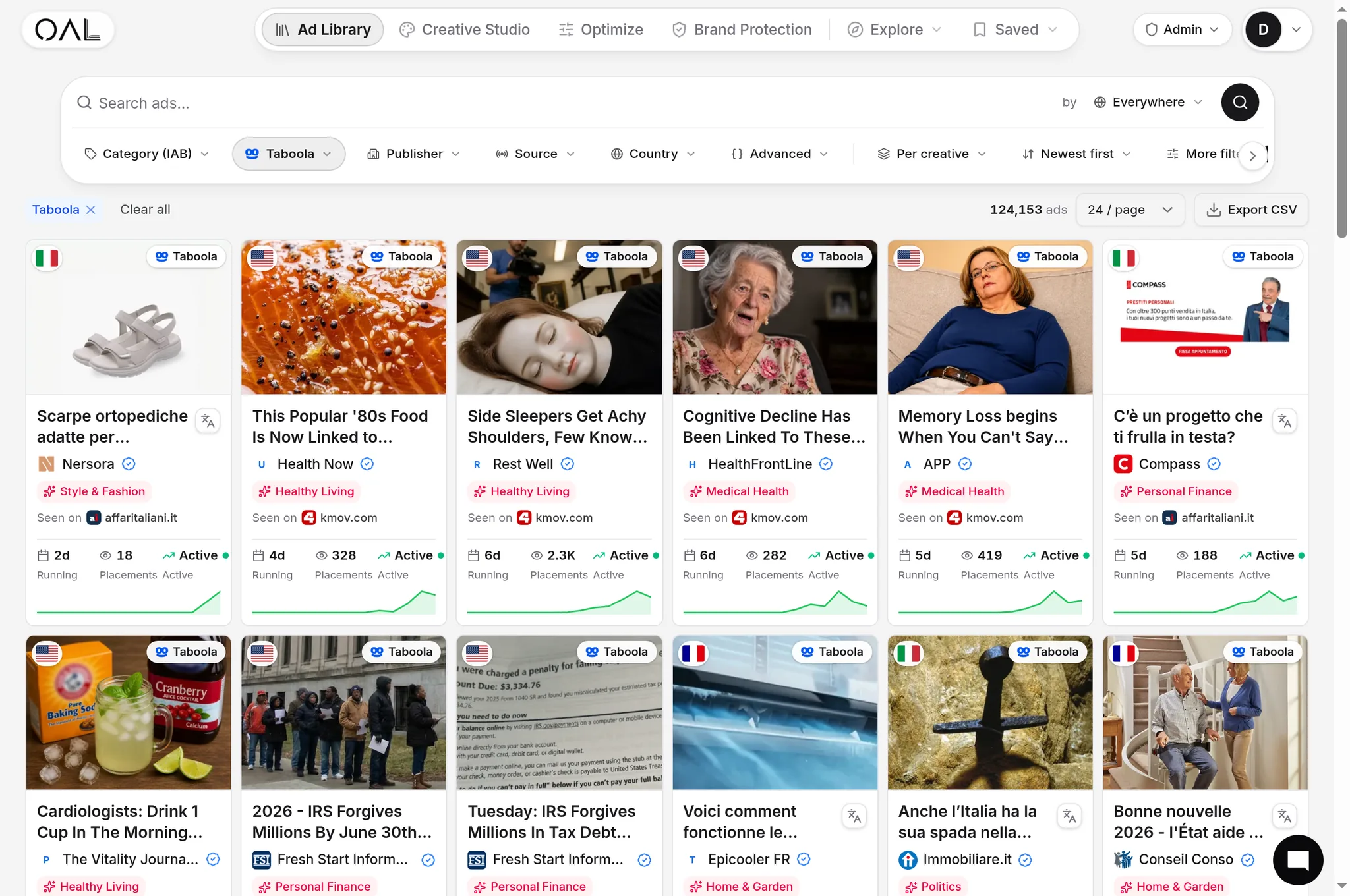
- Check the vertical's network mix. Verticals concentrate differently per network: in OpenAdLibrary's June 2026 index, health is the largest classified vertical on Taboola (11,982 live creatives) while MGID's largest is entertainment (13,987) — the same offer meets a very different feed on each network. The index spans 725,000+ live creatives across 49 networks, and the native ad spy tool filters by network, vertical, geo and device so you can see where competitors in your niche actually concentrate their spend.
Research also tells you what not to test. If every three-week survivor in your vertical runs a mobile advertorial funnel and nobody links ads directly to an offer page, that is the market telling you the direct path has been tried and buried. You can still test it — sometimes conditions change — but test it as the long shot it is, with the smaller budget a long shot deserves, not as your primary launch plan.
Phase 3: Tracking — the phase that kills the most launches#
Placement-level cuts are the heart of native optimization, and they are impossible without clean data. Every item here is verified by doing, not by assuming:
- Tracker campaign created and click IDs passing. Click through your own funnel from a phone and confirm the click ID arrives in the offer URL.
- Server-to-server postback configured and test-fired. Set up the postback URL, fire a test conversion, and watch it land in the tracker. A postback that has never fired a test event is a postback that doesn't work.
- Sub-ID conventions set so publisher and placement IDs flow into your tracker. Your first-week decisions are placement cuts; without sub-IDs those cuts are guesses.
- Network conversion tracking registered and verified — pixel or S2S, with a test event confirmed in the network UI. The network's algorithm optimizes toward whatever you feed it; feed it nothing and you get nothing.
- Cost token passing, so cost per placement is computable without manual CSV surgery.
- Conversion window and deduplication understood. Know how long after a click a conversion still attributes, and confirm duplicate conversions are collapsed on both the tracker and network side. A double-counted test conversion at launch becomes a systematically inflated CVR you will make bad decisions on for weeks.
- Every CTA on the landing path routes through the tracker — including the second CTA halfway down the pre-lander that everyone forgets.
Then do the whole thing once more as a stranger: open the ad's landing path on a phone, on cellular, in a private browsing session, and follow it through to a test conversion. The office wifi, cookied-browser version of your funnel is the version that always works. The reason all of this is a launch gate and not a week-two cleanup: data you fail to capture on day one is gone. You cannot retroactively attribute the spend that taught you the least.
Phase 4: The creative package#
- 5–10 headlines across 2–3 genuinely distinct angles — fear-of-missing-out, curiosity, authority, price — not ten rewordings of one idea. Angles are the unit of testing; headlines are just their clothing — and your Phase 2 swipe file is where the angle candidates come from.
- 3–5 images per angle, native-style: editorial, in-context, imperfect. Polished banner-style graphics underperform in feeds designed to look like content.
- Message match verified: each headline's promise is the first thing its pre-lander delivers.
- Claims pre-checked against policy. Anything a reviewer could read as a disease cure, guaranteed earnings, or an implied endorsement will bounce — and repeated bounces damage account standing. Disclosure requirements for advertorial-style pages are covered in the FTC advertorial disclosure rules.
- A naming convention that encodes angle, image, geo and device into every ad name. Future-you, staring at a placement report, will be grateful.
Plan for creative fatigue before it happens. Native creatives wear out as the network's audience cycles through them; the buyers who scale keep a bench — at least one fresh angle and a batch of images ready to rotate in — so a fatiguing winner is refreshed from prepared stock instead of triggering a panicked rewrite. Fatigue on a proven angle is normal maintenance; treat it as scheduled, not as a crisis.
Phase 5: The landing path#
- Pre-lander loads fast on a mid-range phone over cellular. Native clicks are impulse clicks; every second of load time is paid traffic evaporating.
- Ad disclosure present and above the fold on any advertorial-style page.
- Every link tracked (see Phase 3) and pointing at the current offer URL.
- Tracking parameters survive the full redirect chain. Some offer pages and shopping carts drop query parameters on redirect; click through and verify the click ID is still present at the final URL.
- Offer page tested from the target geo — through a proxy or VPN. Geo redirects silently break funnels: the page you see from your office is not always the page your traffic sees.
- A backup offer approved and ready. Offers get paused without notice; a backup turns a dead campaign into a redirect change. How the pieces fit together economically is covered in landing page funnels for native traffic.
Phase 6: Campaign settings#
- One geo per campaign. Mixed geos hide losers inside averages and make bid decisions meaningless.
- Desktop and mobile split into separate campaigns wherever the network allows — costs and conversion behavior differ too much to blend.
- Bid near the network's suggestion to start. Underbidding buys the feed's leftovers; placement-level bid adjustments come later, with data.
- Budget caps set at both campaign and account level. Two caps, because one of them will eventually be fat-fingered.
- Targeting mode decided in advance: whitelist if you have placement data, open targeting as a deliberate, short-lived discovery phase. The whitelist and blacklist mechanics matter more in native than almost any other channel because inventory quality varies wildly between publishers.
- Conversion goal wired to the real conversion, not a proxy like pre-lander clicks — unless you have deliberately chosen a proxy for signal volume and written that decision down.
- Schedule set if the offer conversion depends on business hours (call centers, approval flows).
Also decide how fast the budget should spend. Some networks pace a daily budget across the day; others will happily spend it in the first two hours of morning inventory. If your network spends fast, a full-day budget judged at 10 a.m. tells you about morning traffic only — either pace it deliberately or plan your monitoring around when the spend actually happens.
Phase 7: Launch day and the first 72 hours#
- Hour 1: reconcile spend and clicks between network and tracker. Discrepancies beyond roughly 15–20% mean a tracking gap or click loss — pause and fix rather than accumulating unattributable spend.
- Hours 4–8: first placement pass. Block the obvious junk: placements with bounce rates near 100%, zero pre-lander engagement, or click volume wildly out of proportion to their size.
- Judge click quality before conversion volume. Conversions lag; engagement doesn't. Time-on-page and pre-lander CTR tell you within hours whether a placement sends humans.
- Kill rules, pre-committed. A common practitioner heuristic: pause a placement once it spends two to three times target CPA with zero conversions. Set your own threshold to your risk tolerance — the point is that it is written down before launch, when you are still rational.
- Scale criteria, pre-committed. Define what earns more budget (e.g., a placement converting under target CPA across a meaningful sample) so winners get fed as systematically as losers get cut. The playbook for that next stage is in how to scale affiliate campaigns.
- Log every change with a timestamp. Post-mortems die without change logs, and week-one native campaigns generate a lot of changes.
Days two and three are about resisting two opposite temptations. The first is premature scaling: one good afternoon is not a trend, and doubling budget into it usually buys a worse-converting slice of inventory. The second is premature death: native campaigns frequently look terrible on day one — untrimmed placements drag the averages — and only reveal their real shape once the first two placement passes have cut the junk. Hold both urges until the test budget you committed in Phase 1 has actually spent. That is what the number was for.
What this checklist cannot do#
A checklist catches preventable failures; it does not manufacture winners. If the offer is weak, the angle is tired, or the vertical's economics have shifted since the research phase, a perfectly executed launch will produce a perfectly instrumented loss. What the checklist guarantees is narrower and still valuable: when the campaign fails, you will know why — which placement, which angle, which step of the funnel — and the next launch inherits that knowledge instead of repeating the spend. Most media buyers do not lose money because they lack talent; they lose it twice because nothing was set up to record the first loss.
The one-page checklist#
Economics — payout confirmed in writing · breakeven CPC computed · offer validated · test budget written down · cash-flow gap planned
Research — live ads found in vertical + geo · 3-week survivors identified · three funnels walked · headline swipe file built · network mix checked
Tracking — click ID verified end to end · postback test-fired · sub-IDs passing · network conversion event verified · cost token passing · all CTAs tracked
Creative — 2–3 distinct angles · 5–10 headlines · 3–5 native-style images per angle · claims policy-checked · naming convention applied
Landing path — mobile speed pass · disclosure above the fold · geo-tested through proxy · backup offer ready
Settings — one geo per campaign · device split · bid at suggestion · campaign + account caps · targeting mode decided · conversion goal wired · schedule set
First 72 hours — spend reconciled hour one · placement pass by hour eight · click-quality read · kill rules written · scale rules written · change log running
Print it, or rebuild it in your project tool — the medium doesn't matter. What matters is that every launch pays the same fixed cost of discipline, because the checklist is cheapest exactly when it feels unnecessary.