Español
 Português (Brasil)
 Français
 Deutsch
 Italiano
 Nederlands
 Polski
 Svenska
 Türkçe
 Русский
 日本語
日本語 한국어
한국어 简体中文
简体中文 Tiếng Việt
 Bahasa Indonesia
 繁體中文
繁體中文 Čeština
 Dansk
Dansk Norsk (bokmål)
 Suomi
Suomi Ελληνικά
 Română
 Magyar
 Українська
 ไทย
ไทย हिन्दी
 العربية
 עברית
עבריתTaboola Ad Approval: Policies, Rejection Reasons & How to Pass Review
Taboola reviews every ad and landing page as a pair. Here are the policies that matter in practice, the eight rejection reasons behind most failures, and the checklist that passes review the first time.


Every ad you submit to Taboola goes through review — the creative (image plus headline) and the landing page are evaluated together, and campaigns typically clear within a business day or two. Most rejections trace back to a short list of causes: unsubstantiated or exaggerated claims, restricted categories handled carelessly (health, finance and crypto carry extra rules), landing pages that don't match the ad or lack basic trust elements, and image-policy violations like before/after shots and fake interface elements. This guide covers how the review actually works, the policies that matter in practice, the rejection reasons that account for most failures, and a pre-submission checklist that gets campaigns approved the first time.
How Taboola's review process works#
The mechanics shape the strategy, so start here:
- The unit of review is the ad + landing page pair. Reviewers evaluate whether the creative's promise matches what the destination delivers. A perfectly compliant image with a bait-and-switch lander fails; so does a clean lander behind a policy-breaking headline.
- Review is a mix of automated screening and human evaluation. Obvious violations get caught instantly; borderline items get human eyes, which is why some ads clear in an hour and others take longer.
- Timing is typically within a business day or two — plan launches around it rather than submitting Friday evening for a weekend push. Timelines aren't guaranteed; check Taboola's current documentation for what to expect.
- Edits re-trigger review. Changing a headline, image or destination URL puts the item back in the queue. Batch your edits rather than trickling them.
- Policies vary by geo and category. The same crypto or gambling ad can be approvable in one country and prohibited in the next. Taboola's Help Center hosts the current advertising policies — bookmark them, because they change.
- Account history matters. Accounts with repeated violations get slower reviews and less benefit of the doubt. Compliance is an account-level asset.
What Taboola prohibits outright#
The hard-no list holds few surprises and isn't worth testing: adult content and services, weapons, illegal drugs and drug paraphernalia, counterfeit goods, hate or discriminatory content, tobacco, and anything illegal in the target market. Two prohibitions that do catch legitimate marketers:
- Deceptive functionality. Images that imitate interface elements — fake play buttons, fake close buttons, fake download buttons, fake dropdowns — are banned. This is one of the most common image rejections because these elements demonstrably lift CTR, so buyers keep trying them.
- Malicious or deceptive destinations. Auto-downloads, browser-locking scripts, forced redirects. Obvious, but affiliates running third-party landers sometimes inherit these without knowing — audit any lander you didn't build.
Restricted categories: where careful buyers still get rejected#
Between "allowed" and "prohibited" sits the restricted zone — categories Taboola accepts under conditions. This is where most working media buyers live, and where most rejections happen:
- Health, supplements and nutra. No disease-cure claims, no guaranteed outcomes, no "doctors hate this" framing around actual medical conditions, and before/after imagery is heavily restricted. The nutra space runs on Taboola at scale, but the survivors write benefit-adjacent copy rather than medical claims — more on this pattern below.
- Finance and investment. No guaranteed returns, no get-rich-quick framing, and geo-specific licensing and disclosure requirements. Loan and investment offers face extra scrutiny on the lander: terms, rates and risk disclosures need to be visible.
- Cryptocurrency. Restricted and geo-dependent; some markets allow regulated offerings with disclosures, others are closed. Check the current policy for every geo you target.
- Gambling and sweepstakes. Licensed, geo-gated, and disclosure-bound where allowed at all. Sweepstakes offers additionally need clear terms on the landing page.
- Dating. Allowed in mainstream form, restricted for adult-adjacent positioning.
- Political and social-issue advertising. Subject to verification and labeling requirements where accepted.
The common thread: restricted-category rejections are usually not about the category itself but about the claims made within it. An insurance ad saying "compare rates in your state" sails through; the same product behind "slash your premium 70% — insurers furious" gets flagged.
Policies shift by geo — plan for it#
The same campaign can be approvable in one market and prohibited in the next, and this bites hardest during geo expansion. Crypto and gambling are the obvious cases — licensing regimes differ per country — but disclosure norms, financial-promotion rules and health-claim standards also vary. Two habits prevent most of the pain: keep a per-geo policy sheet for your vertical (thirty minutes against the Help Center per market, updated when policies change), and never clone a campaign into a new country without re-checking category status there. "It was approved in the US" is not an argument reviewers accept, and repeated cross-geo violations damage the account standing you'll want later.
The eight rejection reasons that account for most failures#
- Unsubstantiated claims. Specific promises — numbers, timeframes, outcomes — that nothing on the landing page supports. "Lose 30 pounds in 30 days" fails; so does "earn $500/day from home." If a claim is quantified, it needs substantiation; if it can't be substantiated, unquantify it. The fix is usually a rewrite, not a retreat: the outcome-promise becomes a curiosity frame ("What a nutritionist wishes people knew about stubborn weight") that loses nothing in CTR and everything in policy exposure.
- Before/after and body-focused imagery. The classic weight-loss split image is restricted, as are zoomed-in body parts and medically graphic imagery. Health advertisers commonly pass review with lifestyle imagery instead — a person doing the activity, not the transformation collage.
- The clickbait gap. A curiosity-driven headline is not itself a violation — native runs on curiosity — but the landing page must actually deliver what the headline teases. Headlines promising a specific revelation that the lander never provides are a mismatch rejection waiting to happen. The test is mechanical: read your headline, then read your lander's first screen, and ask whether a reasonable reader would feel answered. If the answer arrives only after an email gate or three scroll-depths of filler, close the gap before a reviewer does it for you.
- Landing-page trust failures. Missing privacy policy, no contact information, no about page, dead links, or a checkout with no terms. Reviewers check for these; so should you. This is the cheapest rejection to prevent.
- Missing advertorial disclosure. Running an advertorial or pre-lander without labeling it as advertising fails both Taboola policy and the FTC's native advertising rules. "Advertorial" or "Sponsored Content" belongs visibly at the top — the full requirements are in our FTC disclosure guide.
- Trademark and endorsement misuse. Using brand names you don't own in headlines, implying celebrity endorsement that doesn't exist, or dressing a lander up as a news outlet it isn't. Fake celebrity endorsements are among the fastest routes to account-level bans, not just ad rejections.
- Fake UI elements in creatives. Covered above, worth repeating as a rejection reason because it's so common: play buttons on static images, fake system dialogs, imitation platform notifications.
- Geo/language and category drift. Ads in the wrong language for the target geo, or campaigns that quietly drift into a restricted category the account isn't approved for (an ecommerce account suddenly running supplement offers).
A ninth cause deserves its own line because it's invisible until it isn't: tracking-link hygiene. Affiliates routing clicks through long redirect chains inherit every domain in that chain — if one hop runs through a domain that's been flagged for cloaking or malware elsewhere, the ad fails no matter how clean the creative and final lander are. Keep chains short, use your own tracking domain, and test every link end to end before submission.
Landing pages and pre-landers: where approval is really won#
Most buyers over-invest in creative compliance and under-invest in the lander — backwards, since the pair is reviewed together and the lander is where trust checks concentrate. The lander baseline:
- Disclosure up top if it's an advertorial-format page: a visible "Advertorial" or "Sponsored" label before the reader is asked to believe anything.
- Working trust furniture: privacy policy, terms, contact page, about page — real ones, linked, loading.
- Claim symmetry: every specific claim on the page matches what the ad promised, and any quantified claim carries substantiation (study link, disclosed typicality, terms).
- Functioning exits: no trapped users. Back button works, no exit-intent hijacking that blocks leaving.
- Consistent identity: the advertised brand, the lander's brand, and the checkout's brand line up.
And the one rule that overrides everything: never cloak. Showing reviewers a compliant page while sending real traffic elsewhere — ad cloaking — is not a rejection risk but an account-termination and blacklist risk, and networks have gotten materially better at detecting it. If an offer only works cloaked, the offer doesn't work.
Compliant patterns that still convert#
The persistent myth about native compliance is that it costs performance — that the policy-safe version of an ad is the boring version. The live evidence says otherwise. The creative patterns that dominate long-running Taboola inventory are all fully within policy:
- The question hook. "Struggling to Hear Clearly?" opens a health ad without asserting a single medical fact. Questions generate the same self-selection as claims, with none of the exposure.
- The negative-angle listicle. "Top 5 Shampoos To Avoid" and its thousand siblings — warning framing creates urgency and curiosity while claiming nothing about any product's results.
- The first-person story. "My garden had no butterflies for years — then I hung one of these up." Anecdote is not a claim; it reads as testimony and reviews as narrative.
- Curiosity with delivery. Tease something specific, then actually reveal it on the lander. The gap between tease and delivery is the violation — closing the gap keeps the click quality and the approval.
- Lifestyle imagery over transformation imagery. The person enjoying the result, not the before/after collage. Converts adequately, passes consistently.
Write the aggressive version first if it helps you find the emotional core — then translate it into one of these shapes before submitting. The translation step is where good native copywriters earn their keep; a deeper library of compliant hook structures is in our native ad creative best practices.
Pass review the first time: a pre-submission checklist#
- Claims audit: no quantified promise without substantiation on the lander; no cure, guarantee, or income claims.
- Imagery audit: no before/after, no zoomed body parts, no fake UI, no shock imagery, no unlicensed brand or celebrity likenesses.
- Headline↔lander match: the tease is answered on the page.
- Advertorial disclosure visible above the fold where applicable.
- Privacy policy, contact, about, terms — present and loading.
- Geo/language match for every targeted market; restricted-category rules checked per geo.
- Tracking links resolve cleanly — no redirect chains through flagged domains.
- Edits batched, submission timed for business days.
Teams that pin this list see the difference in account health, not just approval speed — reviewers treat clean accounts better.
Study ads that already passed review#
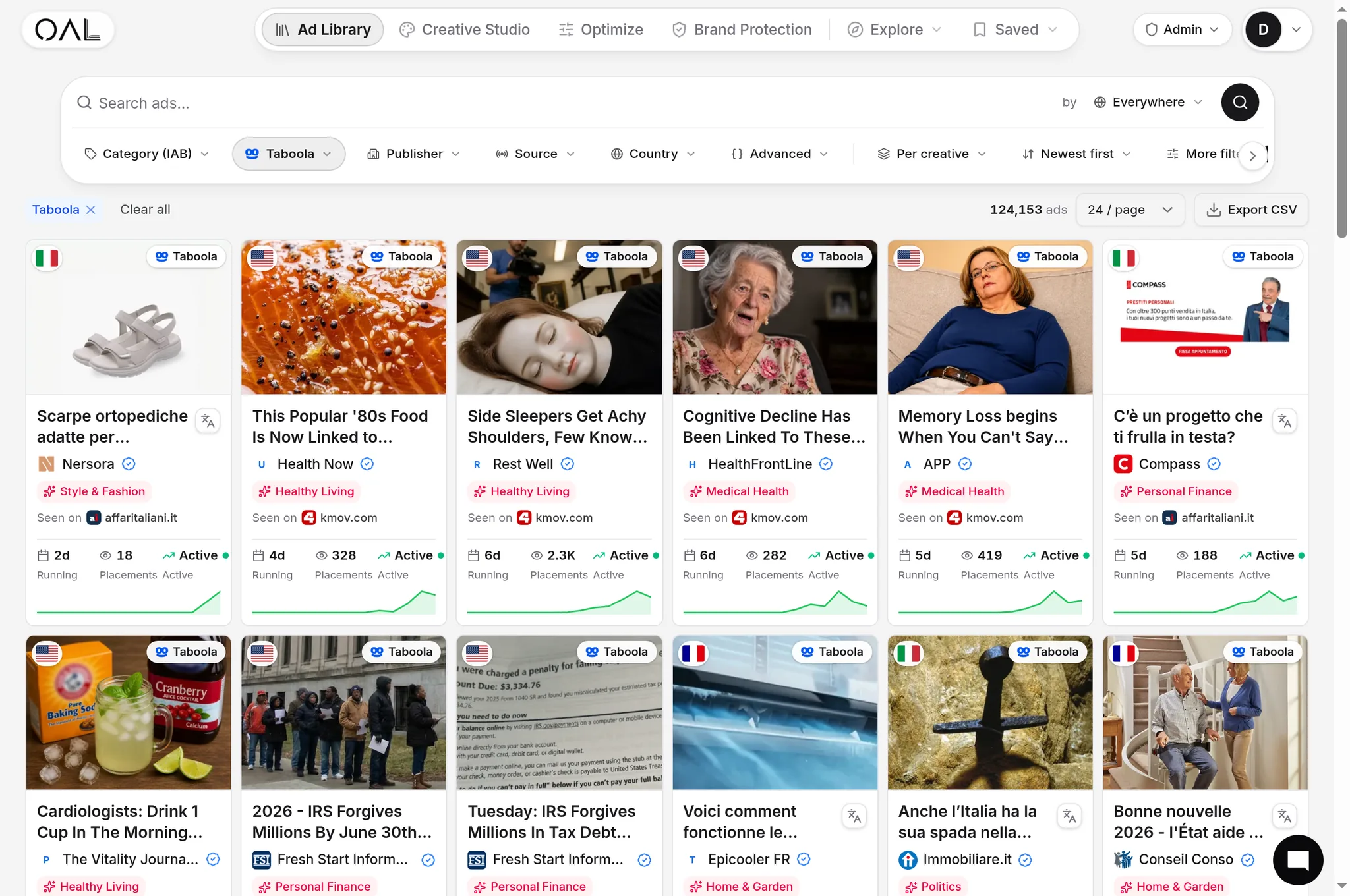
The fastest way to calibrate what Taboola accepts in your vertical is to read ads that passed review and then survived on paid traffic for weeks. OpenAdLibrary's index of 206,000+ live Taboola creatives (June 2026) records how long each ad has been running — and longevity is the tell: an ad live for 30+ days passed review, kept passing re-reviews through edits, and pays for itself.
The pattern you'll see in long-running health ads is instructive. A hearing-care ad captured in our index at 37 days running leads with "Struggling to Hear Clearly? Discover a Device Transforming Lives" — a question plus an invitation, no medical claim, no promised outcome. A beauty ad at 21 days runs "Top 5 Shampoos To Avoid" — a negative-angle listicle hook that generates curiosity without claiming any result. That's the compliance frontier in practice: emotionally sharp, factually unfalsifiable. Browse your own vertical on /spy/taboola, filter to long-running creatives, and reverse-engineer the phrasing — more worked examples are dissected in our Taboola ad examples teardown.
Rejected anyway? Do this#
- Read the stated reason precisely — Taboola tells you the policy area. Fix that item; don't shotgun changes.
- Fix and resubmit. Most rejections are item-level, resolved by a claim rewrite, image swap or lander repair.
- Appeal through support or your account manager when you genuinely believe the call is wrong — borderline calls do get reversed, especially with a clean account history.
- Don't create duplicate accounts or resubmit identical ads unchanged. Both escalate an ad-level problem into an account-level one.
- Log every rejection and resolution. Three rejections in means you have an internal policy map for your vertical that new hires can follow.
One more distinction worth internalizing: an ad-level rejection is feedback, an account-level warning is a fire alarm. If you receive the latter — or notice reviews suddenly taking days instead of hours — stop launching, audit every live campaign against the checklist above, and talk to support before submitting anything new. Accounts rarely die from one bad ad; they die from a pattern the buyer didn't notice forming.
Approval is a compounding game: clean accounts get faster reviews, better support and more benefit of the doubt. Treat the review desk as infrastructure to build a relationship with, not an adversary to sneak past.