Español
 Português (Brasil)
 Français
 Deutsch
 Italiano
 Nederlands
 Polski
 Svenska
 Türkçe
 Русский
 日本語
日本語 한국어
한국어 简体中文
简体中文 Tiếng Việt
 Bahasa Indonesia
 繁體中文
繁體中文 Čeština
 Dansk
Dansk Norsk (bokmål)
 Suomi
Suomi Ελληνικά
 Română
 Magyar
 Українська
 ไทย
ไทย हिन्दी
 العربية
 עברית
עבריתHow Revcontent Works: Native Ad Network Guide for Advertisers
Revcontent serves native ads through publisher widgets you bid on one by one, and here is how its delivery, site-level targeting, CPC bidding and optimization levers actually work, with real captured ads.


Revcontent is a native ad network. It drops sponsored recommendation units inside publisher pages, usually under labels like "Around the Web" or "You May Also Like," and routes the resulting clicks to advertisers on a cost-per-click basis. If you have ever scrolled past a grid of curiosity-gap headlines at the bottom of a news article, you have seen its inventory.
The thing that actually defines Revcontent for a buyer is not the format. It is the unit of control. Most networks want you to optimize an audience or a category. Revcontent hands you the widget as the primary lever: every publisher placement is its own biddable, blockable supply source. Get your head around that one idea and the rest of the platform clicks into place.
This guide covers how Revcontent delivers ads, how site-level bidding and blocking work, which targeting levers move the needle, and how to study real campaigns before you spend a dollar. For the wider category, see our native advertising guide. Here we are zooming all the way into one network.
How does Revcontent work?#
Revcontent works by embedding native ad widgets on publisher sites, then auctioning each impression to advertisers who bid a cost-per-click. You build a campaign with geo, device and interest targeting, set a default CPC, and then optimize by raising or lowering bids on individual widgets or blocking the ones that waste money. You pay only when a reader clicks through to your landing page.
That puts Revcontent in the native ad network tradition pioneered by Taboola and Outbrain, but with a smaller, leaner publisher footprint and a reputation as a performance-and-affiliate-friendly buy. Revcontent reports a network of roughly 9,000+ publisher sites reaching well over 100 million daily users, with exclusive placements on a handful of large mainstream publishers.
For scale context from our own data: we have indexed 11,478 live Revcontent creatives in the OpenAdLibrary index (June 2026), a small slice of the 589,000+ creatives we have captured across 42 networks. Revcontent is leaner than the giants. Taboola alone accounts for 157,727 of those creatives. So when people call Revcontent a "smaller" network, the captured ad volume backs that up.
Widgets are the atomic unit#
On most platforms you think in campaigns and ad sets. On Revcontent you also have to think in widgets. A widget is a specific recommendation placement on a publisher's page, effectively a unique ad slot and supply source. The publisher installs Revcontent's content recommendation widget code, styles it to match their editorial design, and Revcontent fills the slots with paid recommendations from advertisers like you.
Two things follow from that, and they shape everything you do as a buyer.
First, each widget behaves like a site-level target. You see performance per widget, you set a separate bid per widget, and you can block any widget outright. This is the closest analog to the "site/placement" targeting other networks expose, and it is where most of your optimization time goes.
Second, volume is distributed, not concentrated. A new campaign gets throttled on any single widget until you signal, through higher bids, that you want more from that source. This stops one advertiser from dominating a publisher's feed, and it forces you to earn scale placement by placement.
The biggest mental shift on Revcontent: you do not optimize an audience, you optimize a portfolio of widgets. Winners get bid up. Losers get bid down or blocked. The campaign is the sum of those decisions.
Revcontent also pitches its widgets as fast-loading, which matters more than it sounds. A slow recommendation module drags down a publisher's Core Web Vitals and quietly suppresses the viewable impressions advertisers actually pay attention to.
The ad is a headline and a thumbnail. That is it.#
A native ad lives or dies on one image and one line of text. Here is what real ones look like, pulled straight from our index. None of these are mockups.

The pattern is relentless: a deadline, a number, a "find out" hook. Finance is the single biggest native vertical in our whole index at 17,232 creatives (June 2026), and on Revcontent specifically it is the second-largest category behind health. Insurance and health round out the top of the overall table at 15,629 and 14,895 creatives. If you are wondering which verticals native advertisers think work, that ranking is your answer.
Health creatives are their own genre. The hook is almost always a list, a warning, or a "doctors don't want you to know" frame.

Health is Revcontent's number-one vertical, with 1,459 of the 11,478 Revcontent creatives we have indexed sitting in that bucket (June 2026). NUTRA shows up in the network's top five too, which tells you a lot about who buys here. If you run supplement or health offers, this is your neighborhood.
Bidding: CPC by default, vCPM when you want reach#
Revcontent supports two bid types.
| Bid type | You pay for | Best for |
|---|---|---|
| CPC (cost per click) | Each click to your landing page | Performance, affiliate, lead-gen, most advertisers |
| vCPM (cost per thousand viewable impressions) | Viewable impressions, not clicks | Awareness, reach, branding |
Most performance buyers run CPC, so spend tracks engagement instead of raw exposure. You set one default bid at launch, then override it per widget as the data comes in. Revcontent's "Widget Targeting" screen gives you four ways to manage those overrides:
- Individual. Type a new CPC for one widget.
- Bulk. Apply one bid across many widgets at once.
- Percentage. Scale all current bids up or down by a percent, which keeps the relative granularity you have already tuned.
- CSV. Upload mass bid changes for large accounts.
There is no minimum spend, which is a genuine differentiator versus enterprise-tier networks. Revcontent's own guidance is to let creatives accumulate roughly $300 to $500 in spend before you draw conclusions. That is sober advice, because per-widget data is noisy until you have enough clicks to trust it. Native CPCs generally sit well below search and social, which is exactly why a low-margin affiliate offer can pencil out here when it would never survive on Google.
Targeting and A/B levers that actually move performance#
Revcontent's targeting is geo, device and context-led rather than deep identity-based. The levers worth knowing:
- Geo. Country include and exclude, region refinement, and ZIP-code targeting (with CSV upload and exclusion lists) for hyper-regional offers.
- Device and OS. Desktop, mobile and tablet, with OS selection (Android, iOS, Windows) and even browser-level targeting on desktop.
- Interest targeting. A large interest taxonomy Revcontent markets in the thousands of options, used to bias delivery toward relevant content environments.
- Widget-level bidding and blocking. The real optimization surface, covered above.
Where Revcontent rewards discipline is testing the creative and the widget layer at the same time. The headline-plus-thumbnail pair is the entire ad, so a tiny change swings click-through hard. A workable loop:
- Launch 5 to 10 creative variants (same offer, different headline and image) at a competitive default bid to buy fast, broad distribution.
- Let spend reach the $300 to $500 threshold so per-widget numbers stabilize.
- Cut the losing creatives. Concentrate budget on the 1 or 2 winners.
- Move to the widget portfolio: bid up widgets converting below your target cost-per-acquisition, bid down the marginal ones, and block widgets that burn spend without converting even at low bids.
- Re-test fresh creative against the surviving winner to fight fatigue.
Reporting refreshes in near real time, clicks usually register within minutes, so the feedback loop on these decisions stays tight.
How long do native ads actually run?#
Here is a number worth internalizing before you obsess over creative fatigue. In our index, the longest continuously observed creatives have been running for 28 days straight (OpenAdLibrary, June 2026). That is the ceiling of our current observation window, not a hard limit on the ad. The point is that the survivors are out there for weeks, quietly profitable.

You will see the industry lore about "90-day winners" thrown around. Treat that as folklore, not data: it is a useful heuristic that a creative still spending after three months is almost certainly profitable, but it is not something we have measured. What we have measured is that an ad still on rotation across many placements weeks later is the strongest "this works" signal in native. Longevity plus spread beats any vanity metric.
What a Revcontent ad and landing page actually look like#
Theory only gets you so far. The fastest way to learn the network is to study live ads: which advertisers are buying, what headline-and-image combinations they run, how long a creative survives, and, the part most people skip, where the click actually goes.
That last part is where most "research" falls apart. The visible ad is only half the funnel. The pre-lander and the offer page are where the money is made or lost.

OpenAdLibrary captures live public Revcontent creatives at full image quality, classifies the ad-tech supply chain behind each placement, and, without clicking live ads, follows each creative's click path to the destination so you can see the actual landing page or pre-lander an advertiser uses. Because we track creatives over time, you can read longevity and spread signals directly. You can browse all of this on our Revcontent ad spy page.
When you inspect a captured Revcontent ad, you can usually answer four questions:
- Who is the real advertiser? Resolved past the affiliate redirect.
- What is the exact creative? Headline plus thumbnail, captured at source quality.
- How long has it run, and how widely? Longevity plus widget spread.
- What does the landing page sell, and how is it framed? The pre-lander template.
How Revcontent compares to the rest of the native field#
Revcontent sits in the same product category as the bigger recommendation networks, with trade-offs worth weighing before you allocate budget.
| Network | Position | Notable for advertisers |
|---|---|---|
| Revcontent | Lean, performance-leaning | No minimum spend, granular per-widget bidding, affiliate-friendly |
| Taboola | Largest by scale | Deepest reach and data; see how Taboola ads work |
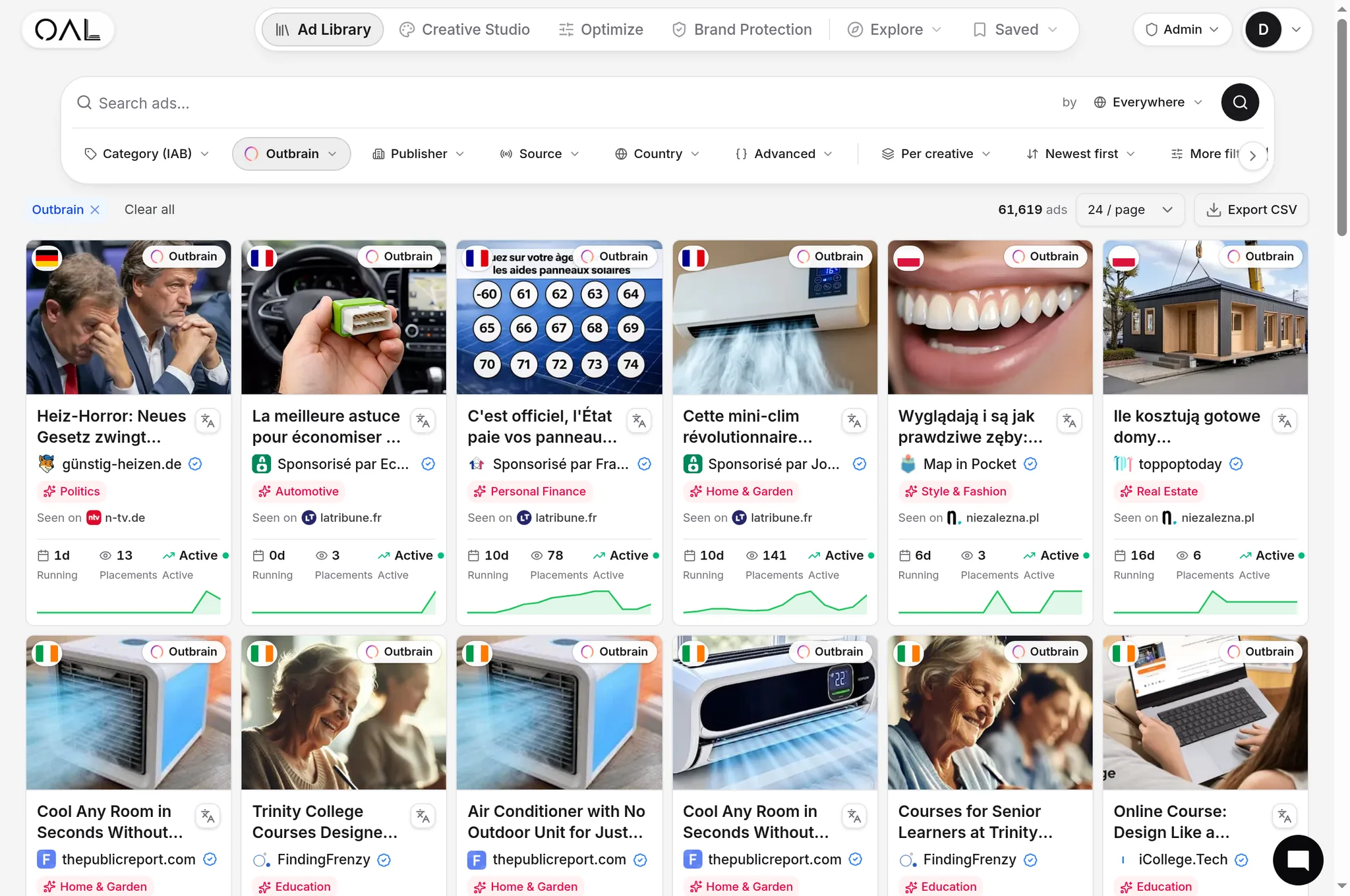
| Outbrain (Teads) | Premium publishers | Now merged with Teads; see how Outbrain works |
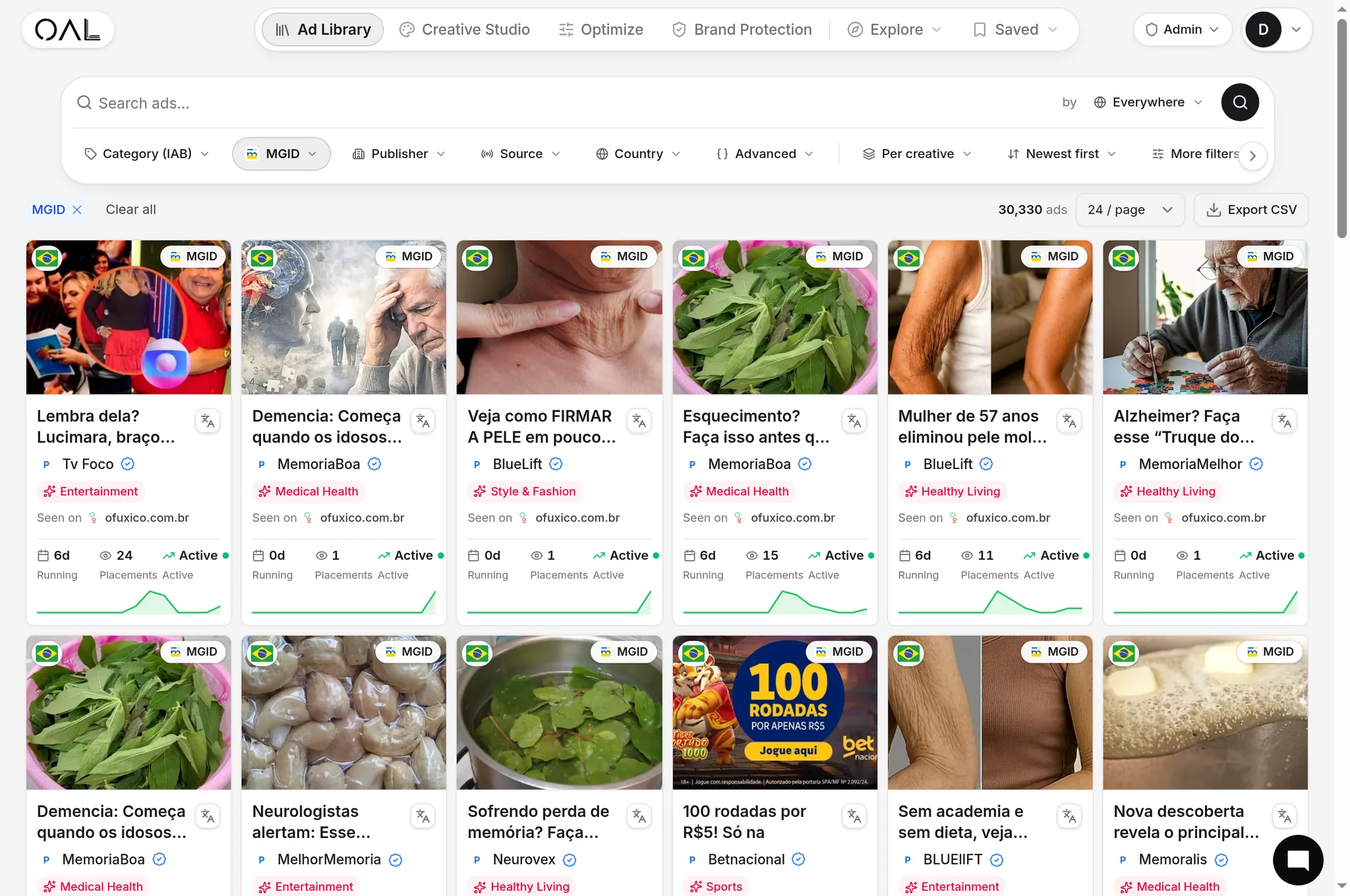
| MGID | Mid-market, global | Strong in emerging-market geos; see how MGID native ads work |
The scale gap is real and you can see it in our capture counts: 157,727 Taboola creatives versus 11,478 on Revcontent (June 2026). That does not make Revcontent worse. It makes it different. Less auction pressure on a placement can mean cheaper clicks for the same offer.
Serious native buyers run several of these networks in parallel and arbitrage the differences. A creative that fatigues on Taboola often gets fresh life on Revcontent or MGID, and the reverse happens too. Studying all of them through one ad network lens, rather than learning each one in isolation, is how experienced media buyers compress their learning curve.

A practical starting playbook#
Launching on Revcontent for the first time:
- Pick one tight offer and one geo. Do not dilute early data across markets.
- Ship 5 to 10 creative variants with a competitive default CPC to win broad distribution fast.
- Spend to the $300 to $500 marker before any major cuts. Premature optimization on thin data is the most common Revcontent mistake.
- Optimize the widget portfolio, not just the creatives. Bid up converters, bid down or block the rest.
- Research before and during, not after. Pull the winning creatives and landing pages already running in your vertical so you are testing against the market's best instead of guessing.
Revcontent is not a set-and-forget channel. Its strength is the granular control it gives you, and that control only pays off with active management. Get the widget-level discipline right, feed it intelligence on what is already working, and it becomes one of the more cost-efficient places to scale a proven native offer.
Want to see live Revcontent ads, their real advertisers and their landing pages? Start free and browse 200 ads, no card required.