Español
 Português (Brasil)
 Français
 Deutsch
 Italiano
 Nederlands
 Polski
 Svenska
 Türkçe
 Русский
 日本語
日本語 한국어
한국어 简体中文
简体中文 Tiếng Việt
 Bahasa Indonesia
 繁體中文
繁體中文 Dansk
Dansk Norsk (bokmål)
 Suomi
Suomi Ελληνικά
 Română
 Magyar
 Українська
 ไทย
ไทย हिन्दी
 العربية
 עברית
עבריתB2B Native Advertising: What Actually Works (With Live Examples)
Native feeds don't sell job-title targeting — the B2B advertisers who win make the headline and the funnel do the qualifying. Live examples from the index, the three plays that keep working, and how to pick a network.


B2B native advertising works, but not the way most B2B teams first try it. Content-recommendation feeds on news sites sell cheap, high-volume clicks against story-led creative — they do not sell firmographic targeting, and they punish "book a demo" messaging aimed at a job title that makes up a fraction of a percent of the audience. The B2B advertisers who sustain spend on Taboola, Outbrain, MSN and Teads all run content-first funnels: a cost-anchored problem story or a genuinely useful diagnostic up front, a landing page that qualifies the reader, and measurement patient enough to judge cost per qualified lead rather than same-week pipeline. This guide breaks down what is live right now — drawn from OpenAdLibrary's index of 725,000+ native ad creatives across 49 networks (June 2026) — and the three plays that keep showing up because they keep working.
Does native advertising work for B2B?#
It works for three jobs and reliably fails at a fourth.
It works for distributing content that earns attention — research, explainers, opinion pieces aimed at a market you need to educate before you can sell to it. It works for direct-response offers whose economics survive broad targeting — audits, assessments, calculators, tools and flat-fee services with a clear cost anchor. And it works for filling a retargeting and first-party-data pool at a cost per visitor that search and LinkedIn cannot approach.
It fails as a demo-request machine. Pointing native traffic at a "talk to sales" page produces bounce rates that turn cheap clicks into expensive ones, and it is the single most common reason B2B teams write off the channel after one test.
The reason is structural. Native networks place ads in recommendation widgets on publisher sites, and their targeting is contextual and behavioral, not firmographic. You cannot buy "VP of Engineering at a 200-person SaaS company" the way you can on LinkedIn. What you can buy is scaled attention from people reading business and technology coverage — a pool that contains your buyers along with many people who are not. The creative and the funnel must do the qualifying that the targeting cannot.
The compensation for that inefficiency is price. Media buyers commonly report native CPCs at a small fraction of LinkedIn's — often several times cheaper for the same nominal audience — with the caveat that a smaller share of those clicks belong to your ICP. Whether the trade works depends entirely on whether your funnel filters cheaply. Our native CPC benchmarks piece covers what buyers report paying by network and geo.
One more fit check before you build anything: deal size. Native's filtering costs show up as wasted clicks and nurture overhead, and a product with a small contract value cannot absorb them. As a rough rule, if a single closed deal cannot fund several months of testing on its own, run the productized-diagnostic play (which monetizes the funnel itself) or stay out; if your ACV is five figures and up, even a trickle of qualified leads justifies the channel.
What's actually live: B2B on native, by the numbers#
Software and business services are not fringe on native networks. Across OpenAdLibrary's index, software is a top-six vertical with roughly 14,900 live creatives (June 2026), and the volume is distributed unevenly in ways that should shape your network choice:
- Microsoft Audience Network (MSN): 7,909 software creatives — the largest single pool, and software is the network's #5 vertical overall.
- Taboola: 3,665 — meaningful volume inside the largest premium-news footprint in native.
- Outbrain: 1,932 — smaller, and skewed toward brand and thought-leadership demand.
- Yahoo: 466 — modest in absolute terms, but software is the #1 vertical in our Yahoo slice, ahead of finance and insurance.
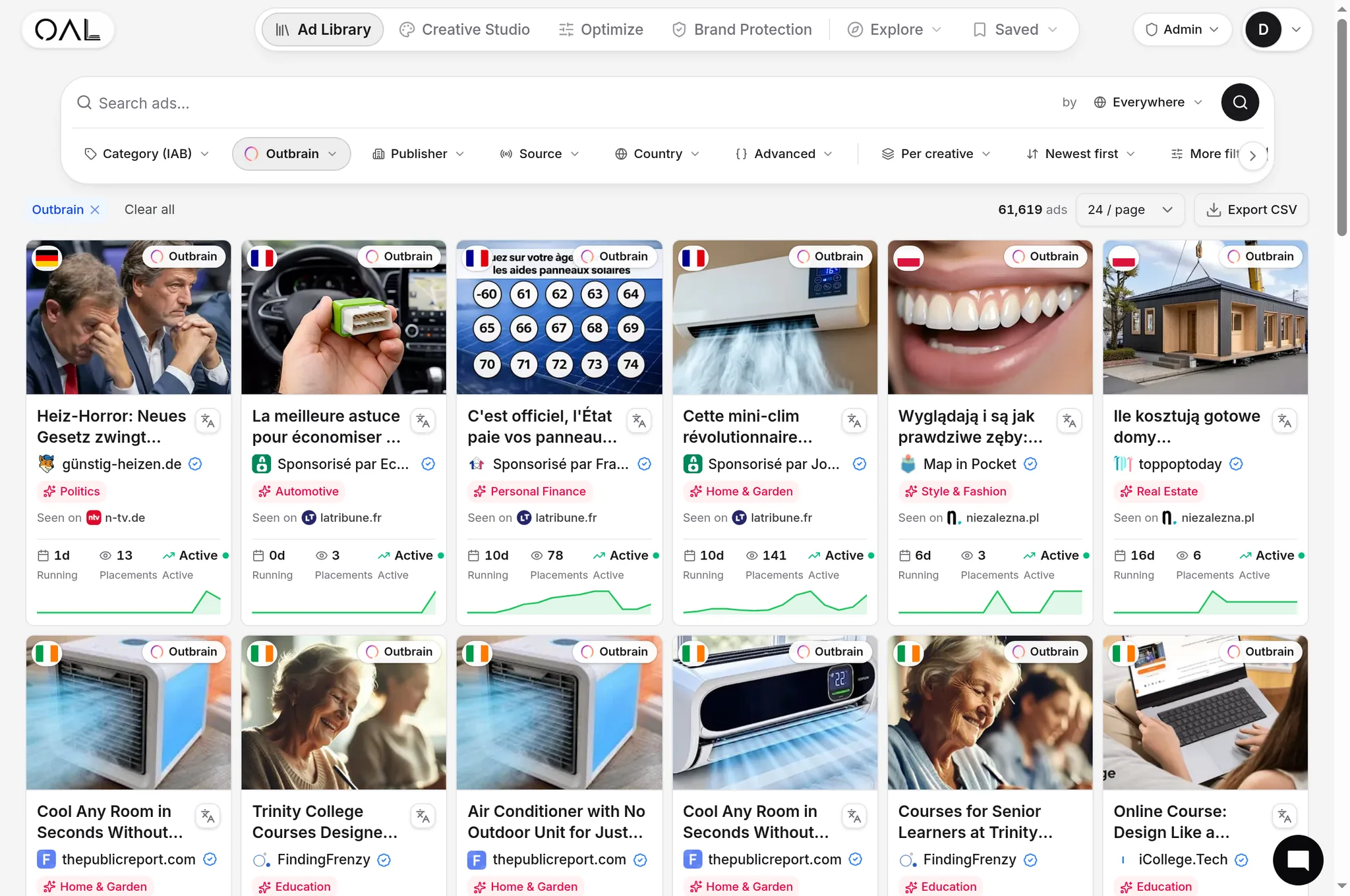
Here is a sample of what those numbers look like as actual ads, captured live from the networks:
| Advertiser | Headline | Network | The play |
|---|---|---|---|
| Perpetual Ad Tech | "Paying An Agency $3k/Month? A Machine Does It For A Flat Fee" | MGID | Cost-anchored direct response |
| Perpetual Ad Tech | "The $950 Audit That Shows Where Your Marketing Loses Money" | MGID | Productized diagnostic |
| Perpetual Ad Tech | "See Exactly Where Your Business Bleeds 12 Hours Every Week" | MGID | Quantified pain |
| SPECTRA by MHI | "Methane: Tackling a rising climate priority" | Outbrain | Corporate thought leadership (34 days live at capture) |
| Georgetown University | "Georgetown's Master in Applied Intelligence: Apply Now, No Fee" | Teads | Professional education lead gen |
| MONOBUNT | "Professionelle Onlineshops" | MSN | Agency services (DACH market) |
Three very different advertisers — a marketing-technology service, a heavy-industry conglomerate's content brand, and a university — and not one of them is running "request a demo." That is the pattern to internalize before writing a single headline.
The three B2B plays that actually work#
Play 1: cost-anchored direct response#
Perpetual Ad Tech's MGID campaign is a small masterclass in making broad targeting irrelevant. Every headline contains a number tied to money or time: $3,000 a month, a $950 audit, 12 hours a week. Each one names an incumbent cost the reader is already paying and positions the offer against it.
The mechanism is self-qualification. Nobody who isn't currently paying an agency clicks "Paying An Agency $3k/Month?" — the headline is the firmographic filter the network can't provide. The audience waste that broad targeting creates gets absorbed at the impression level, where it's nearly free, instead of the click level, where it isn't.
Notice also that the offer is a diagnostic, not a contract. An audit is a low-commitment first purchase that naturally escalates into the ongoing service. That structure — small productized entry point in the ad, real engagement sold afterward — recurs across most B2B native campaigns that last.
To copy the play: name the cost your buyer already pays, quantify it in the headline, offer the smaller diagnostic instead of the engagement, and land the click on an advertorial or calculator — never the homepage.
Play 2: thought-leadership distribution#
SPECTRA by MHI — Mitsubishi Heavy Industries' content brand — runs explainer content on Outbrain about methane abatement and waste-to-energy. One creative had been live 34 days at capture, which signals a sustained content-distribution budget rather than a test. Nobody fills in a lead form from these ads; that is not the goal. The goal is putting an agenda in front of the people who read premium business press, building branded search volume and a retargeting pool that sales and ABM programs harvest later.
This play suits enterprise sellers with long cycles and committee buying, where "the buying committee has read your ideas" is a real pipeline input. The honest KPIs are engaged read time, newsletter signups and retargeting-pool growth — judged over quarters, not weeks. If your leadership demands leads-in-week-one from this play, do not run it; run Play 1 or nothing.
Play 3: professional education and high-ticket lead gen#
Georgetown University's Teads creatives sell master's programs to working professionals — "Apply Now, No Fee" removes one specific, known friction from a high-consideration decision, and "Become a Leader in the Cybersecurity Field" sells the career outcome rather than the curriculum. Education, certification and executive-program offers are structurally B2B-adjacent: a consumer signature, a career motivation, a five-figure price.
The funnels that work here are email-capture first — program guides, information sessions, application-deadline reminders — followed by long nurture. Expect weeks to months between the first click and an application, and build reporting that survives that gap.
Choosing a network for B2B#
| Network | Software creatives (June 2026) | B2B read |
|---|---|---|
| MSN / Microsoft Audience Network | 7,909 | The sleeper. News-feed inventory on Windows devices reaches professionals at their desks during working hours. See our MSN native ads guide. |
| Taboola | 3,665 | The largest premium-news supply; the scale play once you have a working funnel. Start with how Taboola ads work. |
| Outbrain (Teads) | 1,932 | Premium-publisher bias suits thought leadership and brand-led plays. See how Outbrain works and what Teads is now. |
| MGID | — | Lower CPCs and a direct-response culture; where cost-anchored offers like Perpetual Ad Tech's live. |
| Yahoo | 466 | A small pool, but software is its #1 vertical in our index; the finance-reader skew fits fintech and B2B finance tools. |
Start where your play fits, not where inventory is biggest: direct response on MGID or Taboola, thought leadership on Outbrain/Teads, at-work reach on MSN.
Targeting when you can't buy job titles#
- Contextual sections. Business, finance and technology categories concentrate professional readers. It is coarse, but it beats run-of-network by a wide margin for B2B offers.
- Publisher allowlists. Run broad for two to three weeks, then cut to the publishers producing qualified leads. Publisher-level performance in B2B is dramatically uneven — the average always hides two great sites and twenty irrelevant ones.
- Device and daypart. Desktop, weekday, business hours is the closest native proxy for "at work." It routinely improves lead quality for B2B offers at the cost of volume.
- The headline as filter. The qualifying number, tool name or jargon term in the headline is your real targeting layer. A headline that civilians happily click is a broken filter, however good its CTR looks.
- Retargeting. Treat native as the cheap top of the funnel; convert the pool later through email, search and social retargeting.
Funnels: the landing page does the qualifying#
A native click is not a search click. The reader was interrupted mid-article; they arrive with curiosity, not intent. Send them to an advertorial or pre-lander that continues the story the headline started, or to a diagnostic — calculator, assessment, audit request — that delivers value before asking for anything.
Gate late. Asking for a work email before any value lands kills conversion on interrupt traffic. Capture after the calculator output, or midway through content that has already proven useful.
Measure cost per lead first, but judge lead-to-SQL rate per publisher over 30–60 days and feed it back into your allowlist. B2B native campaigns often look expensive in week one and cheap in month two once quality data arrives — judging on a three-day window is how good campaigns get killed.
Measuring a channel your CRM will undercount#
Native traffic converts late and often on a different device, so last-click reporting will understate it. Practical countermeasures:
- UTM discipline at the publisher level, so lead-quality analysis can run per site, not just per campaign.
- Self-reported attribution ("How did you hear about us?") on every form — native-driven leads frequently arrive via branded search days later.
- Branded-search and direct-traffic lift during flight vs. pre-flight as a sanity check on the thought-leadership play.
- CRM cohorting by first-touch month, so the 60-day maturation of native leads is visible instead of averaged away.
None of this is exotic; it just has to be set up before launch, because you cannot reconstruct it afterward.
Budgets and bid reality#
Treat any number here as a heuristic, not a rate card: media buyers commonly report Tier-1 desktop CPCs from roughly $0.30 to $1.00 for business-adjacent native inventory, with mid-tier networks materially cheaper and premium placements above that; your niche and geo will move this a lot. Plan test budgets around clicks-per-publisher rather than total spend — you need enough clicks on each publisher to judge it before cutting, which usually means testing one geo and a handful of creatives at a time rather than everything at once. Scale by widening geos and publishers only after the funnel converts, not to find out whether it converts.
Research first: see what B2B advertisers sustain#
The cheapest B2B native research is looking at what other B2B advertisers keep paying for. A creative that has run for 30+ days is being sustained by someone watching the numbers — ad longevity is the strongest working-signal available in a channel with no public spend data. OpenAdLibrary's ad intelligence platform lets you filter the software vertical by network, sort by days running, and trace each creative through to its landing page — the whole funnel, not just the thumbnail. Put your category's advertisers on a watchlist and check what survives each month; you can browse Outbrain's live inventory and every other major network on the free tier.
Mistakes that kill B2B native campaigns#
- Homepage landings. The click dies without a story bridge.
- Judging in week one. B2B lead quality reveals itself over 30–60 days.
- Testing every geo at once. Budget spread too thin to judge any single publisher.
- Reusing LinkedIn creative. Polished brand banners underperform editorial-style imagery inside a content feed.
- Gating too early. Interrupt traffic will not pay an email address for a promise.
- Ignoring publisher-level data. Campaign averages hide where the qualified leads actually come from.
- CPL sticker-shock panic. A cheap native CPL with a zero SQL rate is worse than an expensive one that closes.
- No nurture behind the form. Native leads are earlier-stage than search leads; without an email sequence and retargeting behind the capture, most of what you paid for evaporates.
The bottom line#
B2B native advertising is a qualification problem, not a targeting problem. The networks hand you cheap attention from an audience that contains your buyers; the headline, the offer and the landing page have to find them. The advertisers doing it well — visible live in the index every day — run cost-anchored diagnostics, distribute genuinely useful content, and measure on windows that match a real B2B cycle. Copy the play, not just the creative.