Español
 Português (Brasil)
 Français
 Deutsch
 Italiano
 Nederlands
 Polski
 Svenska
 Türkçe
 Русский
 日本語
日本語 한국어
한국어 简体中文
简体中文 Tiếng Việt
 Bahasa Indonesia
 繁體中文
繁體中文 Čeština
 Dansk
Dansk Norsk (bokmål)
 Suomi
Suomi Ελληνικά
 Română
 Magyar
 Українська
 ไทย
ไทย हिन्दी
 العربية
 עברית
עבריתHow MGID Native Ads Work: Formats, Targeting and Pricing Explained
A media buyer's walkthrough of MGID's native formats, contextual targeting and low entry CPCs, backed by the real creatives and tracker stacks we capture on live MGID placements.

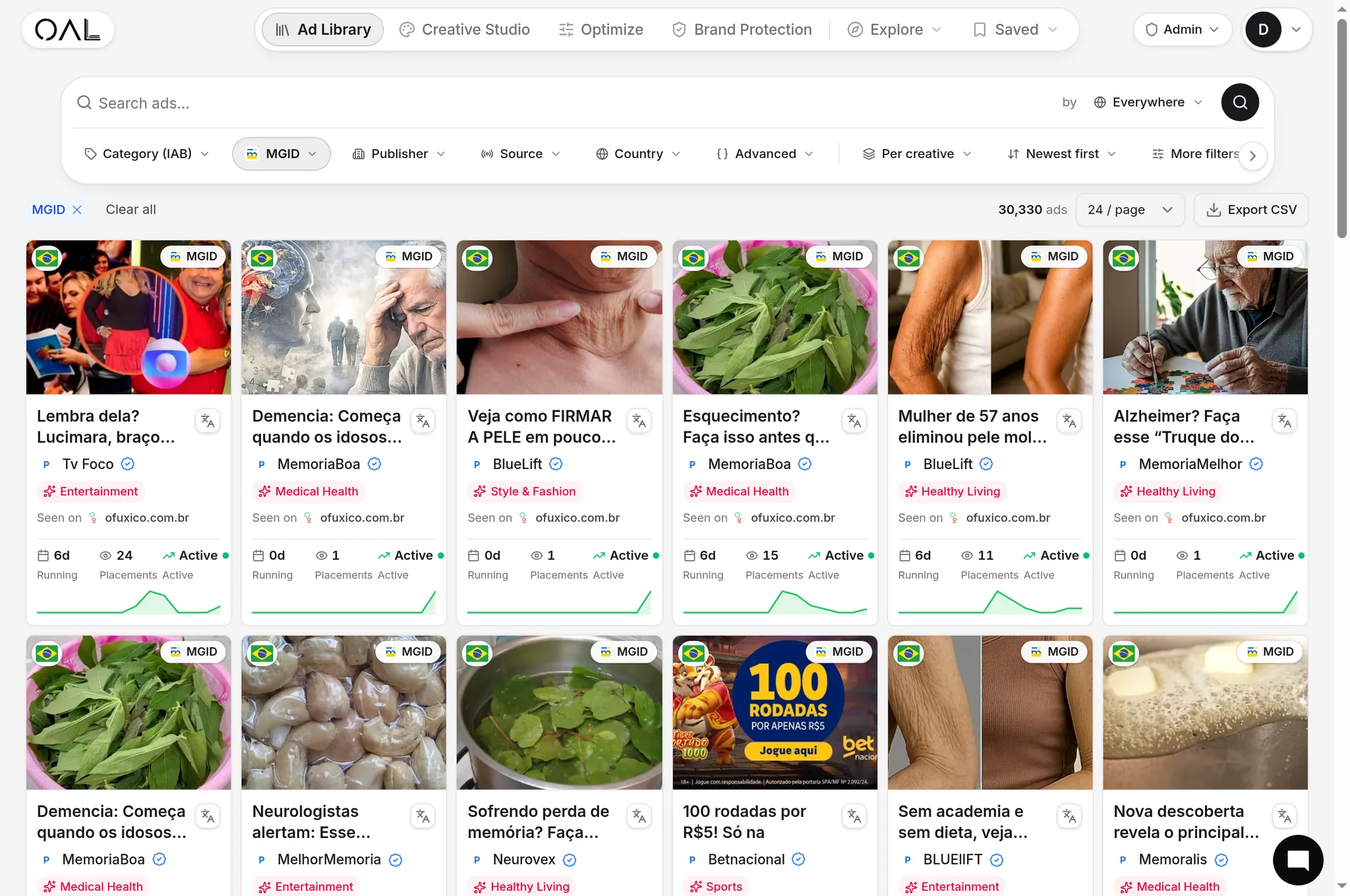
MGID is the native network you reach for when you want cheap clicks, a low barrier to entry, and reach in geos the bigger players underserve. It powers the "Recommended for you" and "You may also like" blocks beneath millions of articles, and it has earned a reputation as the proving ground for affiliate offers, advertorials and content funnels before they ever get scaled on premium inventory.
We have indexed 49,689 MGID creatives so far (OpenAdLibrary, June 2026), which is roughly one in twelve of the 589,000+ native creatives in our archive. That gives us a clear, ground-truth view of how the network is actually used, not how its sales deck describes it. This guide covers the formats, the auction, the targeting model, and what pricing really looks like once you strip away the marketing copy. It also shows you how to read the supply chain behind a live placement, because the tracker stack on a creative tells you as much about a campaign as the headline does.
How does MGID work?#
MGID is a self-serve native advertising network that places image-plus-headline ads inside content-recommendation widgets and in-feed slots on publisher sites. You bid on a cost-per-click basis in a real-time auction, target by geography, device, interest and page context, and pay only when someone clicks. Campaigns can launch from a $100 minimum deposit, which makes it one of the cheaper native networks to test.
Founded in 2008 and headquartered in Santa Monica, MGID delivers north of 185 billion monthly impressions across more than 10,000 publishers. That scale, plus deep tier-2 and tier-3 coverage, is why it shows up so often in affiliate and arbitrage workflows. If you are new to native as a channel, start with the native advertising pillar guide and the MGID glossary entry for the short definitions, then come back here for the operating detail.

The two core formats: widgets and in-feed#
MGID inventory comes down to two native placements, both of which inherit the look of the page they sit on rather than shouting "ad."
- Content-recommendation widgets. These are the classic native ad widget blocks: a grid of thumbnails and headlines, usually labeled "Recommended for you," "You may also like," or "From around the web," sitting below or beside an article. The widget is the format MGID is best known for and the one with the most inventory.
- In-feed units. These slot into a publisher's content stream so the ad reads as one more item in the feed. An in-feed ad tends to earn higher attention because the user is already scanning with intent, whereas a widget catches people at the end of an article.
Both formats are built from the same two assets: a creative image (typically 16:9 or close to it) and a headline of a few words. There is no body copy on the unit itself. The click does all the heavy lifting, sending the user to your landing page or pre-lander. That minimalism is why creative testing on MGID is really image-and-headline testing, and why winning advertisers run dozens of image variants against a handful of hooks.
You can watch that variant-stacking happen in our index. Take HDFC Life, an Indian life-insurance advertiser. We have it running the same offer ("around ₹24/day") across a cluster of near-identical creatives with rotating angles: "Secure More, Just ₹24/day," "Big Cover, Just ₹24/day," "Cover Your Family Today," "Protection Without Pause." Same hook, different framing, all live at once.

The unit you buy is tiny: one image, one line of text. Everything that makes a native campaign profitable happens after the click, on the page you control. Treat the ad as the audition and the landing page as the performance.
Beyond the two staples, MGID also offers "smart" widgets that mix editorial and paid recommendations, in-content placements injected mid-article, and programmatic native delivered through RTB so the same creatives can be bought through a DSP.
The auction and how bidding works#
MGID runs a CPC auction. You set a bid at the campaign level and, if you want finer control, at the individual ad level, and your placement is decided by a native ad auction that weighs your bid against the expected engagement of your creative. A higher click-through rate effectively subsidizes your bid, because the network earns more per impression when your ad performs. Strong creatives win placements that a higher-bidding but duller ad cannot.
Three mechanics are worth internalizing:
- Prepay model. MGID is pre-funded. You deposit, the platform spends down the balance, and you top up. The entry deposit is $100, which is part of why it attracts smaller advertisers and solo affiliates.
- Bid by source and placement. Inventory is segmented by publisher "widget" or source, and you can raise or lower bids per source or block underperformers entirely. This source-level control is where most of the real optimization work happens.
- Algorithmic optimization. Once enough data accrues, MGID's system shifts delivery toward the placements and creatives producing the cheapest conversions, the same way every major native network self-optimizes.
What CPCs actually look like#
MGID does not publish a single global minimum CPC. The floor is set by competition for your specific geo, device and placement, and the platform's traffic-insight tool surfaces a suggested minimum per target. The practical ranges advertisers report cluster by traffic tier:
| Traffic tier | Example geos | Typical CPC range |
|---|---|---|
| Tier 1 | US, UK, Canada, Australia | ~$0.20 to $0.30 |
| Tier 2 | much of Europe, LATAM, SE Asia | ~$0.01 to $0.10 |
| Tier 3 | many emerging markets | fractions of a cent |
Those figures are directional, not guarantees. Bids move with seasonality, vertical competition and the quality score your creatives earn. But the shape holds: MGID is cheap to enter and cheap to test, with tier-1 traffic still well below what you would pay on search or social for comparable intent.
Targeting: contextual first, audience second#
MGID grew up as a contextual network, matching ads to the topic and category of the page rather than to a tracked individual. That heritage matters more in a post-cookie world, because contextual targeting keeps working when third-party identifiers disappear. On top of context, MGID layers the standard performance-marketing controls:
- Geo: country, region, and often city-level targeting, which is essential for tier-based bidding.
- Device, OS and browser: split mobile from desktop early. Their CTRs and conversion economics rarely match.
- Interest and category: align the creative to the content vertical it runs against.
- Retargeting: re-engage users who already touched your funnel.
- Schedule and frequency: dayparting and caps to control spend pacing.
The most reliable lever, though, is the one that does not appear in a targeting dropdown: placement (source) management. Because each publisher widget behaves differently, the winning campaign is usually the one pruned down to the handful of sources that convert, with bids tuned per source. New buyers who treat MGID as a set-and-forget audience platform bleed budget. The ones who treat it as a marketplace of individual placements do well.
What runs on MGID skews more toward content-style and health-or-quiz angles than the channel as a whole. Across our full index, finance leads every vertical at 17,232 creatives, with insurance (15,629) and health (14,895) close behind (OpenAdLibrary, June 2026). On MGID specifically, the most common vertical we tag is entertainment, with 8,904 creatives, the curiosity-gap content that funnels into arbitrage. That gap is a tell: MGID is where you go to run the "you won't believe what your dog's licks mean" style hook before you spend real money pushing a hardened offer onto premium inventory.

Reading the supply chain behind an MGID ad#
Here is where competitive intelligence separates good native buyers from average ones. When you look at a live MGID placement, the creative is only the surface. Underneath sits a measurable supply chain: the tracking and attribution stack the advertiser wired up, and the destination the click resolves to. That stack is evidence of how serious and how sophisticated the campaign is.
On real MGID placements, the detectable footprint usually includes:
- MGID's own click and serving infrastructure, the wrapper domains and click trackers that route the impression and the click.
- Third-party click trackers and affiliate networks like Voluum, RedTrack and ClickFlare, which signal an affiliate or arbitrage operation running tight ROI tracking.
- Analytics and pixels on the landing page, such as Google Analytics, Meta and TikTok pixels, and conversion tags that reveal measurement maturity.
- The landing page or pre-lander itself, the advertorial, quiz or product page the click ultimately reaches.
This is exactly the layer OpenAdLibrary is built to expose. We continuously capture live MGID widget and in-feed creatives, store the real creative image at full quality, classify the ad-tech supply chain on each placement, and follow the click through to the advertiser's landing page, without ever clicking the live ad. We have logged 926,259 landing-page captures and 5.4 million ad observations across 42 networks, so you can see not just what an ad says, but who is behind it, what tools they run, and where the funnel goes.

Two signals make that data actionable:
- Longevity. A creative that has run for weeks is, by definition, working. Nobody pays per click to lose money for a month. Ad age is the closest thing native has to a public performance metric. Our index currently spans up to about 28 days of continuous observation per creative, and the ads that sit at the top of that range (next-gen hearing aids, IQ quizzes, IRA-tax advertorials) are exactly the kind of durable offers worth reverse-engineering. The MGID creatives in our index are younger, mostly in the 16-to-19-day band, which fits a network where buyers cycle angles fast.
- Spread. A creative appearing across many publishers and geos is one the advertiser is confident enough to scale. Concentration plus duration is the fingerprint of a winner.
How MGID compares to the other native networks#
MGID rarely operates in isolation. Most performance buyers run it alongside the other discovery networks, and the differences are practical, not cosmetic.
| Network | Position | Where it fits |
|---|---|---|
| MGID | Accessible, low entry, strong tier-2/3 | Testing offers, affiliate funnels, cheaper reach |
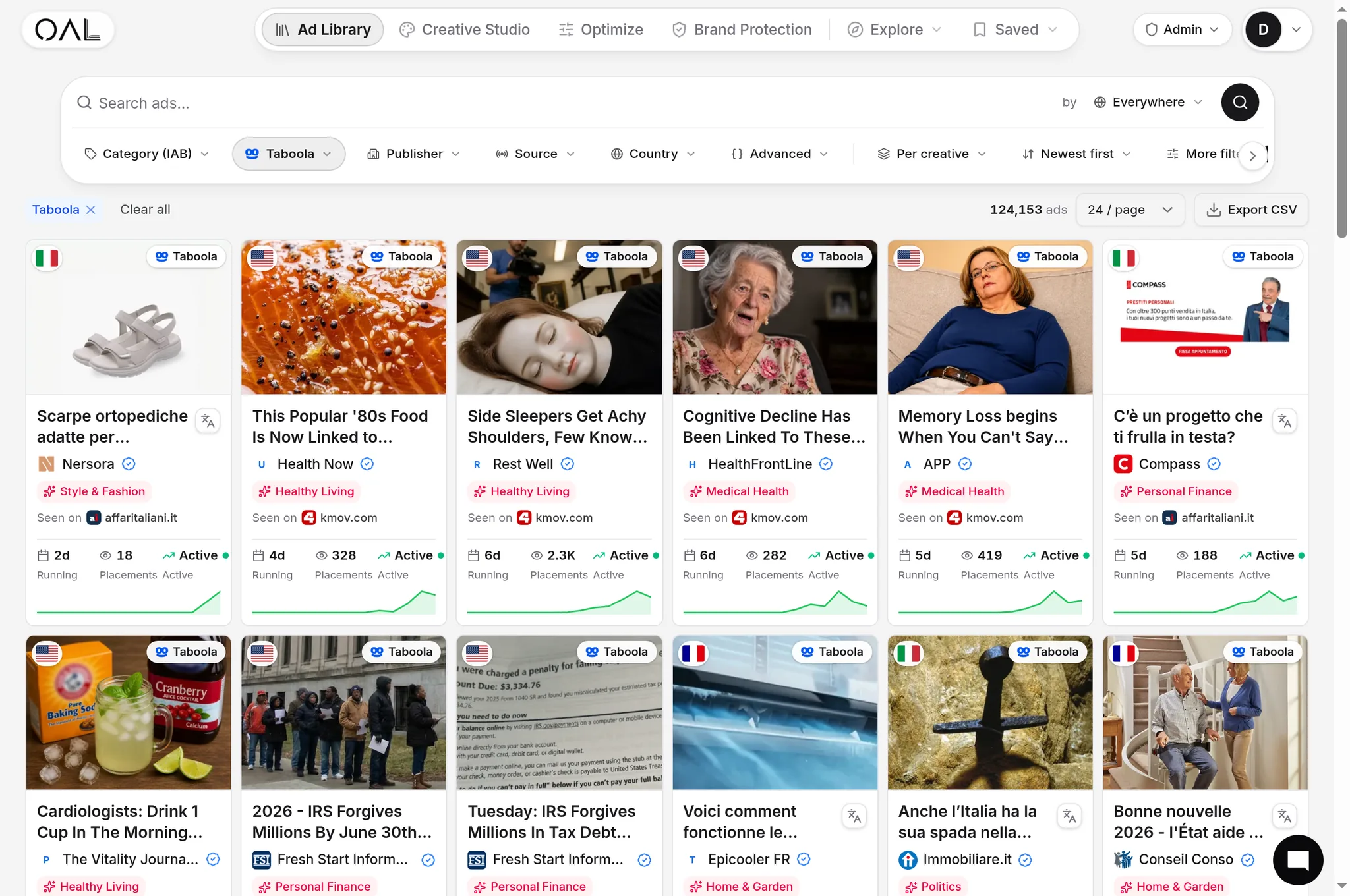
| Taboola | Largest premium-publisher reach | Scaling proven winners on top-tier inventory |
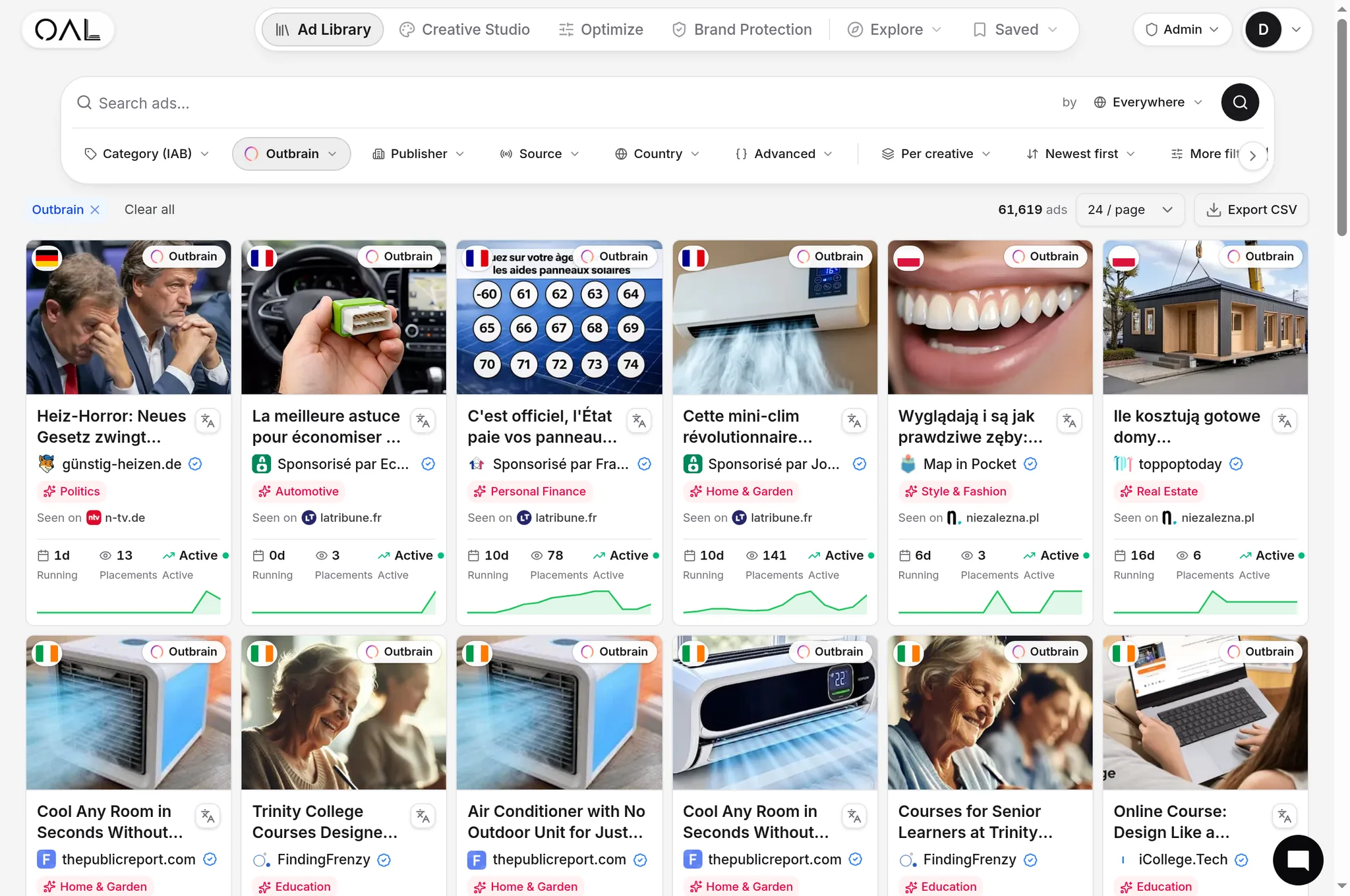
| Outbrain (now Teads) | Merged recommendation and outstream | Brand plus performance on combined inventory |
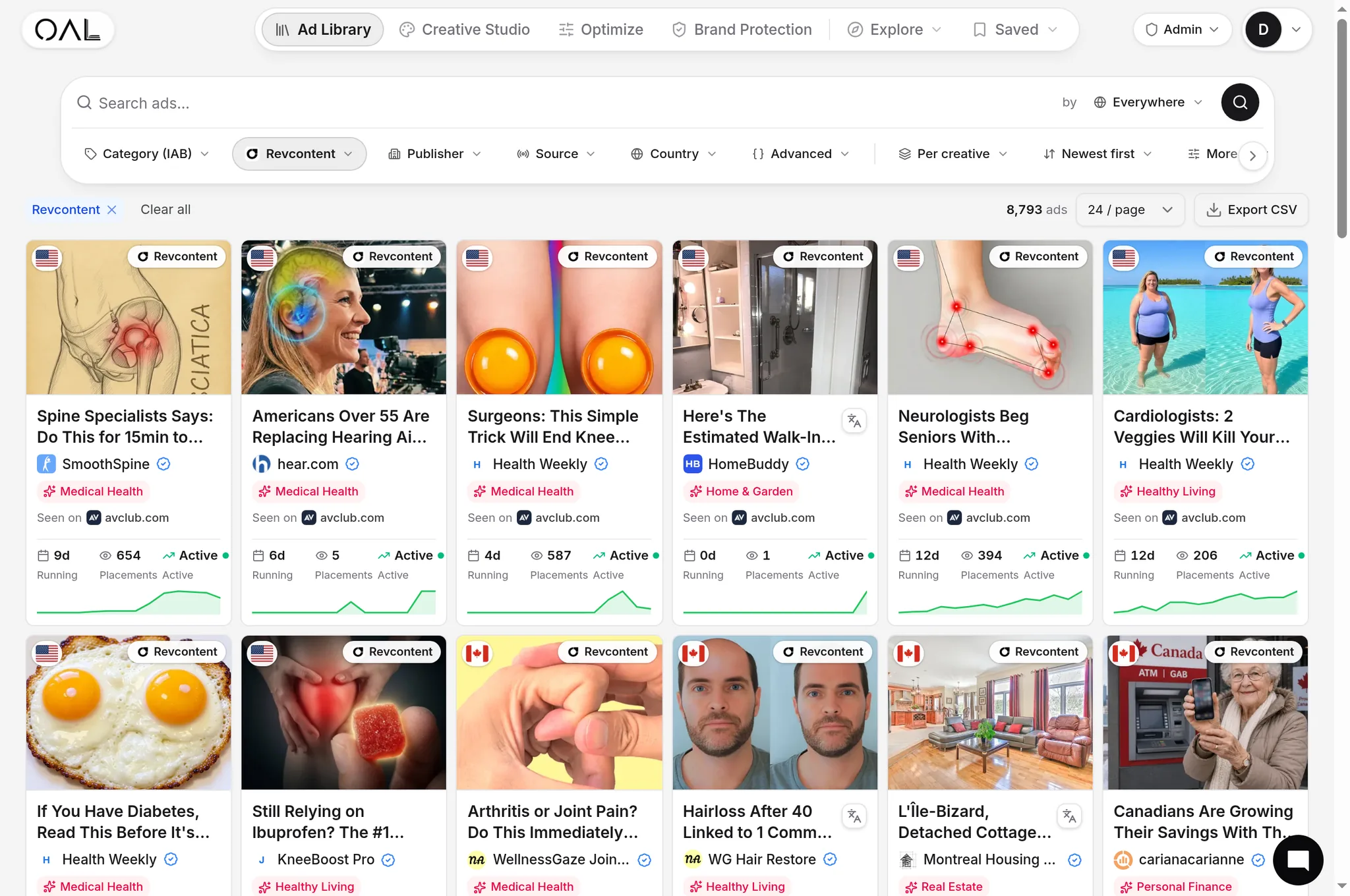
| Revcontent | High-volume, performance-leaning | Aggressive CPCs, arbitrage-friendly |
A common pattern: prove a creative-and-offer combination cheaply on MGID, then port the winners up to bigger inventory. For the mechanics on the others, see how Taboola ads work, how Outbrain works now that it is part of Teads, and the Revcontent network guide. For the wider category context, including how native advertising and programmatic native advertising fit together, the pillar guide ties it all up.
A practical starting workflow#
If you are launching your first MGID campaign, this sequence avoids the most expensive beginner mistakes:
- Pick one geo tier and one device. Start narrow, for example US desktop, so your data is clean.
- Build 8 to 15 creatives. Vary the image heavily and the headline lightly. Image usually drives CTR more than copy, which is exactly why HDFC Life and IForex run clusters of near-twin variants rather than one "perfect" ad.
- Set a bid near the suggested minimum for your target, then let it spend enough to gather click data before judging anything.
- Prune by source. Within a few days you will see which publisher widgets convert. Cut the rest, raise bids on the winners.
- Spy before you scale. Before you pour budget in, study what is already winning: which angles, pre-landers and offers have longevity in your vertical, and reverse-engineer the structure instead of guessing.
That last step is the one most people skip, and it is the cheapest edge available. Instead of burning your own deposit to discover what works, read the campaigns that have already paid for that lesson. Across 25,933 advertisers in our index, the patterns repeat far more often than newcomers expect.
Start free on OpenAdLibrary to browse 200 live native ads with no card, including real MGID widget and in-feed creatives, their tracker stacks, and the landing pages behind them, then move to the full archive when you are ready to build campaigns on evidence instead of hunches.