Español
 Português (Brasil)
 Français
 Deutsch
 Italiano
 Nederlands
 Polski
 Svenska
 Türkçe
 Русский
 日本語
日本語 한국어
한국어 简体中文
简体中文 Tiếng Việt
 Bahasa Indonesia
 繁體中文
繁體中文 Čeština
 Dansk
Dansk Norsk (bokmål)
 Suomi
Suomi Ελληνικά
 Română
 Magyar
 Українська
 ไทย
ไทย हिन्दी
 العربية
 עברית
עבריתHow to Advertise on MediaGo: Account, Creatives & Smart Bidding
MediaGo pairs premium portal feed inventory with deep-learning bidding. Here is the full setup — account, tracking, targeting, creatives and Smart Bid discipline — the way a working media buyer runs it.


Advertising on MediaGo comes down to five moves: open an account at mediago.io (most advertisers end up paired with an account manager), install the MediaGo pixel or a server-to-server postback so the platform can see your conversions, build a campaign with geo, device and placement targeting, upload a batch of native image creatives, and hand bidding to Smart Bid — MediaGo's deep-learning bid system — with a realistic target CPA. The interface is simpler than Taboola's or Outbrain's; the leverage sits almost entirely in tracking quality, creative volume and how you manage Smart Bid's learning phase. Here is the whole process, in the order a working media buyer would run it.
What MediaGo is and where your ads actually run#
MediaGo is a native advertising platform that launched in 2020 out of Baidu's international ads business, built around one core pitch: deep-learning bid optimization applied to premium mainstream feed inventory. Instead of asking buyers to hand-manage granular publisher bids the way older native platforms do, MediaGo scores every impression for conversion probability and adjusts the bid on the fly.
The supply side is what makes that pitch interesting. MediaGo's reach is concentrated in premium portal placements — the sponsored slots inside mainstream news feeds, with MSN inventory featuring heavily — rather than the long tail of small content sites. If you have read our MSN native ads guide, you already know this audience: mainstream, skewing older, strong in tier-1 English-speaking geos plus Japan and parts of Europe and APAC. Two practical consequences follow. First, this is not an impulse-scroll audience — it rewards clear, plain-language angles over shock creative. Second, your ad renders inside a news-style feed, so creatives that look like editorial content consistently outperform creatives that look like banners.
For scale context: OpenAdLibrary's index of 725,882 live native ad creatives across 49 networks (July 2026) includes 6,571 live MediaGo creatives. That makes MediaGo a mid-sized network in our corpus — a fraction of Taboola's volume, but with a distinctly premium-feed footprint. The MediaGo glossary entry has the one-paragraph history if you want it.
Here is what runs there, by vertical:
| Vertical | Live MediaGo creatives (July 2026) |
|---|---|
| Insurance | 378 |
| Home & garden | 301 |
| Ecommerce | 265 |
| Auto | 257 |
| Gaming | 218 |
| Health | 155 |
Insurance and home services lead, which tracks the network's older, homeowner-heavy audience. The gaming number is the one that surprises people — browser and strategy games advertise persistently on MediaGo. This creative for a browser MMO had been live 17 days when we captured it:

A game advertiser keeping the same creative live for weeks on a CPC network is paying for those clicks with revenue — the same longevity logic we unpack in why a native ad running 30+ days is probably profitable.
Account setup: what to expect#
Sign-up starts at the official site, mediago.io. Depending on your region and expected spend you will either get straight self-serve access or a short sales conversation followed by onboarding with an account manager. The AM-supported route is common and worth taking: reps can unlock placements, whitelists and beta features the raw UI does not surface, and they will tell you honestly whether your vertical performs on the network.
Expect three things during onboarding:
- Advertiser and landing-page review. MediaGo checks your vertical and destination pages before serving anything. Restricted categories — aggressive health claims, financial promises — get extra scrutiny, so have compliant, finished landers ready rather than half-built coming-soon pages.
- Prepaid billing. Like most native platforms, new accounts typically fund a balance up front. Deposit minimums vary by region and account type; confirm current numbers in MediaGo's own documentation or with your rep rather than trusting third-party blog posts, which age badly.
- A goals conversation. You will be asked for target geos, daily budget and CPA target. Answer honestly — Smart Bid's configuration flows directly from this.
Set up conversion tracking before you touch targeting#
Nothing else in this guide matters if MediaGo cannot see conversions. Smart Bid optimizes toward the events you feed it; without a signal it is just buying clicks and hoping.
- Site advertisers: install the MediaGo pixel sitewide and define a conversion event at the point where value is created — a purchase, a qualified lead, a trial start. The mechanics follow the standard base-code-plus-event-code pattern used by every ad pixel.
- Affiliates and anyone running a tracker: use a server-to-server postback URL instead. MediaGo passes a click ID into your tracking link; your tracker fires the postback carrying that click ID when the offer converts. S2S is more reliable than browser pixels for affiliate flows and survives ad blockers and iOS privacy features.
One decision new buyers consistently get wrong: which event to optimize on. If your end conversion is rare — an insurance policy sale, a high-ticket purchase — Smart Bid may see too few events at starting budgets to learn anything. Feed it a higher-volume upstream event first (lead submit, add-to-cart, qualified landing-page engagement), then move the goal down-funnel once volume exists.
Campaign structure and targeting#
MediaGo's structure is flat: campaigns hold budget, schedule, targeting and bidding; ads sit inside. The settings that matter:
- Geo. Target at country level, with finer subdivisions available in major markets. Run one geo per campaign — CPCs, competition and Smart Bid behavior differ enough by country that blended campaigns hide what is working. Mixed-geo campaigns are the most common structural mistake we see in new native accounts.
- Device, OS and browser. Portal-feed audiences behave very differently on desktop versus mobile; split them once budget supports it. OS and browser filters exist for offers with technical constraints.
- Placement and publisher controls. You can steer toward or away from specific supply as data accumulates. Start open; block underperformers from the placement report after a statistically real sample, not after ten clicks.
- Budget and dayparting. Daily budgets with scheduling controls. Leave dayparting open in week one and let conversion data, not intuition, tell you when your audience buys.
Resist the urge to slice thin. Every split — geo × device × placement — divides the conversion data Smart Bid learns from. Start with a small number of fat campaigns, then split proven winners.
Creatives that fit the MediaGo feed#
MediaGo renders your ad as an image plus headline plus brand name inside a news feed. The specs are conventional — a landscape main image, a headline within a tight character budget, multiple sizes recommended so the platform can fill more slot shapes. Check MediaGo's current documentation for exact pixel requirements; those change more often than the principles do.
The principles, read straight from the live corpus:
- Real photography beats designed graphics. Winning MediaGo creatives look like news photos: a hand holding a product, a room mid-renovation, a face. Studio-polished banner design signals "ad" and dies in feed context.
- Specific, curiosity-forward, but coherent. A Loop of Now creative headlined "House Cleaning Rates in New Zealand: What You Should Know in 2026" had run 22 days at capture — it names the audience and the topic while withholding the answer, so the reader clicks to complete the thought. Our native ad headline formulas piece catalogs the recurring patterns.
- Localize hard. MediaGo's premium feeds are strong in specific geos, and the long-running creatives lean into it: country names in headlines, local currency, local rates. The same advertiser above runs parallel New Zealand variants on cleaning rates, term deposits and license-free cars — one angle template, re-localized per topic.
- Ship volume. Launch with 5–10 creatives per campaign, not two. You are buying information about angles as much as clicks. More on the production side in native ad creative best practices.
A useful sample of what longevity looks like on this network, from the index:
| Headline | Vertical | Days running at capture |
|---|---|---|
| "A Real MMO for Grown-Up Gamers" | Gaming | 17 |
| "Sciatica Is Not from a Slipped Disc. Meet the Real Enemy of Sciatica" | Health | 21 |
| "House Cleaning Rates in New Zealand: What You Should Know in 2026" | Lead gen / content | 22 |
| "Play for free in your browser – no download needed!" | Gaming | 29 |
Working with Smart Bid instead of against it#
Smart Bid is MediaGo's headline feature: the system predicts conversion probability per impression and bids accordingly, steering spend toward the target CPA you set. If automated bidding is new territory, the smart bidding glossary entry covers the general concept. The platform documents its mechanics; what it does not document is buyer discipline, which is where campaigns actually die:
- Set a realistic target CPA. Anchor near your true historical CPA — or 20–30% above it during learning — rather than the CPA you wish you had. An impossibly tight target starves delivery: the algorithm simply cannot find impressions it believes will hit your number.
- Respect the learning phase. Early on the system explores. Expect volatile CPCs and mediocre CPAs for the first stretch while it accumulates conversions. Every major edit — target changes, big budget swings, wholesale creative swaps — partially resets that learning. Batch your changes and make them at most every few days.
- Feed it volume. Automated bidding degrades when conversions are scarce. If you are seeing a trickle, raise budget, widen targeting, or move the conversion event up-funnel — in that order of preference.
- Judge on the right window. Evaluate CPA over a period long enough to contain meaningful conversion volume. A bad Tuesday means nothing; a bad two weeks means act.
A sane first two weeks looks like this: days 1–3, verify tracking fires and spend is pacing — touch nothing else. Days 4–7, kill only creatives with a large click sample and zero engagement past the lander. Week two, compare CPA to target, adjust the target once if needed, and start a placement review. Structural changes — new geos, device splits — wait until week three.
What MediaGo traffic costs#
MediaGo bills on CPC. There are no official rate cards, and any precise number you read in a blog post is dated or invented. What we can responsibly say: media buyers commonly report tier-1 CPCs from roughly $0.10 to $0.60 on premium-feed native inventory of this type, with mobile below desktop and competitive verticals like insurance and finance at the top of the range. Treat that as an unofficial, heavily vertical-dependent heuristic — your geo and niche will move it a lot. Tier-2 and tier-3 geos run far cheaper. For how these ranges compare across networks, see our native ads CPC benchmarks.
Budgeting follows the conversion-data logic from earlier: a workable daily budget buys multiple conversions per day at your target CPA. If that math fails at your true CPA, optimize toward an upstream event until the arithmetic works — an algorithm fed three conversions a week is guessing, whatever the platform marketing says.
MediaGo vs Taboola and Outbrain: is it the right network first?#
Honest positioning, since "should I even start here?" is half the question:
| MediaGo | Taboola / Outbrain | |
|---|---|---|
| Scale in our index | 6,571 live creatives | 206,145 / 108,573 live creatives |
| Supply character | Concentrated premium portals (MSN-heavy) | Broad open-web publisher networks |
| Bidding | Smart Bid (CPA-oriented, algorithmic) | CPC with optional automated layers |
| Buyer competition | Thinner | Dense, sophisticated |
| Best first use | Insurance, home, ecommerce, gaming into tier-1 portals | Volume scaling across many publishers |
The practical read: MediaGo is a strong second or third network — the premium-feed inventory is real and the competition thinner — but most buyers should prove an offer on a bigger native network first, where volume makes testing faster. If you are starting from zero, our Taboola advertising walkthrough is the companion piece; port what converts there onto MediaGo.
Research the feed before you spend a dollar#
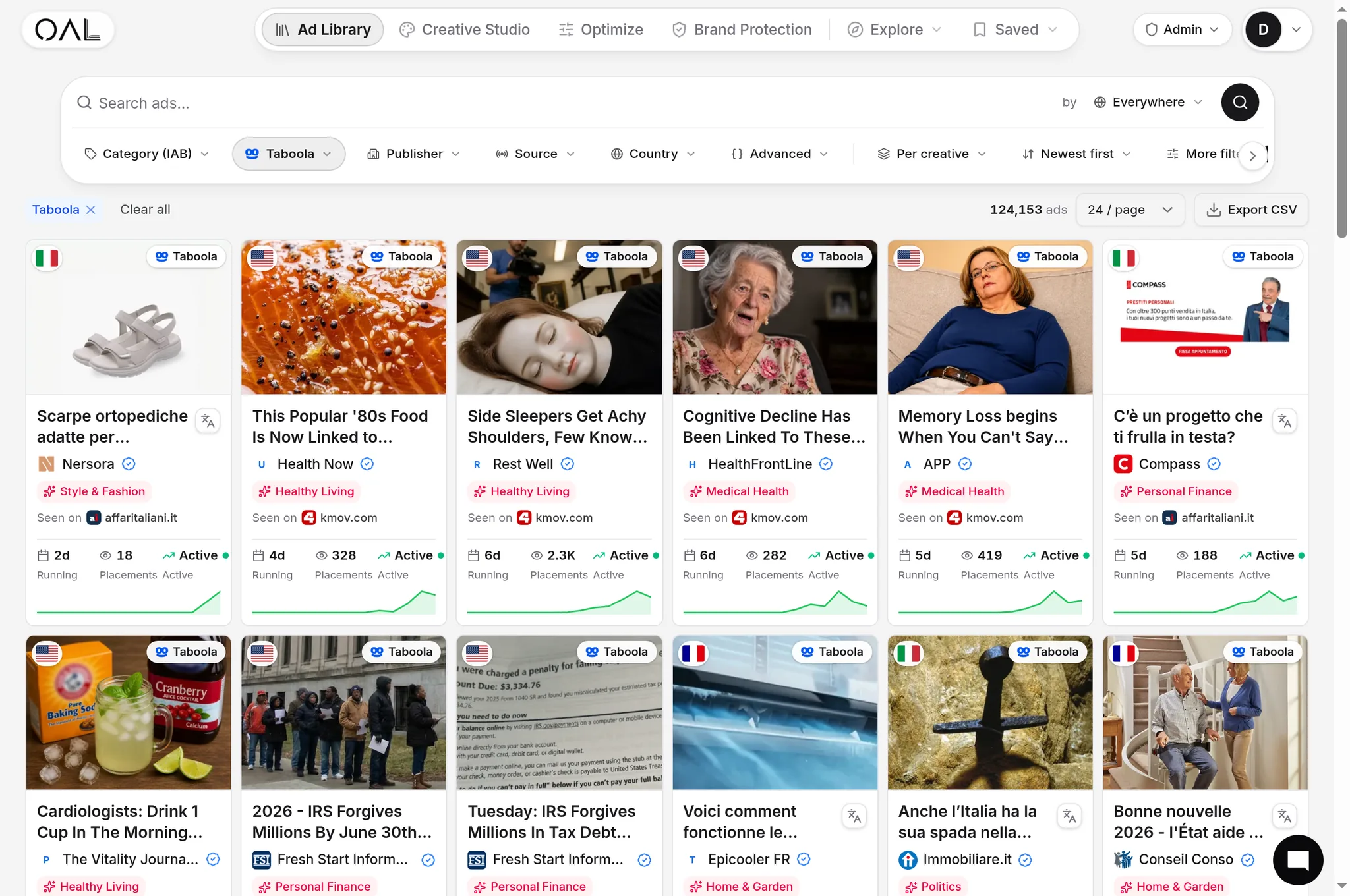
The cheapest mistakes are the ones other advertisers already made for you. MediaGo has no official transparency center, so an independent index is the only way to see what is actually running: browse live MediaGo creatives by advertiser, vertical and geo in the MediaGo ad library, or work from the MediaGo spy tool directly. Fifteen minutes there answers, before launch: which angles insurance and home advertisers have kept live for weeks (longevity means the ad pays), which headline conventions dominate your target geo, and what their landing pages do that yours does not. The free tier covers casual research; premium unlocks the full index with landing-page traces.
Launch checklist#
- Account approved; landing pages compliant, finished and fast.
- Pixel or S2S postback verified with a test conversion before spend.
- Conversion event chosen with enough expected volume for learning.
- One geo per campaign; device splits only when budget supports them.
- 5–10 feed-native creatives per campaign at launch.
- Target CPA set near reality, not aspiration.
- Daily budget covers several conversions per day at target CPA.
- Hands off during learning; edits batched every few days.
- Placement report reviewed after a real sample; laggards blocked.
- Competitor angles re-checked against the live index before every creative refresh.