

 Español
 Português (Brasil)
 Français
 Deutsch
 Italiano
 Nederlands
 Polski
 Svenska
 Türkçe
 Русский
 日本語
日本語 한국어
한국어 简体中文
简体中文 Tiếng Việt
 Bahasa Indonesia
 繁體中文
繁體中文 Čeština
 Dansk
Dansk Suomi
Suomi Ελληνικά
 Română
 Magyar
 Українська
 ไทย
ไทย हिन्दी
 العربية
 עברית
עבריתMGID & Revcontent Ad Spy: Track Advertisers on Mid-Tier Native Networks
MGID and Revcontent are where smart media buyers diversify after Taboola and Outbrain, and here is how to spy on both properly using real captured longevity, geo, and advertiser data.

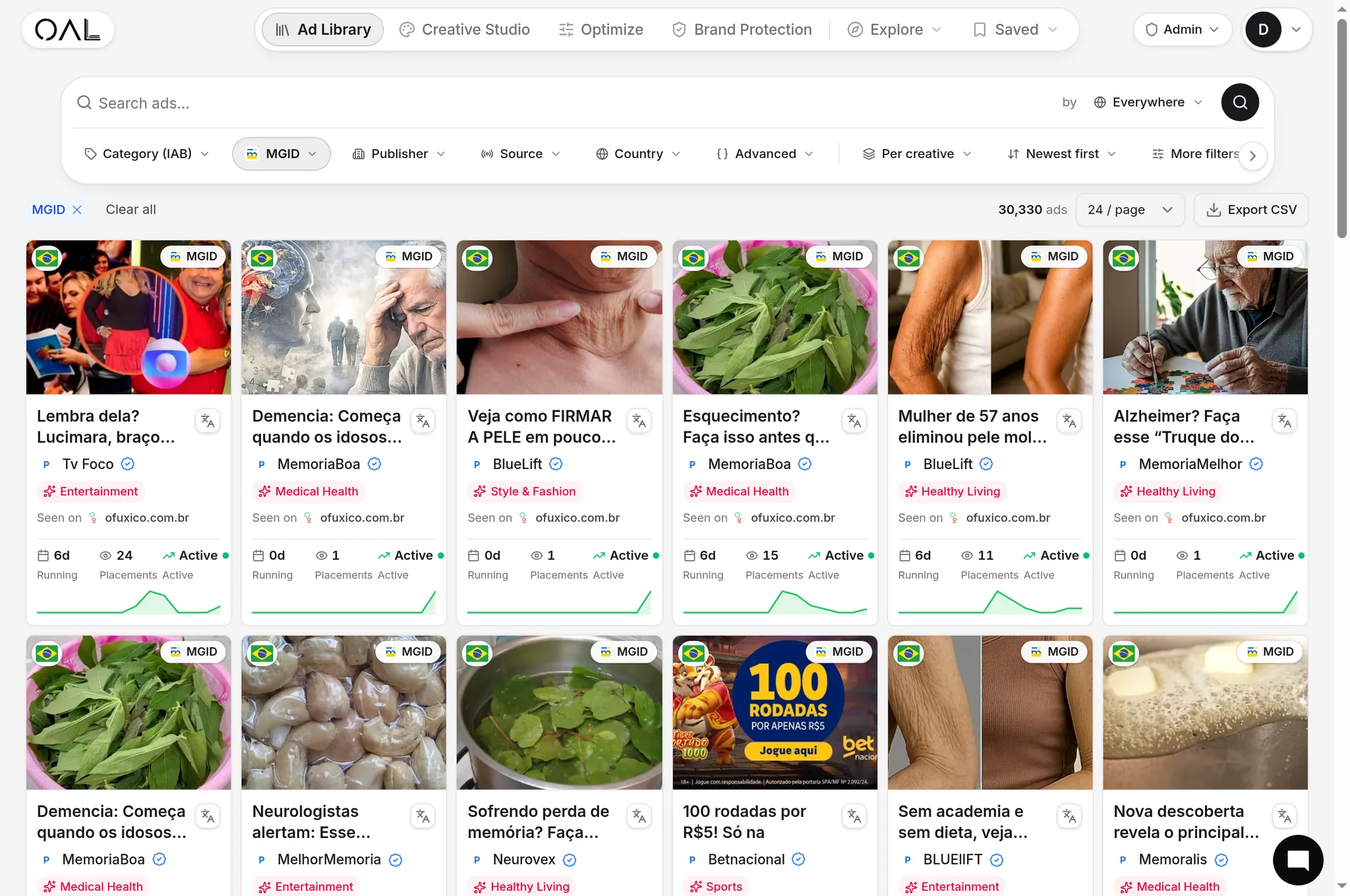
Most native ad spy guides stop at Taboola and Outbrain. So do most media buyers, and that is the problem. The two majors run the most competitive auctions in native, so angles get copied within days and CPCs climb as more buyers pile in. The advertisers who quietly scale are the ones who port a proven creative onto MGID and Revcontent, the mid-tier networks where the same offer meets fresher publisher inventory and a thinner field of competitors.
The catch is that these are the networks most spy tools cover shallowly. This guide shows you how to track advertisers on MGID and Revcontent properly: what to look for, where generic tools fall down, and how to read the signals that separate a real winner from a launch that fizzled in a week.
For context on how seriously we take the mid tier, our index currently holds 49,689 MGID creatives and 11,478 Revcontent creatives (OpenAdLibrary, June 2026), out of 589,036 creatives total across 42 networks. These are not networks we crawl once a fortnight.
Why MGID ad spy is harder than Taboola spy#
MGID ad spy means systematically capturing which advertisers run on MGID, what creatives and landing pages they use, and how long those campaigns survive. It is harder than spying on Taboola because mid-tier networks get smaller crawl budgets from spy vendors. Inventory goes stale and the long tail of smaller advertisers gets under-sampled, which is precisely where the less-contested winners live.
The reason is scale and incentive. Taboola and Outbrain are the headline networks every vendor markets coverage for, so they get the most frequent crawls. MGID still reaches over 850 million monthly unique users across more than 32,000 publishers, and Revcontent serves roughly 180 to 500 million daily impressions. Neither is a small network. But in the spy-tool economy they are second-tier priorities, and it shows: longer refresh gaps, thinner advertiser coverage, and creative thumbnails instead of full-quality captures.
Here is a live MGID creative we captured. A trading ad from IForex, running 16 days at the time of capture, with no brand name on the card itself.

The mid-tier paradox: the networks hardest to spy on cleanly are the ones where competitive intel is most valuable, because fewer of your rivals are looking.
What you actually want to know about a mid-tier advertiser#
Pulling a wall of creative thumbnails is not competitive intelligence. When you study an advertiser on MGID or Revcontent, you are answering five operational questions.
- Who is really behind the ad? Native creatives almost never name the brand on the card. The advertiser identity lives in the click destination and the ad-tech supply chain, not the headline. The IForex ad above is a perfect example: the card sells "trading," nothing more. We resolved the brand from the click trace, not the creative.
- How long has it run? Longevity is the most honest performance proxy in native. Nobody burns budget on a loser for weeks. Our index currently spans up to 28 days of continuous observation per creative, and the ads that hit that ceiling are doing something right.
- Where is it running? Geo tells you whether an advertiser is testing cheap Tier 2 / Tier 3 traffic or has graduated a winner into expensive Tier 1 markets.
- Is the same angle on multiple networks? A creative that appears on Taboola and MGID is a diversification signal. The advertiser has validated it and is hunting fresh impressions.
- What is the landing page? The pre-lander and offer page are where the funnel lives. The creative is bait. The landing page is the business.
A thumbnail grid answers question one or two at best. The other three are where the money is.
What the captured data tells you about each network#
The vertical mix on each network is not random, and it shapes what you should go looking for. On MGID, entertainment dominates our capture by a wide margin: 8,904 of the 49,689 MGID creatives we hold are entertainment, with health (615), insurance (378), and software (161) trailing well behind (OpenAdLibrary, June 2026). That entertainment skew is the clickbait quiz-and-curiosity machine. Here is one of those creatives, a Zestradar curiosity hook running 17 days.

Revcontent tilts the other way. Its top vertical in our index is health (1,459 creatives), followed by finance (424), home and garden (403), insurance (322), and nutra (250). That is a performance and arbitrage crowd, heavier on supplements and direct-response offers than on viral content widgets. If you are hunting nutra or health angles, Revcontent is the better hunting ground; if you want international entertainment arbitrage tested early, MGID is where it surfaces first.
Step back to the whole index and the picture flips again. Across all 42 networks, finance (17,232 creatives) and insurance (15,629) lead, with health (14,895), ecommerce (13,872), and entertainment (11,784) close behind (OpenAdLibrary, June 2026). So the verticals that dominate native overall are not the ones that dominate MGID specifically. That mismatch is a tell: when a heavily-funded finance or insurance offer shows up on MGID, it is usually an advertiser deliberately moving down-market for cheaper impressions, not the network's default crowd.
You can watch that play happen in real time. HDFC Life, an insurance advertiser, was running a tight cluster of MGID creatives for 19 days, all hammering the same "₹24/day" price hook in slightly different wording.

When you see seven near-identical variants from one advertiser on a single network, you are not looking at one ad. You are looking at someone's split test, and the variant that survives longest is the answer key.
Where generic spy tools fall short on MGID and Revcontent#
To be fair, the major tools do list these networks. Anstrex tracks 27-plus native networks including MGID and Revcontent, AdPlexity Native covers nine core networks with both included, and Adbeat layers publisher-level spend estimates on top. The question is rarely "Is the network listed?" It is "How deep, how fresh, and how complete is the data once you filter to it?"
Here is how the dimensions that matter stack up across approaches.
| What you need | Typical generic spy tool | What thorough mid-tier coverage looks like |
|---|---|---|
| MGID / Revcontent listed | Usually yes | Yes |
| Refresh frequency | Lower priority than Taboola/Outbrain | Live capture on the same cadence as the majors |
| Creative quality | Compressed thumbnail | Full-quality original image captured |
| Real advertiser identity | Inconsistent | Resolved via the ad-tech supply chain |
| Click traced to landing page | Often missing or stale | Followed to the live landing page |
| Cross-network angle matching | Rare | Same creative tracked across networks |
| Pricing | Commonly $80 to $400/mo | Open, low-cost access |
The failure modes are predictable. You filter to MGID and the most recent ad is two weeks old. You find a promising Revcontent creative but the advertiser field reads "unknown." You see the card but the landing-page link is dead or was never captured. None of these matter much on the well-funded majors, where sheer volume papers over gaps. On the mid tier, where the whole point is finding the under-watched winner, a stale or incomplete record means you miss the play entirely.
A practical workflow for spying on MGID and Revcontent#
Treat the mid tier as a structured search, not a browse. This is the sequence that consistently surfaces real opportunities.
1. Start from the advertiser, not the creative#
If you know a competitor is active in your vertical, pull their full footprint first. Map every creative they run, then sort by how long each has been live. The oldest survivors are your study set. Those are the winners they have already paid to validate. New launches are noise until they prove longevity. The HDFC Life cluster above is what this looks like in practice: one advertiser, one offer, many variants, sorted by days running.
2. Filter by network and watch for cross-network overlap#
Isolate MGID and Revcontent, then cross-reference against Taboola and Outbrain. When the same angle appears on a major and a mid-tier network, you have caught a diversification move in progress. That overlap is the strongest buy-side signal native intelligence offers, and it is invisible if your tool only crawls one network well. Our Taboola vs Outbrain comparison covers why the majors behave differently from the mid tier, and the best native ad networks ranking maps the full landscape these advertisers move across.
3. Read geo before you read the creative#
A creative running only in the Philippines or Brazil is in the test phase. The same creative running in the US, UK, or Germany has graduated. The IForex "Best Overall Broker In Asia" variant we captured tells you exactly where that campaign was pointed before you even read the headline. Sort by Tier 1 presence to find offers that have already survived the cheap-traffic gauntlet, because the advertiser has effectively pre-tested them for you.
4. Follow the click to the landing page#
The creative tells you the hook. The landing page tells you the funnel, the offer mechanics, and the monetization. Always pull the destination. The strongest tools follow the click to the advertiser's landing page or pre-lander without clicking the live ad, so you study the funnel without skewing the advertiser's metrics or tipping them off.
5. Compare network economics before you commit budget#
Spy data tells you what is working. It does not tell you what it costs to copy. MGID and Revcontent both run CPC auctions with no hard minimum, which is why they suit smaller test budgets. Revcontent CPCs commonly fall in the $0.01 to $0.20 range. Pair your intel with the underlying economics in our native ad cost guide, and weigh the two networks head-to-head in the MGID vs Revcontent comparison before you allocate.
MGID vs Revcontent: what the spy data tends to show#
The two networks attract overlapping but distinct advertiser profiles, and the captured data reflects their positioning. Use this as a starting hypothesis, then verify against live data for your vertical rather than treating it as gospel.
| Signal | MGID | Revcontent |
|---|---|---|
| Reach profile | 850M+ monthly uniques, strong in EU, LATAM, SEA, US | 180 to 500M daily impressions, US-heavy premium publishers |
| Our captured creatives | 49,689 (entertainment-led) | 11,478 (health-led) |
| Top vertical in our index | Entertainment (8,904) | Health (1,459) |
| Geo strength | Deep Tier 2/Tier 3 plus Tier 1 | Tier 1 publisher inventory weighted |
| Best spy use | Catching international test campaigns early | Watching US performance offers scale |
For the full side-by-side on reach, cost, and advertiser mix, see Revcontent vs Taboola and MGID vs Taboola. Both frame the mid-tier networks against the majors your competitors are also buying.
A note on longevity, and what we can actually prove#
You will read elsewhere that a "90-day winner" is the gold standard in native. That is general industry lore, and it is directionally true: the longer an ad runs, the more confident you can be it is profitable. But be honest about what your data source can actually show you versus what it is repeating from a forum post.
Our own continuous observation currently spans up to 28 days per creative, so when we say an ad is a survivor, we mean we have watched it stay live across that window, not that we are guessing. Right now our longest-running survivors sit at the 28-day ceiling, dominated by health and entertainment offers like Hidden Hearing's "Try next-gen hearing aids" and the relentless "My IQ" quiz funnel on the Microsoft Audience Network. The same logic applies on the mid tier: an MGID creative still live at 19 days, like the HDFC Life cluster, has outlasted the vast majority of launches around it. Trust observed day-counts. Treat round numbers from industry lore as a useful frame, not as evidence.
Here is what a long-running health offer looks like up close, the Insulux diabetes angle, captured at 18 days on MGID.

How OpenAdLibrary covers the mid tier#
OpenAdLibrary was built for exactly this gap. It captures live public native ads across Taboola, Outbrain, MGID, Revcontent, Teads, MediaGo, Yahoo, and MSN on the same harvest cadence. The mid-tier networks are not an afterthought. For each placement it captures the real creative image at full quality, classifies the ad-tech supply chain to resolve the actual advertiser behind the card, and follows the click through to the landing page without clicking the live ad. As of June 2026 that adds up to 589,036 creatives from 25,933 advertisers and 926,259 landing-page captures across 42 networks. Longevity and spread signals are first-class, so you can sort by what has survived rather than what just launched.
Because it is an open, low-cost native ad network intelligence platform at $29.99/mo, with a free tier to browse 200 ads with no card, it removes the price barrier that keeps the $80 to $400/mo tools out of reach for solo buyers and small teams. From there, Creative Studio, Optimize, Copy DNA, and an API plus MCP let you act on what you find instead of just looking at it.
If you want to see what your competitors are running on MGID right now, the dedicated MGID spy view is the fastest way in. Start free and pull your first advertiser footprint in a few minutes. No card required.
The takeaway#
The mid tier is undervalued precisely because it is harder to watch. Taboola and Outbrain are crowded with advertisers and with the people spying on them. MGID and Revcontent carry serious volume, a different vertical mix (entertainment on one, health on the other), and fresher angles. But that only helps you if your intelligence source crawls them deeply, keeps them current, resolves the real advertiser, and traces the click to the landing page. Get that right and the mid tier stops being the networks everyone skips, and becomes the networks where you find the winner first.