 Español
 Português (Brasil)
 Français
 Deutsch
 Italiano
 Nederlands
 Polski
 Svenska
 Türkçe
 Русский
 日本語
日本語 한국어
한국어 简体中文
简体中文 Tiếng Việt
 Bahasa Indonesia
 繁體中文
繁體中文 Čeština
 Dansk
Dansk Norsk (bokmål)
 Suomi
Suomi Ελληνικά
 Română
 Magyar
 Українська
 ไทย
ไทย हिन्दी
 العربية
 עברית
עבריתNative Ad Network Minimum Deposits Compared (2026 Table)
The sticker minimum and the real minimum are different numbers. Here is what each major native network commonly requires to open an account — and what you actually need to run a test that produces a decision.


Most native ad networks let you start with a few hundred dollars: mid-tier networks like MGID and Revcontent commonly ask for an initial deposit in the low hundreds, while premium networks like Taboola and Outbrain typically skip a deposit but enforce daily or per-campaign budget minimums that add up to a similar monthly commitment. The lowest barrier to entry is not the same as the cheapest place to learn, though — the real number that matters is the budget required to reach a statistically meaningful decision, and that is set by CPC and testing math, not by the network's payments page.
This article compares the entry costs across the major native networks the way a media buyer actually experiences them: the money the network asks for up front, the money the auction quietly demands, and the money a competent first test consumes. One caveat before the table: minimums are the single most frequently changed number in native advertising. Networks adjust them by geo, by account type (self-serve vs. managed), by sales team and by quarter. Treat everything below as commonly reported practitioner experience as of mid-2026, and confirm the current figure with the network before you fund an account.
Minimum deposits and budgets: the comparison table#
| Network | Entry model | Commonly reported minimum to start | Practical notes |
|---|---|---|---|
| Taboola | Daily/monthly budget minimums, no classic deposit | Self-serve accounts typically carry a modest daily budget floor per campaign; managed accounts require a much larger monthly commitment | The self-serve floor is low, but Taboola's Tier-1 CPCs make real tests expensive. See how Taboola ads work before funding. |
| Outbrain (Teads) | Daily budget minimums per campaign | Low daily minimums on self-serve; managed/agency tiers negotiate committed spend | Post-merger account structures are in flux — confirm current thresholds. Background: how Outbrain works now. |
| MGID | Prepaid deposit | Initial deposit commonly reported in the low hundreds of dollars | Among the lowest barriers in native; a personal account manager is usually assigned even at small spend. Mechanics: how MGID works. |
| Revcontent | Prepaid deposit | Deposit commonly reported in the low-to-mid hundreds | Historically had a much higher floor; it has come down. Overview: how Revcontent works. |
| MediaGo | Deposit / insertion-order style entry depending on region | Varies widely by region and rep | Baidu's international DSP is more rep-driven; get the number in writing. |
| EvaDav, Adcash and other long-tail networks | Prepaid deposit | Frequently under one hundred dollars | Cheapest entry, but inventory quality varies enormously — budget for placement auditing. |
Two patterns worth noticing. First, the networks split into two entry models: prepaid deposits (you load a wallet, spend it down) and budget minimums (no wallet, but the network enforces a floor on what each campaign spends per day). Deposits feel scarier but are often friendlier — unspent money is usually refundable or sits in your balance. Daily minimums feel painless but quietly commit you to a burn rate.
Second, the entry price is inversely correlated with traffic quality almost everywhere. The networks with the lowest deposits monetize the longest tail of publishers. That is not a reason to avoid them — MGID and Revcontent are legitimate mid-tier buys — but it means the money you save on the deposit should be reallocated to placement policing.
The real minimum: what a decision-grade test costs#
The deposit gets you through the door. The test budget gets you an answer. Practitioners commonly size a first native test using simple math: enough clicks per creative to judge CTR, and enough clicks per landing page to judge conversion behavior. A common heuristic is a few hundred clicks per landing-page variant before trusting any conversion signal, and at least 10–15 creatives in the first wave, because native creative performance is wildly uneven — a pattern you can verify by browsing what long-running native ads look like versus the median ad.
Run the numbers with commonly reported CPC ranges — media buyers typically report Tier-1 desktop CPCs from roughly $0.20 to $0.90 on premium native networks, and Tier-2/3 clicks from a few cents; your niche and geo will move this a lot (see the full native CPC benchmarks breakdown):
- Premium network, Tier-1 geo: several hundred clicks across a small creative set lands most buyers in the low four figures for a first real test.
- Mid-tier network, Tier-1 geo: the same test commonly fits in the mid-to-high hundreds.
- Mid-tier network, Tier-2/3 geo: decision-grade data for a few hundred dollars is realistic — which is why affiliates so often learn on MGID in Europe or LatAm before touching US Taboola inventory.
If your total available budget is close to the deposit minimum itself, you are underfunded for that network. A $150 balance on a network whose clicks cost $0.60 buys 250 clicks spread across everything you test — that is noise, not data. Either move down a tier or save until the test math works. The budgeting guide to native ad costs walks through this arithmetic in more depth.
How to choose your entry network by budget#
- Under ~$500 total: mid-tier deposit networks (MGID, Revcontent) in Tier-2/3 geos, or the long tail if you can audit placements daily. Wide creative testing, cheap clicks, fast lessons.
- ~$500–$2,000: mid-tier networks in Tier-1 geos, or a tightly scoped premium-network test (one geo, one device, one offer). Comparison shopping helps here: MGID vs Taboola is the classic budget-vs-premium decision.
- $2,000+ per month sustained: premium self-serve (Taboola, Outbrain) becomes rational, and at meaningfully higher commitments the managed tiers start offering better support and beta access.
Whichever tier you enter at, the beginner's media buying playbook applies: one variable at a time, placement-level reporting from day one, and no scaling until the tracker agrees with the network's numbers.
Don't pay the deposit to learn what ads work — that part is free#
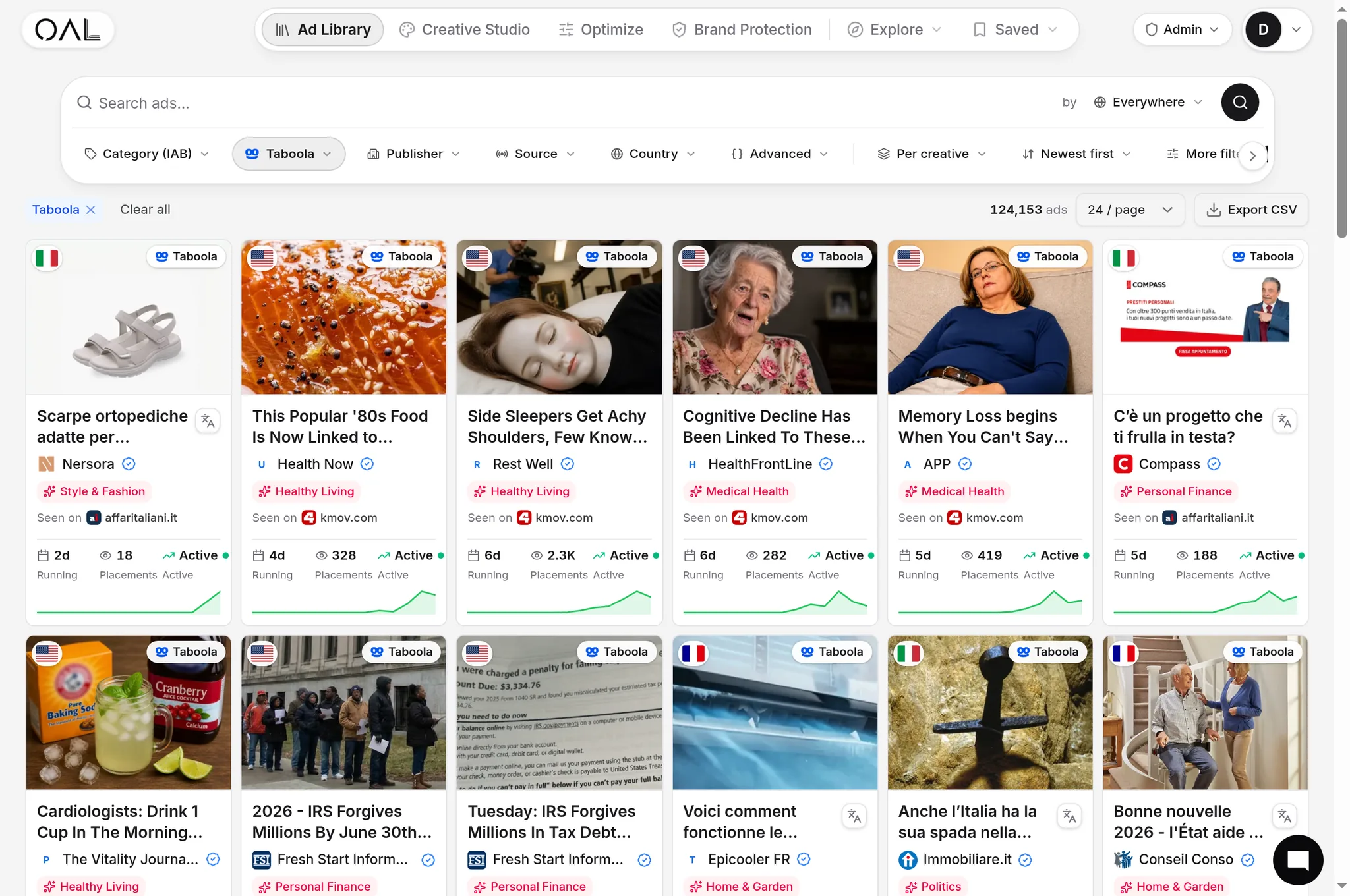
The most expensive way to use your first deposit is creative discovery: paying the auction to tell you which hooks and angles are already proven. That information is publicly observable before you spend anything. OpenAdLibrary's index of 725,000+ live native ad creatives across 49 networks (June 2026) — including 206,000+ on Taboola, 108,000+ on Outbrain and 62,000+ on MGID — shows you which creatives competitors keep paying for, how long they have run, and which landing pages they feed. Ads that survive 30+ days of continuous spend are almost certainly profitable, which makes the index a map of validated angles you can study on the free native ad research tier before your deposit clears. Reserve the deposit for what only spend can buy: your own conversion data.
Fine print that catches first-time depositors#
- Refund policy varies. Some networks refund unspent balances on request; others apply dormancy fees or make refunds painful. Read the funding terms before wiring anything.
- Minimum CPC floors bind harder than deposits. A network with a $100 deposit but a per-click floor above your economics is more expensive than a $500 deposit network where the auction clears lower — the floor, not the deposit, sets your economics.
- Managed-account minimums are negotiable; self-serve ones rarely are. If a sales rep quotes a large monthly commitment, that number is an opening position.
- Geo changes everything. The same network can have different deposit rules, budget floors and payment methods by country. Confirm for the geo you will actually bill from.
- Top-up minimums differ from initial deposits. Some networks let you open with one number but enforce a different minimum on subsequent top-ups — worth knowing before you architect a small-and-frequent funding routine.
The honest summary: entry to native advertising costs less than most channels — low hundreds of dollars on mid-tier networks — but a decision-grade test costs the same everywhere the math says it does. Budget for the test, not the deposit, and spend your research hours on free intelligence before spending your first dollar on clicks.