Español
 Português (Brasil)
 Français
 Deutsch
 Italiano
 Nederlands
 Polski
 Svenska
 Türkçe
 Русский
 日本語
日本語 한국어
한국어 简体中文
简体中文 Tiếng Việt
 Bahasa Indonesia
 繁體中文
繁體中文 Čeština
 Dansk
Dansk Norsk (bokmål)
 Suomi
Suomi Ελληνικά
 Română
 Magyar
 Українська
 ไทย
ไทย हिन्दी
 العربية
 עברית
עבריתRevcontent Minimum Budget: The $100/Day Rule Explained
The $100/day rule is a filter, not a fee. What Revcontent's minimum really covers, the arithmetic of a meaningful test, and when to start on a cheaper network instead.


Revcontent requires a minimum daily budget of $100 per campaign — the long-standing "$100/day rule" that makes it one of the more expensive native networks to enter. That is a budget floor, not a spend guarantee: the campaign must be allowed to spend $100 in a day, though it may deliver less. In practice a serious first month on Revcontent runs into the low thousands of dollars once you fund a real test, and the network has historically also expected an initial deposit on account opening. Terms change; confirm current minimums with Revcontent's documentation or your rep before planning around any number, including this one.
What the $100/day rule actually means#
Three distinctions save people from budgeting mistakes:
- It is per campaign, not per account. Two campaigns means two $100/day floors. Buyers who like to isolate geos or devices into separate campaigns — the standard native structure — multiply the floor with every split. Structure your first test as one campaign with placement-level optimization rather than five thin campaigns.
- Budget is permission, not obligation. A $100/day budget with a conservative bid may spend $40. The floor exists so that campaigns have room to gather data, not to drain accounts. That said, plan as if it will spend — because with competitive bids, it will.
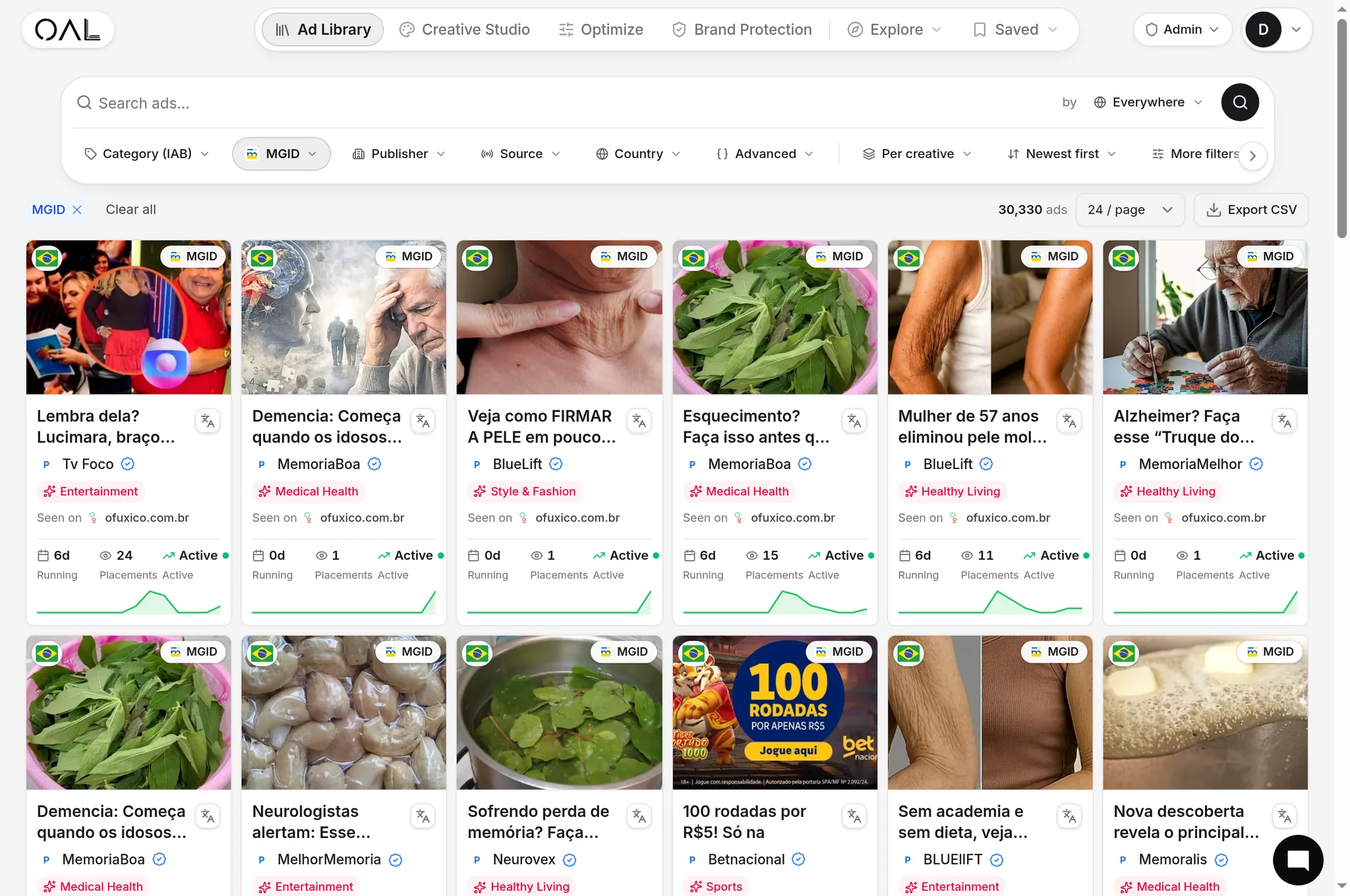
- The floor shapes the network. A $100/day entry bar filters out hobbyists. That is part of why Revcontent's auction, though smaller than Taboola's, is populated by committed direct-response buyers — visible in the live capture data, where the network's 15,789 live creatives (OpenAdLibrary index, June 2026) skew heavily toward health, finance and home offers run by repeat operators.
Why Revcontent sets a high floor#
The economics are straightforward. Native networks earn a share of advertiser spend, and small accounts cost nearly as much to moderate, support and police as large ones. A high minimum concentrates the network's compliance and support effort on advertisers who can sustain campaigns — and it protects publisher yield, because campaigns with room to spend produce stable widget revenue. For buyers, the practical consequence cuts both ways: fewer dabblers bidding up placements with random tests, but no cheap way to poke at the network before committing. Everything about how Revcontent works — placement reporting, CTR-weighted auction, rep support — assumes you are operating at at least this scale.
What $100 a day actually buys#
Here is illustrative arithmetic — not official pricing. If your clicks cost around $0.20–$0.40, the range media buyers commonly report for competitive US placements on mid-tier native networks, $100 buys roughly 250–500 clicks a day. Check that against what a test needs to teach you:
- Creative testing works at this scale. Spread across 10 creatives, 250–500 clicks a day will surface CTR winners within a few days.
- Placement cutting works at this scale. A week of data — call it 2,000–3,000 clicks across the network's widgets — is enough to identify placements that spend without converting and start building a whitelist.
- Conversion judgment usually does not. If your funnel converts around 1% and your offer pays out on sales, a single day's clicks produce a handful of conversions at best. Statistical confidence on ROI takes one to two weeks minimum, which is why the honest unit of testing on Revcontent is the week, not the day — and why a real test budget is $1,500–$3,000, not $100.
Budget the month, not the day. Our native advertising cost guide covers the full stack of costs around the media itself — tracker, creatives, pre-landers — and cross-network CPC benchmarks help you sanity-check the click-cost assumption for your geo and vertical.
How Revcontent's entry bar compares#
Exact minimums move around and networks negotiate, so treat this as relative positioning and verify current terms with each platform:
| Network | Entry bar (relative) | Character |
|---|---|---|
| MGID | Low | Small deposits accepted; built for gradual self-serve testing |
| Taboola / Outbrain | Moderate | Modest daily minimums, but competitive CPCs raise the real cost of learning |
| Revcontent | High | $100/day per campaign; assumes committed DR budgets |
If the Revcontent floor is more than about 10% of your total monthly test budget, start on a cheaper network, prove your funnel mechanics, and come back. The MGID vs Revcontent comparison covers the most common downgrade path — similar advertiser tolerance, far lower entry cost, at the price of messier international inventory.
How not to waste the first $100 days#
The minimum makes wasted days expensive, so front-load the free work:
- Research the live auction before depositing. Pull what is currently running in your vertical with the Revcontent spy tool — advertisers, hooks, pre-landers and how long each creative has been live. Creatives running 30+ days mark funnels that survive the network's economics; the Revcontent ad library lets you browse the whole captured corpus.
- Copy structure, not copy. The surviving funnels tell you which angle families and pre-lander formats the audience accepts. Build your own version; cloned creatives get moderated and cloned funnels convert worse.
- Launch with a full creative slate. Ten-plus creatives against one lander. The CTR-weighted auction punishes thin tests twice: worse data and more expensive clicks.
- Instrument before the first click. A tracker with postback conversions and per-placement reporting is non-negotiable at this price point — placement cutting is the entire optimization game, and you cannot cut what you cannot attribute. The wider workflow is in our media buying guide for native.
- Judge on EPC, weekly. Kill placements on spend-without-conversion, keep the whitelist, and evaluate the campaign at week boundaries. Daily ROI panic at $100/day sample sizes produces exactly the wrong decisions.
Common mistakes at the $100/day tier#
The minimum has a way of amplifying ordinary media-buying errors into expensive ones. The recurring failures, in the order they usually happen:
- Splitting campaigns too early. Separating desktop and mobile, or three geos, into their own campaigns on day one turns a $100/day test into a $300–$500/day commitment before you have a single conversion. Start consolidated; split only what the data proves deserves its own budget.
- Launching with two creatives. At this spend level, creative variety is what converts budget into information. Two creatives at $100/day teaches you almost nothing a coin flip would not; twelve creatives at the same spend maps the angle space.
- Reacting daily. A bad Tuesday at a few hundred clicks is noise. Buyers who pause campaigns on single-day ROI at this sample size systematically kill campaigns that were converging — and then conclude the network "doesn't work."
- Never graduating to a whitelist. The run-of-network phase is a data-collection expense, not a destination. If you are still buying broad placements in week three, the minimum is being spent on inventory you have already proven does not convert for you.
- Judging the network on the first funnel. A failed test at $100/day proves one offer-angle-lander combination failed. The advertisers visible running for weeks in the live index iterated to their winners; almost none of them hit it on the first funnel.
Each of these mistakes exists on every native network; the $100 floor just makes their tuition higher. The discipline they demand — consolidated structure, wide creative slates, weekly judgment, placement graduation — is the same discipline that makes the spend worthwhile.
The bottom line#
The $100/day rule is a filter, and it works as designed. It keeps out buyers who cannot fund a statistically meaningful test — and it forces everyone else to show up prepared. If the floor stings, that is the network telling you to prove the funnel somewhere cheaper first. If the floor is comfortable, Revcontent's thinner, committed auction is one of the few places in native where preparation still buys a real edge.