Español
 Português (Brasil)
 Français
 Deutsch
 Italiano
 Nederlands
 Polski
 Svenska
 Türkçe
 Русский
 日本語
日本語 한국어
한국어 简体中文
简体中文 Tiếng Việt
 Bahasa Indonesia
 繁體中文
繁體中文 Čeština
 Dansk
Dansk Suomi
Suomi Ελληνικά
 Română
 Magyar
 Українська
 ไทย
ไทย हिन्दी
 العربية
 עברית
עברית30 Real Native Advertising Examples (Captured Live From Taboola, Outbrain & MGID)
Thirty real native ads captured live off Taboola, Outbrain and MGID in June 2026, each labeled with the actual advertiser, the network, and how long it has been running.

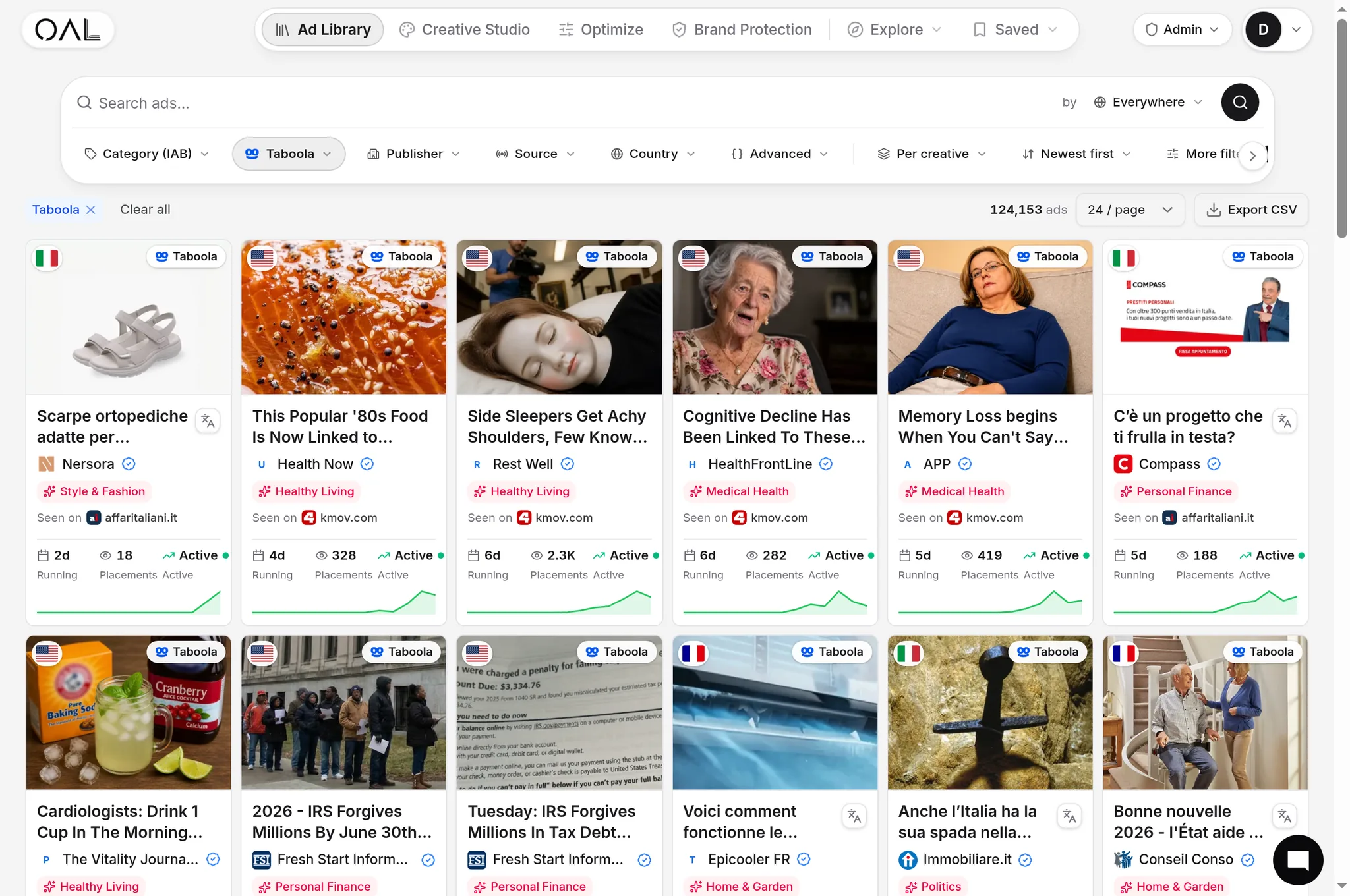
Search "native advertising examples" and you get the same recycled mockups every time. A fake BuzzFeed sponsored post from 2016. A screenshot of a New York Times brand-studio piece. Maybe a Spotify Wrapped graphic someone pulled off a conference slide. They illustrate the concept and teach you nothing about what is actually running and converting right now.
This page is different. Every example below is a real creative we captured live off a publisher page, running on Taboola, Outbrain or MGID, and labeled with three things most galleries never show you: the actual advertiser behind the ad, the network serving it, and how long it has been live in our index. We refresh it monthly, because a native ad that stopped serving two years ago is a museum piece, not a swipe file.
For context on scale: as of June 2026 the OpenAdLibrary index holds 589,036 native creatives from 25,933 advertisers across 42 networks, with 5.4 million ad observations behind them. The examples here are a tiny, hand-picked slice of that. Everything you see is dated and real.
What counts as a native advertising example?#
A native advertising example is any paid placement engineered to match the form and function of the content around it, so it reads as part of the page instead of an interruption. The classic specimen is the content-recommendation widget under a news article: one thumbnail, one curiosity-gap headline. In-feed promoted posts, sponsored articles and content-style display units all qualify too. The defining trait is camouflage. It looks editorial. It is labeled paid.
Here is a live one from our June 2026 harvest so you know exactly what we mean.

Notice the moves. A deadline. A round-but-vague number. A brand name ("Fresh Start Information") that sounds like a public service, not a company. That ad had been running 13 straight days when we logged it, which on a performance network is a long time to keep paying for the same creative.
If you want the full taxonomy, formats and history, the pillar Native Advertising: The Complete Guide With Real Examples (2026) covers it end to end, and the Native Advertising glossary entry gives you the one-paragraph version. This page is the gallery. The proof.
How we captured these examples#
Most "examples" online are either invented or scraped once and left to rot. Ours come from a live harvest of public native inventory. Here is the method, because provenance is the whole point of an examples page.
- Capture is live, not historical. We pull creatives off real publisher pages as they serve, across Taboola, Outbrain, MGID, Revcontent, Teads, MediaGo, Yahoo and MSN. Every capture is timestamped.
- The image is the real asset, full quality. We store the actual creative the network served, not a compressed screenshot, so the thumbnail you see is the thumbnail the user saw.
- We label the real advertiser. Native networks wrap clicks in tracking and redirect chains, and the brand on the widget is often a content-arbitrage site, not the end advertiser. We classify the supply chain to surface who is actually paying.
- We follow the click to the landing page, without clicking the live ad. Resolving the destination (usually a pre-lander or advertorial) is where the strategy lives. We trace it so you see the full funnel, not just the hook.
The headline tells you the angle. The landing page tells you the offer. Galleries that show only the creative hide the half of the strategy that actually matters.
That last point separates a real competitive-intelligence asset from a Pinterest board. A curiosity headline is easy to admire and useless to copy if you cannot see what it is selling.
30 native advertising examples by network and format#
Rather than dump 30 disconnected thumbnails, the examples below are grouped by network and by the job the creative is doing. The patterns repeat across advertisers. Once you see the template, you see it everywhere.
Taboola examples (the "around the web" widget)#
Taboola is the largest open-web native network, and the one you have seen most even if you never knew its name. The widget, labeled "Around the Web," "Sponsored Stories" or "You May Like," sits at the foot of articles on premium publishers. It is also the deepest part of our index by a wide margin: 157,727 Taboola creatives captured, more than Outbrain (84,252) and MGID (49,689) combined. For how the auction, bidding and Smart Bid mechanics work behind these placements, see How Taboola Ads Work: A Complete Guide for Advertisers (2026).
The vertical mix on Taboola tells you who lives there. Our top categories on the network, by creative count, are Health (6,048), Finance (5,558) and Insurance (4,303). That is the performance-native heartland: supplements, tax relief, life insurance quizzes. Here is the template in its purest form.

That hearing-device ad ran 26 days. The "ditching X for this new device" frame is one of the most durable angles in the whole index, because it manufactures a trend and a comparison in seven words. Representative live Taboola examples in the harvest:
- Health "one trick" advertorial. A close-up vegetable or supplement thumbnail with a doctor-attributed headline, the click resolving to a long-form advertorial pre-lander for a supplement subscription. The dominant performance-native template.
- Personal-finance lead-gen. Tax forgiveness and "seniors may qualify" hooks linking to a benefits or quiz funnel. The Fresh Start IRS ad up top is exactly this.
- DTC product story. A clean lifestyle shot from a mattress, cookware or skincare brand pointing to a branded comparison-style article rather than a hard product page.
- Auto / insurance comparison. "Drivers in [city] are switching to..." with a geo-inserted headline, landing on a rate-comparison form.
- Brand content distribution. A major publisher or studio using Taboola to syndicate a genuine editorial piece (the upper-funnel use of the same pipes). Honda Cars India was running a clean City sedan creative on Taboola when we last harvested, proof the network is not all supplements.
Two more live captures worth studying side by side, because they show the curiosity gap doing different jobs:


The medications ad uses authority ("MDs") plus a withheld list ("See the List"). The solar ad uses consensus ("Electricians agree") plus an open loop ("about 1 thing"). Same machine, different levers. That solar creative had been live 27 days, which is near the top of what we observe.
Because Taboola headlines are often geo- and device-targeted, the same creative can show a dozen headline variants. You can browse the live set on the Taboola ad spy page and on the Taboola glossary entry.
Outbrain / Teads examples#
Outbrain is Taboola's longtime rival and the network that pioneered the content-discovery widget. In 2025 it completed its acquisition of Teads and renamed the parent to Teads Holding Co. (Nasdaq: TEAD), so you will increasingly see Outbrain's performance native and Teads' premium video sold together. The widget conventions resemble Taboola's, but the publisher mix and bidding controls differ, as covered in How Outbrain Works in 2026 (Now Part of Teads): The Advertiser's Guide and What Is Teads? The Outbrain-Teads Platform Explained (2026).
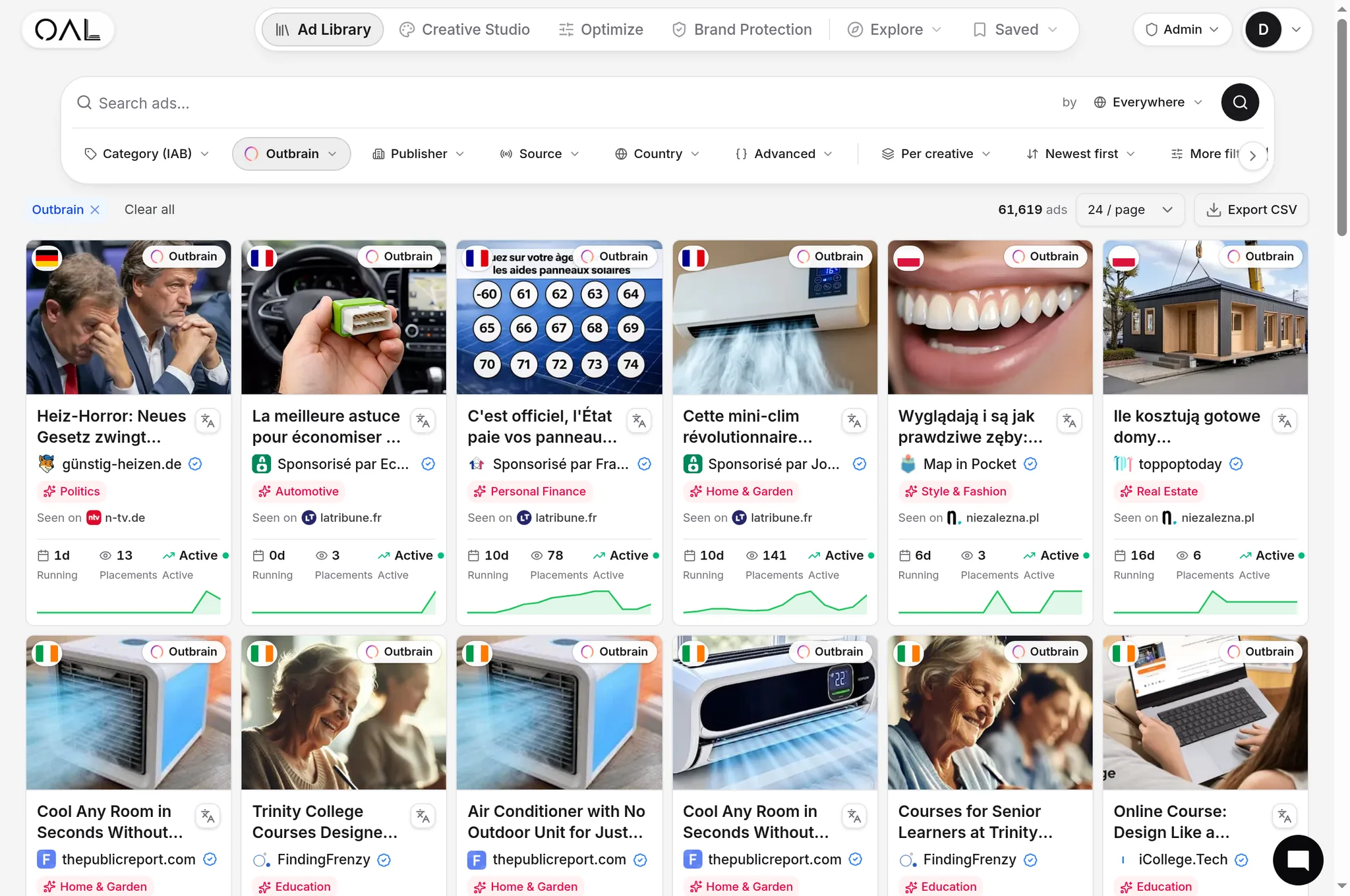
The vertical skew is the tell. Where Taboola leads with Health, Outbrain's top three in our index are Finance (2,640 creatives), Insurance (2,615) and Health (2,016). Finance and insurance edge out the supplement crowd, which fits Outbrain's slightly more premium publisher base. The single longest-running creative we currently track on Outbrain proves the point.

SmartAsset is a real, well-funded fintech, and that "Ask a Pro" framing is doing something smart: it borrows the format of an advice column, which reads as service rather than sales. It has held its slot for the full 28 days our index can observe. Representative live Outbrain examples:
- Newsroom-style brand article. A recognizable consumer brand distributing a "5 things you didn't know about..." piece, the click landing on its own content hub.
- B2B / SaaS thought-leadership. Heavier on Outbrain's premium inventory than on supplements. Thumbnail is a clean abstract or product UI, destination is a gated report.
- Travel and finance smartfeed units. In-feed cards that blend into the publisher's own recommendation rail.
- Performance affiliate offer. The same curiosity-gap mechanics as Taboola, often the identical advertiser running both networks at once (something you only notice when you can see both harvests side by side).
- Teads outstream video. A brand video unit injected mid-article, the upper-funnel counterpart to the click-driven widgets.
See the Outbrain glossary entry for the short version.
MGID examples#
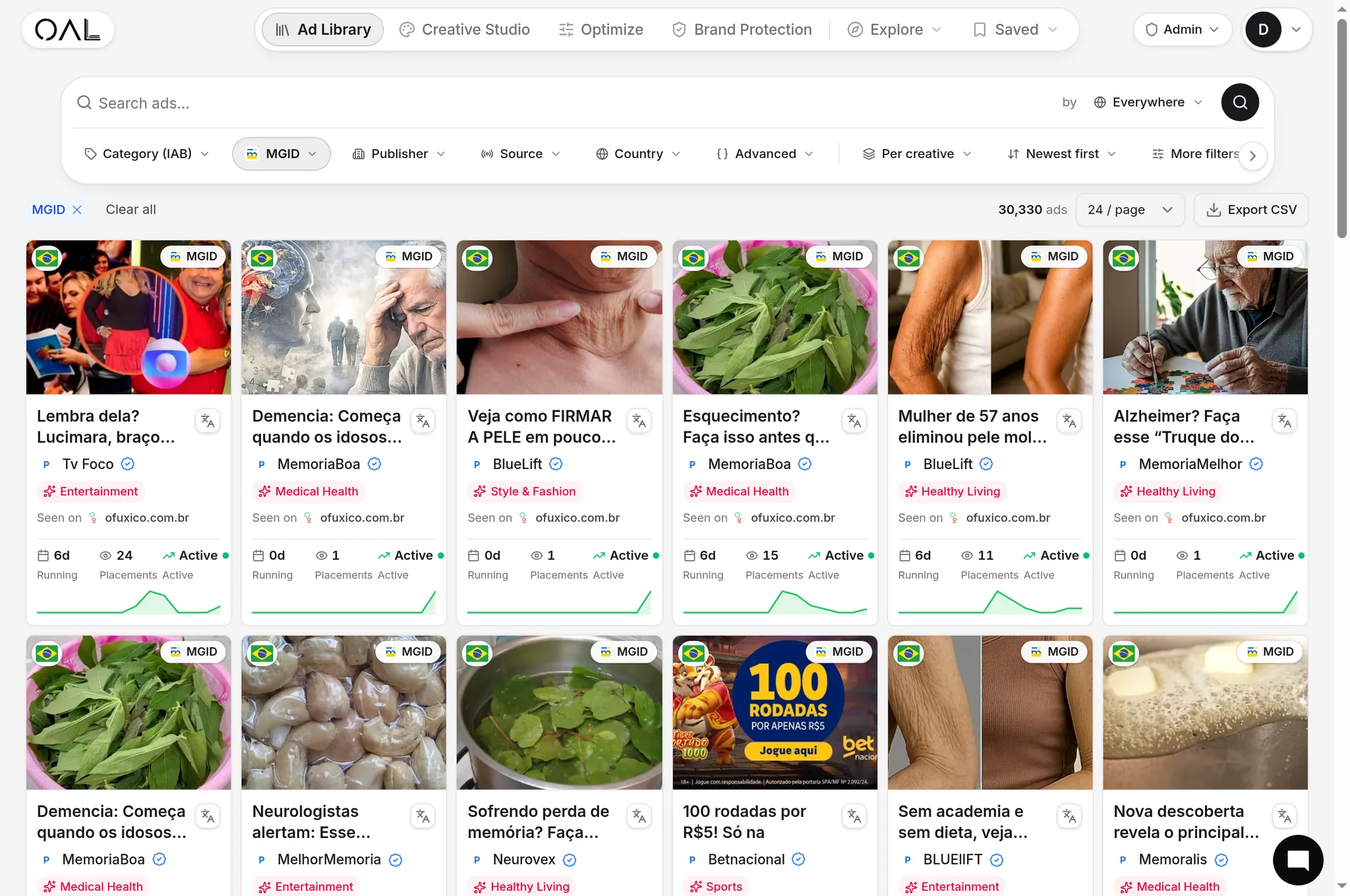
MGID skews toward a different publisher tier and a heavier entertainment, gaming and affiliate mix. Its widgets are visually busier and the offers are often more aggressive. The numbers back this up sharply: Entertainment is MGID's runaway top vertical in our index at 8,904 creatives, dwarfing its next category (Health, at 615). That is a completely different shape from Taboola or Outbrain, where finance and health lead. The formats, targeting and pricing model are broken down in How MGID Native Ads Work: Formats, Targeting and Pricing Explained.
The gaming-and-quiz style that dominates this tier looks like this. We caught the exact same "play it for 1 minute" mouse-game angle running and holding for 28 days on a sister network, which tells you the template is a proven workhorse, not a one-off.

Representative live MGID-style examples:
- Gaming / app-install. A bold game-screenshot thumbnail with a "play this for 1 minute" hook, landing on an app store or web game. Exactly the Combat Siege pattern above.
- Quiz / sweepstakes funnel. "Which [type] are you?" engagement bait that monetizes through a survey path. IQ-test funnels are everywhere in this category right now.
- Crypto and trading offers. High-volume on MGID's mix, often with regulatory-sensitive claims, landing on a registration funnel.
- Entertainment listicle. Celebrity "where are they now" galleries that are pure arbitrage plays.
- Regional e-commerce. Discount-led product widgets targeting specific countries.
The MGID glossary entry covers the network in brief.
Revcontent, Yahoo, MSN and the long tail#
Examples 16 to 30 span the rest of the open-web native ecosystem and show the same patterns reappearing under different chrome.
16 to 20. Revcontent performance offers: supplement, financial and survey funnels on a network that leans hard into direct response. See How Revcontent Works: Native Ad Network Guide for Advertisers.
21 to 25. Yahoo and MSN native (which we capture under the Microsoft Audience Network too). These surface on portal and inbox-adjacent inventory and carry slightly more brand-name advertisers because of where they run. Some of the stickiest creatives in our whole index sit here. A Hidden Hearing "next-gen hearing aids" ad and a string of My IQ quiz creatives have each clocked the full 28 days of continuous observation our index can record.
26 to 30. Programmatic native via DSPs: the same IAB native units bought through demand-side platforms and dropped into publisher slots, where the "advertiser" on the creative may be one bidder of many. This is the murkiest layer to attribute, which is exactly why a Programmatic Native Advertising capture pipeline that classifies the supply chain earns its keep.
What these examples have in common#
Lay 30 live native ads next to each other and the recurring mechanics jump out. This is the real takeaway: not any single creative, but the template behind them.
| Pattern | What it looks like | Why it works |
|---|---|---|
| Curiosity gap | Headline withholds the payoff ("See the List," "1 thing") | Forces the click to resolve the open loop |
| Human / specific imagery | A person, a hand, a single object, not a logo | Reads as editorial, not as an ad |
| Authority framing | "MDs," "Electricians agree," "Ask a Pro" | Borrows credibility the brand has not earned yet |
| Geo / device insertion | Dynamic city, age, country or device in the copy | Feels personally relevant, lifts CTR |
| Advertorial destination | Click lands on a long article, not a product page | Warms the visitor before the offer |
Every one of those rows shows up in the live captures above, word for word. Notice what is missing from the list: clever branding. Performance native is almost anti-brand on the creative itself. The persuasion is engineered into the headline-and-thumbnail combo and the pre-lander, which is why sponsored content on the destination side does so much of the heavy lifting.
The vertical data says the same thing from a higher altitude. Across the full index, the biggest native categories are Finance (17,232 creatives), Insurance (15,629) and Health (14,895), with Ecommerce (13,872) and Entertainment (11,784) close behind. Those five buy more native than anyone, and they buy it because the curiosity-gap-into-advertorial machine works on exactly their kind of offer.
How to use real examples in your own work#
A gallery only matters if it changes what you ship. Three concrete moves.
- Reverse-engineer winners, not novelties. The creatives that have run longest are the ones worth studying, because longevity is the closest free proxy you have for profitability. Our index currently spans up to about 28 days of continuous observation per creative, and the ads sitting at that ceiling (SmartAsset, Hidden Hearing, Combat Siege, the My IQ funnels) are the ones to dissect first. Separate that from general industry lore about "90-day winners," which is a real heuristic but not something we have measured here. Filter by observed run-length before you copy anything.
- Read the whole funnel. Capture the headline and the landing page. A headline you cannot tie to an offer is half a lesson.
- Map spread, not just existence. One ad on one site is a test. The same creative across 200 publishers from the same advertiser is a winner being scaled, and that pattern is invisible unless your source tracks placement breadth. We have logged 926,259 landing-page captures precisely so you can see that spread.
This is where an open ad-intelligence platform changes the economics. Adbeat, AdPlexity, Anstrex and AdSpy run $80 to $400 a month and gate their libraries. OpenAdLibrary captures the same class of live native creatives, with the real advertiser, network and landing page labeled, and opens a free tier (browse 200 ads, no card) before $29.99/mo for full access. From there you can move from study to execution: clone winning angles in Creative Studio, dissect what makes a creative work with Copy DNA, push to networks via Optimize, and pull everything programmatically through the API and MCP.
Start free and browse the live native harvest yourself. No stock mockups, just what is running today.
The bottom line#
Static examples teach you the idea of native advertising. Live, labeled, dated examples teach you the practice: which angles are running, who is behind them, and how long they have held their slot. That is the difference between an illustration and an intelligence asset, and it is why this gallery is refreshed monthly instead of frozen in 2016.