Español
 Português (Brasil)
 Français
 Deutsch
 Italiano
 Nederlands
 Polski
 Svenska
 Türkçe
 Русский
 日本語
日本語 한국어
한국어 简体中文
简体中文 Tiếng Việt
 Bahasa Indonesia
 繁體中文
繁體中文 Čeština
 Dansk
Dansk Norsk (bokmål)
 Suomi
Suomi Ελληνικά
 Română
 Magyar
 Українська
 ไทย
ไทย हिन्दी
 العربية
 עברית
עבריתThe Real Budget You Need to Start Native Ads (Affiliate Edition)
Minimum deposits say hundreds; reality says more. The click-level math behind a real native ads starting budget, where the money goes, and how research cuts the number.


Plan on roughly $1,000–$5,000 of risk capital to start native ads as an affiliate — that is the band working media buyers most commonly report as realistic for reaching a first profitable campaign, not an official figure from any network. Network minimum deposits are far lower, often a few hundred dollars, but a deposit is not a budget. The real cost of starting is the data you must buy: enough clicks across enough creatives, publishers, and landing pages to find a converting combination before the money runs out. Everything in this article is about making that data cheaper.
Why the minimum deposit is not your budget#
Self-serve native platforms advertise low entry points, and deposit minimums commonly sit in the low hundreds of dollars — check each network's current documentation, because these change. The deposit buys you an account. The budget buys you decisions: keep or kill this creative, this publisher, this lander, this geo. Each decision costs a statistically meaningful number of clicks, and clicks cost money.
Treat your starting budget as tuition, not as investment principal that must return a profit. Buyers who expect their first $500 to come back with margin quit within two weeks and conclude native "doesn't work." Buyers who budget for the learning phase — and compress it with research — are the ones still buying in month three, which is where the profit typically starts.
The budget math that actually matters#
Your test budget is a simple product:
Budget ≈ CPC × clicks per decision × number of decisions
Each variable is controllable:
- CPC. Media buyers commonly report Tier-1 desktop native CPCs from roughly $0.20 to $0.90 depending on network and vertical, with mobile and Tier-2/Tier-3 geos often dramatically cheaper — your niche and geo will move this a lot, and none of it is official rate-card data. Our native ads CPC benchmarks piece covers the network-by-network picture.
- Clicks per decision. CTR verdicts are cheap — an obviously dead creative reveals itself within a few thousand impressions. Conversion verdicts are expensive: at a 1% funnel conversion rate, 100 clicks is one expected sale, so kill/keep decisions on landers and offers need hundreds of clicks each before the numbers mean anything.
- Number of decisions. Launching with 6 creatives × 2 landers on one offer is 12+ decisions before you have touched publisher pruning. This is why "I tested native with one ad and $200" is not a test.
To make it concrete with deliberately round, hypothetical numbers: at a $0.40 CPC, buying 300 clicks of conversion data on each of four ad-and-lander combinations costs about $480 — before you have optimized anything. That is the honest floor of a real test on one offer, and it is why the commonly reported starting band begins around $1,000.
The metric that ties the whole system together is EPC — earnings per click. The entire game is making your EPC exceed your CPC; your budget is what you spend learning how.
Where the money actually goes in month one#
- Creative testing — the largest line. Most first-batch creatives fail; that is normal and priced in. Cutting this line is done with research, not smaller batches: starting from winning native ad angles already proven in your vertical beats inventing from a blank page.
- Publisher discovery. Native networks spray your ads across large numbers of publisher sites, and placement quality varies wildly. Expect a meaningful share of early spend to go to placements you will later block — building your whitelist and blacklist is a real, unavoidable cost of the first weeks.
- Landing page iteration. Your first pre-lander is a hypothesis. Budget for two or three revisions informed by real traffic — the mechanics are covered in landing page funnels for native traffic.
- Tooling. A click tracker, page hosting, and a research tool. Modest next to media spend, but skipping the tracker is the single most expensive "saving" available — untracked spend produces no decisions at all.
Budget tiers and what each unlocks#
| Starting budget | What it realistically buys | Honest odds |
|---|---|---|
| Under $1,000 | One offer, one geo (often Tier-2/3), one network, sequential testing | Possible with heavy research and cheap clicks; zero slack for error |
| $1,000–$5,000 | The standard path: one vertical, 2 offers, parallel creative tests, real publisher pruning | Where most buyers who make it actually started |
| $5,000–$15,000 | Multiple offers in parallel, faster iteration, Tier-1 geos on premium networks | Speed, not certainty — discipline still decides |
| $15,000+ | This is scaling capital, not starting capital | Deploy it after something works |
Two notes on the tiers. First, the sub-$1,000 route usually means the lower-entry networks and cheaper geos — MGID and Revcontent are commonly cited as friendlier small-budget entry points, while Taboola and Outbrain reward bigger daily budgets and stricter funnels; verify current minimums in each network's documentation. Our guide on how much native ads cost breaks the network entry math down further. Second, more money does not fix a research deficit — it just makes the lesson more expensive.
How research shrinks the number#
The budget math above assumes you are testing blind. Research replaces paid tests with free observation:
- Start from ads that already survived. A creative with 30+ days of continuous observed runtime is being paid for by someone who knows their numbers — ad longevity is the strongest public profitability signal available. Modeling your first batch on long-runners in your vertical routinely saves an entire generation of failed creatives.
- Pick offers with visible demand. Choosing a vertical where many advertisers sustain spend beats guessing. The data in best affiliate verticals for native ads shows where the money concentrates, and offer validation covers how to confirm an offer converts before you buy traffic for it.
- See the whole funnel before building yours. Studying competitors' pre-landers and landing flows tells you the market's proven structure for your exact offer type.
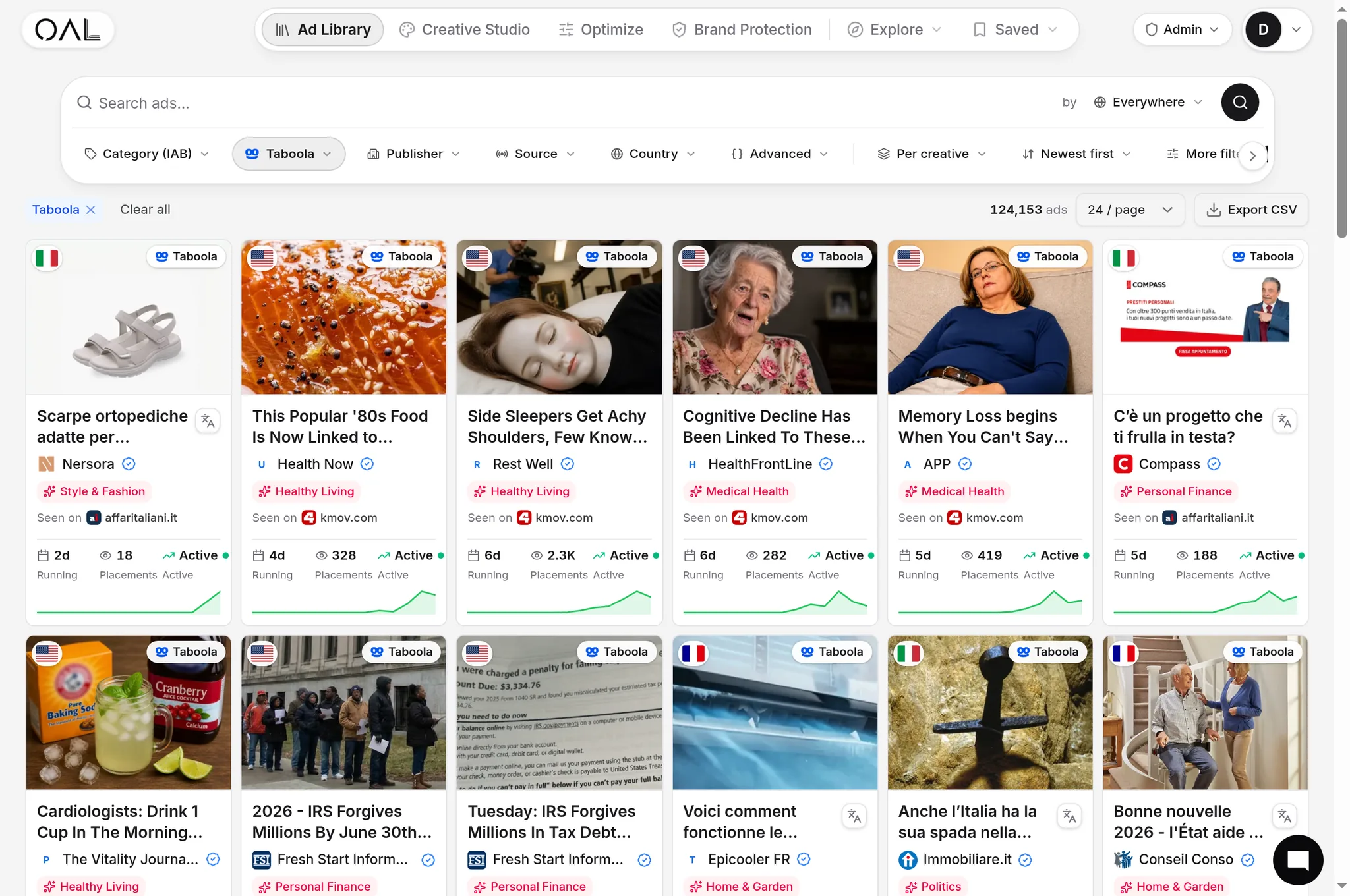
This is the research layer OpenAdLibrary exists for: the index holds 725,000+ live native creatives across 49 networks with 1.3 million+ captured landing pages (June 2026), searchable by vertical, network, geo, and runtime through the native ad spy tool. The free tier covers genuine pre-launch research — and next to a single failed $500 creative test, the premium tier pays for itself the first time it kills a bad idea before launch.
Pacing: how fast to spend the budget#
Two campaigns with identical budgets can have completely different outcomes purely on pacing. Spend $3,000 in four days and you have volume without decisions — conversions arrive after attribution delays, publisher patterns need days to separate signal from noise, and you will have burned the budget before learning which half was wasted. Spend the same $3,000 over five to six weeks and every week's data improves the next week's targeting.
Practitioners commonly run modest daily caps per campaign during testing — enough to clear a few hundred clicks a day across the creative set, no more — and hold the cap steady until a kill/keep decision is actually due. Resist the temptation to raise budgets on a good afternoon: daily noise in small samples is enormous, and native platforms' delivery algorithms need consistency to settle. The budget you planned in this article is a learning budget; its job is to be spent slowly enough to produce decisions and fast enough to reach them before motivation runs out. Four to eight weeks is the band most buyers report as realistic for a first verdict on an offer.
A lean starter plan#
- Pick one vertical with demonstrated native demand and one validated offer.
- Spend a week in the index before spending a dollar: collect long-running ads, extract angles, map competitor funnels.
- Choose one network matched to your budget tier and one geo.
- Launch 5–6 creatives against 1–2 pre-landers with full click tracking from day one.
- Kill creatives on CTR fast; judge landers and the offer only after real conversion volume.
- Prune publishers weekly; move spend toward what survives.
- Only scale — or add a second offer — once EPC beats CPC with room to spare.
The affiliates who fail at native mostly fail before launch: wrong budget expectations, no research, no tracking. Get those three right and $1,000–$5,000 is genuinely enough to find out whether native works for your offer — which is all a starting budget is for.