Español
 Português (Brasil)
 Français
 Deutsch
 Italiano
 Nederlands
 Polski
 Svenska
 Türkçe
 Русский
 日本語
日本語 한국어
한국어 简体中文
简体中文 Tiếng Việt
 Bahasa Indonesia
 繁體中文
繁體中文 Čeština
 Dansk
Dansk Norsk (bokmål)
 Suomi
Suomi Ελληνικά
 Română
 Magyar
 Українська
 ไทย
ไทย हिन्दी
 العربية
 עברית
עבריתBrand Protection in Native Advertising: A Practical Guide
Native ad networks are where brand impersonation, copycat landing pages, and cloaked offers thrive, because the creative blends into the article and the real advertiser hides behind redirect chains; here is how to monitor, detect, document, and escalate brand abuse with evidence that holds up.

Native is the hardest channel to police for brand abuse, and it is not close. On search and social, the ad sits in a clearly labeled slot and the advertiser is usually verified. In native, the entire point of the format is that the ad looks like the article around it: same fonts, same thumbnail grid, same "you may also like" framing. Add redirect chains that hide the real destination and creative approvals that can be gamed after the fact, and the native ecosystem becomes the path of least resistance for anyone who wants to ride on your brand without asking.
Here is the scale we are talking about. As of June 2026, OpenAdLibrary has captured 589,036 native creatives from 25,933 advertisers across 42 networks, with more than 5.4 million ad observations and 926,259 landing-page captures behind them. Finance, insurance, and health lead the pack (17,232, 15,629, and 14,895 creatives respectively), and those are exactly the verticals where impersonation pays best. If you run a brand of any size, your logo, your founder's face, and your highest-converting offers are almost certainly in that stream somewhere, used by someone who is not you.
The question is whether you can see it, prove it, and get it removed before it costs you customers, chargebacks, or a regulator's attention. This guide is the hub for doing that: the threat models, the detection methods, the evidence standard, and the escalation paths, with deeper articles linked at each step.
What brand protection in native advertising actually covers#
Brand protection in native advertising is the continuous practice of monitoring native ad networks for unauthorized use of your brand (impersonation, trademark misuse, copycat landing pages, cloaked offers) and documenting each instance with reproducible evidence so it can be escalated to the platform, registrar, payment processor, or regulator. Unlike protecting your own paid media, it points outward. You are surveilling the open ecosystem, not auditing your own account.
It helps to separate this from the disciplines it gets confused with. Brand safety is about keeping your ads away from bad content. Brand suitability is about contextual fit. Brand protection, the subject here, runs the opposite direction: it is about keeping bad actors away from your brand in their ads. The glossary entry on Brand Protection in Advertising draws those lines in full. If the terminology is new, start there and come back.
To monitor the channel you have to understand it. Native inventory is bought and sold programmatically through auctions, rendered into the recommendation grids you see at the bottom of articles, and trafficked across a long chain of SSPs, exchanges, and widgets. Each layer is a place abuse can hide, so the mechanics matter for detection. The glossary covers the moving parts: Native Advertising as a format, Programmatic Native Advertising as the buying model, the Native Ad Auction that decides which creative wins a slot, the Native Ad Widget that renders it on the publisher's page, and the broader machinery of Programmatic Advertising underneath it all.
The four threat models you are defending against#
Brand abuse in native is not one problem. It is four, and they need different detection signals and different escalation paths. Most real incidents combine several of them.
| Threat | What it looks like | Primary harm | Hardest part to prove |
|---|---|---|---|
| Brand impersonation | Your logo, name, or executive's face in a creative you didn't run | Customer deception, reputational damage | Linking the creative to a non-authorized advertiser |
| Trademark misuse | Your mark in headlines or display URLs by affiliates or competitors | Diluted brand, bid inflation, confusion | Distinguishing fair comparison from infringement |
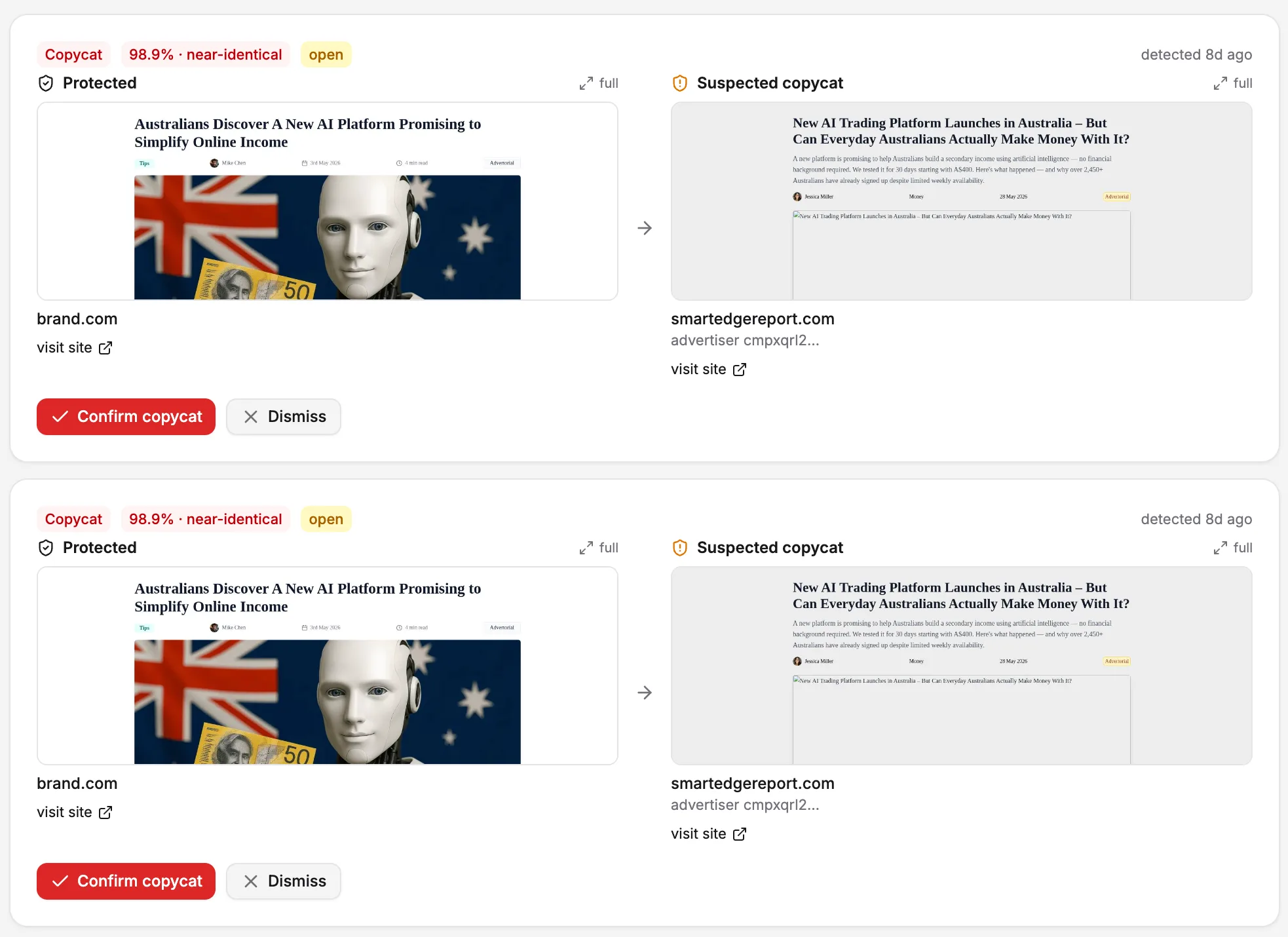
| Copycat landing pages | A cloned site behind the ad harvesting data or money | Direct financial fraud, chargebacks | Capturing the page before it is swapped |
| Cloaking | A clean page for reviewers, an abusive page for users | Evades platform review entirely | Reproducing the abusive variant on demand |
Look at what real native creative actually reads like and the threat models stop being abstract. Finance is the richest hunting ground for impersonation, and the live ads in our index show why.

That "IRS Forgives Millions" creative from an advertiser called Fresh Start Information had been running for 13 days when we captured it. It is not impersonating a brand, but it shows the exact template a scammer borrows: an authority signal (the IRS), a deadline, and a vague advertiser name you will not remember tomorrow. Swap "IRS" for your bank's logo and you have textbook impersonation.
Each threat has a dedicated playbook in this cluster. Brand impersonation and trademark abuse overlap but are legally distinct, and the latter has its own detection-and-documentation guide in Trademark Infringement in Ads, which covers fair-use comparison advertising versus genuine infringement and how to build a case a platform will act on. The fraud layer underneath impersonation is dissected in Copycat Landing Pages, which walks through how scammers clone brand sites in native funnels and the signatures that separate a clone from your real property.
The most dangerous abuse is the kind you cannot see by clicking the ad yourself. If the bad actor only serves the abusive variant to mobile users in one country at a certain time of day, your manual spot-check shows a clean page every time, and the abuse runs for months.
That is why cloaking deserves its own treatment. The standard scam shows reviewers and brand-protection teams an innocuous page while users get routed to the real, harmful destination. Defeating it is not about clicking harder. It is about reproducible, condition-specific capture and an evidence trail the abuser cannot wave away. Ad Cloaking: How It Works and How Auditable Evidence Exposes It is the deep dive on the technique and the counter-technique.
How to detect brand abuse at scale#
Manual monitoring does not work in native, and it is worth being honest about why. There is no single "native ad library" you can search the way you would search a social platform's ad center. Inventory is fragmented across networks, creatives rotate constantly, and the same advertiser will run dozens of variants to dodge pattern-matching. By the time you stumble across an impersonation ad organically, it has usually been running long enough to do damage.
Effective detection rests on four capabilities working together.
- Broad live capture. You need ads pulled from across the major native networks continuously, not a one-time scrape. To put the breadth in context: Taboola alone accounts for 157,727 creatives in our index, Outbrain another 84,252, and MGID 49,689. Abuse that runs for three days and disappears is invisible to anything slower.
- The real creative, at full quality. A thumbnail is not evidence. You need the actual creative image as served, because the logo, the fake headline, and the deceptive framing are the infringement.
- Supply-chain classification. Knowing which network served the ad, and which advertiser account is behind it, is what lets you separate authorized partners and affiliates from impostors. Without advertiser identity, every flagged ad is just a screenshot.
- Click-path resolution to the landing page. The creative is half the story. You have to follow the click, through any redirect chain, to the destination, because that is where impersonation becomes fraud. This has to happen without clicking live ads in a way that charges the advertiser or trips bot defenses.
Health is the category where the deceptive-framing problem is most visible, and it is the third-largest vertical we track. Two live Taboola health ads make the pattern obvious.


The "Americans Are Ditching Hearing Aids" ad from Nebroo had been live for 26 days when we caught it. The "MDs Identify 10 Medications" creative from Vital Guardian was only three days old. Same playbook, different stage of its life. A health brand watching this category needs both: the long-runner that has quietly been scaling, and the fresh launch that has not had time to do damage yet.
This is the gap a purpose-built native ad spy tool is meant to close. OpenAdLibrary captures live public native ads across those networks, stores the real creative image at full quality, classifies the ad-tech supply chain behind each placement, and traces each click to the advertiser's landing page or pre-lander, all without clicking the live ad. For brand protection, that turns "did anyone misuse our brand this month?" from a manual hunt into a searchable query. Search your brand name, your executives' names, and your product names across both creatives and landing-page domains, then filter to advertisers that are not on your authorized list.
There is a defensive bonus. The same longevity signals competitive-intelligence teams use to spot winning campaigns also flag abuse. In our index, the longest continuously observed creatives have been running for 28 straight days (we currently track up to about four weeks of unbroken observation per creative), and they are exactly the ads you would want to know about if they carried your brand. A SmartAsset finance ad ("How Can I Avoid Paying Taxes on IRA Withdrawals?") and a cluster of "My IQ" quiz creatives both sit at that 28-day ceiling. An ad using your brand that has been running that long across dozens of publishers is either an authorized campaign you forgot about or an industrialized impersonation operation. Both are worth knowing about immediately.
A practical weekly monitoring routine#
You do not need a security operations center to run competent brand protection. A disciplined weekly cadence catches the vast majority of abuse.
- Brand-term sweep. Search your brand, sub-brands, product names, and executive names across native creatives and landing-page domains. Flag any advertiser you do not recognize.
- Logo and likeness check. Scan creatives in your category for your logo or an executive's face. Impersonators reuse a small library of stolen assets, so this is high-yield.
- Lookalike domain watch. Watch for landing-page domains that are typosquats or close variants of your real domain. That is the classic copycat signature.
- Affiliate boundary audit. Confirm your affiliates are bidding within agreed brand-term rules. Trademark "misuse" is frequently your own partners breaking policy, not strangers.
- Geo and device spread review. For any flagged advertiser, check which geographies and devices the ad targeted. Narrow, unusual targeting is a cloaking tell.
The evidence standard: documentation that survives a dispute#
Detection without documentation is a complaint nobody acts on. The single biggest reason brand-protection escalations stall is that the evidence is a lone screenshot, which the abuser dismisses as faked or out of date and which the platform cannot independently verify. Auditable evidence is the difference between a takedown in days and a ticket that rots in a queue.
A complete evidence package for a single infringing native ad contains:
- The creative image at full quality, exactly as served.
- The headline and ad copy, verbatim.
- The publisher and widget where it ran, and the network serving it.
- The advertiser identity as classified from the supply chain.
- The full redirect chain from click to destination.
- The landing-page URL and screenshot, captured under the same conditions a real user would experience.
- The geos and devices the ad targeted, which is essential for proving cloaking.
- Timestamps throughout, so the record is reproducible rather than anecdotal.
The point of insisting on this standard is that it pre-empts every objection. A reviewer shown a creative, the serving network, the redirect chain, and the cloaked destination cannot claim "we can't reproduce that." A registrar looking at a typosquatted copycat domain with a captured clone of your site has a clear-cut case. The step-by-step mechanics of assembling this package, and the specific channels for each network and authority, are laid out in How to Report a Scam Ad (And Document the Evidence).
Escalation: who to tell, and in what order#
Once you have a documented case, escalation is mostly sequencing. Hit the channels that move fastest for your specific threat first, and run the slower legal tracks in parallel rather than waiting.
- The native network's trust-and-safety team. This is the fastest lever for impersonation and cloaking. The network can suspend the advertiser account and pull every associated creative at once, not just the one you found.
- The publisher, when a specific high-traffic placement is doing outsized damage and you want it down while the network investigates.
- The domain registrar and hosting provider, for copycat landing pages. Abuse and phishing reports against a cloned site are often the quickest way to kill the funnel even if the ad keeps running.
- The payment processor, when the copycat is harvesting card details or running a subscription trap. Processors act decisively on documented fraud because they own the chargeback risk.
- Regulators and your legal team, for trademark enforcement and pattern abuse. This is where your accumulated, timestamped evidence record pays off.
The regulatory backdrop is moving in your favor. Under the EU's Digital Services Act, very large online platforms must maintain public ad repositories disclosing what is being promoted, who paid, the period it ran, and how it was targeted, and enforcement has teeth, including a substantial fine against X over a non-compliant ad repository. In the US, the FTC's standard is that an ad must not imply it is anything other than an ad, and its updated endorsement and review rules raise the bar on deceptive formats. The direction of travel is more public disclosure of advertising, not less, which means brand-protection teams who already capture and document native ads are aligned with where the law is heading.
Where brand protection meets competitive intelligence#
The infrastructure you build to defend your brand is the same infrastructure that tells you what is working in your market. Once you are capturing live native ads, resolving advertiser identity, and tracing clicks to landing pages, you have a competitive-intelligence platform whether you intended one or not.
That dual use is deliberate. The same capture-and-trace pipeline that surfaces an impersonator surfaces a competitor's new winning angle. The longevity and spread signals that flag industrialized abuse also reveal which offers are scaling.

That Honda City placement is a clean, legitimate brand ad, and that contrast is the whole point. The same query that pulls a real Honda campaign pulls the impostors trading on Honda's name. Tools like Creative Studio, Optimize, Copy DNA, and the API and MCP integrations exist so the data you collect for defense feeds straight into offense: finding the real advertiser behind an ad, seeing the pre-lander it routes to, and understanding why a campaign is sticking. For most teams, brand protection is the reason they start watching the native ecosystem, and competitive intelligence is the reason they never stop.
It is open and affordable by design. Legacy native intelligence and brand-protection suites run from roughly $80 to $400 a month and lock their data behind enterprise contracts. OpenAdLibrary is the open, low-cost alternative: a free tier lets you browse 200 ads with no card, and full access is $29.99 a month, because brand protection should not be a luxury reserved for companies with a dedicated trust-and-safety budget.
Build the habit before you need it#
The brands that handle impersonation well are not the ones with the best lawyers. They are the ones who were already watching. By the time a copycat funnel is draining your conversions or a fake-news creative with your founder's face is circulating, the difference between a two-day takedown and a two-month ordeal is whether you had a capture record in place beforehand. Set up the weekly sweep, hold every flagged ad to the auditable-evidence standard, and keep the escalation paths warm. The work compounds: every documented case makes the next one faster, and the same data quietly tells you what your market is doing.
Start by getting eyes on the native ecosystem. Start free, browse 200 live native ads with no card, search your brand across creatives and landing pages, and see who is already using it.