
 Español
 Português (Brasil)
 Français
 Deutsch
 Italiano
 Nederlands
 Polski
 Svenska
 Türkçe
 Русский
 日本語
日本語 한국어
한국어 简体中文
简体中文 Tiếng Việt
 Bahasa Indonesia
 繁體中文
繁體中文 Čeština
 Dansk
Dansk Suomi
Suomi Ελληνικά
 Română
 Magyar
 Українська
 ไทย
ไทย हिन्दी
 العربية
 עברית
עבריתWhere Do Taboola Ads Appear? The Publisher Network Mapped
Taboola doesn't publish its publisher list — but the network is mappable. The site tiers, the page placements, and three ways to check any website in under a minute.


Taboola ads appear on publisher websites — mostly news, entertainment, sports, weather, finance and lifestyle sites — as "Sponsored" or "You May Like" content-recommendation widgets placed below articles, inside article bodies, and in homepage feeds. The roster runs from premium publishers under publicly announced partnerships (Yahoo signed a 30-year exclusive deal for Taboola to power native ads across its properties in 2022) down to thousands of mid-tier and long-tail content sites. Taboola does not publish a complete site list, but you can map its network yourself: check a page's widget byline, its source code, or its ads.txt file — or work backwards from a live ad index that records where creatives were actually observed.
The three tiers of Taboola publishers#
Thinking of Taboola's supply as one thing is the first mistake advertisers make. In practice the network breaks into three tiers, and they behave very differently.
Premium news anchors#
Taboola's business is built on multi-year, often exclusive deals with large publishers. The most visible is Yahoo: the 30-year agreement announced in 2022 makes Taboola the native advertising engine across Yahoo's digital properties — mail, news, sports and finance surfaces with enormous logged-in audiences. Beyond Yahoo, Taboola has historically anchored itself with major national news brands and broadcaster sites in the US, UK, Germany, Japan and other Tier-1 markets. Publishers sign these deals because the feed widget is one of the highest-RPM units on the page and requires no sales team on their side.
For advertisers, premium anchors mean scale and mainstream audiences — but also the widest range of visitor intent. Someone checking their email is not in the same mindset as someone reading a product review.
Mid-tier magazines, local news and niche content#
Below the anchors sits a broad middle: regional news groups, special-interest magazines, hobbyist sites, health and finance content brands. These placements are where a lot of native campaigns quietly make their money — audiences are more contextually aligned (a gardening offer inside a gardening site), competition per impression is lower, and CPCs tend to be friendlier than on flagship news homepages.
The long tail#
Finally there is the long tail: smaller content sites, viral-slideshow domains and traffic arbitrage operations that buy visitors cheaply and monetize them with recommendation widgets. Volume here can be huge and cheap, but quality varies wildly — this is the tier that fills placement reports with sites you have never heard of, and the reason experienced buyers watch site-level data from day one.
Where Taboola units sit on the page#
Site identity is only half the answer; the unit's position on the page changes everything about the click you get.
- Below-article feed — the classic unit, an endless grid or feed under the article body. Highest volume. Readers arrive at it after finishing (or abandoning) the content, so curiosity-driven headlines dominate.
- Mid-article units — inserted between paragraphs. They interrupt active reading, which usually means higher visibility but choosier clicks.
- Right rail / sidebar — persistent thumbnail stacks on desktop layouts. Lower CTR, steady volume.
- In-feed placements — sponsored items woven into homepage and section-front feeds, styled like editorial links. See the in-feed ad glossary entry for how these differ from widget units.
All of these render from the same content recommendation widget infrastructure, and the "Promoted" or "by Taboola" disclosure is what tells you whose ad you are looking at.
How to check whether a specific site runs Taboola#
You do not need any tool to verify a single site. Three checks, in increasing order of rigor:
- Read the widget byline. Scroll to the recommendation grid and look for the attribution text — Taboola units carry a "by Taboola" label (wording varies by market and template). This is the fastest check but can miss sites that only serve Taboola in some geos or on some templates.
- View the page source. Search the HTML for
taboola— publisher pages that carry the network load its loader script from Taboola's CDN and initialize a_taboolaobject. If it is in the source, the relationship exists even when a widget did not render for you. - Check ads.txt. Fetch
example.com/ads.txtand look fortaboola.comlines. The ads.txt file is the publisher's own declaration of who may sell its inventory, so this catches direct relationships and resold paths alike — and it works even when widgets are geo-targeted away from you.
If you are starting from an ad rather than a site — you saw a competitor's creative somewhere and want to know what network served it — reverse the process with the steps in how to identify the ad network behind any ad.
What advertisers see: the site dimension#
Once you run campaigns, the map stops being abstract. Taboola's campaign reporting breaks performance out by site, with each publisher identified by name and a site ID. Two things surprise first-time buyers:
- How long the list gets. A run-of-network campaign in a Tier-1 geo can accumulate hundreds of distinct placements within days.
- How steep the variance is. A handful of sites typically drive most of the spend, and conversion rates between placements on the same campaign can differ by an order of magnitude. Identical creative, identical audience targeting — completely different economics.
That variance is why placement-level management (blocking junk sites, bidding up proven ones) is where most of the optimization work in native media buying actually happens, and why the site dimension is the first report worth checking daily on any native campaign.
Mapping Taboola's footprint with live ad data#
The checks above answer "does this one site run Taboola?" The inverse question — "where is this advertiser's Taboola campaign actually running, and what is running at scale across the network?" — needs observation at scale.
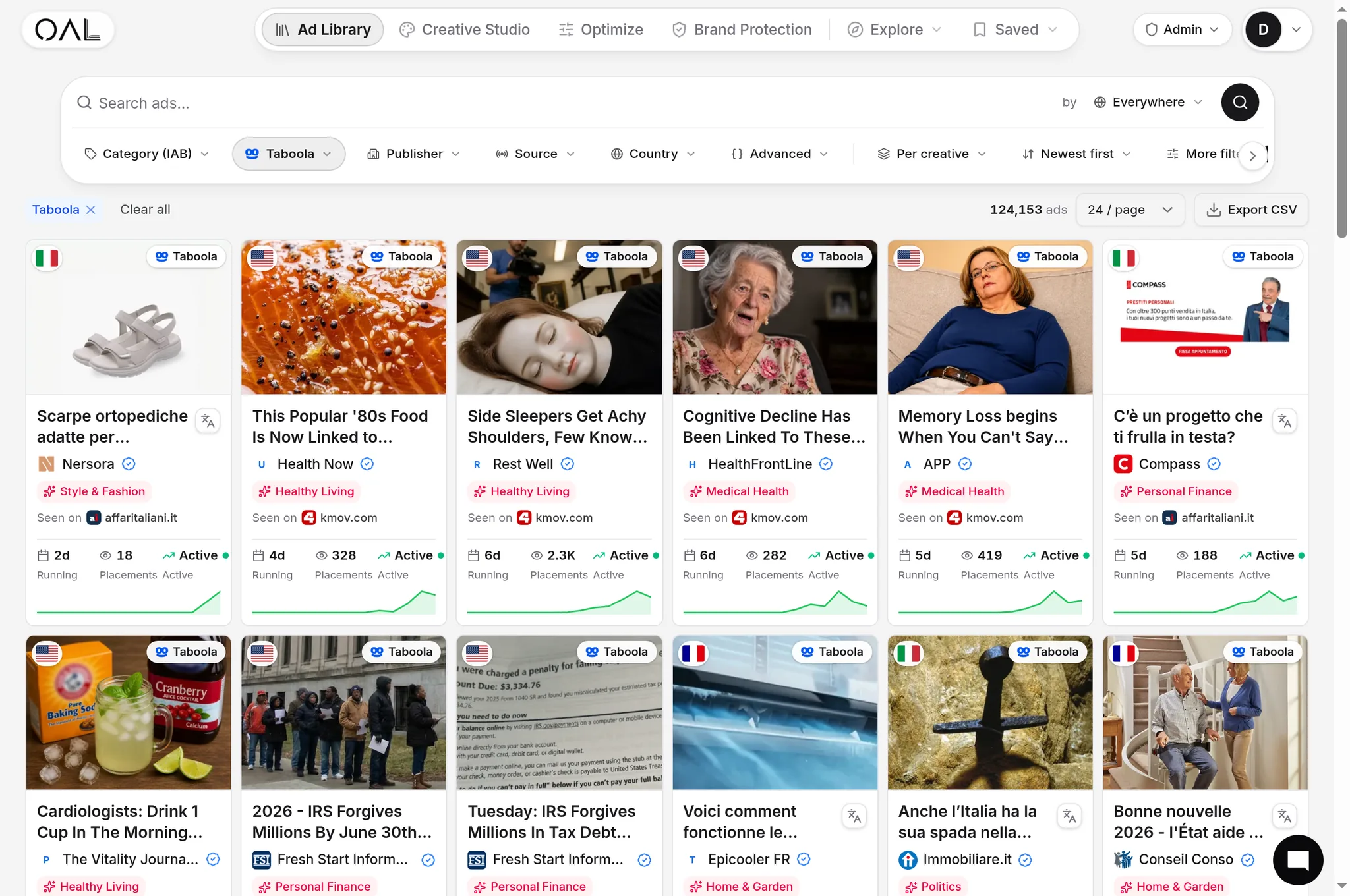
That is what an independent ad index does. OpenAdLibrary continuously captures live native placements across publisher pages and traces each ad's supply chain — the mechanics are documented in the native ad supply chain, explained. As of July 2026 the index holds 206,000+ live Taboola creatives inside a total corpus of 725,000+ native creatives across 49 networks, built from 6.8 million+ individual ad observations. Every observation ties a creative to its capture context — network, geo and device — so you can see not just that an ad exists but where and how it was served. You can browse the Taboola corpus directly at /spy/taboola, or start from the Taboola ad library overview for what each record contains.
The footprint is geo-specific#
One subtlety that breaks naive site lists: Taboola's effective footprint differs by country. A publisher may serve Taboola widgets to its US visitors and a different monetization stack elsewhere; exclusive deals are often market-specific; and campaign delivery concentrates wherever your target geo's supply actually lives. Practical consequences:
- A site that "runs Taboola" when checked from New York may show you nothing from Sydney — which is why the ads.txt method beats eyeballing for verification.
- The placement list your campaign accumulates in Germany will look almost nothing like the same campaign's list in the UK. Budget planning that assumes one global site mix gets surprised twice.
- Long-tail supply grows as you move down geo tiers: Tier-1 campaigns lean harder on premium anchors, while cheaper geos fill with smaller content domains.
If you buy in multiple markets, map the footprint per market. It is the same twenty minutes of work per geo, and it prevents the classic mistake of copying a placement block list from one country's campaign into another's.
Why the site answer matters more than it looks#
"What sites use Taboola" sounds like trivia, but it decides real money questions:
- For advertisers, the publisher mix defines the audience you are buying. A network anchored by mainstream news and mail portals delivers older, broader, desktop-heavy traffic than social feeds do — which is exactly why certain verticals (insurance, finance, health, home) dominate native while others never crack it.
- For competitor research, placement context explains creative strategy. The same advertiser will run curiosity angles into long-tail feeds and straighter product angles on premium sites. The Taboola ad spy guide covers how to read a competitor's Taboola presence end to end.
- For publishers, the tiers above are the honest benchmark: what a recommendation widget pays depends on which tier your traffic resembles, not on the network's headline partners.
The network's roster shifts constantly — publishers join, leave and renegotiate — so treat any static list as stale on arrival. The durable skill is knowing how to check: byline, source, ads.txt, and a live index for the aggregate view. For the advertiser side of the same map, see who advertises on Taboola.