Español
 Português (Brasil)
 Français
 Deutsch
 Italiano
 Nederlands
 Polski
 Svenska
 Türkçe
 Русский
 日本語
日本語 한국어
한국어 简体中文
简体中文 Tiếng Việt
 Bahasa Indonesia
 繁體中文
繁體中文 Čeština
 Dansk
Dansk Norsk (bokmål)
 Suomi
Suomi Ελληνικά
 Română
 Magyar
 Українська
 ไทย
ไทย हिन्दी
 العربية
 עברית
עבריתHow to Advertise on MGID: Campaign Setup, Moderation & First-Week Playbook
A practitioner's walkthrough of launching on MGID: account funding, campaign targeting, the moderation rules that trip up new buyers, and a day-by-day first-week playbook.


To advertise on MGID you create a self-serve advertiser account, fund it (minimum deposits are commonly reported in the low hundreds of dollars — confirm current terms at signup), build a campaign with geo, device, and browser targeting, upload teaser creatives, pass moderation, and set per-geo CPC bids. Your ads then serve across MGID's network of publisher widgets, and the first week is spent cutting weak placements and iterating creatives while conversion data accumulates. This guide walks through each step, the moderation rules that trip up new buyers, and a day-by-day playbook for the first week — the stretch where most new MGID accounts either find signal or burn the deposit learning nothing.
What you're actually buying on MGID#
MGID sells clicks from content-recommendation widgets embedded on publisher sites — the grids of image-plus-headline teasers below and beside articles. When your bid wins, your teaser renders in those widgets; you pay per click. How MGID works covers the network's formats and pricing model in detail; the short version for a new buyer:
- Supply skews global. MGID's publisher network is genuinely worldwide, with unusual depth in Tier-2 and Tier-3 geos and non-English markets — the index captures MGID creatives running in Greek, among many other languages. If your offer works outside the US/UK/CA/AU core, MGID is one of the few networks with real supply there.
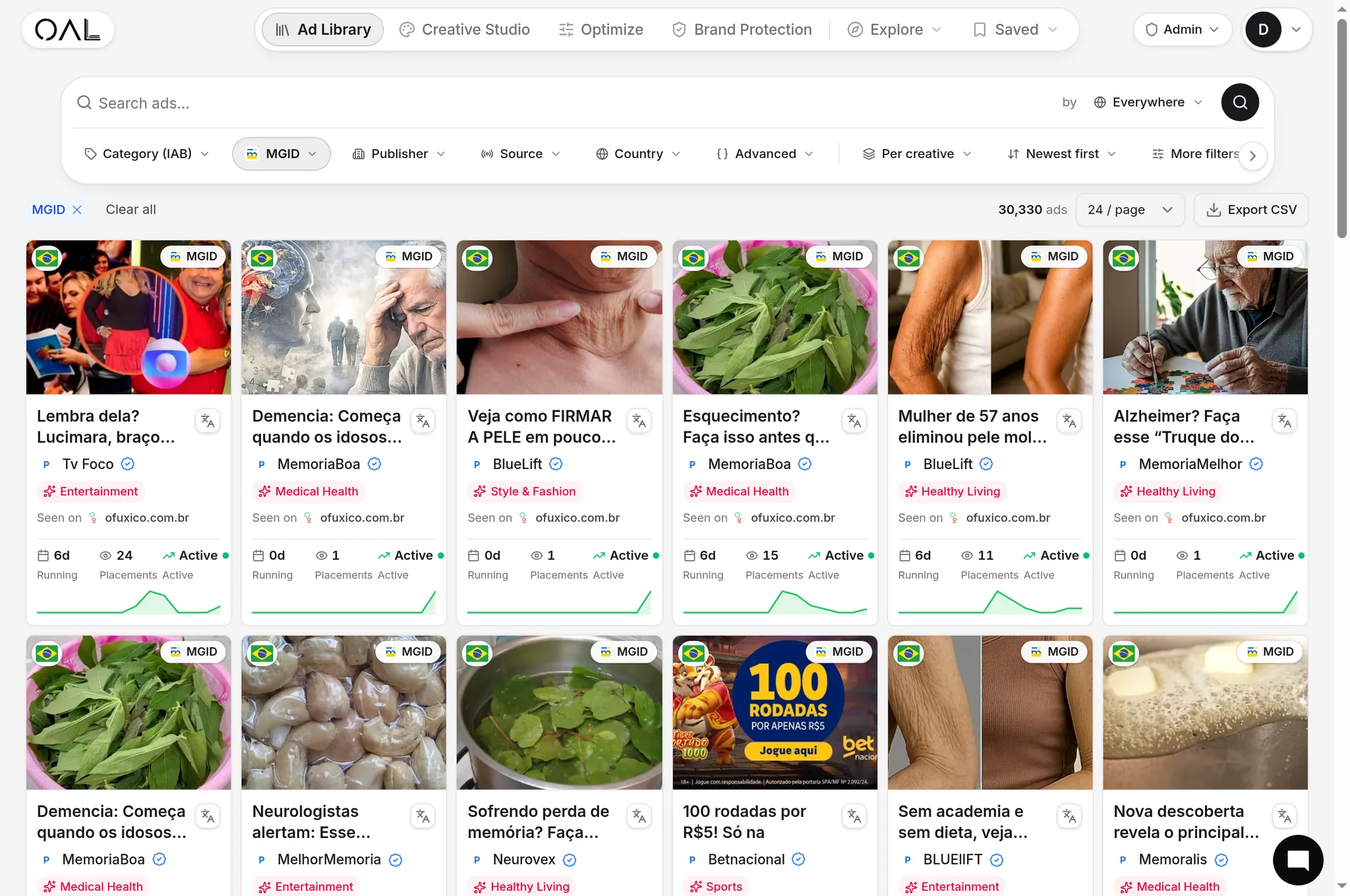
- The creative register is curiosity-led. In OpenAdLibrary's index, 62,765 live MGID creatives were being tracked as of June 2026, and entertainment-style content dominates the classified mix (13,987 creatives — more than the next five verticals combined). Story hooks, curiosity gaps, and advertorial-style teasers are the native language of this supply.
- The advertiser mix is wider than its reputation. Live MGID creatives in the index range from classic health advertorials ("Doctors Call It 'Nature's Morphine'" — live 16 days when captured) and skincare angles ("Everyone Lotions Crepe Skin. Koreans Do This Instead") to discount ecommerce and even B2B lead generation — a marketing-audit ad targeting business owners was running in the same widgets as the nutra offers. The network rewards whoever adapts to the teaser format, not one vertical.
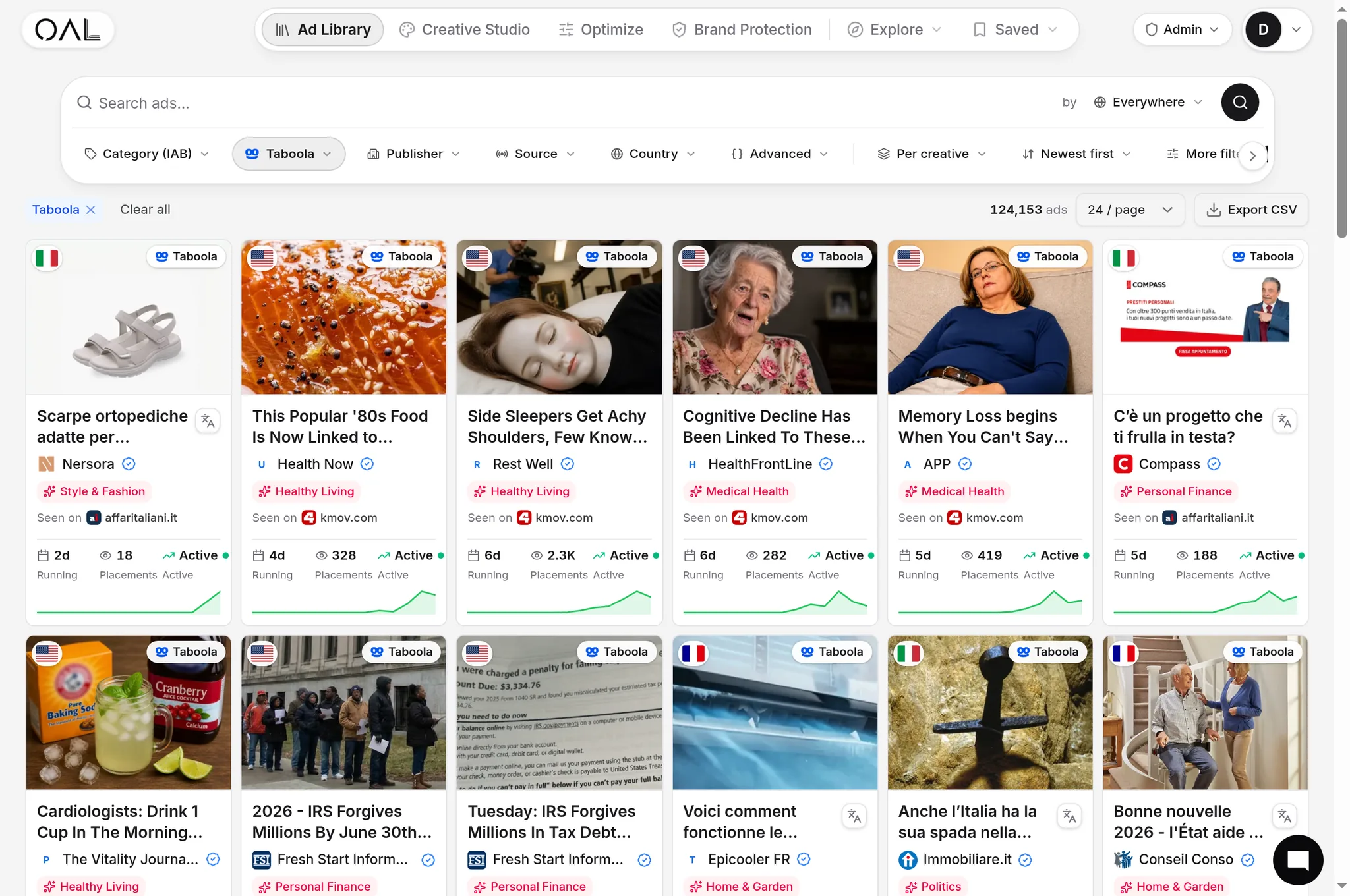
Media buyers commonly pair MGID against the premium networks as the low-floor, fast-iteration option: cheaper clicks and looser moderation than Taboola or Outbrain, with placement quality variance as the trade. MGID vs Taboola covers when each wins. The variance point deserves emphasis: because MGID's publisher bar is lower, the gap between its best placements and its worst is wider than on premium networks — which is precisely why the optimization loop described below revolves around placement-level data rather than campaign averages.
Step 0: research before you deposit#
Do not fund an account to find out what works on MGID — the network's live ads are public and searchable. Spend an hour in the MGID ad library before you spend a dollar:
- Filter to your vertical and target geo, and read every teaser that has been running two weeks or more. Longevity is the strongest public profitability signal — nobody pays for a losing MGID campaign for three weeks.
- Note the angle families, image styles, and headline structures that recur among long-runners. That recurrence is the market telling you what this supply responds to.
- Follow the landing pages. Are winners sending traffic to advertorial pre-landers or direct to offer pages? Match your funnel to what survives.
- Check competitor density: how many advertisers run your exact offer type in your geo? A crowded field means proven demand and higher bids; an empty one means either opportunity or a graveyard.
The MGID spy tool gives you the live view of all of this — creatives, advertisers, run duration, and traced landing pages.
Account setup and funding#
Signup is self-serve at MGID's advertiser portal: register, verify the account, and deposit. Three practical notes:
- Minimum deposit. Commonly reported in the low hundreds of dollars; the exact figure and available payment methods vary by region and change over time, so treat the signup page as the source of truth.
- Account managers. MGID assigns human support as spend grows; at meaningful budgets you get an account manager who can whitelist placements, advise on geo bids, and expedite moderation. Early on, you are mostly self-serve — plan accordingly.
- Budget reality. Plan a test budget that can survive learning. Native traffic needs volume before placement-level data means anything; a deposit that only buys a few hundred clicks will end ambiguous. Media buyers commonly size first tests so each creative can collect at least a few thousand impressions per placement group before judgment.
- Geo choice shapes the budget. The same deposit buys dramatically more clicks — and therefore more learning — in Tier-2/3 geos than in the US. If your offer pays out internationally, many buyers deliberately run their first MGID test in a cheaper geo to debug the funnel and creative approach, then carry the validated angle into Tier-1 where each click costs multiples more.
Campaign setup, step by step#
MGID's campaign builder is straightforward; the decisions that matter are these:
- Campaign goal and funnel shape. Decide before building: direct-to-offer, or through an advertorial pre-lander? On curiosity-led widget traffic, cold offers almost always convert better behind a pre-lander that bridges the teaser's story to the offer's pitch.
- Geo and language. Target one geo per campaign (or a tight cluster sharing a language), and match creative language to the geo exactly — an English teaser in a non-English geo wastes spend even when the network allows it. If you are new to non-Tier-1 buying, the geo-tier framework explains how supply, CPCs, and payout economics shift across tiers.
- Device, OS, and browser targeting. Split desktop and mobile into separate campaigns from day one — bids, CTRs, and conversion rates differ enough that a blended campaign hides the truth. OS and browser filters matter mostly for app and sweepstake funnels; leave them broad otherwise.
- Schedule. Run 24/7 for the first days unless your offer has a hard conversion window (call centers, COD verticals). Daypart later, from your own data, not from folklore.
- Budget caps. Set a daily cap you can sustain for a week of learning. A cap that exhausts by 9 a.m. samples only morning traffic and skews every placement metric you will optimize with.
- CPC bid. MGID bids are per-geo CPC. Media buyers commonly report MGID clicks from a few cents in Tier-3 geos to a few tens of cents in Tier-1 — but the range is wide, your vertical and creative CTR move it a lot, and any published number is a starting point rather than a benchmark. Practical approach: start near the platform's suggested bid, watch delivery, and adjust in small steps — underbidding buys only the placements nobody else wants.
Creatives and moderation#
Your teaser is an image plus a headline (and a short description in some placements). What to know before you upload:
- Make it native to the widget. The winning register on MGID is editorial-adjacent: photographic images with a clear focal subject, headlines that open a specific curiosity gap. Study the headline formulas that recur across native ads and write ten variants per angle — teaser CTR differences of 2–3× between variants of the same angle are normal, and you cannot predict the winner.
- Moderation reviews every creative and its landing page before serving. Commonly reported turnaround is within a business day; regulated verticals and new accounts can take longer.
- The predictable rejections: medical cure claims and prohibited health language; implied celebrity endorsement; before/after imagery in restricted categories; adult or shock imagery outside the geos and categories where it is permitted; landing pages that mismatch the teaser's promise; missing sponsored-content disclosure on advertorial pre-landers. MGID is more permissive than the premium networks, not permissionless — geo-specific rules matter, and the fastest way to a smooth account is a funnel that would survive scrutiny anywhere.
- Rejected creatives are editable and resubmittable. Read the stated reason, fix that thing, resubmit. Repeated borderline submissions slow review on everything you upload.
Tracking: do not launch blind#
Widget traffic optimization lives and dies on placement-level conversion data, which means tracking is not optional infrastructure — it is the product you are buying with your test budget:
- Pass MGID's click-ID macro into your tracker or analytics on every click, so each conversion can be attributed to the exact placement and creative that produced it.
- Fire conversions back via a postback URL (server-to-server) rather than relying on pixels alone — widget traffic hits enough privacy-restricted browsers that pixel-only tracking undercounts.
- UTM-tag everything as a fallback layer, and verify the whole chain — click, redirect, landing, conversion — with a test conversion before the campaign goes live.
The first-week playbook#
The first week is a data-collection exercise with a budget attached. Day by day:
- Days 1–2: launch broad, resist judgment. One geo, one device type, 5–10 creative variants across 2–3 angles, bid near suggested. Let placements accumulate spend. Do not pause anything yet — early placement metrics are noise.
- Days 3–4: cut the obvious losers. Blacklist placements with meaningful spend and zero engagement — the widget equivalent of weeding. How whitelists and blacklists work covers the mechanics; the discipline is cutting on sufficient data, not on vibes. Kill creatives whose CTR sits far below your account average; ship new variants of whatever angle leads.
- Days 5–6: feed the winners. Nudge bids up on placements that convert; keep pruning the spend-no-convert tail. If one angle clearly leads, build its next iteration generation — same angle, new images, new headline structures.
- Day 7: decide. If cost-per-conversion is within striking distance of target with an improving trend, the campaign has earned week two: consider a whitelist campaign of proven placements alongside the broad one, then widen geos deliberately — the geo-expansion playbook covers cloning campaigns into new tiers without resetting your learning. If nothing converts after a fair test, the problem is almost always the funnel (teaser-to-lander mismatch, weak pre-lander, slow page), not the traffic switch — fix the funnel before buying more clicks.
Reading week-one metrics: what good actually looks like#
New buyers consistently misread MGID's early numbers because widget traffic behaves differently from search or social. Calibration points:
- Teaser CTR is a relative metric, not an absolute one. Widget CTRs are low by social-ads standards — that is normal for the format. What matters is the spread between your creatives: a variant meaningfully outperforming your account average is a winner regardless of what the absolute number is, and a 2–3× spread between best and worst variants of the same angle is expected, not a problem.
- Placement spread is the real report. Expect a long tail: a modest set of placements will drive most spend, and conversion quality between two placements with identical CTRs can differ enormously. This is why placement-level attribution is non-negotiable — the campaign-level average is a fiction assembled from great and terrible widgets.
- Cheap clicks that never convert are the signature of junk placements, not of a broken offer. High CTR plus near-zero site engagement (instant bounce, zero scroll) from a specific placement means cut the placement; the same pattern account-wide means check your tracking before concluding anything.
- Conversion lag is real. Advertorial funnels commonly convert hours after the click, and postbacks arrive on their own schedule. Evaluate yesterday's traffic, not the last hour's.
- Volume gates every judgment. A placement with a handful of clicks has told you nothing. Set minimum-spend thresholds for decisions (a multiple of your target cost per conversion is the common heuristic) and hold to them even when the early pattern looks dramatic — especially when it looks dramatic.
If after a fair week the account shows a normal placement spread, a creative leader, and conversions arriving at a cost within sight of target, you have a workable base. From there the operation is pruning, feeding winners, and expanding — the same loop, run weekly.
The mistakes that burn first deposits#
The same failure modes account for most abandoned MGID accounts:
- Judging in 24 hours. Native placement data needs days to mean anything; day-one panic optimization locks in noise.
- One creative. A single teaser gives moderation one chance to say no and gives you zero information about angles.
- No tracker. Without placement-level conversion attribution, week one produces spend and no learning — the most expensive possible outcome.
- Cold offer pages. Sending curiosity-click traffic straight to a product page built for search intent; bridge it with a pre-lander.
- Language mismatch. English creative in non-English geos because the campaign builder allowed it.
- Chasing the cheapest clicks. The lowest-CPC placements in any geo include the network's junk tail; judge placements on conversion, never on click price.
- Scaling on day 3. Doubling budget before placement data stabilizes just doubles the noise.
MGID rewards the boring fundamentals: research the live ads before depositing, launch with enough creative variants to learn, track at placement level, cut with discipline, and scale only what the data has already proven. Buyers who run that loop commonly find MGID one of the cheapest places in native to develop a winning funnel — and the ad library means you never have to develop it from a blank page.