 Español
 Português (Brasil)
 Français
 Deutsch
 Italiano
 Nederlands
 Polski
 Svenska
 Türkçe
 Русский
 日本語
日本語 한국어
한국어 简体中文
简体中文 Tiếng Việt
 Bahasa Indonesia
 繁體中文
繁體中文 Čeština
 Dansk
Dansk Suomi
Suomi Ελληνικά
 Română
 Magyar
 Українська
 ไทย
ไทย हिन्दी
 العربية
 עברית
עבריתBest Native Ad Networks for Ecommerce in 2026
Taboola, Teads (Outbrain), MGID, and Revcontent each reward different ecommerce categories and margins, and our June 2026 capture data shows exactly where your product type actually has demand before you spend a dollar.


Most "best native ad network" lists rank platforms by reach and stop there. For ecommerce that ordering is close to useless. The network that prints money for a $9 supplement offer is rarely the one that scales a $180 skincare subscription. The question you actually need answered is not "which network is biggest." It is "which network already has profitable demand for products like mine, at a CPC my margin can absorb."
This guide answers that the way a media buyer works in practice: network by network, mapped to the direct-to-consumer (DTC) categories that are genuinely active on each, the advertiser profiles that scale there, and the economics you should expect before you commit a test budget. We're going to back the claims with our own capture data, because we run the index: 589,036 creatives, 25,933 advertisers, and 5.4 million ad observations across 42 networks as of June 2026. This pairs with our pillar ranking, Best Native Ad Networks in 2026 (Ranked by Real Ad Volume), which orders the same platforms by live ad volume rather than by ecommerce fit.
The short answer#
For ecommerce in 2026, Taboola (now powering Yahoo's properties) and Teads, the merged Outbrain brand, win for higher-AOV, higher-consideration DTC products that can absorb premium CPCs. MGID and Revcontent remain the testing grounds for thin-margin, supplement-style, and dropshipping offers thanks to lower minimums and cheaper clicks. Match the network to your margin and your category, not to its raw reach.
One number to keep in your head before we go deeper: ecommerce is the 4th-largest vertical across our entire index (13,872 creatives), but it sits behind Finance (17,232), Insurance (15,629), and Health (14,895). Native ad inventory is built first for lead-gen verticals. Product sellers are buying space in a system optimized for someone else's funnel. That shapes everything below.
How to read this list (the only three variables that matter)#
Before the network breakdown, three factors decide fit for ecommerce. Everything else is noise.
- Margin tolerance. Native CPCs vary widely by platform and geo. A high-margin DTC brand can profitably outbid a dropshipper for the same placement. A thin-margin store cannot. Your CPC ceiling is set by your contribution margin per conversion, not by the network's rate card. We break the numbers down in How Much Do Native Ads Cost? A 2026 Budgeting Guide.
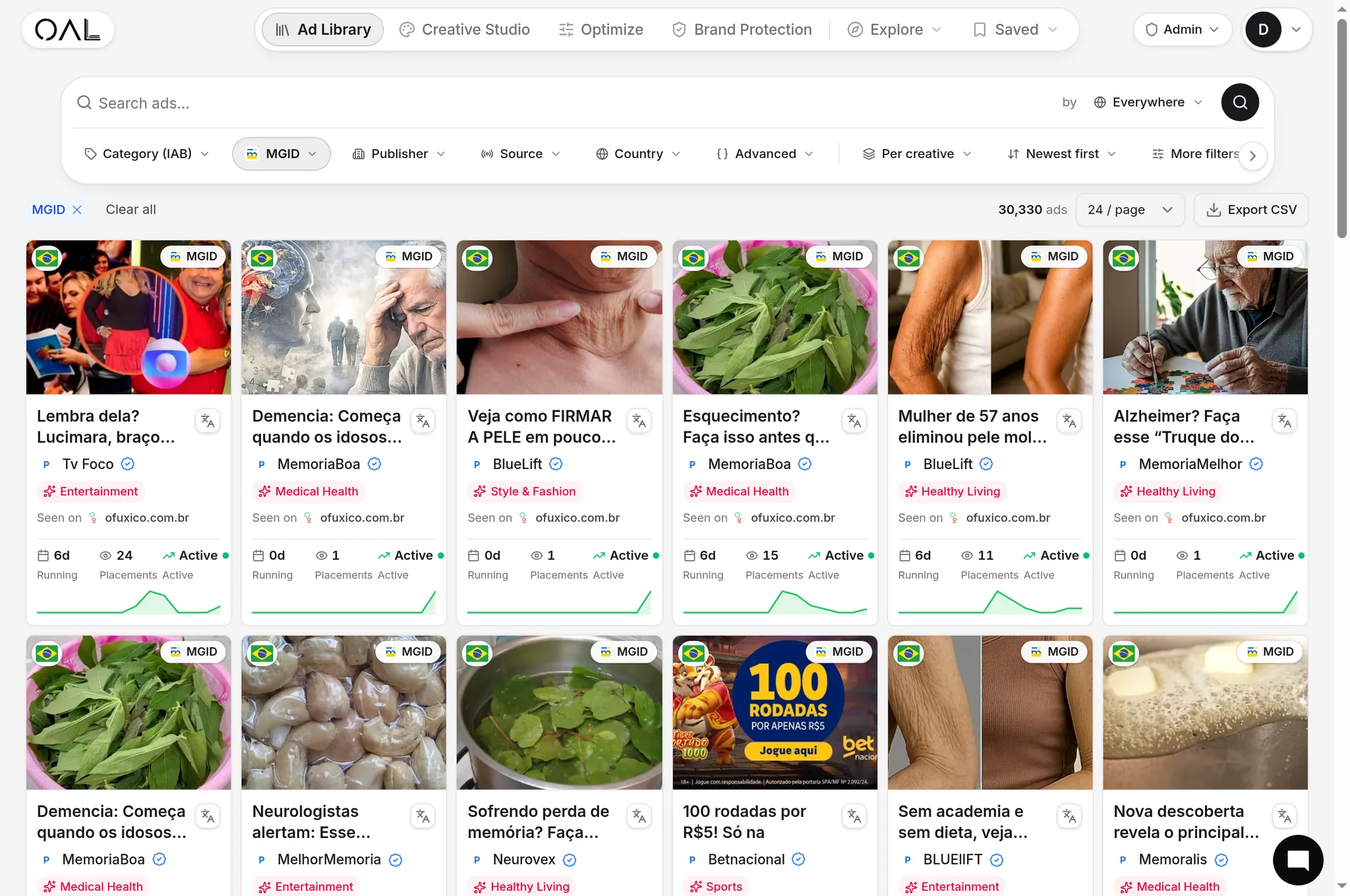
- Category demand on the network. Each native ad network has its own publisher inventory and audience, so its profitable category mix differs. This is not a vibe. On Taboola, ecommerce is the 4th-densest vertical we track (3,330 captured creatives). On MGID, ecommerce is barely present: 138 creatives against 8,904 in entertainment. Same product, wildly different odds.
- Approval and compliance posture. Premium networks reject aggressive claims and certain verticals outright. Cheaper networks are more permissive, but the inventory quality and click intent reflect that. Your creative angle has to survive the network's review before scale matters.
The fastest way to mis-spend a native budget is to pick the network with the biggest audience and assume your category is welcome and affordable there. Reach is a denominator, not a strategy.
Network-by-network for ecommerce#
Taboola: premium reach, higher intent, higher CPC#
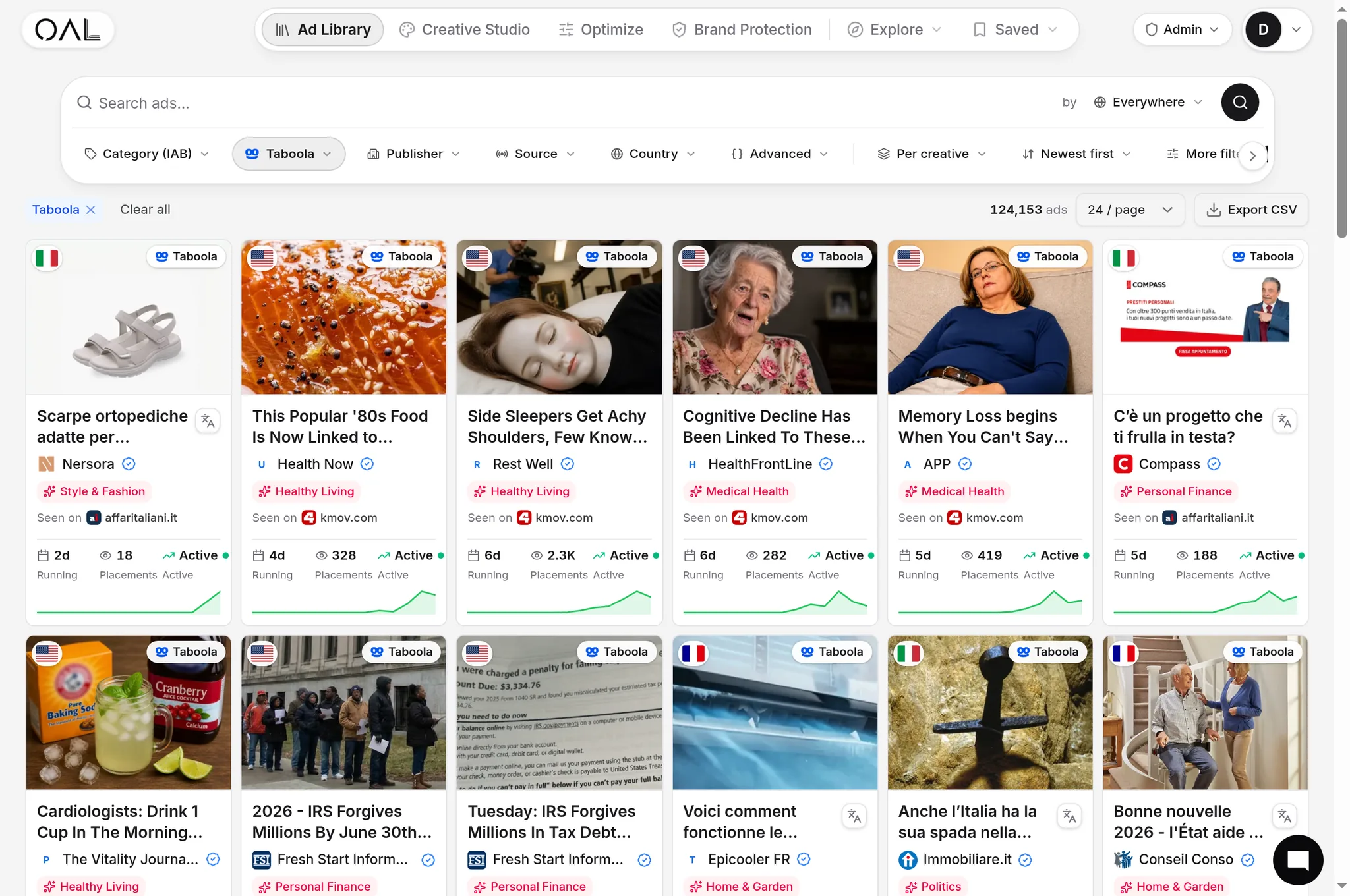
Taboola is the largest open-web native platform, and it is the one we capture most heavily: 157,727 creatives in our index, nearly double the next platform. Since its 30-year exclusive partnership with Yahoo, it serves native placements across Yahoo Finance, Yahoo News, Yahoo Sports, AOL, and Engadget on top of its existing premium publisher network. For ecommerce that means a large, relatively high-intent audience on recognizable properties.
It also means ecommerce demand actually exists here. Taboola's vertical mix in our data runs Health (6,048), Finance (5,558), Insurance (4,303), then Ecommerce (3,330) and Home & Garden (2,630). Ecommerce cracks the top four. That matters, because density of advertisers like you is the single best proxy for "this offer can work here."
A word on what these ads actually look like, though, because the headlines are nothing like the polite product shots you'd expect on Meta. This is a real, currently-running Taboola creative we captured:

That is the house style on Taboola: curiosity-gap headlines, advertorial framing, a strong implied claim. Even legitimate DTC product ads here lean into the same energy. Here's one selling a physical consumer-tech product, dressed as a third-party "test" article:

Who scales here: higher-AOV DTC brands. Home goods, kitchen and gadgets, apparel, wellness products with credible claims, subscription boxes. Advertisers that can sustain CPCs in the higher native range and that lean on a strong advertorial or product-story landing page tend to do well. Taboola's approval process is stricter, so the hardest "shocking" supplement angles that thrive elsewhere often get rejected.
Watch-outs: CPCs are typically the highest in the native category, and the learning phase costs more to exit. You need clean tracking and a real margin cushion before scaling. For a head-to-head on reach, cost, and advertiser mix against the other large player, see Taboola vs Outbrain in 2026: Data-Backed Comparison (Now Teads).
Teads (the merged Outbrain): premium publishers, branding to performance#
In a structural change every native buyer should internalize, Outbrain completed its acquisition of Teads in February 2025 and rebranded the combined company as Teads, now trading on Nasdaq under TEAD. The classic Outbrain native recommendation widgets still run on premium publishers, but they sit inside a larger omnichannel platform that also offers outstream video and CTV.
Our index holds 84,252 Outbrain creatives, and the vertical skew is even more lead-gen-heavy than Taboola: Finance (2,640) and Insurance (2,615) lead, Health follows (2,016), and Ecommerce sits fourth at 1,479. Read that as a signal about audience. Outbrain's premium editorial inventory rewards considered-purchase and finance-adjacent funnels more than impulse-buy product ads.
The longest-running ad in our entire index right now is an Outbrain placement, and it tells you exactly what this network rewards. It is not a product. It is a curiosity quiz:

And the other long-haul Outbrain survivor in our data is a finance advisory hook from SmartAsset, live for 28 consecutive days:

Who scales here: DTC brands that want premium editorial context and are comfortable with a branding-plus-performance posture. Finance and fintech offers, higher-consideration retail, media and subscription products, content-led ecommerce funnels. The publisher quality skews premium, which suits brands that care about adjacency.
Watch-outs: like Taboola, expect higher CPCs and stricter review than the mid-tier. The merger also means positioning is shifting toward omnichannel outcomes, so if you only want classic native recommendation traffic, confirm you are buying that surface specifically.
MGID: mid-tier scale, but check your category first#
MGID sits squarely in the affordable mid-tier. CPCs and minimum spends run lower than the premium pair, and the network is more permissive on creative angles, which makes it a workhorse for testing.
Here is the honest caveat our data forces. MGID is dominated by one thing: entertainment, with 8,904 captured creatives, more than 14x any other vertical on the network. Health is a distant second at 615, and pure ecommerce is tiny at 138 creatives. If you sell a physical product, you are not entering a crowded, validated ecommerce market on MGID. You are early, which can be opportunity or warning depending on your offer. Read it before you assume "mid-tier = cheap ecommerce traffic."
Who scales here: supplement and nutra-style offers, beauty and skincare, weight and wellness, and dropshipping products with broad appeal. MGID's international inventory is a genuine advantage if you sell into tier-2 and tier-3 geos where premium-network CPCs are wasted on the wrong audience.
Watch-outs: inventory quality is more variable than premium networks, so placement-level optimization and aggressive blocklisting matter more. You will spend time pruning low-quality publishers. Two useful comparisons: MGID vs Revcontent: Mid-Tier Native Networks Compared and MGID vs Taboola: Which Native Network Wins for Your Budget?.
Revcontent: cheap clicks, aggressive angles, careful curation needed#
Revcontent rounds out the major mid-tier networks. It is known for low CPCs and a permissive stance that has long made it a favorite for affiliate and aggressive DTC angles. We capture fewer creatives here than the others (11,478), and the mix is health-led (1,459), then Finance (424), Home & Garden (403), Insurance (322), and a meaningful Nutra block (250). The presence of a distinct nutra cluster tells you who is comfortable here.
Who scales here: supplement and "as seen on" style offers, low-AOV impulse products, and affiliate funnels where the math works at very cheap clicks. If your offer survives on volume and a strong pre-lander, Revcontent can be efficient.
Watch-outs: click quality and placement curation need real attention. Cheap traffic is only a bargain if it converts. Compare its reach and advertiser mix against the category leader in Revcontent vs Taboola: Reach, Cost and Advertiser Mix Compared.
Network fit at a glance#
The table below is a planning shortcut, not a verdict. Your specific offer can defy these defaults, which is exactly why verification beats assumption. The "captured creatives" column is our live June 2026 index count, a rough read on each platform's scale on the open web.
| Network | Captured creatives | Typical CPC tier | Approval | Best-fit DTC categories | Ecommerce density in our data |
|---|---|---|---|---|---|
| Taboola | 157,727 | High | Strict | Home & gadgets, apparel, wellness, subscriptions | Strong (3,330 ecom creatives, top-4 vertical) |
| Teads (Outbrain) | 84,252 | High | Strict | Finance/fintech, higher-consideration retail, subscriptions | Moderate (1,479 ecom creatives) |
| MGID | 49,689 | Mid | Moderate | Supplements, beauty, weight/wellness, dropshipping | Thin (138 ecom; entertainment-dominated) |
| Revcontent | 11,478 | Low | Permissive | Supplements, low-AOV impulse, affiliate | Niche (health/nutra-led) |
For the broader family of ad networks beyond these four, including MediaGo, Teads outstream, and the Yahoo/MSN surfaces, the pillar ranking covers where each fits by raw volume.
How to verify category and advertiser fit before you spend#
Rate cards and "best for" tables get you to a shortlist. They do not tell you whether a brand selling your exact product is profitable on a given network right now. That requires looking at live ads, and there is a reliable signal hidden in plain sight.
Longevity and spread reveal winners. Nobody pays to keep a losing creative running. An ad that has stayed live across many publishers for weeks is, with high confidence, converting. To be precise about what "weeks" means in our own data: our index currently records continuous observation up to 28 days per creative, and the ads sitting at that 28-day ceiling are exactly the kind you want to study. The Outbrain dog-licks quiz, the SmartAsset finance hook, and several Microsoft Audience Network IQ-test funnels are all pinned at the top of our longest-running list. (Industry lore about "90-day evergreen winners" may well be true, but that is general folklore, not something our 28-day observation window has measured yet, so treat the two separately.)
Spread matters as much as duration. Here is a Taboola health ad we observed running 26 days, the durable end of what we capture:

Here is the workflow we recommend before committing a test budget to any network:
- Find advertisers in your category, per network. Filter live captured native ads by network and by the product type you sell. The presence, and the density, of advertisers like you tells you whether demand exists there. This is the difference between Taboola's 3,330 ecommerce creatives and MGID's 138, made browsable.
- Sort by longevity. Surface the ads that have run longest. Those are your proven winners to learn from, not the noise of short-lived tests.
- Follow the click to the landing page. The creative is only half the offer. The pre-lander and landing page are where conversion is won or lost. Seeing the full funnel, without clicking the live ad and polluting the advertiser's data, shows you the actual mechanics of what is scaling. We've preserved 926,259 landing-page captures for exactly this.
- Identify the real advertiser behind the ad. Native ads frequently route through tracker and arbitrage layers, so the brand on the creative is not always the entity paying. Knowing the real advertiser lets you map who is genuinely scaling on each network.
This is precisely the gap a native ad spy tool closes. OpenAdLibrary captures live public native ads across Taboola, Outbrain/Teads, MGID, Revcontent and more, preserves the real creative image at full quality, records longevity and publisher spread, classifies the ad-tech supply chain, and follows each click through to the advertiser's landing page, all without clicking live ads. As an open, low-cost alternative to the $80 to $400 per month legacy spy tools, it lets you answer "who is scaling what, on which network" with evidence instead of guesswork. You can browse 200 ads free, no card required. Start free and check your category before you spend.
Putting it together#
There is no universal "best" native network for ecommerce. There is the best network for your margin and your category. As a starting frame:
- High-AOV, premium DTC: lead with Taboola and Teads. Budget for higher CPCs and a strong advertorial funnel. The ecommerce demand is densest here.
- Thin-margin supplement, beauty, or dropshipping: start on MGID and Revcontent to test cheaply, then graduate winners upward if the margin supports premium CPCs. Check category density first, because MGID's ecommerce footprint is thinner than its reach suggests.
- International or tier-2/3 geos: weight toward MGID's broad inventory rather than burning premium-network CPCs on the wrong audience.
Then validate the frame against live data. Pick the two networks where advertisers in your category are most densely and durably active, study the long-running creatives and their landing pages, and let the longevity signal, not a rate card, decide where your first test dollars go.