Español
 Português (Brasil)
 Français
 Deutsch
 Italiano
 Nederlands
 Polski
 Svenska
 Türkçe
 Русский
 日本語
日本語 한국어
한국어 简体中文
简体中文 Tiếng Việt
 Bahasa Indonesia
 繁體中文
繁體中文 Čeština
 Dansk
Dansk Suomi
Suomi Ελληνικά
 Română
 Magyar
 Українська
 ไทย
ไทย हिन्दी
 العربية
 עברית
עבריתBest Native Ad Networks in 2026 (Ranked by Real Ad Volume)
We ranked the major native ad networks by the only metric that predicts where your money goes: how many live ads each one is actually running right now, pulled straight from OpenAdLibrary's index of 589,000+ captured creatives.


Most "best native ad network" lists rank platforms by their own marketing copy: publisher counts, monthly impressions, a wall of logos. Those numbers tell you how big a network says it is. They tell you nothing about where advertiser money is actually flowing. The question that predicts your results is simpler. How many live ads is each network running right now, and who is running them?
So that's what this guide does. We rank the major native networks by real, observable ad volume from OpenAdLibrary's own index, then explain where each one fits a 2026 media plan. As of June 2026 we're tracking 589,036 distinct native creatives from 25,933 advertisers across 42 networks, with 5.4 million individual ad observations behind those counts. The ranking below comes from that data, not a vendor deck. This is also the hub for our deeper comparisons: every head-to-head and budgeting breakdown links out from here.
The 2026 ranking, by real ad volume#
Here's how the major native networks stack up by the number of distinct live creatives we've captured (OpenAdLibrary index, June 2026):
| Rank | Network | Creatives in our index | Best for | Entry cost |
|---|---|---|---|---|
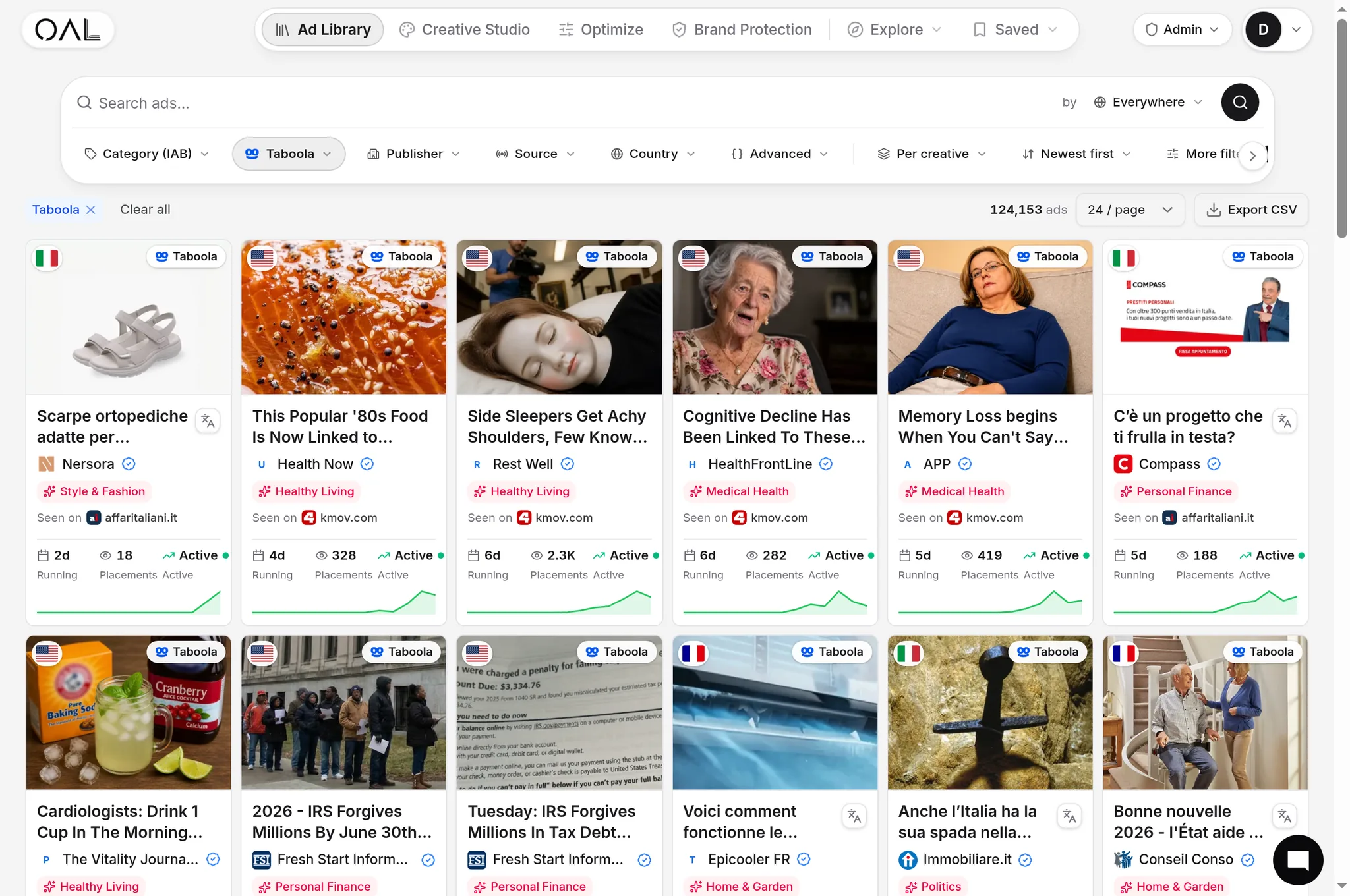
| 1 | Taboola | 157,727 | Scale, direct response, content arbitrage | Mid to high CPC |
| 2 | Outbrain / Teads | 84,252 | Premium publishers, branding, outstream video | Mid to high CPC |
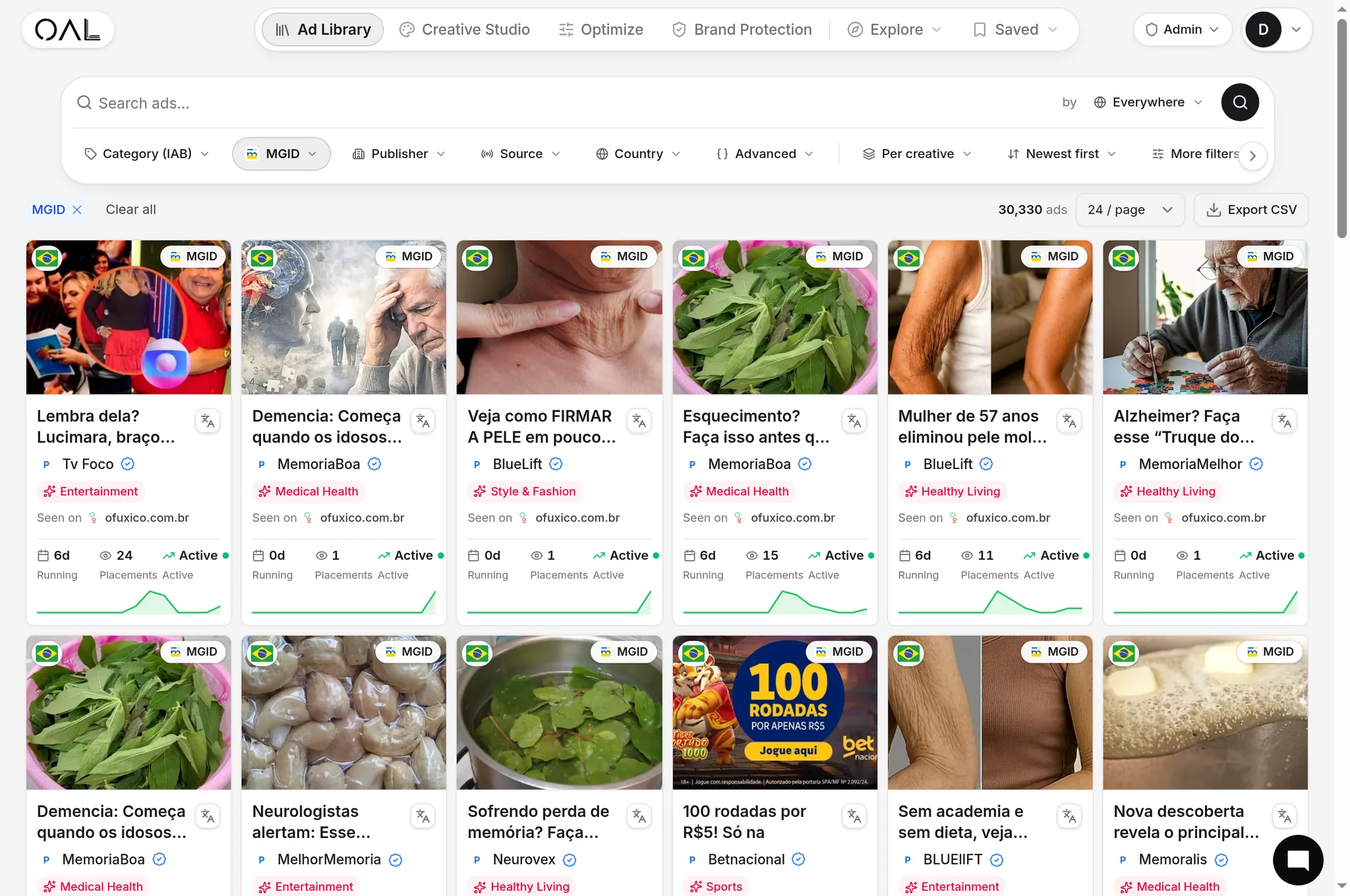
| 3 | MGID | 49,689 | Affiliates, broad geos, emerging markets | Low CPC |
| 4 | Revcontent | 11,478 | Curated quality, US-heavy direct response | Low to mid CPC |
| , | Teads (standalone label) | 55 | Premium brand video, captured separately | High CPC |
| , | Microsoft Audience Network, MediaGo, MSN | Varies | Specialist supply, brand-safe placements | Varies |
Read that Taboola number again. It runs nearly twice the live creative volume of Outbrain (the next biggest), and more than triple MGID. The drop-off is steep, and it matches what buyers feel in the auction: Taboola is where the deepest pool of competitors, and the most inventory to test against, actually sits.
The number that matters isn't a network's claimed publisher count. It's how many distinct live creatives it's serving today. That's the real signal of advertiser demand and the amount of inventory you can learn from.
A network can advertise 50,000 publishers and still be a thin market if few advertisers are buying. A "smaller" network running thousands of fresh, long-lived creatives is a deep, liquid auction worth your test budget. That's why we judge networks on what's live, not on the brochure.
How we rank: ad volume, not press releases#
"Ad volume" here means the count of unique native creatives a network is serving, deduplicated, attributed to the real advertiser, and tracked over time. Three signals fall out of that:
- Sustained volume. How many distinct ads are live across a network's inventory. More live ads means deeper demand and more competitors to learn from.
- Creative longevity. How long individual ads stay live. In direct response, longevity is the best free proxy for profit you'll find. Nobody keeps paying to run a loser. In our current index, the longest-running creatives we've observed continuously have been live for 28 days and counting.
- Advertiser mix. Who is buying. A network full of nutra and "one weird trick" arbitrage behaves nothing like one carrying Fortune 500 brand budgets.
You can't get any of this from a network homepage. You get it from an ad-transparency layer that captures live public placements across the open web. That's the whole reason a native ad spy tool exists, and why the rankings below lean on observable behaviour. New to the category mechanics? Our glossary entries on the native ad network model and native advertising as a format are decent 60-second primers.
1. Taboola: the volume leader, and it isn't close#
Taboola is the default answer to "what's the biggest native network" for one structural reason. Its 30-year exclusive native partnership with Yahoo, live since 2023, routes Yahoo's properties (close to 900 million monthly users across mail, finance, sports and news) through Taboola's single buying platform. That deal also handed Yahoo roughly a 25% stake in Taboola, so the two are intertwined rather than competing for the same demand.
The volume backs the reputation. We're tracking 157,727 distinct Taboola creatives, more than any other network in the index. The advertiser mix skews hard toward direct response: Health (6,048 creatives), Finance (5,558) and Insurance (4,303) lead, followed by Ecommerce, Home & Garden and Software. This is content arbitrage, lead gen and subscription territory, and the creative refresh cadence is brutal. Winners get cloned within days.
Here's what that arbitrage style actually looks like in the wild. A live finance ad we captured in June:

And a health-adjacent ad that had been running 26 days when we last checked, which tells you it's almost certainly profitable:

Costs run higher than the mid-tier and approval is stricter. You're paying for scale and quality. Taboola is the network you benchmark everything else against. For the two comparisons buyers run most before committing, see Taboola vs Outbrain in 2026: Data-Backed Comparison (Now Teads), which covers how the Outbrain-Teads merger reshaped that rivalry, and Revcontent vs Taboola: Reach, Cost and Advertiser Mix Compared for the scale-versus-cost trade-off against the mid-tier.
2. Outbrain / Teads: the premium and branding play#
This is the one stale guides get wrong. Outbrain completed its acquisition of Teads in February 2025, took on the Teads brand, and began trading under the ticker "TEAD" on Nasdaq in June 2025. So when you read "Outbrain" in 2026, you're really looking at the combined company now marketed as Teads, an end-to-end platform pairing Outbrain's native recommendation widgets with Teads' strength in outstream video and premium publisher relationships.
In our index, the legacy Outbrain supply is the clear number two with 84,252 creatives, while ads served under the standalone "Teads" label are still tiny at 55, which is what you'd expect from a brand-led premium platform that runs fewer, higher-budget creatives rather than thousands of arbitrage variants. The Outbrain advertiser mix leans more toward regulated, high-value verticals than Taboola does: Finance (2,640) and Insurance (2,615) sit at the top, ahead of Health, Ecommerce and Software.
Outbrain/Teads also carries the longest-lived ads we track. Of our current 28-day veterans, several are Outbrain finance and entertainment creatives, including this SmartAsset retirement-tax angle that has been live the full 28 days:

Why second and not first? Quality over raw volume. Teads has historically leaned premium: tier-1 news and magazine inventory, stricter editorial standards, a stronger awareness story than pure arbitrage. The merger bolted a serious outstream video business onto the native footprint, which matters as native and video budgets converge. The legacy Outbrain feeds and DSP didn't vanish, but go-to-market is now unified under Teads. If your offer is brand-led, or you just want cleaner placements than the arbitrage-heavy networks, this is the strongest alternative to Taboola. The merger details and how they change buyer strategy are covered in our Taboola vs Outbrain (Now Teads) comparison.
3. MGID: the broad, affordable workhorse#
MGID is the most common entry point for affiliates and performance buyers who want scale without Taboola-level minimums or scrutiny. By its own 2025 disclosures it spans 32,000+ publisher sites across 60+ countries, with strong coverage in emerging markets and a looser content policy than the premium platforms.
The capture data shows just how different its character is. We're tracking 49,689 MGID creatives, but the vertical mix is wildly skewed: Entertainment alone accounts for 8,904 of them, dwarfing Health (615), Insurance (378) and everything else. That's the signature of quiz funnels, gaming offers and broad-appeal arbitrage, exactly the verticals a permissive network attracts. It's a double-edged advantage you should manage on purpose with placement-level optimization and exclusion lists, because quality varies a lot by geo and publisher.
MGID sits at the centre of the mid-tier, so it anchors two of our most-read comparisons: MGID vs Revcontent: Mid-Tier Native Networks Compared for the head-to-head most affiliates actually face, and MGID vs Taboola: Which Native Network Wins for Your Budget? for the classic "cheap and broad versus expensive and deep" decision.
4. Revcontent: curated quality in the mid-tier#
Revcontent is the quality-first option among the affordable networks. It reaches a reported 228M+ users across 7,000+ publishers and deliberately keeps that base smaller and more vetted than MGID's. Quality over quantity is the explicit pitch.
The data is consistent with the positioning. At 11,478 creatives, Revcontent runs a fraction of MGID's volume, and the mix tilts back toward serious direct-response verticals: Health (1,459) leads, then Finance (424), Home & Garden (403), Insurance (322) and Nutra (250). Cleaner inventory, more publisher control, strong US and English-language coverage. Less raw reach than Taboola or MGID, which is why Revcontent is often a complement (a place to scale a proven winner) rather than your only network. The two comparisons buyers run most are MGID vs Revcontent for the mid-tier call and Revcontent vs Taboola for curated mid-tier versus the volume leader.
Yahoo Native and the specialist supply#
A note that trips people up: Yahoo's native inventory is no longer bought as a standalone network. Since the 2023 deal it's purchased through Taboola, so "Yahoo Native" as a separate buy folded into the volume leader. (Yahoo still sells its own display, but native runs through Taboola.)
Beyond the top four, a few specialist sources are worth knowing. The Microsoft Audience Network turns up constantly in our longest-running set: nearly all of our 28-day evergreen ads outside Outbrain are MSN placements, from "My IQ" quiz funnels to hearing-aid and card-machine offers. That's a brand-safe, tightly policed ecosystem where ads tend to run long once approved. Here's one of those MSN veterans, an IQ-quiz creative live the full 28 days:

MediaGo (Baidu's native/programmatic supply) is useful for extra reach and certain geos, and Teads outstream video is increasingly its own discipline as native and video budgets merge. None of these usually replaces a core network, but they're valuable for diversification once your main channels are dialled in.
What the verticals tell you about where to fight#
Zoom out from individual networks and the index shows where native demand concentrates across the whole open web. The top verticals by live creative volume (OpenAdLibrary, June 2026):
| Vertical | Creatives in index |
|---|---|
| Finance | 17,232 |
| Insurance | 15,629 |
| Health | 14,895 |
| Ecommerce | 13,872 |
| Entertainment | 11,784 |
| Software | 10,825 |
| Travel | 10,692 |
Finance, insurance and health are the three deepest auctions in native, full stop. If you're in one of those, expect crowded inventory and aggressive creative testing from competitors. If you're outside them, the upside is less competition and the chance to stand out, but you'll have fewer rival ads to learn from. Either way, knowing the depth of your vertical before you bid changes how you budget your first test.
Choosing the right network for your situation#
There's no single best native ad network. There's the best one for your offer, geo, budget and risk tolerance. A practical decision path:
- Brand or awareness budget, premium placements? Start with Outbrain/Teads, then test Taboola.
- Direct response, want maximum scale and the deepest competitor pool? Taboola first.
- Affiliate or aggressive vertical, testing many geos cheaply? MGID, with Revcontent for cleaner US scale.
- Tight budget, validating an offer first? Mid-tier (MGID/Revcontent), then graduate winners to Taboola/Outbrain-Teads.
Cost decides most of these calls, and native pricing varies widely by network, geo and vertical. We break down realistic CPCs, minimum deposits and how to budget a first test in How Much Do Native Ads Cost? A 2026 Budgeting Guide. It's also worth understanding the mechanics under your bids: how programmatic native advertising and the native ad auction decide what you actually pay, how the native ad widget format shapes creative, and how all of it descends from the broader ad network model.
Why live ad volume beats every other ranking#
Here's the practitioner's edge that pulls this together. Most teams pick a network from a list, fund an account, and then start learning what works, paying for that education in spend. The faster path is to read the market before you bid.
That's what an ad-transparency platform gives you. OpenAdLibrary captures live public native ads across Taboola, Outbrain/Teads, MGID, Revcontent, MediaGo, Yahoo and MSN, then turns raw ads into a media plan three ways:
- Captures the real creative image at full quality. The actual hook, headline and thumbnail competitors are running, like the side-sleeper and AC-unit angles below, not a blurry recreation.
- Identifies the real advertiser behind each ad and classifies the ad-tech supply chain, so you know who's buying, not just what's showing.
- Follows the click to the landing page (without clicking live ads). We've captured 926,259 landing pages so far, revealing the pre-lander and offer flow that usually decides profitability.

Layer in creative longevity and spread and you get a free, honest signal of what's winning: an ad like that solar-battery creative, live 27 days across many placements, is almost certainly profitable. From there, Creative Studio, Optimize, Copy DNA and an API and MCP let you turn those observations into your own tested creatives. It's the open, low-cost alternative to Adbeat, AdPlexity, AdSpy and Anstrex, built so the intelligence costs less than a single bad test campaign.
You can browse 200 ads with no card to see which networks and advertisers are most active in your vertical before you spend a dollar.
Start free and rank the networks by what's actually running, not by what their decks claim.
OpenAdLibrary is an open, affordable ad-transparency and competitive-intelligence platform. Live ad-volume figures (589,036 creatives, 25,933 advertisers, 42 networks, June 2026) come from OpenAdLibrary's capture of public native placements. Network reach and corporate figures (the Yahoo deal, the Outbrain-Teads merger, publisher counts) are drawn from each company's own public disclosures and verified announcements.