Español
 Português (Brasil)
 Français
 Deutsch
 Italiano
 Nederlands
 Polski
 Svenska
 Türkçe
 Русский
 日本語
日本語 한국어
한국어 简体中文
简体中文 Tiếng Việt
 Bahasa Indonesia
 繁體中文
繁體中文 Čeština
 Dansk
Dansk Suomi
Suomi Ελληνικά
 Română
 Magyar
 Українська
 ไทย
ไทย हिन्दी
 العربية
 עברית
עבריתWhat Is a Native Ad Library and Why One Didn't Exist Until Now
Meta and Google run public ad libraries; Taboola, Outbrain and MGID never did, so here is what an open native ad library has to capture, and why that gap sat empty for a decade.


If you advertise on Facebook, you can open the Meta Ad Library, type a competitor's name, and see every ad they are running right now. Creative, dates, the lot. Try the same move on a Taboola advertiser and you hit a wall. There is no Taboola Ad Library. No Outbrain Ad Library. No MGID, Revcontent, or Yahoo native library either. For a category of advertising that quietly moves billions of dollars a year, the public record just does not exist at the source.
That gap is the reason this page exists. A native ad library is the missing piece of ad transparency, and for the first decade of programmatic native, nobody had built one.
What is a native ad library?#
A native ad library is a searchable archive of live native ads: the "recommended for you" and "around the web" units served by networks like Taboola, Outbrain, MGID, Revcontent, Teads, MediaGo, Yahoo and MSN. It stores each ad's creative image, the advertiser behind it, the supply-chain path that served it, and the landing page it points to. The point is to let you search, filter and track competitors the way you already can on Meta and Google.
The definition is simple. Delivering it is not. Here is what one of those ads actually looks like once it is captured and dated:

Finance is the single biggest native vertical in our index, with 17,232 creatives captured across all networks (OpenAdLibrary index, June 2026). The ad above is a textbook example of why: a deadline, a vague promise of "millions forgiven," and a brand name ("Fresh Start Information") that tells you almost nothing about who is actually buying the media.
Why Meta and Google have libraries and the native networks don't#
The big walled gardens did not build ad libraries out of generosity. They built them under pressure. Political-ad scandals, public scrutiny, and eventually regulation forced their hand. Under the EU's Digital Services Act, platforms designated as Very Large Online Platforms have to keep a public ad repository that is searchable, queryable on multiple criteria, and accessible by API: who paid, what was promoted, when it ran, how it was targeted. Meta and Google clear those user thresholds easily, so they comply.
The native networks do not clear them. Taboola, Outbrain, MGID and Revcontent are large advertising businesses, but they are not "platforms" in the DSA sense the way Facebook or YouTube are, and no equivalent law compels them to expose their inventory. So they never did.
The absence of a native ad library is a regulatory gap, not a technical one. The networks have every ad in a database. They simply have no obligation, and no commercial incentive, to let outsiders search it.
The commercial incentive actually runs the other way. Opacity protects the advertisers who do best on native: the supplement sellers, the financial-offer arbitrageurs, the affiliate operators running "one weird trick" angles at scale. A public library would expose their winning creatives to every competitor overnight. The networks have no reason to do that to their highest-spending customers.
| Meta / Google | Taboola / Outbrain / MGID | |
|---|---|---|
| Public ad library | Yes, official | None |
| Driven by | DSA / regulatory pressure | No mandate |
| Searchable by competitor | Yes | No (at source) |
| Creative archived | Yes | No |
| Landing page captured | No | No |
Look at the last two rows. Even the platforms that do run libraries stop at the impression. They show you the ad as a thumbnail. They do not follow where the click goes. For native, where the whole game is the funnel from widget to advertorial to offer, that destination is the most valuable data of all, and nobody was capturing it.
Why nobody just built the native version#
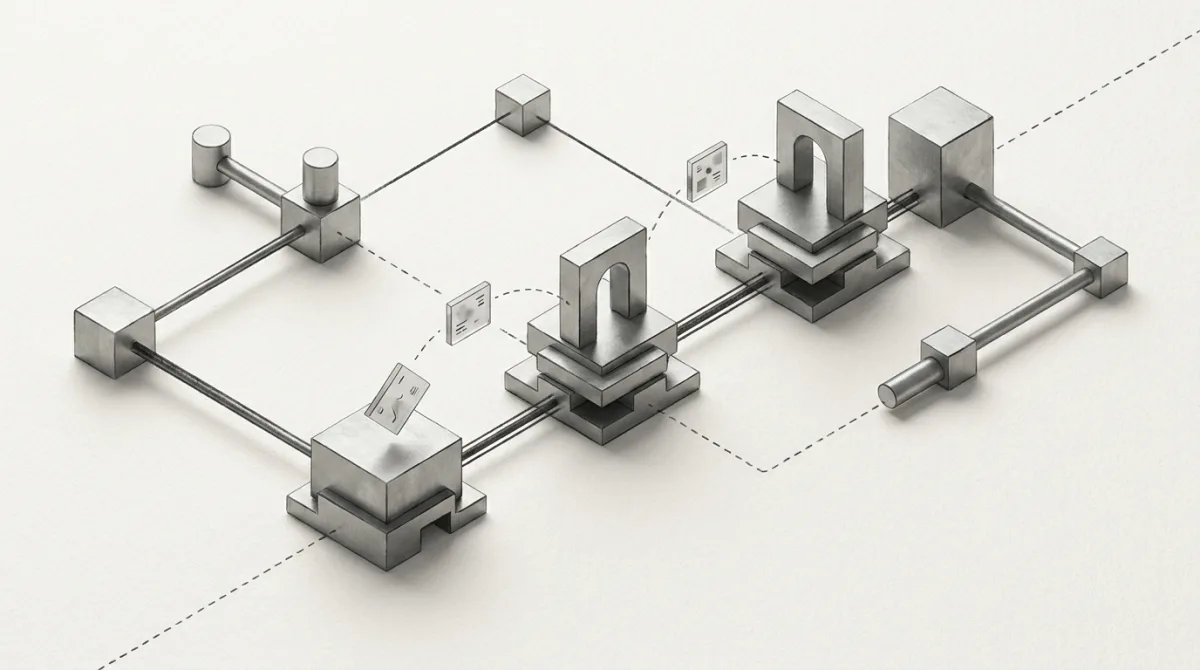
If the networks will not publish a library, why did someone else not build one years ago? Because doing it properly is genuinely hard. It helps to know how the native ad supply chain actually works: an impression passes through an exchange, a demand-side platform, trackers and redirects before a human ever sees it. A real native ad library has to reconstruct that chain from the outside. That means four hard jobs, all at once:
- Loading the open web like a real reader. Native units get rendered into publisher pages by a native ad widget. They do not sit in a tidy API you can query. You have to visit thousands of articles, across many geographies, to see what actually serves.
- Capturing the creative at full quality. A native ad is an image plus a headline. If you do not store the real asset the moment it renders, it is gone. These placements rotate constantly.
- Identifying the real advertiser. The brand name on the widget is often a cloaked label. Resolving it means reading the supply chain, the same skill set you would use to identify the ad network behind any ad.
- Following the click to the destination. The landing page or pre-lander is where the offer lives, and it is the single most useful artifact for understanding a campaign.

Each of those is a hard engineering problem on its own. Stacking all four, continuously, across every major native ad network and dozens of geos, is why a true native ad library did not exist for so long. To put scale on it: doing this properly is what produces an index of 589,036 creatives, 25,933 advertisers, and over 5.4 million ad observations across 42 networks (OpenAdLibrary, June 2026). You do not get those numbers from a feed. You get them from watching the live web, page by page.
The legacy "spy tools" (Adbeat, AdPlexity, Anstrex, AdSpy) partly addressed this, but behind $80 to $400 a month paywalls, with patchy creative quality and thin supply-chain detail. They were intelligence vendors, not libraries.
What an actual native ad library has to do#
The line between a "spy tool" and a genuine library is whether it gives you the open, searchable, evidence-grade record that Meta provides, for the networks that refuse to. Concretely, that means capturing and keeping:
- The live creative, stored at full quality the moment it renders, not a degraded thumbnail.
- The real advertiser, resolved from the supply chain rather than the cloaked display name.
- The full supply path: which SSP, which DSP, which trackers, so you can tell who is buying ads on a website and through which intermediaries.
- The click destination, captured by following each placement to its landing page without clicking live ads (clicking would cost the advertiser money and pollute their data).
- Longevity and spread, the dates and geos where each creative showed up.
That last point is what turns an archive into intelligence. A single snapshot tells you an ad exists. A dated, repeated capture tells you which ads work, and that is the whole difference between trivia and a competitive edge.
Here is a concrete example. In our index, the longest-running native creatives we are currently observing have been live for about 28 days of continuous capture. One of them is this Outbrain finance ad from SmartAsset:

Twenty-eight days of continuous observation is our current ceiling, not the ad's lifetime: native creatives often run far longer, and industry lore about 90-day winners is real, just not something our index can yet confirm on its own. What we can say is that the ones still rendering after weeks, across many publishers, are the ones earning their keep. A "My IQ" quiz ad and a "Hidden Hearing" next-gen hearing-aid ad both sit in that same 28-day cohort on the Microsoft Audience Network. When an offer survives that long, it is almost never an accident.
OpenAdLibrary: the open native ad library#
This is the gap OpenAdLibrary was built to close. It does exactly what the section above describes. It loads the live public web across geographies, captures the real creative at full quality, classifies the ad-tech supply chain behind each impression, and traces every click to the advertiser's landing page, all without clicking live ads. The result is a searchable, dated archive of native advertising that behaves like the Meta Ad Library, for the networks that never built one.
The coverage is not even across the field, and that itself is useful intelligence. Taboola is by far the deepest network in our index at 157,727 creatives, followed by Outbrain at 84,252 and MGID at 49,689 (June 2026). The mix shifts by network, too. Taboola and Outbrain skew heavily toward health, finance and insurance offers, while MGID's largest single bucket is entertainment, with 8,904 creatives. If you are researching a vertical, knowing where it actually lives saves you a lot of guessing.

Two things make this more than a clone of the old spy tools. First, it is open and affordable: a free tier lets you browse around 200 ads with no card, and the full plan is $29.99 a month, against the $80 to $400 a month the legacy rivals charge. Second, it goes past observation into action. Features like Creative Studio, Optimize, Copy DNA, and an ad intelligence API with MCP support let you turn what you find into your own campaigns. If you are new to the wider category, the ad transparency tool explainer maps how open libraries fit alongside the regulatory ones, and the ad transparency pillar covers the laws and libraries end to end.
It is worth placing this inside the broader practice of native advertising and the general idea of an ad library. For the walled gardens, the library came first and third parties bolted intelligence on top. For native it had to be built the other way around: the intelligence work is what creates the library, because the source data was never published.
The takeaway#
"Native ad library" describes something that, for the networks themselves, still does not exist. Meta and Google were pushed into transparency by regulation. Taboola, Outbrain and MGID never were, and their best customers benefit from the silence. Closing that gap meant rebuilding the entire native pipeline from the outside: loading real pages, archiving real creatives, resolving real advertisers, and following real clicks. That is a high bar, which is exactly why the category sat empty for so long. The 589,036 creatives now in the index are what that work looks like once you actually do it.
Start free and search the native ad library the networks were never going to build.