
 Español
 Português (Brasil)
 Français
 Deutsch
 Italiano
 Nederlands
 Polski
 Svenska
 Türkçe
 Русский
 日本語
日本語 한국어
한국어 简体中文
简体中文 Tiếng Việt
 Bahasa Indonesia
 繁體中文
繁體中文 Čeština
 Dansk
Dansk Norsk (bokmål)
 Suomi
Suomi Ελληνικά
 Română
 Magyar
 Українська
 ไทย
ไทย हिन्दी
 العربية
 עברית
עבריתTaboola Whitelist Strategy: From Broad Buys to Proven Sites
How to go from broad Taboola buys to a proven-site whitelist in three phases — and how to shortcut the expensive discovery phase with observation data.


A Taboola whitelist is a campaign restricted to publisher sites you have already proven convert; a blacklist is the running set of sites you have blocked for burning budget. You get to a working whitelist in three phases: run broad to buy per-site data, blacklist the bleeders as evidence accumulates, then duplicate the proven sites into a dedicated campaign with its own bids and budget. There is also a shortcut for the expensive first phase: observing which publishers long-running advertisers concentrate on — a pattern visible across the 6.9 million ad observations in OpenAdLibrary's index (July 2026). This article covers the full workflow and the shortcut.
Whitelist vs blacklist: mechanics on Taboola#
The vocabulary first, since the two lists get conflated constantly (full definitions in the whitelist/blacklist glossary entry):
- Blacklist — sites excluded from delivery. Taboola supports blocking publishers at both campaign level (this offer does not work there) and account level (never serve there at all). Blocks are subtractive: everything else keeps serving.
- Whitelist — the inverse: delivery restricted to an explicit list of publishers, typically implemented as a dedicated campaign targeting only proven sites. Whitelists are additive: nothing serves unless you put it on the list.
Each publisher property is identified in reporting by a site identifier — the publisher/site ID glossary entry explains how these map to actual domains. Exact console controls evolve, so check Taboola's current documentation for where blocks and site targeting live today; the strategy below is stable either way. If you are new to the network's structure entirely, start with how Taboola ads work.
Phase 1: run broad and buy the data#
A whitelist is a conclusion, not a starting hypothesis. Phase one is a broad campaign — run-of-network within your structural splits (platform, geo tier, funnel) — whose job is not profit but a per-site dataset. Expectations for this phase:
- Concentration is coming. A common pattern across native campaigns: a small share of sites ends up producing most conversions while a long tail nibbles budget. Your goal is to find out which sites sit in which group for your offer specifically.
- Do not judge early. A site with a handful of clicks has proven nothing in either direction. Let sites accumulate meaningful spend before they enter the block/keep decision.
- Budget it as tuition. Whatever the broad phase costs, it is buying the asset every later campaign runs on. Underfunding it produces a whitelist built on noise, and that noise compounds through every campaign you later build on top of the list.
What to judge a site on (it is more than CPA)#
Before pruning, decide what "proven" means. Four reads per site, in priority order:
- Conversion math. CPA against target is the headline number, but weight it by sample — a site at 1.2× target on three conversions is unproven, not failing.
- Volume capacity. A site converting beautifully on twenty clicks a week cannot anchor a whitelist. Note which converters can actually absorb budget; the scaling decision later depends on it.
- Consistency across weeks. One hot week is often a placement change or a traffic spike on the publisher's side. Sites that convert across two or three consecutive review cycles are the real candidates.
- Funnel quality signals. Where you track pre-lander clickthrough or on-page engagement, per-site differences are diagnostic: a site with fine ad CTR but dismal pre-lander progression is sending skimmers, not readers, and no bid adjustment fixes that.
Keeping these on one sheet per campaign turns phase two from vibes into arithmetic.
Phase 2: blacklist the bleeders#
As per-site data matures, prune weekly — not hourly:
- Block on evidence. The common heuristic: a site that has spent two to three times your target CPA with zero conversions gets blocked.
- Bid down before cutting. Sites that convert but over target get a negative bid adjustment first; blocks are for sites with no redeeming math.
- Mind the failure mode. Over-blocking early is the classic mistake — it throttles discovery, and campaigns that block too aggressively can strangle their own delivery.
- Choose block scope deliberately. Account-level blocks are for fundamental failures (quality, brand safety); campaign-level blocks for sites that merely do not fit this offer. Keep a record — forgotten account-level blocks silently distort every future test.
Phase 3: the whitelist campaign#
When a set of sites has repeatedly converted under target, graduate it:
- Duplicate, do not mutate. Clone the campaign and restrict the clone to the proven sites. Keep the broad campaign alive at reduced budget as your discovery engine — a whitelist with no feeder eventually starves.
- Bid up. On known-good placements you are no longer paying to explore; you are competing for specific inventory. Higher bids on a whitelist buy position on placements you already know convert.
- Expect faster fatigue. A fixed set of placements means a fixed audience pool. Whitelist campaigns burn through creative faster than broad ones, so rotate executions more aggressively there.
- Know the ceiling. Whitelisting is the placement version of vertical scaling — squeezing more from what works — and it caps out. The interplay with horizontal expansion is covered in horizontal vs vertical scaling.
The shortcut: see where proven advertisers already run#
Phase one is the expensive part, and observation data compresses it. Every one of the 6.9 million ad observations in OpenAdLibrary's index ties a creative to the publisher page where it was captured, with first-seen and last-seen dates. A pattern we see repeatedly across the index: advertisers whose ads survive 30+ days concentrate their impressions on a recurring set of publishers rather than spraying the network — their spend distribution is a de facto whitelist, visible from outside.
The workflow:
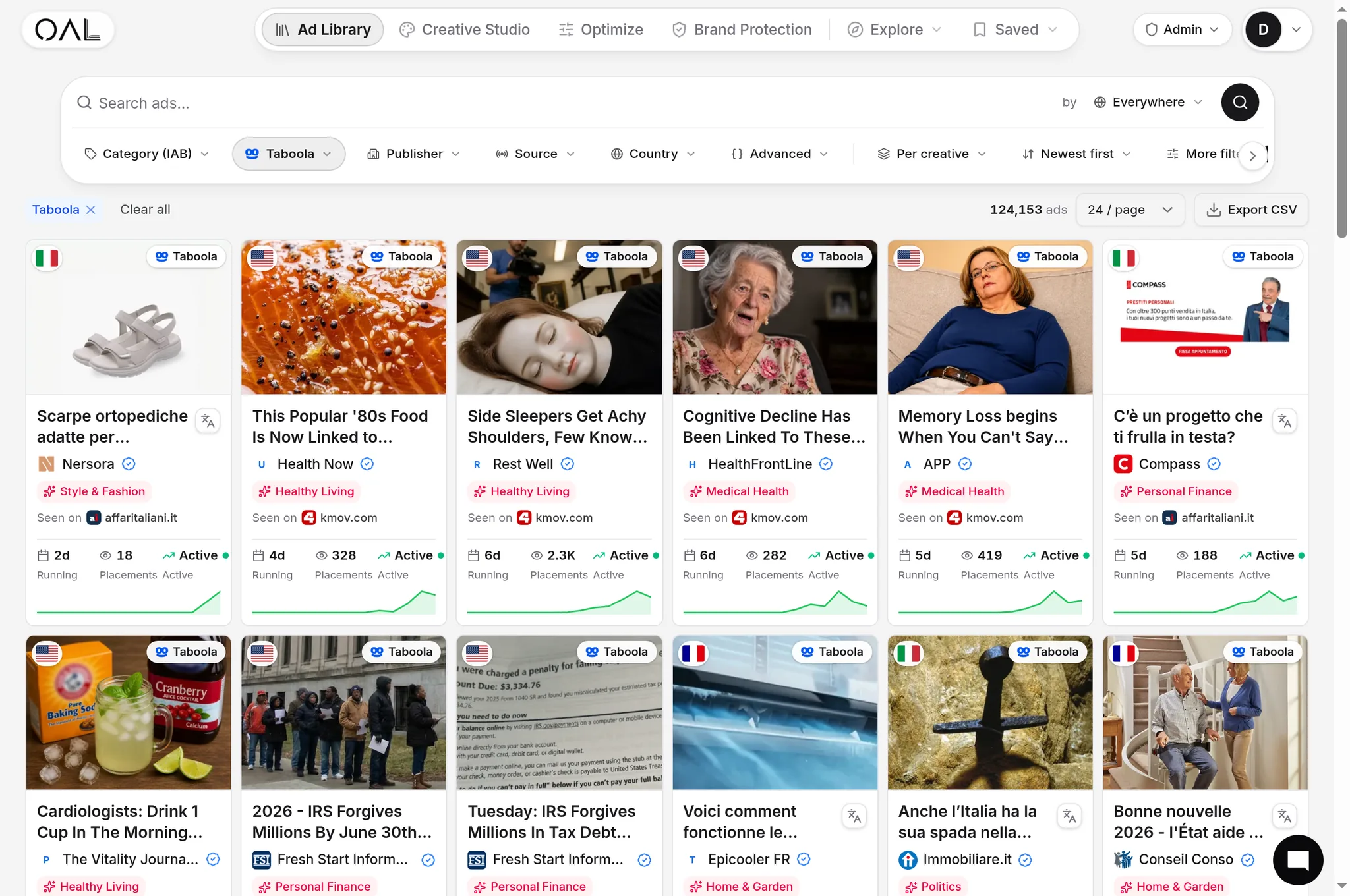
- Find the survivors in your vertical. Filter Taboola creatives by category and run duration in OpenAdLibrary's Taboola spy tool; ads past the 30-day line are the proven ones (why longevity means profit).
- Note where their ads keep appearing. Repeated observations of the same advertiser on the same domains over weeks signal deliberate concentration, not run-of-network accident. The reverse lookup — starting from a publisher and seeing who buys there — is covered in who is buying ads on a website.
- Seed your test list. Those domains become a prioritized phase-one list rather than a blind RON buy.
The honest caveat: their economics are not yours. A site that works for a competitor's offer, payout and funnel may fail your math. Observation data buys you a better-ordered test queue, not a guaranteed whitelist — the full research method is in the Taboola ad spy guide.
Pitfalls that recur#
- Whitelisting too early. Small samples produce confident, wrong lists. Wait for real spend per site.
- Letting the whitelist rot. Publisher audiences, layouts and widget positions change. Re-validate the list quarterly; drop sites whose math has drifted.
- No discovery budget. Teams that go all-in on the whitelist wake up six months later with a fatigued list and no pipeline of candidates.
- Treating domains as uniform. Different sections of one large publisher can behave like different sites. Where reporting exposes that granularity, use it before judging a whole domain.
- Blacklist amnesia. Undocumented account-level blocks are invisible sabotage on every later campaign. Keep the list written down, with dates and reasons.
- Porting a whitelist across offers. A site list proven for one funnel is a hypothesis for the next one, not a birthright. New offer, new phase one — just a shorter one, seeded by the old list.
The whitelist is not really the asset. The asset is the loop that produced it: broad discovery, evidence-based pruning, graduation, and re-validation. Advertisers who keep that loop running always have a current list; advertisers who treat a whitelist as a finished artifact are usually scaling last year's internet.