Español
 Português (Brasil)
 Français
 Deutsch
 Italiano
 Nederlands
 Polski
 Svenska
 Türkçe
 Русский
 日本語
日本語 한국어
한국어 简体中文
简体中文 Tiếng Việt
 Bahasa Indonesia
 繁體中文
繁體中文 Čeština
 Dansk
Dansk Norsk (bokmål)
 Suomi
Suomi Ελληνικά
 Română
 Magyar
 Українська
 ไทย
ไทย हिन्दी
 العربية
 עברית
עבריתHow to Diversify Beyond Meta Ads (Native Channel Playbook)
If Meta is 90% of your spend, you don't have a marketing channel, you have a single point of failure; here's how to add native as a second engine and use competitive recon to de-risk every step.


If Meta is 90% of your spend, you don't have a marketing channel. You have a single point of failure. Every business built on one ad platform is one disabled account, one CPM spike, or one policy update away from a revenue cliff. The advertisers who survive those events weren't luckier. They built a second engine before they needed it.
This is a playbook for adding native advertising as that second engine. It's not a "quit Meta" pitch (Meta is too good at what it does). It's a concrete sequence for de-risking the move into native, with competitive reconnaissance as the step that turns an expensive experiment into a calculated one.
Why single-channel dependency is the real risk#
Leaning on one ad platform stacks three risks you don't control. There's account risk: a ban, a disabled ad account, or a payment hold can take revenue to zero overnight. There's auction risk: rising CPMs and new competitors quietly eat your margin. And there's policy risk: a vertical or creative crackdown can kill a working angle with no appeal. Diversification doesn't make these go away. It stops any single one from being fatal.
The pattern repeats across every cohort of media buyers. A channel works, the business leans in, the channel changes the rules, and the buyer with no second engine starts over from scratch. The ones who shrug it off already had a profitable second channel absorbing the shock.
Native is the most natural second engine for Meta-native buyers because the skills transfer but the risks don't correlate. You already know how to write hooks, build pre-landers, and read CPA. Native rewards all of it. But native runs on separate supply, separate auctions, and a separate policy regime. A Meta account ban doesn't touch your Taboola spend. And there's a lot of native demand to learn from: across the 589,000+ creatives in the OpenAdLibrary index (June 2026), Taboola alone accounts for 157,727 captured creatives and Outbrain another 84,252.
A second channel isn't insurance you buy and forget. It's a muscle you keep warm. The time to learn native is while Meta is still paying the bills, not the week after your account gets disabled.
Native vs Meta: what actually changes#
Before you move a dollar, understand what's genuinely different. Native advertising places ads inside the editorial flow of publisher sites: the "recommended for you" widgets under articles, in-feed content units, sponsored story modules. The user is reading, not socializing, and that one difference reshapes everything downstream.
| Dimension | Meta | Native (Taboola / Outbrain / MGID / Revcontent) |
|---|---|---|
| User mindset | Social, browsing feed | Reading content, lower ad-guard |
| Targeting | Rich interest/behavioral + algorithm | Contextual + supply-side, broader |
| Creative driver | Thumb-stopping visual + short hook | Curiosity headline + image; pre-lander does the work |
| Click destination | Often direct to offer | Almost always advisorial / pre-lander first |
| Auction | Programmatic, heavy ML optimization | Programmatic native auction, more bid control |
| Scale lever | Audience expansion, ASC | Site/widget expansion, geo expansion |
| Account fragility | High (instant bans common) | Lower, but slower approvals |
The biggest operational shift is the pre-lander. On Meta you can sometimes send cold traffic straight to an offer. On native, the click almost always lands on an advisorial article, a quiz, or a listicle that warms the reader first. Look at how the headlines are written. Here's a live finance ad running on Taboola, captured in our index:

That headline ("2026 - IRS Forgives Millions By June 30th Tax Deadline") isn't selling a product in the image. It's selling the click into an article. Buyers who skip the pre-lander and run Meta-style direct-to-offer funnels on native usually conclude "native doesn't convert," when the real problem is funnel architecture. Our deeper native advertising playbook breaks the mechanics down end to end.
The second shift is what you optimize. Meta's algorithm does enormous lifting. Native hands you granular control over bids at the widget and site level, which means more manual hygiene but far more transparency into exactly where your money goes.
De-risk first: read the market before you spend#
Here's the part most "diversify your channels" advice skips. The dominant cost of entering a new channel isn't the test budget. It's the failed tests you pay for while learning what the channel already knew. Every native veteran has burned four figures discovering which angles, creatives, and pre-landers work in a vertical. You can buy most of that knowledge for the price of looking.
Competitive reconnaissance front-loads the learning curve. Instead of starting from a blank campaign, you start from validated patterns: which advertisers are actually running sustained native campaigns in your vertical, which creatives they've kept live for weeks (a strong proxy for profitability), and where their clicks ultimately lead.
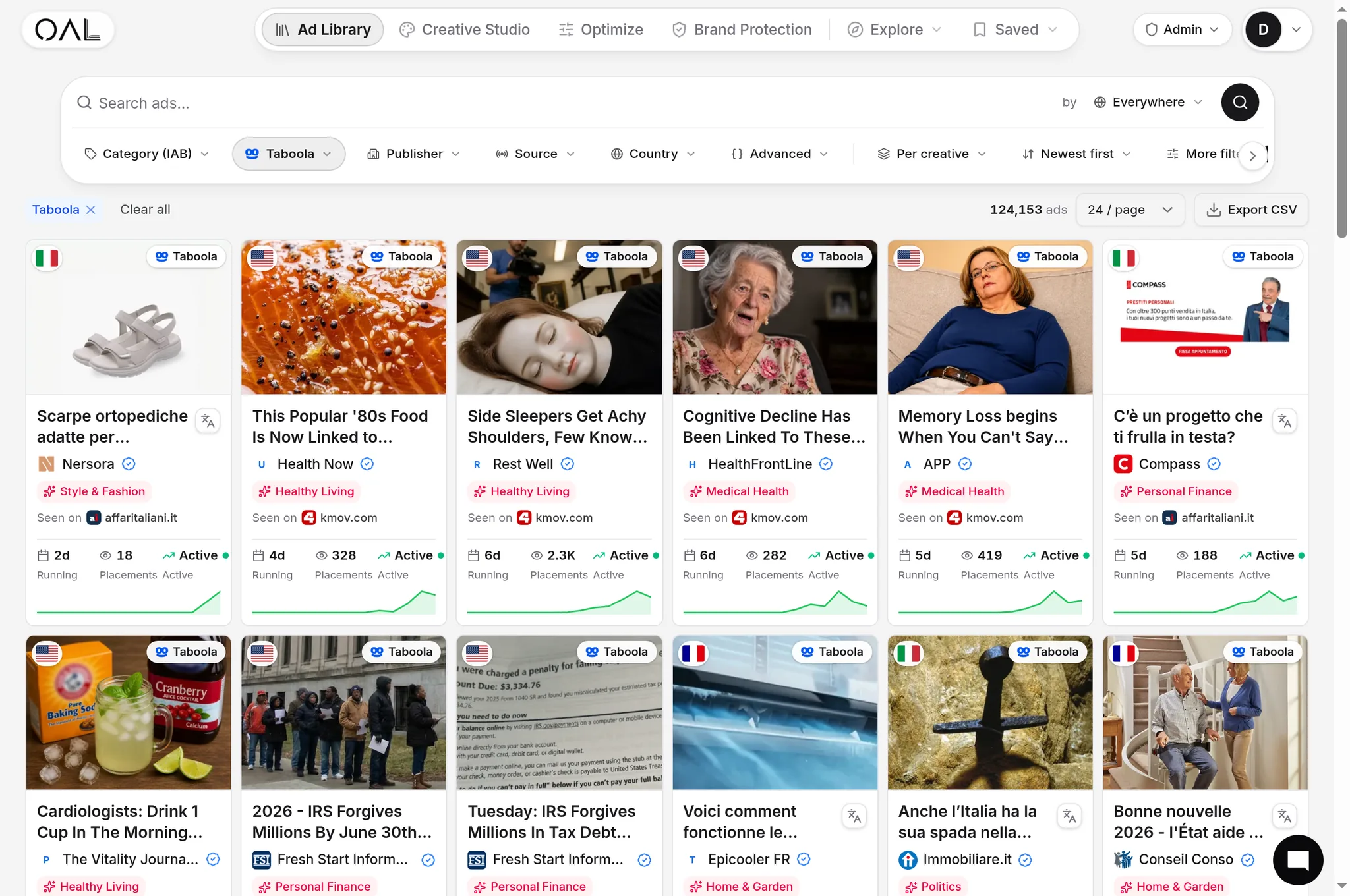
This is the gap OpenAdLibrary is built to close. It captures live public native ads across Taboola, Outbrain, MGID, Revcontent, Teads, MSN, and Yahoo (42 networks and 25,933 advertisers indexed so far), preserves the real creative image at full quality, identifies the actual advertiser behind each placement rather than just the network, and follows the click through to the landing page or pre-lander, without ever clicking a live ad. We've logged over 5.4 million ad observations and 926,000+ landing-page captures, which is what lets you answer questions that would otherwise take a month and a test budget to discover.
Longevity is the single most useful signal here. The longest-running creatives in our index have been observed live and continuous for 28 days straight (the current span of our capture window). When an advertiser keeps the same ad alive that long, it's usually paying for itself. SmartAsset has been running this finance angle on Outbrain across our full observation window:

A note on "winners": industry lore loves the "90-day winner" rule of thumb. That's general folklore, not something we can confirm. What we can tell you is what we directly observe, and right now that ceiling is 28 days of continuous capture. Read longevity as a relative signal (28 days beats three days), not an absolute one.
Before you launch, competitive data answers three things cleanly:
- Who is committed here? An advertiser running the same offer for weeks across dozens of sites has found something that works. A one-day burst hasn't. (Compare the 13-day IRS ad above against a dating creative we caught on day zero.)
- What does a winning funnel look like? Seeing the captured creative and the pre-lander it points to gives you a complete reference funnel for your vertical.
- Where is the demand concentrated? In our index, finance (17,232 creatives), insurance (15,629), and health (14,895) are the three most-captured native verticals overall, with ecommerce (13,872) close behind. That's where the supply, and the competition, is densest.
You're not copying ads. You're reading the market. The same discipline that makes a good Meta buyer (study the swipe file, model the winners, then differentiate) applies, except native ads are public and traceable in a way Meta's are not.
A staged migration plan#
Diversification fails when buyers treat it as a budget reallocation. Pulling spend off a profitable Meta account to fund an unproven native test is how you end up with two underperforming channels. The right framing is addition, then graduation: add a small learning budget to native while Meta runs at full strength, and only graduate spend toward native once it clears break-even at stable volume.
- Recon (week 0). Use competitive data to pick a vertical, a starting network, and two or three reference funnels to model. Decide your break-even CPA before you launch anything.
- Pick one network first. Don't spread a thin budget across four networks. For most English-speaking direct-response advertisers, Taboola is the natural first move. It powers Yahoo's native inventory under a long exclusive deal, so a single platform reaches a vast premium-publisher footprint. Our step-by-step Taboola setup guide walks the account build.
- Build the funnel native expects. Creative (curiosity headline + image), then pre-lander, then offer. Reuse your Meta angles as raw material, but rebuild the funnel for a reading audience.
- Test with money you can afford to lose learning. A few hundred dollars per network over two to three weeks, with enough daily budget to gather real data. This is tuition, not profit-seeking.
- Read the data at the widget/site level. Native's edge is granularity. Cut the sites bleeding money, lean into the ones converting, and let the campaign find its profitable supply. The mechanics of this disciplined ramp are in our native media buying beginner's guide.
- Graduate, then scale. Once a campaign clears break-even at stable volume, now you scale. And only now does it make sense to shift your channel mix.
Geography is one of native's quietest advantages over Meta. Tier-2 and Tier-3 markets carry cheaper, less-contested inventory, and a working funnel can be cloned across geos at a fraction of Tier-1 CPMs. This solar-battery ad has been running 27 days, the kind of durable regional angle that ports well:

The playbook for cloning a winner across regions is in scaling to new geos. And there's a real choice between pushing a proven winner harder on the same supply versus expanding to new placements, which we unpack in horizontal vs vertical scaling.
Choosing your native networks#
The native landscape consolidated sharply, which actually simplifies the choice. Taboola now powers Yahoo's native supply, and Outbrain acquired Teads in early 2025 (the combined company operates as Teads). That leaves a clear hierarchy for a diversifying buyer:
- Taboola (+ Yahoo) is the largest premium-publisher footprint and the biggest single source in our index (157,727 creatives). It's the default first test for most verticals.
- Outbrain / Teads brings strong premium reach with a video and branding lean post-merger (84,252 creatives captured). A natural second network.
- MGID and Revcontent carry cheaper, higher-volume traffic that tends to perform in Tier-2/3 geos and aggressive direct-response verticals. Useful for volume once you've proven a funnel.
Pick based on evidence, not reputation. On Taboola, the densest verticals in our data are health (6,048 creatives), finance (5,558), and insurance (4,303). On Outbrain, finance (2,640) and insurance (2,615) lead instead. If the durable advertisers in your vertical cluster on one native ad network, that's where your funnel has the best odds, and competitive data shows you that faster than any guide can. Each network runs its own programmatic native auction with its own quirks, so plan to learn one well before adding the next.
Even outside the big two, the signal holds. Health offers are everywhere in native, and the angles are remarkably consistent. Here's a hearing-aid ad that's been live 26 days:

The diversification mindset#
Channel diversification is not a project you finish. It's a posture you maintain. The buyers who weather platform shocks treat every channel as temporary and every winner as something to be understood, modeled, and ported elsewhere. Native is the highest-leverage second engine for a Meta-dependent business because the skills carry over while the risks don't correlate. The same logic eventually points you toward a third channel, and a fourth.
The through-line is intelligence. Whether you're entering native, expanding to a new geo, or pressure-testing a competitor's funnel, the advertisers who move fastest are the ones who read the market before they spend. OpenAdLibrary makes that reconnaissance affordable and open: live native ad capture, the real advertiser behind each ad, and the full click path to the landing page, for a fraction of what legacy spy tools charge. Start free and browse 200 ads with no card to see what your competitors are running before you commit a dollar.
Build the second engine while the first one is still running. That's the whole strategy.