Español
 Português (Brasil)
 Français
 Deutsch
 Italiano
 Nederlands
 Polski
 Svenska
 Türkçe
 Русский
 日本語
日本語 한국어
한국어 简体中文
简体中文 Tiếng Việt
 Bahasa Indonesia
 繁體中文
繁體中文 Čeština
 Dansk
Dansk Norsk (bokmål)
 Suomi
Suomi Ελληνικά
 Română
 Magyar
 Українська
 ไทย
ไทย हिन्दी
 العربية
 עברית
עבריתWhat Is Taboola Realize? The Rebranded Ads Platform Explained
Realize is Taboola's 2025 rebrand of its advertiser platform — a strategic repositioning from 'content discovery' to performance advertising. Here is what genuinely changed, what didn't, and how to evaluate it.


Taboola Realize is the performance advertising platform Taboola launched in February 2025 — a rebrand and expansion of what was previously called Taboola Ads. Same company, same auction, same publisher network underneath: Realize repositions Taboola from a "content discovery" vendor into a general performance channel competing for budgets that historically went to Meta and Google, with placements beyond the classic recommendation feed and heavier automation in bidding and creative. If you buy Taboola traffic, Realize is the console you now log into; if you compete against Taboola advertisers, nothing about their ads became less observable.
Why Taboola rebranded#
Three forces pushed the change, and none of them were cosmetic.
The category name had become a ceiling. "Native advertising" and "content discovery" describe a widget, and the widget carries chumbox baggage. Advertisers allocate budget to outcomes, not formats — so Taboola began selling itself the way its buyers already thought: performance advertising, benchmarked against paid social and search rather than against other native ad networks.
The supply outgrew the feed. Between the 30-year Yahoo partnership signed in 2022, the deal to sell native slots inside Apple News and Apple Stocks, and a widening set of placement formats on publisher partners, "the recommendations widget under the article" stopped being an accurate description of what Taboola could deliver. Realize is partly a label for that broader inventory.
Its main rival did the same thing. Outbrain closed its acquisition of Teads in February 2025 and took the Teads name — the story we cover in did Outbrain become Teads. Both of the big native networks concluded, in the same season, that their future budgets come from performance and omnichannel positioning, not from the word "native." When the two dominant players in a category rename themselves within weeks of each other, that is the category telling you where it thinks the money is.
What actually changed for advertisers#
- The name and the console. Taboola Ads became Realize. Campaigns, accounts and billing carried over; buyers did not rebuild anything.
- Positioning around outcomes. The platform leads with conversion- and CPA-oriented buying rather than traffic delivery. Taboola's automated bidding heritage — SmartBid — sits under this, with the emphasis shifting toward goal-based modes over manual CPC nudging.
- More placement variety. Realize sells beyond the classic feed unit: expanded formats across its publisher partners and syndicated supply. The exact placement catalog evolves quickly — check Taboola's current documentation rather than trusting any month-old summary, including this one.
- AI tooling. Creative generation and campaign-assistant features became first-class product surfaces rather than experiments. Useful for velocity; no substitute for knowing which angle to feed them.
What stayed the same#
More survived the rebrand than changed, which is the practical takeaway:
| Layer | Status after Realize |
|---|---|
| Auction model | Unchanged — CPC-first bidding, yield-ranked by bid × CTR |
| Core inventory | Unchanged — recommendation feeds on publisher sites remain the volume |
| Campaign anatomy | Unchanged — campaigns, creatives, geo/device targeting, site blocking |
| Editorial review | Unchanged — creatives still pass content policies before serving |
| What readers see | Unchanged — sponsored feed items with the same disclosures |
The rebrand parallels its competitors' moves rather than diverging from them: Outbrain now trades as Teads (see what is Teads), and Yahoo folded its Gemini native product into the Yahoo DSP years earlier — a lineage we trace in what happened to Yahoo Gemini. The native ad industry keeps renaming itself; the feeds keep serving.
Does Realize change what Taboola costs?#
No — the pricing machine carried over with the platform. Buying remains a CPC auction with no rate card: you bid, the auction ranks ads by bid multiplied by predicted CTR, and you pay per click. Media buyers commonly report Tier-1 desktop CPCs of roughly $0.30–$0.90 and mobile at $0.10–$0.45, sliding lower through Tier-2 and Tier-3 geos — practitioner-reported ranges, not official prices, and unchanged in kind by the rebrand. Minimum daily budgets and per-geo CPC floors still exist and still vary by market; check Taboola's current documentation for the figures that will apply to your account.
What the rebrand may change over time is the default path to those prices: Realize leans buyers toward goal-based automated bidding, which spends differently — better with strong conversion signal, more erratically without it. The budgeting fundamentals are the same as ever, and a decision-grade test still commonly runs $1,000–$3,000 regardless of what the console is called.
How to evaluate Realize if you're new to Taboola#
The rebrand will put Taboola in front of performance buyers who never considered "native" a channel. If that's you, evaluate it like a channel, not a brand launch:
- Start with the corpus, not the pitch deck. Look at who already spends and stays. In OpenAdLibrary's June 2026 snapshot of the network, health is the largest advertiser vertical with 11,982 classified live creatives, followed by finance (8,200), insurance (7,422), ecommerce (5,185), home & garden (4,414) and software (3,665). If your category is represented and its creatives run for weeks, the channel demonstrably supports your economics; if it's absent, you're the experiment.
- Price it with cold-traffic math. Taboola clicks are interruption clicks from content feeds. Media buyers commonly report Tier-1 desktop CPCs in the tens of cents — far below search, but converting them requires story-first funnels, and a decision-grade test commonly runs $1,000–$3,000. Realize's performance framing does not change the temperature of the traffic.
- Discount the automation until you have signal. Goal-based bidding and AI creative tools are the headline features, and all of them run on your conversion data. A new account has none. Wire tracking first, buy signal with manual or lightly automated settings, then let the automation compound what works.
- Keep the old-network disciplines. Site blocking, geo/device splits, creative volume over creative attachment — every practice that made Taboola work under its old name still applies under the new one.
What Realize means in practice#
If you buy Taboola traffic: expect the platform to default you toward automated, goal-based bidding and AI-assisted creative. Those defaults are fine once your conversion tracking is solid and your account has signal — and expensive when it isn't. The fundamentals that decided your results before the rebrand still decide them: creative CTR is your real bid, publisher hygiene is mandatory, and a decision-grade test needs proper budget. Our guide to how Taboola ads work holds up under the new name because the machine underneath is the same.
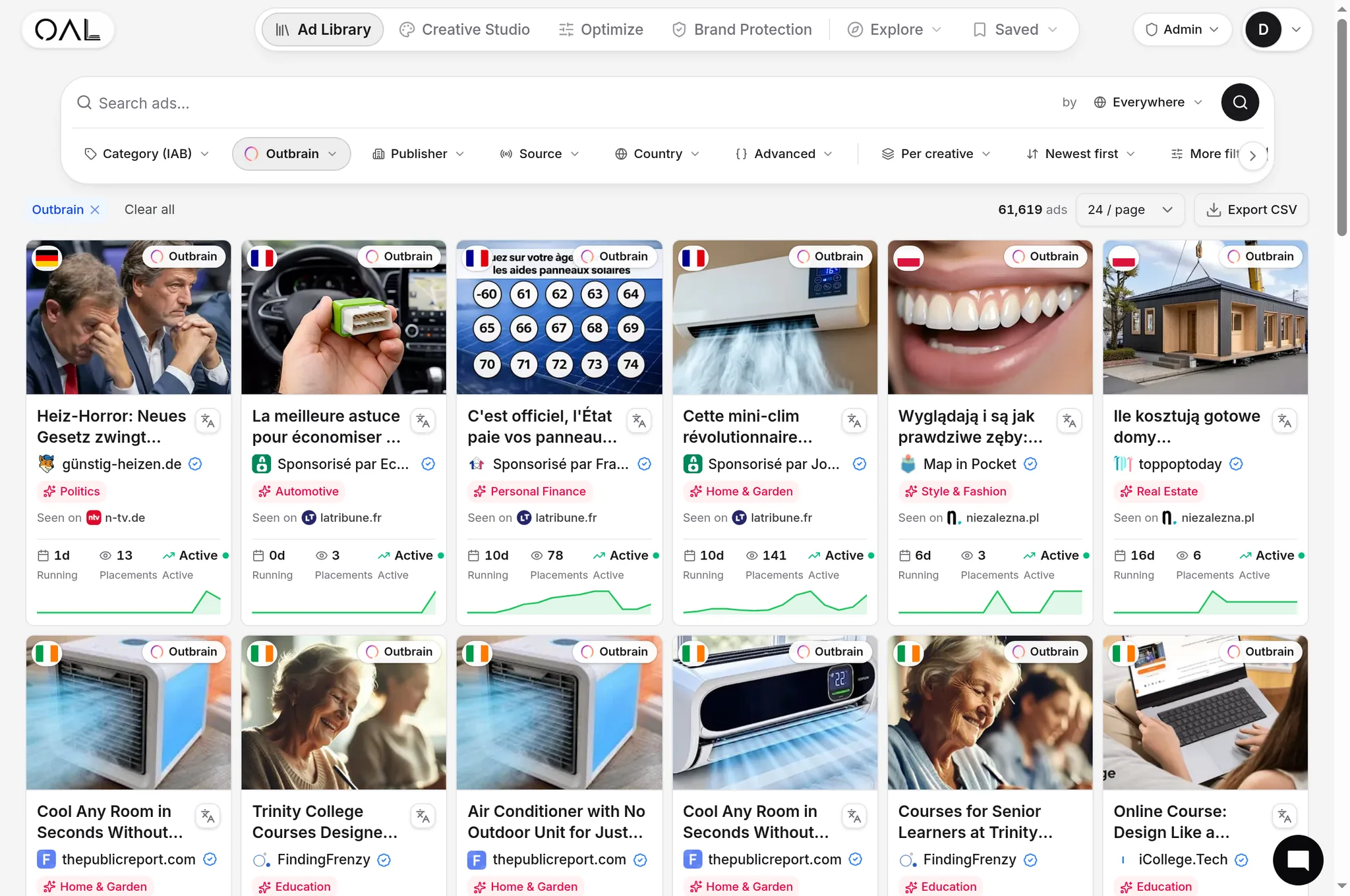
If you research Taboola advertisers: nothing changed. The ads Realize serves are public placements on publisher pages, which means they remain observable no matter what the console is called. OpenAdLibrary's index tracked 206,145 live Taboola creatives as of June 2026 — headlines, resolved advertisers, run durations, geo and device data, traced landing pages — and you can search it free at /spy/taboola. The Taboola ad library walkthrough shows what the corpus holds and how to read it.
If you're choosing between networks: treat Realize as Taboola with wider inventory and a performance accent, then compare it head-to-head the way you would have last year — Taboola vs Outbrain covers that matchup with live data on both sides of the merger-and-rebrand season.
The one-paragraph version#
Taboola Realize is a renaming with a strategy attached, not a new network. The auction, the feed inventory and the advertiser playbook carried over intact; what changed is the pitch (performance, not discovery), the breadth of placements, and how much automation the platform reaches for by default. Judge it the way the market will: not by the brand, but by whether the clicks still price out — and check what its current advertisers keep paying to run before you join them.