 Español
 Português (Brasil)
 Français
 Deutsch
 Italiano
 Nederlands
 Polski
 Svenska
 Türkçe
 Русский
 日本語
日本語 한국어
한국어 简体中文
简体中文 Tiếng Việt
 Bahasa Indonesia
 繁體中文
繁體中文 Čeština
 Dansk
Dansk Norsk (bokmål)
 Suomi
Suomi Ελληνικά
 Română
 Magyar
 Українська
 ไทย
ไทย हिन्दी
 العربية
 עברית
עבריתHow to Advertise on Taboola: Step-by-Step Campaign Setup
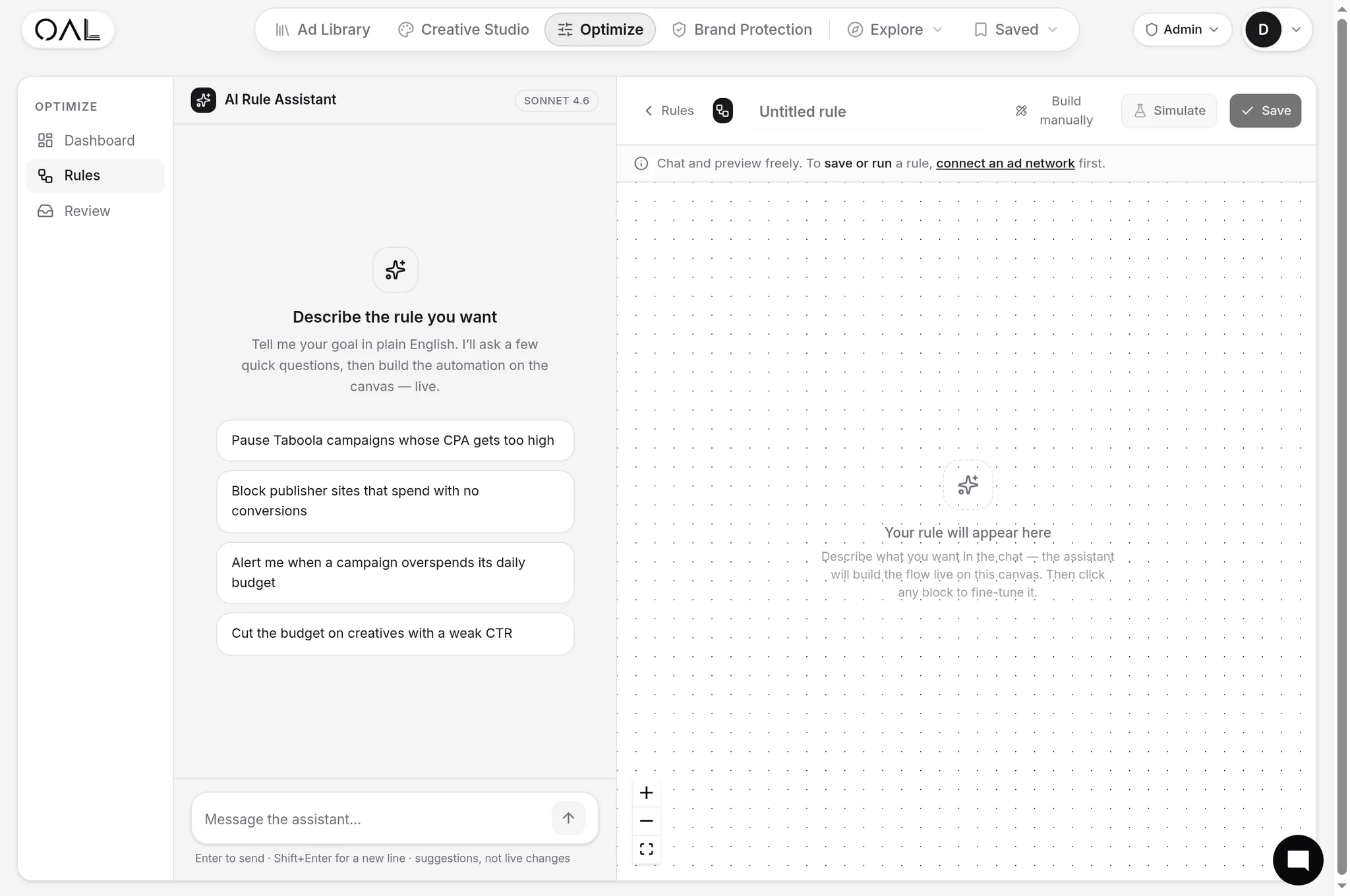
Most Taboola guides stop at "write a curiosity headline." This one walks the full Realize setup, budget math, Maximize Conversions, targeting, tracking, then shows what winning native creatives actually look like using live captured ads.

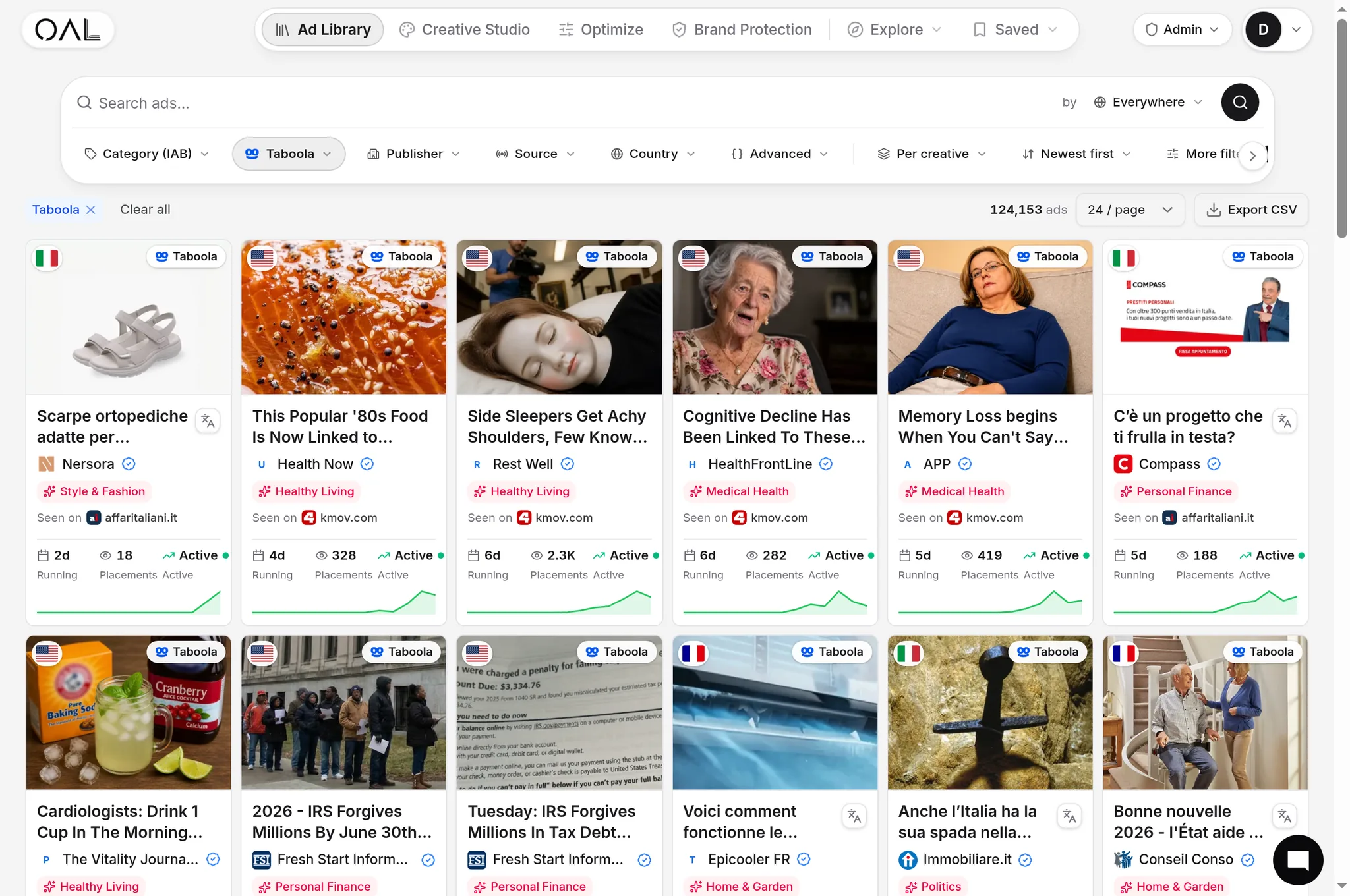
Taboola is the biggest native discovery network on the open web. Its recommended-content widgets sit on news, finance, and lifestyle publishers you simply cannot buy through Facebook or Google. We have captured 157,727 live Taboola creatives so far (OpenAdLibrary index, June 2026), and the pattern in that data is clear: if you sell something that benefits from a story, supplements, finance offers, e-commerce, lead gen, content arbitrage, Taboola is still one of the few places where a cold click is cheap and a good funnel can scale to four figures a day.
This is a setup walkthrough, not a pep talk. We go account, budget, bidding, targeting, tracking, then spend the back half on the part most guides wave away: what a winning native creative actually looks like, using real ads we have captured rather than recycled "write a curiosity headline" advice.
How to advertise on Taboola, in brief#
To advertise on Taboola, create an advertiser account in Taboola Realize, install the Taboola pixel and define a conversion, build a campaign with a daily budget of roughly 10x your target CPA, switch to Maximize Conversions bidding once the pixel has data, upload a 16:9 image (1000x600) with a 34 to 45 character headline, target by platform and geo, then launch and let the algorithm find converting publishers before you start cutting losers. The rest of this guide is the detail behind each of those moves.
Step 1: Set up the account and the pixel first#
Sign up at the Taboola advertiser platform. The current dashboard is called Realize, Taboola's 2025 rebuild that folds contextual signals, deep-learning prediction, and generative creative tools into one console. Verification and a small initial deposit get you live. There is no enterprise gatekeeping for self-serve accounts.
Before you build a single campaign, install the Taboola pixel on your site and define at least one conversion event: a purchase, a lead, or a meaningful intermediate action. This is non-negotiable, and it is where most beginners lose their first $500. Taboola's optimization is only as good as the signal you feed it. Without a firing conversion event, the algorithm optimizes for clicks, and clicks are not the business.
The single highest-leverage thing a new Taboola advertiser can do is have a working conversion pixel on day one. Bidding, the learning phase, scaling, all of it depends on that signal. A campaign that runs a week on clicks-only is a week of training data thrown in the bin.
If you run an affiliate or content-arbitrage funnel where you do not own the final conversion, send a server-side (S2S) postback so Taboola still sees the event. The platform's whole value is the algorithm. Starve it and you are just buying random traffic.
Step 2: Build the campaign and get the budget math right#
A Taboola campaign bundles your budget, bid strategy, targeting, and a set of creatives. The first real decision is the daily budget, and the number is not arbitrary. It comes straight from your CPA goal and the algorithm's appetite for data.
| Bid strategy | Recommended daily budget | When to use it |
|---|---|---|
| Maximize Conversions | ~10x your target CPA | Default once the pixel has conversion data |
| Enhanced CPC | ~5x your target CPA | Transitional, some automation, more control |
| Fixed CPC | ~5x your target CPA | Cold start, manual site and creative discovery |
The logic is simple. To exit the learning phase, the system needs enough conversions per day to model what a converter looks like. If your target CPA is $30, a $300 daily cap gives the algorithm room to find roughly ten conversions and actually learn. Set the cap at $40 and you stall in learning forever, then blame the platform for your own starvation.
For the cold start, before you have conversion history, think in clicks instead. Taboola wants new campaigns to clear 100 to 200 clicks per day to gather signal. At a $0.50 CPC bid, that is a $50 to $100 daily budget just to gather enough data to make a decision. Budget below that and you are reading noise, not results.
If this fund, gather, decide, redeploy cadence is new to you, our media buying for native ads guide covers the rhythm in depth.
Step 3: Choose a bidding strategy that matches your data#
Native advertising on Taboola runs on an auction. You compete for placement in recommendation widgets across thousands of publishers, and how you bid into that auction sets both your cost and your ceiling on scale.
- Fixed CPC. You set the exact cost per click. Best at the very start, when you have zero conversion data and want to manually find which publisher sites convert before you hand the wheel to the machine.
- Enhanced CPC. Your base bid, nudged up or down by Taboola based on conversion likelihood. A reasonable bridge once you have early signal.
- Maximize Conversions. Taboola's recommended default, powered by its SmartBid machine-learning system. It reads historical network data and first-party signals to predict conversion rates and sets bids automatically toward your goal.
The practical sequence: open on fixed or enhanced CPC, let the campaign accumulate 15 to 30 conversions so the model has something to learn from, then switch to Maximize Conversions and stop fiddling. The most common self-inflicted wound on Taboola is flipping to full automation with no conversion history, then panic-editing every few hours and resetting the learning phase each time. Pick a strategy, fund it properly, and give it 3 to 5 days of stability.
It helps to know how the plumbing works underneath. Taboola buys across both its direct publisher integrations and the open programmatic market, so your bid competes through real-time bidding and supply that flows through publisher header bidding setups. You do not manage that machinery directly, but it explains why the same creative can win cheap impressions on one site and get priced out on another.
Step 4: Targeting, let the algorithm work but set guardrails#
Taboola targeting is deliberately coarser than social. You do not get granular interest stacks. You get platform (desktop, mobile, tablet), geo, operating system and browser, connection type, and publisher-site controls. The strategy is the inverse of Facebook: start broad, let the algorithm find your audience inside the traffic, then prune.
- Platform. Split desktop and mobile into separate campaigns from day one. They have different CPCs (mobile averages roughly half of desktop), different creative behavior, and different conversion rates. Mixing them hides which one is actually profitable.
- Geo. Match your offer's footprint. If you can serve Tier-2 and Tier-3 markets, Taboola is one of the best places to find cheap, uncrowded traffic there. We cover that play in scaling to new geos.
- Publisher sites. This is your real lever. Let the campaign run broad for a few days, read the per-site report, then pause the placements that spend without converting. Block the obvious junk and keep the converters.
Resist the urge to over-restrict at launch. A heavily pre-filtered campaign gives the algorithm too little room to discover where your offer actually lands. Broad first, ruthless second.
Step 5: Build creatives that look like the page they sit on#
Here is where setup meets craft. A Taboola ad is three parts: image, headline, and the landing experience behind the click, all rendered inside a recommendation widget that sits among a publisher's own articles. The ad that wins is the one that belongs there.
The verified specs:
- Image: 16:9 landscape, 1000x600 or 1200x600 px. JPEG preferred, minimum 400px wide. One clear subject, no embedded text or logos (they get cropped on auto-resize), uncluttered background. Faces looking into the camera reliably lift click-through.
- Headline: 34 to 45 characters performs best, 60 is the hard cap. Specific beats clever every time.
The specs are the easy part. The hard part is knowing which patterns convert in your vertical right now, and that is exactly what you cannot get from a best-practices PDF, because it changes monthly and varies by offer. This is where studying live ads beats guessing.
Health is the single most contested vertical on Taboola in our data, with 6,048 active creatives, narrowly ahead of finance at 5,558 and insurance at 4,303 (OpenAdLibrary index, June 2026). So if you are entering one of those, you are walking into a crowded auction, and your creative has to do more work. Here is a real finance ad we captured, running for 13 days straight at the time of capture:

Notice what it does: a date, a dollar implication, a deadline. No brand logo, no studio polish. It reads like a news alert, not an ad. That is the whole game. When you look at what is running and staying running on Taboola, a few creative patterns repeat across the winners.
- The everyday-person image, not the studio shot. Native ads that mimic candid, slightly imperfect photography blend into the editorial feed and outperform polished stock. The image should read as a thumbnail from an article, not an ad.
- The implied-story headline. Take a real captured one: "MDs Identify 10 Medications Now Attached to Memory Problems In Seniors (See the List)." It works because it promises a list the widget cannot fully show. Curiosity anchored to specifics, an authority and a number, not empty clickbait.

- Tight image-to-headline coherence. The image raises a question the headline starts to answer. Mismatched pairs still get clicks, but they waste them. You pay for the click either way, so quality of click matters more than volume.
- A bridge page, not a hard sell. Cold Taboola traffic rarely converts on a raw product page. Winners route through an advertorial or pre-lander that continues the story before the offer. The click-through ad is only the first of three or four pages doing the persuasion.
Geo-specific angles matter too. Local credibility cues sell. Here is an Australian life-insurance ad that leans entirely on the reader recognizing themselves:

The way to make all of this concrete for your vertical is to study ads that have already proven themselves. Industry lore says a creative that survives 90 days is a printing press, and that is broadly true, but be careful citing numbers you cannot see. What we can actually observe is up to about 28 days of continuous live capture per creative in our index right now. The longest-running ads we are currently tracking have held for that full 28-day window, names like SmartAsset's "Ask a Pro" tax angle and Hidden Hearing's hearing-aid creatives, which is a strong signal those funnels are profitable. An ad that has been live for weeks across dozens of placements is, by definition, working. Nobody runs unprofitable native ads at scale for a month. That longevity-and-spread signal is the most useful creative-research input you have.
This is the gap an ad-intelligence tool closes. OpenAdLibrary captures live Taboola ads at full image quality, identifies the real advertiser behind each one (not just the network), and traces each click through to the landing page and pre-lander, without clicking live ads. So instead of guessing, you can pull up the Taboola ad spy view, sort by how long a creative has run, see which advertisers are scaling which angles, and reverse-engineer the whole funnel: thumbnail, headline, bridge page, offer. Then you model the structure of what is working rather than copying any single ad. Choosing where to point that research first is its own decision, and our data-backed look at the best native verticals is a good starting map.
Step 6: Launch, read the data, then scale#
Launch with multiple creatives per campaign, five to ten image and headline combinations, so the algorithm has variants to test. Then leave it alone for the learning window. After a few days, this is the data you read:
- CTR by creative. Kill the bottom performers, but do not over-cull before each has spent enough to be statistically real.
- CPA and ROAS by publisher site. Your primary optimization surface. Pause spenders that do not convert, bid up the sites that do.
- Conversion rate by platform and geo. Confirms your desktop/mobile and geo splits were right.
Once a campaign is reliably profitable, scaling on Taboola has two directions. You can lift the budget and bids on what is working (vertical), or duplicate the winning structure into new geos, platforms, and publisher pools (horizontal). Push budget too fast and CPA spikes, because you drag the algorithm back into learning. Scaling without wrecking your margins deserves its own playbook, so see how to scale affiliate campaigns without killing ROI and the trade-offs in horizontal vs vertical scaling.
The setup is the easy 20%#
Anyone can fill in the Realize campaign form. The 80% that decides whether you make money is the creative-and-funnel research that happens before you launch and the disciplined reading of site-level data after. Taboola rewards advertisers who treat it as a system to be learned, not a button to be pushed.
If you want to start that research the smart way, by studying the live Taboola ads, advertisers, and landing pages that are already winning instead of burning budget to discover them yourself, start free and browse the captured library before you spend a dollar on traffic. For the broader strategy this fits into, the native advertising for affiliate marketing playbook is the pillar that ties it all together.