Español
 Português (Brasil)
 Français
 Deutsch
 Italiano
 Nederlands
 Polski
 Svenska
 Türkçe
 Русский
 日本語
日本語 한국어
한국어 简体中文
简体中文 Tiếng Việt
 Bahasa Indonesia
 繁體中文
繁體中文 Čeština
 Dansk
Dansk Suomi
Suomi Ελληνικά
 Română
 Magyar
 Українська
 ไทย
ไทย हिन्दी
 العربية
 עברית
עבריתReverse-Engineer a Competitor's Native Ad Funnel (Creative to Landing Page)
A native ad is just the doorway; here is how to walk the full chain behind it, from creative to SSP to click tracker to pre-lander to offer page, and read what each link reveals about a competitor's strategy.

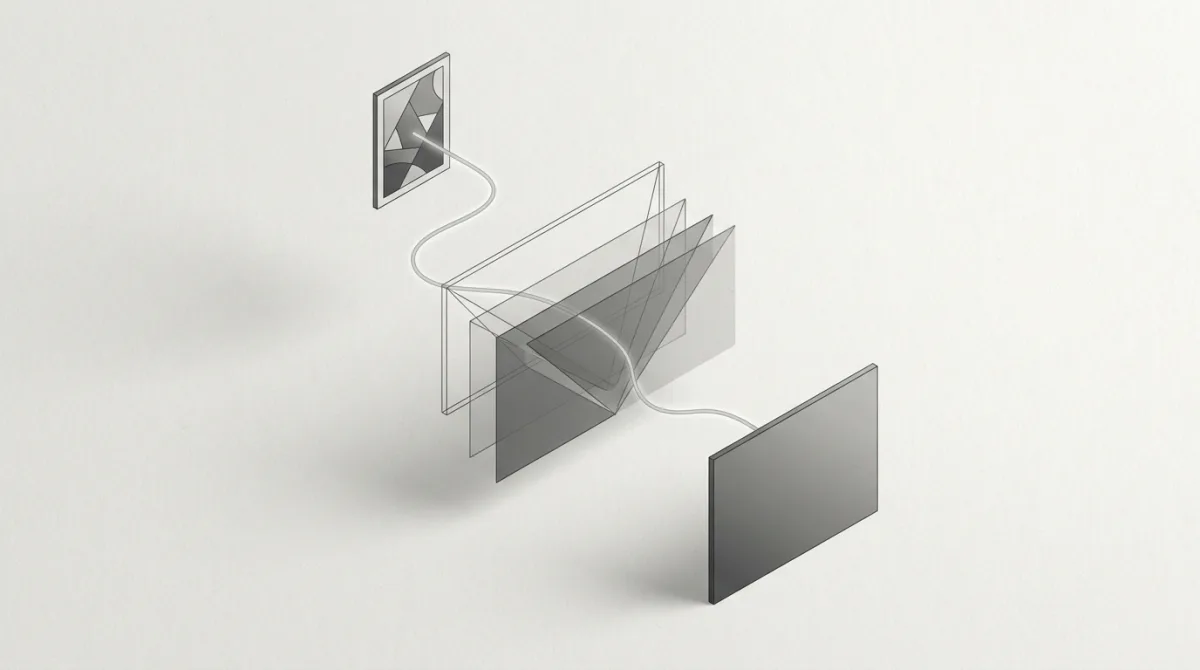
A native ad is not the strategy. It is the doorway. The strategy lives in the chain behind that doorway: the supply path the impression travels, the click tracker that routes the visitor, the pre-lander that warms them up, and the offer page that closes the sale. Screenshot the creative and you have studied the cover and skipped the book.
This guide walks the entire chain. You take one native unit (a Taboola headline, an Outbrain thumbnail, an MGID card) and pull it apart link by link until you understand not just what a competitor is running but how the whole funnel is wired to convert. That is the difference between people who copy headlines and lose, and people who reverse-engineer funnels and win. It sits one level deeper than a general competitor ad spy workflow, and it is the part most tools quietly skip.
For scale: across the OpenAdLibrary index (June 2026) we have captured 589,036 native creatives from 25,933 advertisers across 42 networks, and resolved 926,259 landing-page captures behind them. That last number is the one that matters here. Almost no other tool keeps the page behind the click.
What it actually means to reverse-engineer a native ad funnel#
Reverse-engineering a native ad funnel means tracing one ad backward and forward through its full delivery chain: the creative and headline, the network that served it, the click-tracking redirect that routes the click, and the landing page (usually a pre-lander, then an offer page) the advertiser sends traffic to. The goal is to recover the competitor's complete conversion path, not just the ad they showed you.
Most marketers stop at the first link because most tools stop there. The chain has five links, and each one answers a different question.
| Link in the chain | What it is | What it tells you |
|---|---|---|
| Creative + headline | The image and copy the user sees | The angle, the hook, the audience |
| Native widget / SSP | The native ad widget and supply path | Which network and publishers they buy |
| Click tracker | The redirect URL (e.g. a tblci or Outbrain click param) |
The real advertiser, the tracker, the attribution setup |
| Pre-lander / bridge page | The advertorial or quiz between ad and offer | The persuasion logic and compliance posture |
| Offer / landing page | The final conversion page | The product, price, and call to action |
The creative tells you what a competitor is saying. The landing page tells you what they are selling. The chain in between tells you how they connect the two. Skip the middle and you are reverse-engineering a slogan.
Here is what a real captured creative looks like at the top of one of these chains. Note the headline construction: a dollar figure, a deadline, a "forgiveness" hook. Every word is doing a job.

Why native is harder to trace than Meta, and why that is the opportunity#
Anyone can open Meta's Ad Library and see a brand's social creatives. That transparency is a commodity. Everyone has the same view. Native advertising is the opposite. There is no single public library for Taboola, Outbrain, MGID, Revcontent, Teads, or MSN. The ads are scattered across thousands of publisher pages, served programmatically, and the destination is buried behind redirects.
That opacity is exactly why native funnels stay profitable longer, and exactly why this work pays. The harder a thing is to see, the more edge there is in seeing it clearly. The catch: the two hardest links to recover, the click tracker and the landing page, are the two that Meta-only spy tools cannot show you for native inventory. They index ad images. They do not follow the click.
This is the gap that defines the rest of the guide. A platform built specifically for native, like OpenAdLibrary, captures the live public unit, follows the click in a controlled environment, and stores the resolved landing page as evidence, without ever clicking the live ad in a way that costs the advertiser or flags you. That stored, end-to-end chain is the difference between guessing at a funnel and auditing it.
Step 1: Capture the creative as evidence, not a memory#
Start with the unit, but capture it properly. A real teardown record includes:
- The full-quality creative image, not a thumbnail re-compressed to mush
- The exact headline and any description text
- The publisher and placement where it appeared
- The network that served it
- The first-seen and last-seen dates
That last pair is the most underrated data in native. Advertisers cut losing funnels fast, so a creative that has been live and unchanged for weeks is broadcasting that it is profitable. Our index currently spans up to about 28 days of continuous observation per creative, and the ads sitting at that ceiling are a useful watch list on their own. One example holding at 28 days is a SmartAsset finance ad on Outbrain ("Ask a Pro: How Can I Avoid Paying Taxes on IRA Withdrawals?"), and another is a Hidden Hearing hearing-aid ad on the Microsoft Audience Network. When a brand keeps the same chain live that long, it is not testing anymore. It found a winner.
A quick honesty note, because the difference matters: that ~28-day figure is what we have observed, not an industry law. You will still hear media buyers talk about "90-day winners" as a rule of thumb. Treat that as general lore, not our data. What we can show you is the observed run length on a specific funnel, which is the number you should actually act on.
For the discovery half of this (finding which ads a rival is even running), pair this with the step-by-step guide to finding competitor ads.
Step 2: Identify the supply path, who served this and where#
The next link is the network and publisher set. A single advertiser runs the same creative across dozens of native widgets on different publishers, and the spread tells you how confident they are. One placement is a test. The same funnel across forty publishers and five geos is a scaled winner.
What to record at this step:
- Network: Taboola, Outbrain, MGID, Revcontent, Yahoo/MediaGo, MSN, Teads
- Publishers: which sites carry the widget
- Geos: which countries the unit serves in
- Device split: many native funnels are mobile-only or desktop-only by design
Scale skews heavily toward two networks. In our index Taboola accounts for 157,727 captured creatives and Outbrain for 84,252, which is why most teardowns you do will start on one of those two. The vertical mix is just as telling. Finance leads everything at 17,232 creatives, followed by Insurance (15,629) and Health (14,895). If you buy in those spaces, you are fighting for attention against the most heavily worked angles on the open web.
Here is what that finance and insurance pressure looks like as a real placement. This is an Australian life-insurance unit running on Taboola, the kind of geo-targeted lead-gen ad that fills the Insurance category:

This is where a structured native ad spy tool earns its keep. Instead of browsing publisher sites hoping to catch a widget, you query by advertiser, network, or angle and see the full footprint at once. The mechanics of capturing each network, and their quirks, are covered in the dedicated guide to spying on Taboola, Outbrain, and MGID.
Step 3: Follow the click, the link that reveals the real advertiser#
Here is where most research dies and where the real intelligence begins.
When a user clicks a native ad, they do not go straight to the advertiser. They pass through a click tracker. On Taboola the destination URL carries a tblci click identifier that encodes both the user and the advertiser account. Outbrain uses its own click parameter. Affiliate funnels often stack a third-party tracker (Voluum, RedTrack, Binom) on top of that. The visible "brand" on the widget is frequently just a generic content label or the publisher, not the business actually paying for the traffic.
You can see this in the captured data itself. Look at the brand names attached to these units: "Consumer World," "Vital Guardian," "The Vitality Report," "Fresh Start Information." Those are not the companies selling you anything. They are content-style labels chosen to look like a publisher byline. The real advertiser sits at the end of the redirect chain, in the tracker parameters and the landing-page domain you resolve to.

This is also the most dangerous step to do by hand. Clicking a live native ad:
- Costs the advertiser money (you just spent their CPC)
- Can pollute their analytics and attribution
- May flag your IP or fingerprint as a competitor
- Often shows you a cloaked or geo-mismatched page, not what their real prospects see
The professional approach is to never trigger the live click yourself. Rely on a system that has already followed the click in a controlled, geo-aware environment and stored the resolved destination, the tracker hop and the final URL, as a record you read after the fact. That is the core of OpenAdLibrary's click-trace, and it is why those 926,259 stored landing captures exist: each one is a click someone followed in a controlled environment so you do not have to hit the live unit. It is the single capability that turns "I saw their ad" into "I can attribute their ad to the exact advertiser and tracker behind it."
Step 4: Read the pre-lander, where the persuasion actually happens#
The redirect rarely lands on the offer. In native it lands on a pre-lander, also called a bridge page. This is the advertorial, the quiz, the "I tried this for 30 days" story, the listicle that ranks five products. The pre-lander does one job: turn a cold, curiosity-driven native click into a warm, intent-loaded visitor before handing them to the offer.
This is the most valuable page in the funnel to reverse-engineer, because it carries the competitor's actual persuasion architecture. When you tear one down, document:
- The angle: health scare, financial anxiety, before/after, authority endorsement, curiosity gap
- The format: advertorial article, quiz or survey, listicle, video sales letter, news-style story
- The proof elements: testimonials, comment sections (real or fake), "as seen on" logos, data claims
- The compliance posture: disclaimers, "results not typical," advertorial labels (tells you how aggressive the vertical is)
- The CTA mechanics: how and when the page pushes to the offer (timer, scroll-triggered button, quiz-result gate)
The headline on the creative usually telegraphs the pre-lander angle before you even resolve the page. Take this one, a classic "common evening snack" curiosity-gap health hook. The pre-lander behind it is almost certainly an advertorial that drip-feeds the answer to keep you scrolling:

A pre-lander that has run unchanged for weeks is a tested, optimized asset. You are looking at the output of someone else's split-testing budget. The structure, not the literal copy, is what you adapt.
Step 5: Resolve the offer page and close the loop#
The final link is the offer page: the order form, the lead capture, the checkout, the app-store listing. This landing page tells you the concrete commercial reality, the product, the price point, the guarantee, the upsell path if you can see it. Combined with the pre-lander, you now have the complete chain:
Creative to SSP/publisher to click tracker to pre-lander to offer page.
Now you can answer the questions that drive your own buying decisions. Is this high-ticket or low-ticket? Lead-gen or direct sale? Is the margin in the front end or an upsell? Is the angle compliant enough to run on the same networks? And the big one: is this funnel new, or has it been quietly printing money for a month while you were not looking?
One ethical and strategic note. Reverse-engineering a funnel means learning its structure and logic, not cloning its pages. A wholesale copy is a copycat landing page, a legal risk, a brand risk, and usually a worse performer because it carries none of your own positioning. Use the teardown to understand why the funnel works, then build a stronger version. Studying public ads and the public pages they point to is standard, legitimate research. Regulations like the EU's Digital Services Act have pushed the whole industry toward more public ad disclosure, not less.
Turning one teardown into a repeatable system#
A single funnel teardown is useful. A repeatable teardown system is a moat. The workflow that compounds looks like this:
- Build a watchlist of the advertisers and angles in your vertical, so new funnels surface automatically instead of by luck. (Start with the competitor watchlist guide.)
- Tear down every new winner the moment longevity confirms it, full chain, documented in a consistent template.
- Track the deltas. When a competitor swaps a pre-lander, changes an offer price, or expands to a new geo, that change is a signal worth acting on.
- Feed findings into action. Your next creative test, your next angle, your next landing-page build.
That loop (capture, trace, document, act) is the heart of a mature competitive ad intelligence workflow, and it works best on a weekly cadence rather than a frantic one-off scramble. If you run buys for a living, formalize it into a weekly research routine so the intelligence stays fresh and nothing profitable slips past you.
The bottom line#
Reverse-engineering a competitor's native funnel is not about stealing a headline. It is about recovering the full, auditable chain from creative to cash: the supply path, the click tracker that reveals the real advertiser, the pre-lander that does the persuasion, and the offer page that closes. Then reading what each link tells you about a strategy you cannot see any other way. The creative is public. The funnel behind it is where the edge lives.
The reason this is hard is the reason it is worth doing. Native hides its destinations behind redirects, and the tools most people use never follow the click. A platform that captures live native ads, follows the click in a controlled environment, and stores the landing-page evidence hands you the two links no Meta-only tool can: the real advertiser, and the real page their prospects see.
Start free and trace your first competitor funnel end to end. Browse 200 live native ads with no card, then follow the click to the landing page behind any one of them.