 Español
 Português (Brasil)
 Français
 Deutsch
 Italiano
 Nederlands
 Polski
 Svenska
 Türkçe
 Русский
 日本語
日本語 한국어
한국어 简体中文
简体中文 Tiếng Việt
 Bahasa Indonesia
 繁體中文
繁體中文 Čeština
 Dansk
Dansk Norsk (bokmål)
 Suomi
Suomi Ελληνικά
 Română
 Magyar
 Українська
 ไทย
ไทย हिन्दी
 العربية
 עברית
עבריתIs It Legal to Spy on Competitor Ads? (2026 Legal & Ethics Guide)
Watching the ads your competitors run in public is legal, and regulators are forcing platforms to make those ads even easier to see; the legal line is copying the creative, not researching it.

Short version: studying the ads your competitors run in public is legal, common, and something regulators now actively push platforms to make easier. The danger was never in looking. It's in copying. Lift a competitor's exact creative, headline, or logo into your own campaign and you've crossed from research into infringement. Watch their angles, offers, and funnel and use that to sharpen your own original work, and you're doing what every serious media buyer has done since the first classified ad ran.
This guide draws that line precisely, with the regulations and the case law that back it up, so you can run competitor research without that low hum of worry that you're skating near something you shouldn't be.
The short answer#
Researching competitor ads is legal. Copying their creative verbatim is not.
Ads shown to the general public are not confidential information. By definition they are broadcast to the world. US and EU law treats public ad data as fair to observe and analyze. What the law actually protects is the expression inside a specific creative (copyright), brand identifiers (trademark), and honesty toward consumers (the FTC). Stay clear of those three and competitor ad research sits comfortably on the right side of the line.
To put scale on this: across the 589,000+ creatives we've captured at OpenAdLibrary (index, June 2026), every single one was pulled from public feeds. None of it sits behind a login. That's the whole point. These are ads companies paid to push in front of millions of strangers.
Why public ads aren't protected from being watched#
A confidentiality claim needs the information to actually be confidential. An ad a company pays to inject into millions of feeds is the opposite of a trade secret. It's the company shouting its message at the open market. You can't broadcast something to everyone and then argue that one specific viewer wasn't allowed to pay attention.
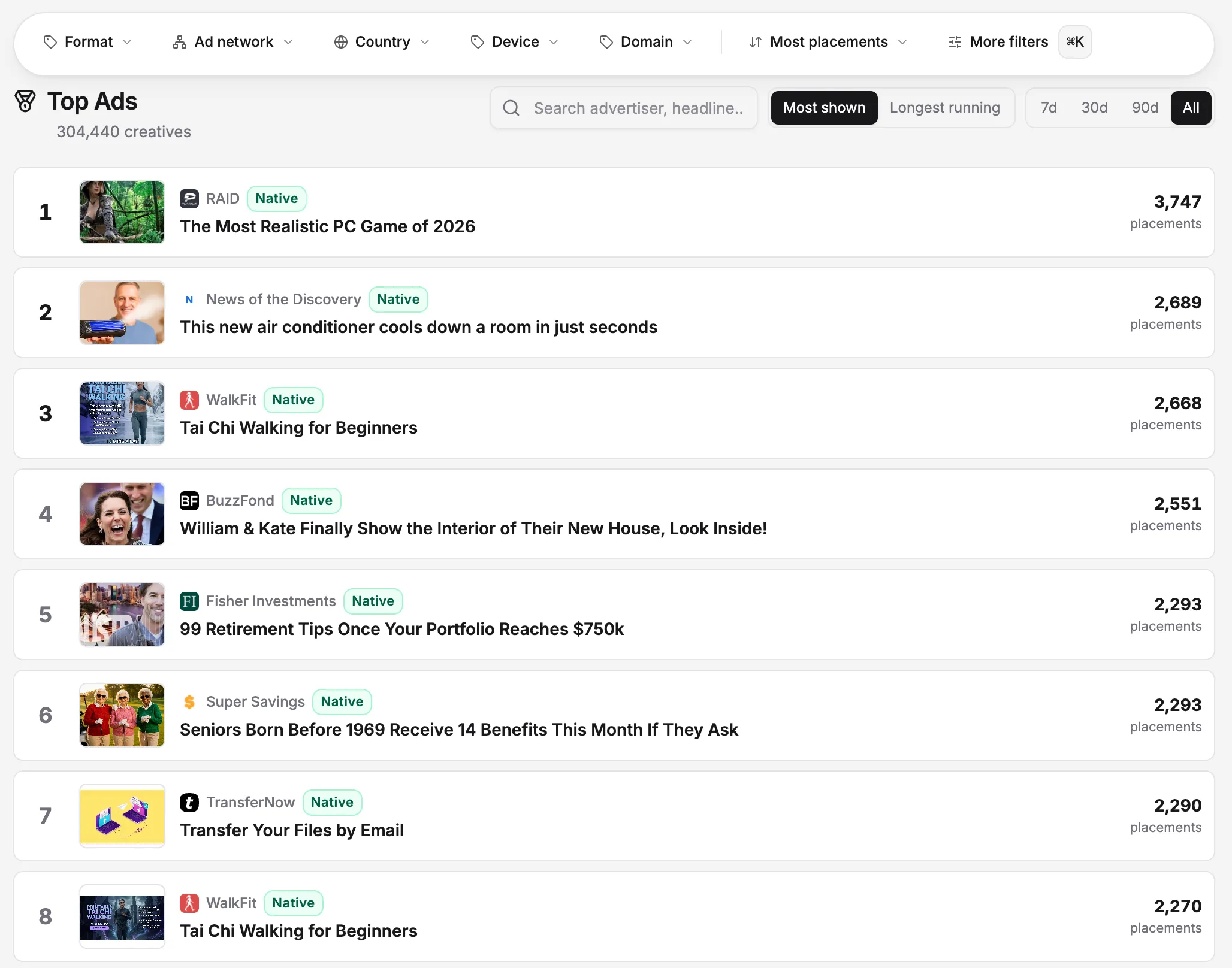
That's why "spying" is a misleading word for what most of us actually do. There's nothing covert about reading a billboard, screenshotting a Taboola widget, or noticing that a competitor has run the same Outbrain headline for a month straight. Take this one, which our index has watched run continuously for 28 days:

When a creative survives four weeks in a market as merciless as native finance, that tells you it's converting. Noticing that is market observation, not espionage, and the law treats it that way. For the practical how-to, see our pillar guide on how to spy on competitor ads in 2026.
The legal question is almost never "can I look at this ad?" It's "what did I do with what I saw?" Keep your output original and you stay clear of trouble.
Regulators are pushing ads toward transparency, not away#
Here's the part that surprises people: the regulatory trend makes public ad research more legitimate every year, not less. Governments increasingly require platforms to expose the exact data competitive researchers want.
The EU's Digital Services Act (DSA) obliges very large online platforms, those with at least 45 million monthly EU users, to maintain a public, searchable ad repository. Under Article 39, that repository has to disclose the content of each ad, who the advertiser is, who paid for it where that differs, the dates it ran, and how it was targeted. All of it queryable through a tool and an API. The DSA also forces platforms to give vetted researchers access to public data. The law is mandating the precise advertiser-and-creative transparency that competitive intelligence runs on.
And the enforcement has teeth. In December 2025 the European Commission fined X €120 million under the DSA. One of the three cited failings: its ad repository lacked critical information like the content of ads and the legal entity paying for them. Read that again. The regulator's complaint wasn't that the data was exposed. It was that it wasn't exposed enough.
| Transparency source | What it makes public | What it means for research |
|---|---|---|
| EU DSA ad repositories (Art. 39) | Ad content, advertiser, payer, dates, targeting | Public, API-accessible advertiser-level ad data is now law for big platforms |
| Meta Ad Library | Active and past ads across Meta properties | Anyone can browse a brand's social creatives |
| Google Ads Transparency Center | Ads, advertiser identity, date ranges | Search and display ads are inspectable by advertiser |
| Native platforms (Taboola, Outbrain, MGID) | Live creatives running across publisher sites | Capturable as they serve to the public feed |
The takeaway is blunt: when a regulator fines a platform for not publishing enough ad data, you can be confident that studying the ad data platforms do publish is not a legal grey area.
Is scraping public ad data legal?#
This is where people get nervous, and where the nuance actually matters.
The leading US authority is hiQ Labs v. LinkedIn. The Ninth Circuit held that accessing data that is publicly available, meaning not gated behind a login or other access control, does not count as access "without authorization" under the Computer Fraud and Abuse Act (CFAA). LinkedIn couldn't turn public data into off-limits data just by mailing a cease-and-desist letter.
So collecting public ad data generally does not violate the CFAA. Two caveats keep careful operators careful:
- Terms of service still exist. A site's ToS can prohibit automated collection even when the CFAA doesn't. That's a contract question, not a criminal one, but it's real. It's also exactly why notable DSA enforcement went after X for blocking researcher scraping rather than allowing it.
- Personal data is a separate regime. Public ad creatives and advertiser identities are fair game. Harvesting personal data about the people an ad was shown to is governed by GDPR, CCPA, and the like. The DSA repositories themselves are explicitly required to contain no personal data of ad recipients, which is a useful tell about where the line sits.
The pragmatic position reputable platforms take is to gather only publicly served ad data and to follow each ad's click path to the advertiser's landing page without engaging the live ad. You observe the funnel the way a real user would, instead of firing fake clicks that distort a competitor's spend. That's the approach OpenAdLibrary takes capturing live native ads from Taboola, Outbrain, MGID, and Revcontent: across 42 networks we've logged 5.4 million ad observations and traced 926,000+ landing pages (index, June 2026), all from public serves, none from fake engagement.

Finance is the most-captured vertical in the whole index at 17,232 creatives, with insurance (15,629) and health (14,895) close behind (OpenAdLibrary, June 2026). Those are also the verticals where the legal questions get asked most, because the offers are aggressive and the creatives are heavily tested. Which brings us to the part that actually carries risk.
Where competitor ad research becomes illegal#
The risk isn't in the research. It's in the output. Three bodies of law mark the boundary.
1. Copyright: don't reproduce the creative#
A specific ad creative (the photograph, the illustration, the exact copy) is protected expression. You can study a competitor's video ad and conclude that a fast-paced unboxing hook works in your category. You cannot rip their footage, re-upload their image, or paste their headline word for word into your own ad. Ideas, angles, and formats aren't copyrightable. The particular expression of them is.
Take this health creative running on Taboola:

Studying it to learn that "Americans are ditching X for this new device" is a durable hook (this one had been live 26 days when we caught it) is research. Copying that exact image and headline into your own ad is copyright infringement. Same observation, completely different legal outcome, and the only variable is what you produced afterward.
2. Trademark: don't borrow their brand identity#
Using a competitor's name or logo to identify them in honest comparative advertising can fall under nominative fair use. Dressing your ad up in their brand elements to imply association, sponsorship, or endorsement that doesn't exist is trademark infringement, and potentially passing off. The test is whether a reasonable consumer would be confused about who's actually behind the ad.
3. FTC and consumer protection: don't deceive#
The FTC polices truth in advertising regardless of what your competitor does. Copying a rival's "clinically proven" claim doesn't make it true for your product. Lifting their fabricated testimonials just imports their liability into your account. The fact that you saw a claim in a competitor's ad is no defense if the claim is deceptive.
Here's the same distinction as a quick reference:
| Activity | Legal status |
|---|---|
| Viewing and screenshotting public ads | Legal |
| Tracking how long a creative has run | Legal |
| Analyzing a competitor's funnel and offer | Legal |
| Drawing inspiration for original creative | Legal |
| Reusing a competitor's exact image, video, or copy | Copyright infringement |
| Putting a competitor's logo in your ad to imply endorsement | Trademark infringement |
| Repeating a deceptive claim you saw in their ad | FTC / false-advertising exposure |
The practitioner's safe-research checklist#
You can run aggressive, thorough competitor research and stay entirely within bounds. The discipline is simple:
- Use public sources. Ad libraries, transparency centers, and live-served native ads captured from open publisher feeds. No logins broken, no paywalls bypassed.
- Extract patterns, not assets. Document the angle, the offer, the hook, the format, the cadence. The strategy. Then rebuild that strategy in your own words and visuals.
- Never paste competitor copy or creative into your own ads. If a phrase is so good you want it verbatim, that's your cue to rewrite it.
- Keep your own claims true. Substantiate everything independently of what you observed.
- Respect brand identity. Reference competitors only for honest comparison, never to borrow their reputation.
Done this way, competitor research compounds into a genuine edge. Knowing which creatives a rival has sustained for weeks (a strong longevity and spread signal) tells you what's actually converting before you spend a dollar testing it yourself.

One honest caveat on longevity, because the affiliate world loves to quote it loosely. Our index currently spans up to about 28 days of continuous observation per creative, so when we say a creative is a long-runner, we mean we've personally watched it serve for nearly a month. The "90-day winner" rule of thumb you'll hear in forums is general industry lore, not a number our data confirms. Treat the two differently. That discipline is the whole premise of a competitive ad intelligence workflow and of reverse-engineering a competitor's funnel from creative to landing page.
So is using an ad spy tool legal?#
Yes. An ad spy tool, or spy tool in the affiliate vernacular, is just an organized window onto ads that are already public. The tool isn't doing anything you couldn't do by hand browsing publisher sites and ad libraries. It's doing it at scale, with the advertiser identified, the supply chain classified, and the click traced to the landing page. The legality of the tool tracks the legality of the underlying activity, and the underlying activity is lawful observation of public advertising.
What separates a responsible platform from a reckless one is how it collects: public data only, no fake engagement with live ads, no personal data on the people who saw an ad, and a click-trace approach that watches the funnel without distorting it. Those are exactly the principles a native ad spy tool built for this market should follow.
The bottom line#
Researching competitor ads is legal, well-established, and backed by a regulatory trend that is forcing more ad transparency, not less. The DSA mandates public ad repositories. hiQ v. LinkedIn protects access to public data. And the only real constraints, copyright, trademark, and the FTC, all police the same simple boundary: don't copy the creative, don't borrow the brand, don't repeat the lie. Stay original and you can study every competitor in your market with a clear conscience and clean legal footing.
Want to research competitor ads the right way, with public data, the real advertiser, and the click traced to the landing page? Start free and browse 200 live ads, no card required.