Español
 Português (Brasil)
 Français
 Deutsch
 Italiano
 Nederlands
 Polski
 Svenska
 Türkçe
 Русский
 日本語
日本語 한국어
한국어 简体中文
简体中文 Tiếng Việt
 Bahasa Indonesia
 繁體中文
繁體中文 Čeština
 Dansk
Dansk Norsk (bokmål)
 Suomi
Suomi Ελληνικά
 Română
 Magyar
 Українська
 ไทย
ไทย हिन्दी
 العربية
 עברית
עבריתOutbrain Campaign Optimization: A Practitioner's Playbook
An independent Outbrain optimization playbook: platform splits, headline testing, section pruning and conversion bidding — illustrated with live, long-running Outbrain creatives.


Outbrain campaign optimization runs on four levers: campaign structure split by platform and geo, continuous headline testing, publisher-section pruning, and a bid strategy that graduates from manual CPC to conversion-based automation as data accumulates. The playbook resembles Taboola's, but the inventory does not: Outbrain — merged with Teads in 2025 and now operating under the Teads name — skews toward premium editorial placements, and its audience rewards a more restrained creative register. This guide works the levers in order of impact, with live examples pulled from the 108,000+ Outbrain creatives in OpenAdLibrary's index (July 2026).
Know the inventory you are optimizing#
Outbrain built its network on long-term relationships with premium publishers, and even after the merger the buying experience reflects that heritage. The mechanics of formats, targeting and account setup are covered in how Outbrain works, and the corporate backstory in the Outbrain-Teads merger explainer. Three properties of the inventory shape everything below:
- Editorial context. Readers arrive mid-article, in lean-back mode. Curiosity and authority angles tend to outperform hard-sell urgency here more than on mid-tier native networks.
- Price band. Premium placements price accordingly; the cost comparison against its main rival is mapped in Taboola vs Outbrain.
- Competitive verticals. In our index's classified Outbrain corpus, insurance (4,345 live creatives), finance (3,990) and health (3,102) lead — regulated, high-LTV categories where creative differentiation wins more often than bid brute force.
Structure: split platforms and geos before you spend#
The discipline is identical to every native network, and skipping it costs the same:
- One platform per campaign. Desktop, smartphone and tablet carry different CPCs, CTRs and conversion behavior. A blended campaign produces reports you cannot act on.
- Geo grouping by tier and language. Never let cheap clicks from low-cost geos starve a Tier-1 test. One campaign per price band, and break out any geo that dominates spend.
- One funnel and one conversion goal per campaign. Define the conversion event before launch, and give the campaign a single primary event to optimize toward.
One practical note: Outbrain's console features, bid controls and campaign settings have kept evolving through the merger period. Verify anything structural against the official advertiser documentation rather than screenshots in old blog posts.
Headlines carry Outbrain creatives#
On feed-style placements the headline does most of the persuasion work, and Outbrain's platform has long been built around testing several headline variants and shifting delivery toward performers. Practices that hold up:
- Run four to eight active variants across two or three distinct angles per campaign. Variant count matters more here than on image-led channels.
- Mine proven patterns instead of inventing from zero. The headline structures that recur across winning native ads are broken down in 12 native headline formulas.
- Match the register of the placement. The long-runners in our Outbrain corpus are calm, specific and curiosity-led rather than shouty. A beauty advertorial from The Skin Mag ("Moisturizer Won't Tighten Skin! Use This Household Item Instead") has held for 30 days; corporate-content pieces from SPECTRA by MHI on methane and waste-to-energy have run for 34 days. Different advertisers, same restraint.
- Rotate before decay. Creative fatigue arrives on Outbrain exactly as it does everywhere: CTR sags at constant bids. Replace fatigued variants with fresh executions of the angle that earned its keep.
Judge every variant on downstream conversion, not CTR alone — a headline that attracts the wrong reader is a tax, not a win.
Publisher and section optimization#
Outbrain reports performance by publisher and section, and the spread is wide: a few sections will quietly consume budget without converting while others carry the campaign. The loop:
- Review the by-section report weekly once spend justifies it.
- Block sections that have spent a multiple of your target CPA with nothing to show. Two to three times target is the common heuristic; hold the line on sample size before acting.
- Bid down the marginal, bid up the proven. Where per-section bid adjustment is available, use it before resorting to blocks — blocks are blunt and permanent until you remember to undo them.
- Protect discovery. Over-blocking early kills reach. Prune on evidence, not vibes, and keep a portion of delivery exploring new sections.
Bidding: manual CPC, then hand over the keys#
Start with manual CPC near the middle of your vertical's realistic band. No official rate card exists; on premium native inventory, media buyers commonly report Tier-1 desktop CPCs roughly in the $0.30 to $1.00 range, with mobile lower — treat that strictly as a starting bracket, because vertical and geo dominate the real number.
Outbrain offers conversion-oriented automated bidding. The same rule applies as on every network: automation is only as good as the conversion volume feeding it. Stay manual while you prune sections and creatives; hand a campaign to automated bidding once conversions arrive consistently; expect a calibration dip; and evaluate over weeks. Keep manual bid moves small — 10–15% steps with breathing room between them.
Feed the bidder clean conversion data#
Everything in the previous section assumes the conversion signal itself is trustworthy, and that is where campaigns quietly go wrong:
- Optimize to an event with volume. If purchases are rare, point the campaign at a qualified upstream event — a lead, a call booked, an add-to-cart — and keep the purchase economics in your own spreadsheet. An automated bidder fed a handful of conversions a week has nothing to learn from and will behave accordingly.
- One primary conversion per campaign. Stacking several optimized events on one campaign blurs the signal and makes the bidder's decisions impossible to audit.
- Instrument the funnel middle. Ad CTR proves the hook; pre-lander clickthrough proves the story; conversion proves the offer. When performance sags, that three-way split tells you which of the three jobs to fix — and saves you from rewriting headlines when the real leak is on the landing page.
Verify the pixel or postback fires before spending in earnest. A day of test conversions is cheaper than two weeks of optimization decisions made on a broken signal.
Live Outbrain ads worth studying#
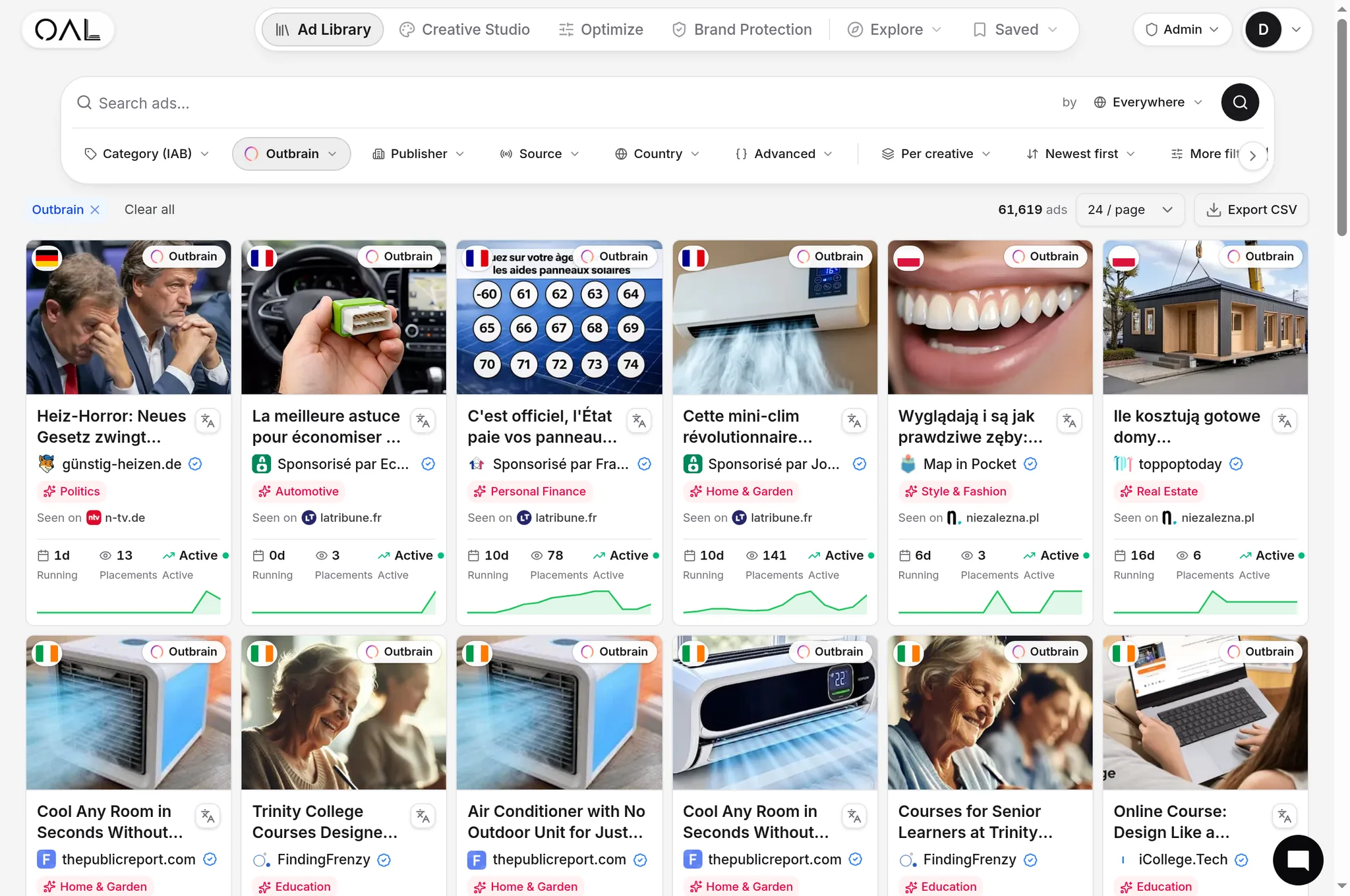
Longevity is the only public performance signal on a network with no official ad library — an advertiser who keeps paying per click for a month is telling you something. The logic is unpacked in why ad longevity is the winning signal. A sample of what is surviving on Outbrain right now, from the index:
| Advertiser | Angle | Days running |
|---|---|---|
| Novelodge | Story-style curiosity content ("Man Helps Hitchhiking Girl…") | 35 |
| SPECTRA by MHI | Corporate branded content on climate tech | 34 |
| The Skin Mag | Beauty advertorial, household-item hook | 30 |
| Tech-tips lead gen | "Turn off ads (Android users)" utility hook | 26 |
| Health Weekly | Cardiologist authority-figure health angle | 22 |
The mix is the lesson: brand content, affiliate advertorials and utility lead-gen all sustain month-long runs when angle, funnel and section targeting line up. Browse the full corpus in the Outbrain ad library, or pull a specific competitor's live ads, landing pages and run durations with OpenAdLibrary's Outbrain spy tool — the research workflow is written up in the Outbrain ad spy guide.
A cadence that compounds#
- Week one: daily checks, minimal action. Let data accumulate.
- Weekly: section report → blocks and adjustments; creative review → cut fatigued variants, queue fresh executions; small bid nudges where margin says so.
- Monthly: competitive sweep — new angles in your vertical, competitor funnels, which of your own ads crossed 30 days.
- Quarterly: funnel audit. If ad CTR holds but conversion sags across campaigns, the problem lives on the landing page, not in the console.
None of these steps is clever on its own. Run together, without skipped weeks, they are the difference between the advertisers whose ads disappear in five days and the ones still visible in the index a month later.