Español
 Português (Brasil)
 Français
 Deutsch
 Italiano
 Nederlands
 Polski
 Svenska
 Türkçe
 Русский
 日本語
日本語 한국어
한국어 简体中文
简体中文 Tiếng Việt
 Bahasa Indonesia
 繁體中文
繁體中文 Čeština
 Dansk
Dansk Norsk (bokmål)
 Suomi
Suomi Ελληνικά
 Română
 Magyar
 Українська
 ไทย
ไทย हिन्दी
 العربية
 עברית
עבריתYahoo DSP Review 2026: Native Ads After Gemini's Sunset
Yahoo folded native advertising into its omnichannel DSP after Gemini's sunset. What that means for buyers, what the platform actually offers, and what 5,926 live Yahoo native ads show.


The Yahoo DSP is now the only scaled way to buy Yahoo's native inventory. When Yahoo retired its Gemini self-serve platform (later branded Yahoo Native), native buying was folded into the company's omnichannel demand-side platform alongside display, video, CTV, audio and digital-out-of-home. For enterprise buyers the pitch is genuinely strong: exclusive access to Yahoo's owned-and-operated properties — the homepage, Mail, Finance, Sports and AOL — plus first-party identity tooling built on logged-in users. For the small self-serve native buyer Gemini used to serve, the honest verdict is that the door has narrowed: the Yahoo DSP is built for agencies and committed budgets, not fifty-dollar tests.
From Gemini to the DSP: what changed#
Yahoo Gemini was a self-serve platform where any advertiser could buy Yahoo's native placements (and search) with a credit card and modest budgets. Yahoo wound it down as a standalone product and consolidated demand into the Yahoo DSP — the full story is in what happened to Yahoo Gemini, with the platform history in our Yahoo Gemini glossary entry. The strategic shift matters more than the dates: native at Yahoo stopped being a standalone ad network and became a placement type inside a full demand-side platform. That repositioned the product upmarket — toward omnichannel buyers, programmatic teams and agencies — and away from the affiliate and small-business crowd that Gemini's self-serve model attracted.
What you can buy through the Yahoo DSP#
- Yahoo owned-and-operated native. Feed and content placements across the Yahoo homepage, Mail, Finance, Sports, News and AOL — inventory no other platform sells at source. Mail is the strategic asset: logged-in users give Yahoo a persistent, cross-device identity spine. The mechanics of the native formats are covered in how Yahoo native ads work.
- Open-web supply. Exchange inventory and programmatic deals beyond Yahoo's own properties, bought through the same seat.
- Omnichannel formats. Display, online video, CTV, audio, DOOH and native under one budget and one reporting view.
- Identity and data tooling. Yahoo's first-party identity graph (ConnectID) and audience tools, positioned for a post-third-party-cookie world.
- Buying routes. Self-serve seats exist but are oriented to agencies and experienced programmatic teams; managed service handles the rest. Spend commitments are negotiated — check current requirements at advertising.yahooinc.com rather than relying on secondhand numbers.
What 5,926 live Yahoo native ads reveal#
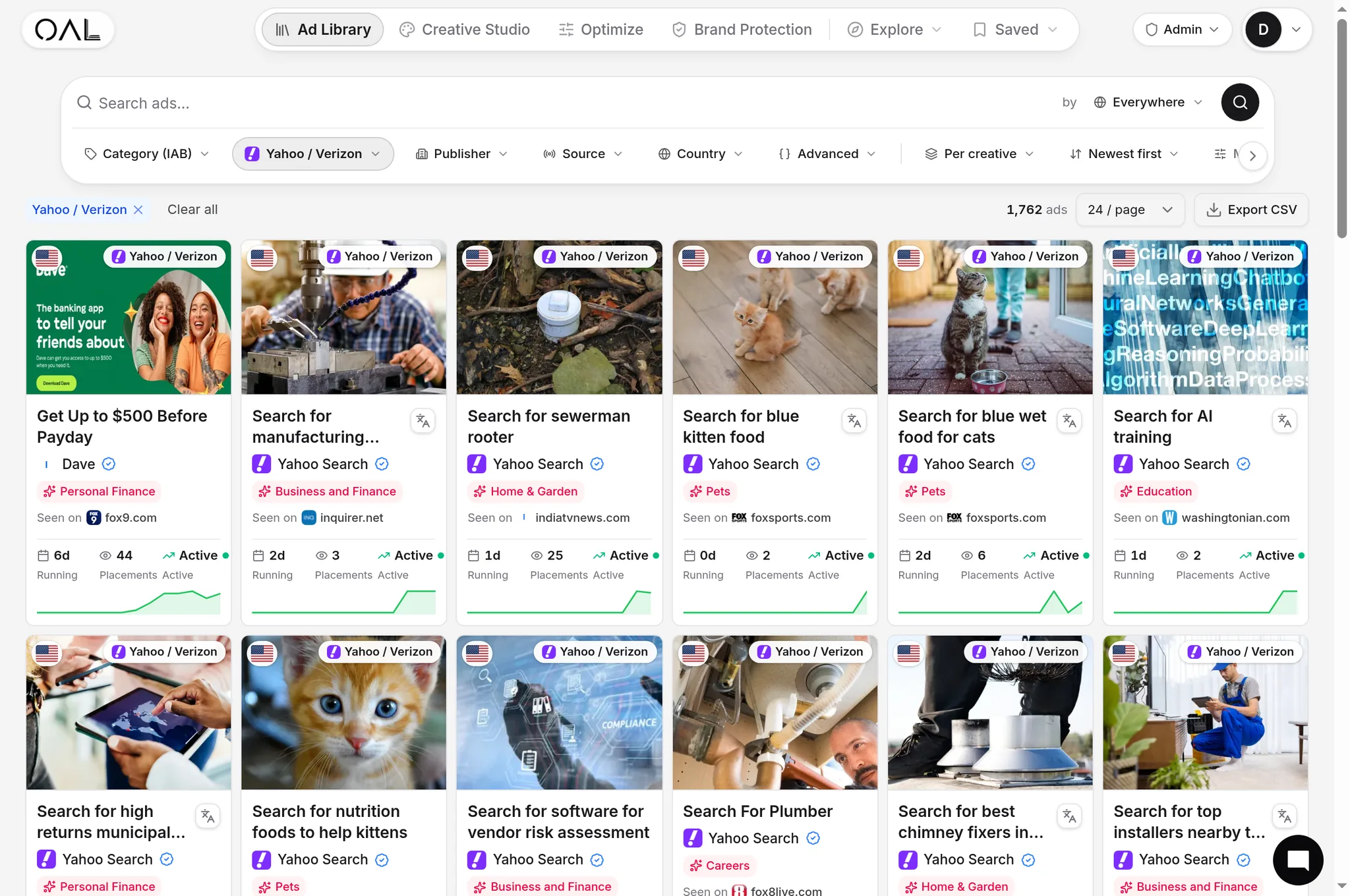
OpenAdLibrary's index holds 5,926 live Yahoo native creatives (July 2026) inside a total corpus of 725,000+ across 49 networks. The classified vertical mix:
| Vertical | Live creatives |
|---|---|
| Software | 466 |
| Finance | 261 |
| Pets | 203 |
| Health | 201 |
| Insurance | 189 |
| Auto | 183 |
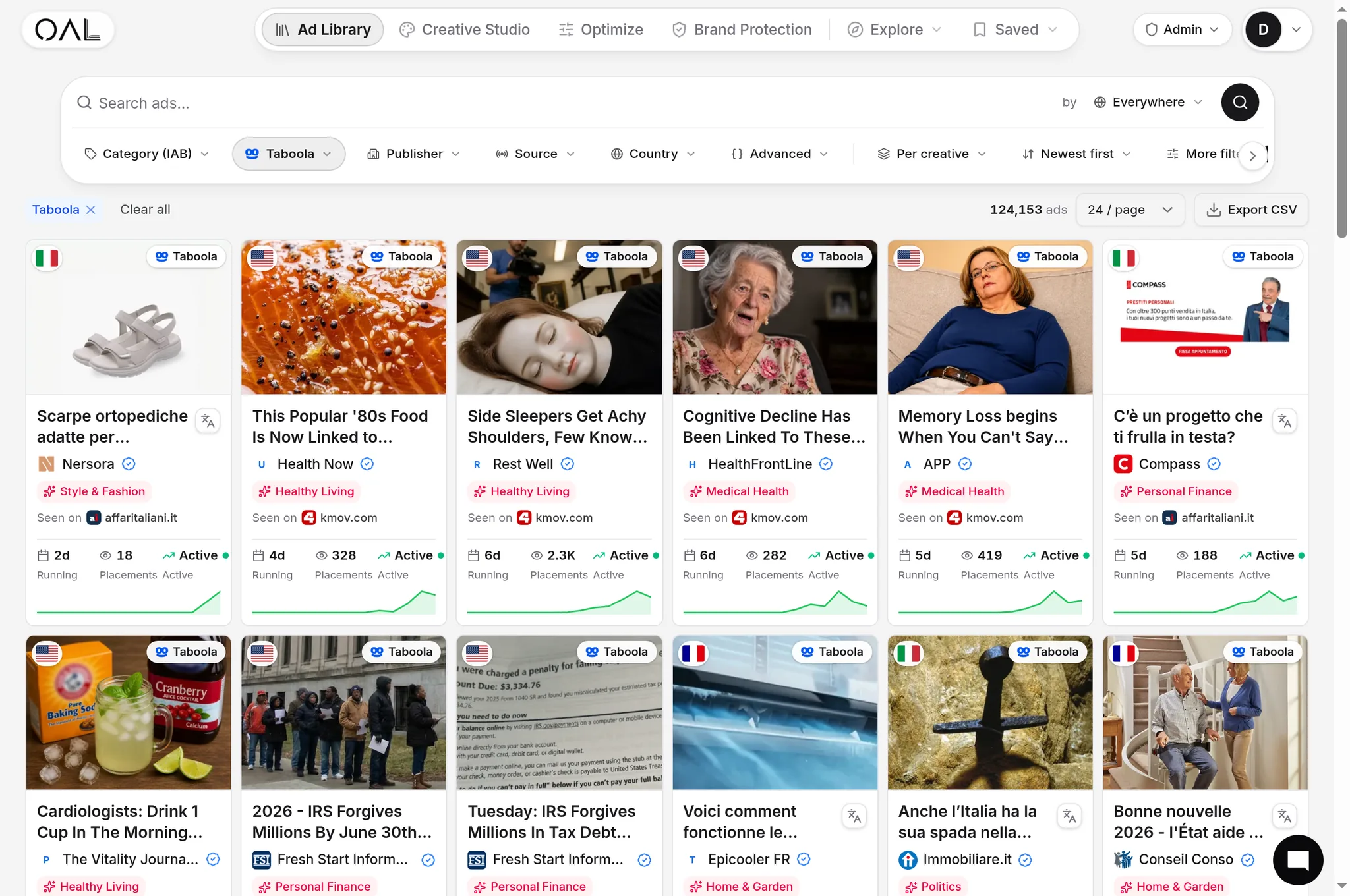
Two things stand out. First, the spread is flat — no vertical dominates the way health dominates Revcontent or entertainment dominates MGID. Second, and more striking: a large visible share of the cards in our capture sample are "Search for …" units branded Yahoo Search ("Search for business insurance", "Search For Superannuation") — generic search-intent cards routing users into search results pages. That is search-feed monetization occupying native slots, a pattern adjacent to traffic arbitrage, and it tells you something real about the marketplace: third-party direct-response advertiser density on Yahoo's native feed is thinner than on Taboola or MGID.
Read that both ways. As a buyer, you inherit less competitive pressure per niche than on the crowded feed networks — genuinely useful if you qualify for access. As an analyst, it confirms the enterprise pivot: the long tail of small native advertisers that once filled Gemini went elsewhere, and the feed now mixes house demand, search syndication and a smaller set of committed advertisers.
Strengths#
- Inventory nobody else sells at source. Yahoo's O&O portfolio — especially Mail's logged-in audience — is unique supply with real scale in Tier-1 markets.
- Omnichannel consolidation. One seat covers native, display, video, CTV, audio and DOOH, with shared frequency and measurement.
- Identity depth. A first-party identity graph built on logged-in users is a durable answer to cookie loss, and it powers the targeting and measurement story.
- Thinner native competition. Fewer direct-response bidders per niche in the native marketplace than on the major feed networks — an opportunity for advertisers who do get seats.
Weaknesses#
- Access. This is the big one. Negotiated commitments and an agency-oriented seat structure mean small buyers are effectively priced out of what used to be a credit-card platform.
- Complexity. You inherit a full DSP — deals, supply paths, bid strategies — to buy what was once a simple native campaign. Teams without programmatic experience will feel it.
- Fee opacity. DSP economics stack a platform fee on media cost, and both are negotiated. Comparing true costs against self-serve networks from the outside is guesswork.
- A thinner ecosystem. Far fewer independent guides, benchmarks and practitioner war stories exist than for Taboola, Outbrain or MGID — you will lean on Yahoo's own teams.
Cost and access: what buyers report#
Yahoo publishes no rate card. Expect standard DSP economics: media cost plus a negotiated platform fee, with meaningful minimum spend commitments commonly reported for a direct seat. Smaller buyers typically reach Yahoo inventory indirectly — through an agency's seat or via deals in another DSP. On unit costs, buyers who ran Gemini historically reported native clicks pricing well below comparable search traffic; on the DSP, your effective cost depends on deal structure and fees more than on any list price. Treat all of it as negotiable and qualitative — our guides to native advertising costs and cross-network CPC benchmarks give the wider budgeting context.
Verdict: who the Yahoo DSP is for#
If you are an agency or in-house programmatic team with committed budgets, a brand-plus-performance mix, and a use for identity-backed targeting across Yahoo's owned properties, the Yahoo DSP is a strong, differentiated buy — premium supply, thin native competition, one consolidated seat.
If you are the small native buyer Gemini used to serve, be realistic: the platform is not built for you anymore. The self-serve feed networks — Taboola, Outbrain, MGID, Revcontent — offer the entry costs and placement control that made Gemini attractive, and our ranking of native ad networks maps that landscape.
Either way, look at the live evidence before committing. OpenAdLibrary tracks the Yahoo native marketplace continuously — browse 5,900+ live creatives with resolved advertisers, observed longevity and traced landing pages in the Yahoo spy tool. The free tier requires no card; full landing traces and watchlists come with the $29.99/month plan. Fifteen minutes of reading what actually runs on the feed will calibrate your expectations better than any sales call.