 Español
 Português (Brasil)
 Français
 Deutsch
 Italiano
 Nederlands
 Polski
 Svenska
 Türkçe
 Русский
 日本語
日本語 한국어
한국어 简体中文
简体中文 Tiếng Việt
 Bahasa Indonesia
 繁體中文
繁體中文 Čeština
 Dansk
Dansk Norsk (bokmål)
 Suomi
Suomi Ελληνικά
 Română
 Magyar
 Українська
 ไทย
ไทย हिन्दी
 العربية
 עברית
עבריתNative Ads vs Search Ads: Intent, Cost & Funnel Roles
Search captures demand people already have; native creates demand they didn't know they had. The cost economics, creative demands, and funnel roles of each — and the playbook for running them together.


Search ads capture existing demand: someone typed their problem into a search engine, and you bid to be the answer. Native ads create demand: you interrupt readers with an editorial-style headline about a problem they were not actively thinking about. That single difference explains everything else — search converts at higher rates on limited volume with expensive clicks; native delivers cheaper clicks at far larger scale but needs a funnel that manufactures intent before the offer. They are complements, not substitutes: search harvests the demand that channels like native plant. The mistake is running either with the other's playbook.
The intent gap is the whole comparison#
Every meaningful difference between these channels traces back to user intent at the moment of exposure.
A search click starts with a query. The user has named their problem, sometimes named the product category, and occasionally named your brand. Your ad's job is small: prove relevance and win the click over three competitors saying nearly the same thing. The conversion work was largely done before you appeared.
A native click starts with a headline in a content feed — a recommendation widget under a news article, an in-feed sponsored story. The user was reading about something else entirely. Your ad's job is enormous: stop the scroll, open a curiosity loop, and pull the reader into content that converts latent interest into active intent. The click is the beginning of persuasion, not the end.
This is why the channels do not compete for the same moment in the customer journey. Search owns the moment after a problem becomes conscious and searchable. Native owns the much longer period before that — which is also why native's addressable volume is so much larger. For any given offer, the number of people who could want it dwarfs the number currently typing it into a search box.
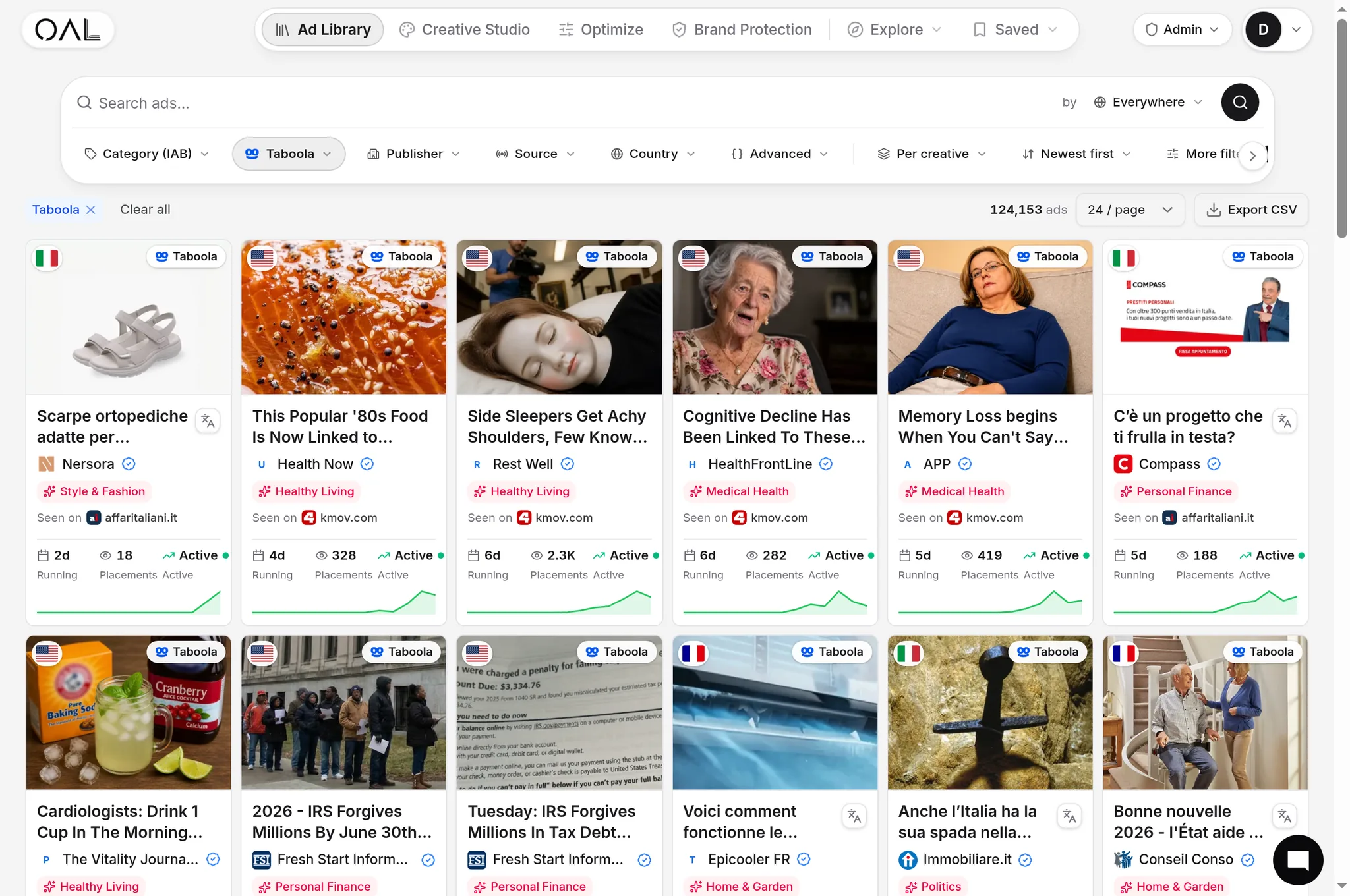
A concrete example makes it tangible. A hearing-aid buyer's search campaign bids on "hearing aid prices" — a query typed by someone already shopping. The same advertiser's native campaign runs a headline like "Struggling to Hear Clearly? Discover a Device Transforming Lives" under news articles — reaching the much larger group that has noticed the problem but never searched it. That exact creative pattern, from a hearing-care brand, has been observed running for 37 straight days in OpenAdLibrary's Taboola index: long enough to say with confidence that manufacturing intent from cold readers is paying for itself.
Cost economics: expensive certainty vs cheap possibility#
Search pricing reflects its intent. In the most competitive categories — insurance, legal, finance, B2B software — a single search click can cost more than some products' entire allowable acquisition cost, because everyone in the category is bidding on the same finite pool of high-intent queries. You pay a premium for certainty, and the auction extracts most of the surplus.
Native pricing reflects the opposite: an enormous supply of attention with no declared intent. Media buyers commonly report Tier-1 desktop native CPCs from roughly $0.20 to $0.90, with mobile and Tier-2/3 geo clicks considerably cheaper — non-official figures that your vertical and creative will move a lot. Network-by-network detail is in our native CPC benchmarks, and full test-budget math in How Much Do Native Ads Cost?.
The arbitrage between those two price levels is a structural feature of performance marketing. It is no accident that finance and insurance — the categories with the most brutal search auctions — are also the heaviest native categories in existence: OpenAdLibrary's index of 725,000+ live native creatives across 49 networks (June 2026) counts 24,068 classified finance creatives and 22,427 insurance creatives, second and third among all verticals. Those advertisers did the math: if a funnel can convert cheap low-intent clicks at even a modest rate, the effective acquisition cost can undercut the search auction — and scale past it.
The equation that decides it for your offer: native CPC ÷ funnel conversion rate vs search CPC ÷ landing conversion rate. Native wins when creative and funnel quality can keep that first conversion rate high enough; search wins when they cannot.
Side-by-side: the dimensions that matter#
| Dimension | Search ads | Native ads |
|---|---|---|
| User intent | Declared — user searched the problem | Latent — user was reading content |
| Volume ceiling | Capped by query volume | Capped by creative + funnel, not audience |
| Typical CPC | High; extreme in competitive verticals | A fraction of search in most categories |
| Conversion rate | High, direct paths | Lower per click; funnel does the work |
| Creative unit | Text keyed to the query | Image + editorial headline |
| Landing flow | Offer page, quote form | Pre-lander / advertorial, then offer |
| Attribution | Flattered by last-click | Needs longer, assisted-view windows |
| Ramp curve | Fast — demand already exists | Slower — testing finds the winning angle |
Creative and landing pages are different jobs#
Search creative is relevance engineering. The ad echoes the query, states the offer, and differentiates in a few characters. Landing pages receive visitors who already want the thing: a quote form, a product page, a demo signup. Direct, dense, transactional.
Native creative is story engineering. The image must read as content, and the headline must open a curiosity gap strong enough to interrupt someone mid-read — the recurring structures are learnable, and studying live winners is the fastest way to absorb them. Then the landing flow has to do the work search takes for granted: a pre-lander or advertorial that develops the problem, introduces the solution, and builds enough intent that the eventual offer page converts. Teams porting search habits into native skip that middle step, send curiosity clicks straight to a quote form, and conclude the channel "doesn't work." The channel works; the funnel was missing. The standard architecture is covered in landing page funnels for native traffic.
The skill sets barely overlap. Search rewards query coverage, bid discipline, and landing-page CRO. Native rewards headline volume, angle discovery, and advertorial craft. Budget for the fact that your team is probably strong at one and unproven at the other.
Measurement: search flatters itself#
Search sits at the bottom of the funnel, adjacent to conversion, so last-click attribution assigns it credit generously — including credit for demand that other channels created. Native sits earlier in the journey; its conversions arrive on longer paths, often via a later branded search, and a last-click lens systematically undercounts it.
Two practical corrections:
- Match your attribution window to the channel. Cold native traffic needs longer windows and view-assisted models to be judged fairly.
- Watch branded search volume when native scales. A native campaign that is working shows up as rising branded queries and cheaper branded-search conversions — credit the last click captures but did not create. This "search halo" is the most commonly missed line item in native P&Ls, and it cuts the other way too: pausing native and watching branded search sag is the cleanest natural experiment for measuring it.
If the stakes justify it, formalize that experiment: run native in a subset of comparable geos and hold others out, then compare total conversions — search included — across the two groups. Geo-split incrementality is cruder than a lab but immune to attribution politics, and it answers the only question that matters: does the account convert more with native on than off? Teams that run this test once tend to stop arguing about attribution models afterward.
Scale ceilings: where each channel tops out#
Search has a hard ceiling: query volume. Once you win most auctions for most relevant queries, spending more buys diminishing scraps — broader matches, weaker intent, worse economics. Growth beyond that point requires demand to grow, which search itself cannot cause.
Native's ceiling is soft: inventory is vast, so scale is limited by your creative pipeline and funnel durability instead. Winning angles fatigue, get cloned by competitors, and need replacing — scaling native is an operating rhythm of testing and rotation, not a budget dial. The channel also scales sideways in ways search cannot: the same funnel, translated, opens new geos on the same networks, whereas a new search market means rebuilding keyword coverage from zero in another language. For teams that have maxed their search accounts (or their Meta accounts — same logic, covered in diversifying beyond Meta), native is one of the few channels where meaningful incremental volume actually exists.
Where each channel fits by business type#
The right mix depends less on preference than on what your business sells and how demand for it forms.
Affiliate and performance marketers live on native's side of the trade. Affiliate margins rarely survive competitive search auctions — the merchant, the aggregators, and other affiliates are all bidding the same terms — while native's cheap clicks and advertorial funnels are the channel's home game. Search plays a supporting role at most. The full channel playbook is in native advertising for affiliate marketing.
DTC and ecommerce brands typically run both, sequenced: search brand coverage from day one, category search terms where the margin allows, and native as the scale channel once a content funnel proves out. Products that need explanation — new categories, considered purchases, anything sold on a mechanism rather than a brand — get disproportionate value from native's advertorial room.
Lead-gen businesses (insurance, home services, legal, education) face the starkest version of the arbitrage: their search CPCs are the most expensive in advertising, and their categories are the deepest on native. For them the question is rarely native or search — it is how fast native can be stood up to relieve a search budget that has hit its ceiling.
Local and B2B niche businesses are the main exception. When your addressable audience is small — one metro area, one narrow job title — search's precision beats native's scale, because native's economics depend on volume your audience cannot supply. Run search deep, and treat native as a later experiment, if at all.
How to run them together#
The channels are more profitable combined than either is alone, because each covers the other's structural weakness.
- Keep search on brand and bottom-funnel terms. This is non-negotiable hygiene: when native creates demand, branded search is where much of it converts. Leaving brand terms uncovered donates your native investment to whoever bids on your name.
- Use native to grow the demand pool search harvests. Point native at the audience one step before the search: the person with the symptom who has not yet named the solution.
- Mine each channel for the other's intelligence. Your highest-converting search queries name the pains that make strong native headlines; your winning native angles predict which category queries will convert if you bid them.
- Retarget across the seam. Native readers who did not convert become search-and-display retargeting audiences already educated by your advertorial.
- Judge the system, not the silo. Blended CAC across the pair is the honest metric; channel-level last-click will always argue for cutting native and always be wrong about it.
A 30-day plan for adding native to a search account#
If search is working and capped, here is a concrete first month of native, drawn from how experienced buyers actually sequence it:
- Week 1 — research, not spending. Pull your top-converting search queries and translate the pains behind them into headline angles. Then study your category's live native footprint: which advertisers run, on which networks, with what hooks, and which creatives have survived 30+ days. Build a swipe file of proven angles before writing your own.
- Week 2 — build the funnel. Write an advertorial that develops your best angle, with the offer as its natural conclusion. Set up tracking with realistic attribution windows, and wire a retargeting pixel into the advertorial page from day one.
- Weeks 3–4 — launch one network, one geo. Ten to twenty headline-image variants, conservative CPC bids, daily creative and publisher pruning. Judge angles on advertorial engagement and funnel starts first — conversion data will lag — and expect the first profitable configuration to look nothing like your launch configuration.
Keep search running untouched throughout, and watch branded query volume as the native spend ramps: that line moving is often the first sign the channel is working, before the native dashboard shows it.
Check who is already making the trade#
Before committing budget, look at what advertisers in your category actually do — not in a survey, but in the live record. If your vertical's biggest search spenders also run deep native campaigns, the arbitrage works at scale and the proof is public: their creatives, angles, and funnels are observable, and their long-running ads mark the angles that pay — the logic behind reading run length as profit is in ad longevity as a winning signal. The workflow for pulling a competitor's full picture is in how to find what ads a competitor is running.
OpenAdLibrary makes that check fast: 725,000+ live native creatives from 29,257 advertisers, searchable by brand, vertical, network, and geo, with observed run lengths and traced landing funnels — start at /spy/ad-intelligence. Twenty minutes of looking at your category's native footprint answers the native-vs-search question with evidence instead of theory.