
 Español
 Português (Brasil)
 Français
 Deutsch
 Italiano
 Nederlands
 Polski
 Svenska
 Türkçe
 Русский
 日本語
日本語 한국어
한국어 简体中文
简体中文 Tiếng Việt
 Bahasa Indonesia
 繁體中文
繁體中文 Čeština
 Dansk
Dansk Norsk (bokmål)
 Suomi
Suomi Ελληνικά
 Română
 Magyar
 Українська
 ไทย
ไทย हिन्दी
 العربية
 עברית
עבריתHow Much Budget to Test an Offer: A Formula, Not a Guess
Test budgets are a formula: target CPA × conversions per cell × cells, plus buffer. Here is how to compute yours — and how research shrinks it before you spend a dollar.

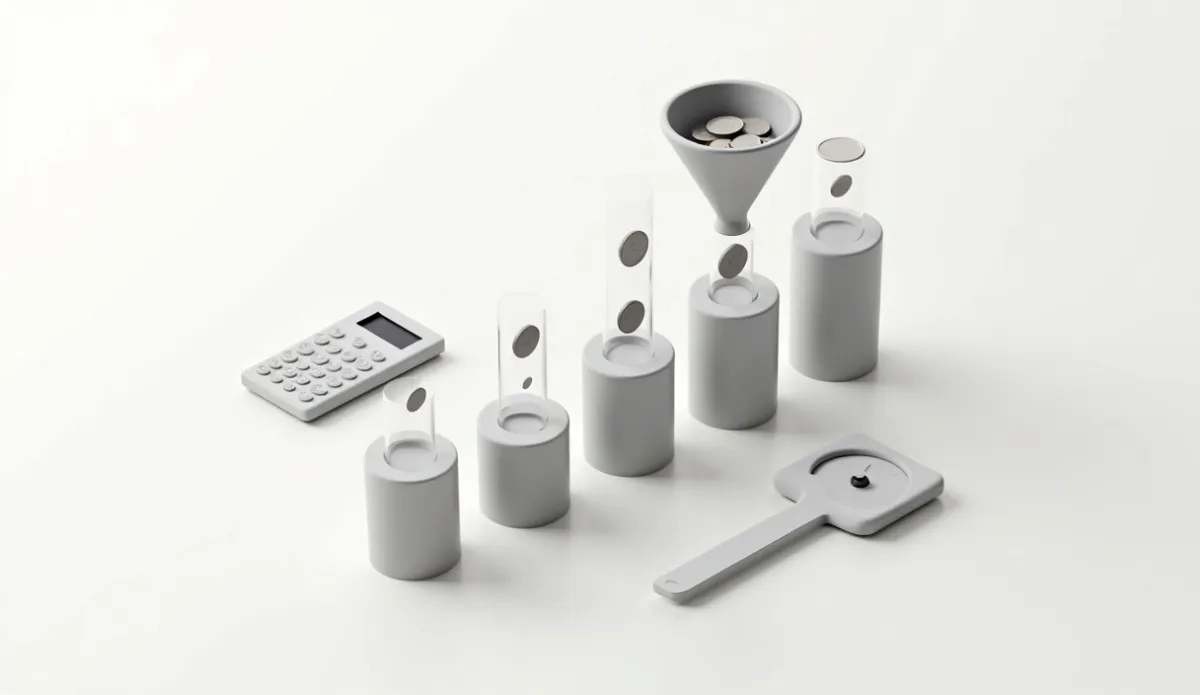
A workable offer-test budget is arithmetic, not vibes: test budget = target CPA × 10–15 conversions per test cell × number of cells, plus a 20–30% buffer for learning waste. Affiliates compress the same idea into a payout multiple — commonly 5–10× the offer payout per creative/lander combination. Either way, a $50-payout offer tested across three angles and two landers lands somewhere between $1,500 and $3,000. If that number exceeds your bankroll, the fix is fewer cells, not thinner cells — underfunded cells return noise, and noise is worse than no data.
The formula, term by term#
Target CPA. For an affiliate offer, the payout minus the margin you require; for your own product, your allowable acquisition cost from AOV and margin. If you can't state this number, you aren't ready to spend — it is the yardstick every cell gets judged against.
10–15 conversions per cell. With ten conversions your measured CPA is still a rough estimate — enough to rank cells against each other and against your allowable, nowhere near enough to prove a precise number. That's fine: the job of a test is a coarse read that tells you fund, fix, or kill. Buyers who wait for statistical certainty on every cell run out of money before they run out of hypotheses.
Cells. Angles × landers (× device or geo splits if you must). This multiplies fast: 5 angles × 3 landers = 15 cells = 150+ conversions of budget before the buffer. Cell count is the variable you control hardest, and the one research shrinks for free (next section).
The buffer. Tracking hiccups, the network's learning phase, and the publisher outliers you'll blacklist in week one all consume spend that teaches you nothing about the offer itself. Budget for it, or it silently eats your last cells.
Worked once: $50 payout, target CPA $40, 12 conversions per cell, 6 cells, 25% buffer → 40 × 12 × 6 × 1.25 = $3,600 ceiling — with the stop-loss rules below usually bringing actual spend in well under it.
Notice what the formula deliberately ignores: days. Budget buys conversions, and conversions arrive at whatever rate your traffic and conversion rate allow. Two buyers with the same $3,600 budget can run the same test in one week or five depending on daily spend — which matters, because a test stretched across five weeks starts absorbing seasonality, creative fatigue, and competitor churn into its results. A useful pacing rule: size daily spend so the whole test resolves inside two to three weeks. If your bankroll can't sustain that pace across all cells, that is another argument for cutting cells rather than trickling budget into all of them.
The payout-multiple shortcut — and when it lies#
The 5–10× payout rule of thumb survives because payout and target CPA are usually close, so 5–10 conversions' worth of spend per cell approximates the formula at typical conversion rates. It lies at the extremes. On a high-payout, low-CVR offer — think $150+ finance leads — 5× payout may buy too few clicks to see even one full conversion cycle. On backend-heavy offers where the real money shows up in EPC over weeks, front-end multiples undercount what patience is worth. Validate the offer's economics before you convert its payout into a budget.
The cheapest lever: cut cells before you fund them#
Research kills cells for free. The angles already running — and staying — in your vertical have been pre-filtered by someone else's budget: an ad that persists for weeks is paying for itself. OpenAdLibrary's index holds 725,000+ live native creatives across 49 networks (June 2026) with observed first-seen and last-seen dates, so you can read longevity as a profitability signal, mine the winning angles in your niche, and research products through their ads before spending a dollar. The free research tier covers angle mining; premium adds full landing-page captures for funnel teardowns. The effect on the formula is direct: a grid of 5 speculative angles × 3 landers (15 cells) becomes 2–3 proven angles × 2 landers (4–6 cells) — a 60%+ budget cut before you touch a bid.
Structure the spend: discovery, then focus#
Fund the test in two phases rather than evenly across the calendar:
- Phase 1 — discovery (roughly the first 60%). Run broadly across the network's inventory to find where your volume and conversions actually live. Expect ugly blended averages; the goal is placement data, not profit.
- Phase 2 — focus (the remaining 40%). Concentrate spend on the publishers that produced, cut the rest into a blacklist, and re-read per-cell CPA on clean traffic. A cell that looked dead on run-of-network often pencils on the right five sites — judging an offer on unfiltered traffic is the most common false negative in native media buying.
The two-phase structure also fixes a subtle accounting error: most buyers judge the offer on total spend, including all the discovery waste. The honest read at the end of phase two is per-cell CPA on whitelist traffic only — that number, not the blended average, is what the offer will do if you fund it properly. Keep discovery spend in its own mental column: it bought you the placement map, and you'd have paid for that map on any offer.
Stop-loss rules that keep the test honest#
The formula sets the ceiling; stop-losses make sure a bad cell never spends to it:
- Per creative: pause at 2–3× payout spent with zero conversions — the common practitioner heuristic.
- Per lander: healthy CTR but nothing converting by ~1.5× payout means the problem is the lander/offer match, not the traffic. Fix before respending.
- Per publisher: blacklist any site ID at 1–2× payout with nothing back.
- Per day: cap daily spend at a fraction of the total budget so one runaway day can't end the test.
Don't set them tighter than the math allows. At a 3% conversion rate a cell averages 33 clicks per conversion, so a stop-loss at 1× a small payout will routinely execute perfectly healthy cells mid-swing. The stop-loss protects the budget from disasters, not from ordinary variance.
Worked examples at three payout levels#
Illustrations of the formula, not promises — your conversion rates and CPCs will move all of these:
| Offer | Cells after research | Per-cell budget | Total test budget |
|---|---|---|---|
| $20 lead-gen (high CVR) | 4 | ~$100–160 (5–8× payout) | ~$400–650 |
| $50 nutra / DTC | 6 | ~$250–400 | ~$1,500–2,400 |
| $150 finance / high-ticket | 4 | ~$750–1,200 | ~$3,000–4,800 |
Notice the high-ticket row: fewer cells, funded deeper. When conversions are expensive, discovery breadth becomes a luxury — research has to do the narrowing that budget can't.
If the number is still too big#
Change the test, not the arithmetic:
- Test upstream of the conversion. Impressions are cheap; run your angles as a CTR-level cull first and send only the survivors into conversion-level spend. Ranking hooks and angles at the click level is imperfect but brutally cost-effective.
- Buy learning in cheaper geos. Tier-2 and Tier-3 geos sell clicks at a fraction of Tier-1 prices; validate mechanics there, then port to Tier-1 knowing performance transfers imperfectly — scaling into new geos covers the porting discipline.
- One variable at a time. A single proven lander under new angles, or a single proven angle over new landers — never both new at once, or a failure tells you nothing.
- Pick offers that fit the bankroll. A $20-payout, high-CVR offer teaches you the same media-buying lessons as a $150 one at a fifth of the tuition.
The discipline underneath all of it: decide the budget, the cell grid, and the stop-losses before the first impression serves. Every number chosen mid-test gets chosen by hope, and hope always votes for one more day of spend.