Español
 Português (Brasil)
 Français
 Deutsch
 Italiano
 Nederlands
 Polski
 Svenska
 Türkçe
 Русский
 日本語
日本語 한국어
한국어 简体中文
简体中文 Tiếng Việt
 Bahasa Indonesia
 繁體中文
繁體中文 Čeština
 Dansk
Dansk Norsk (bokmål)
 Suomi
Suomi Ελληνικά
 Română
 Magyar
 Українська
 ไทย
ไทย हिन्दी
 العربية
 עברית
עבריתNative Ads vs Google Display Network: Cost, Quality and Results
GDN buys cheap banner reach; native buys deliberate editorial clicks. A practitioner's comparison of cost, click quality, targeting and creative — with decision rules for choosing.


Native ads and the Google Display Network solve different problems, and most "which is better" arguments dissolve once you name the job. GDN is programmatic banner reach: enormous scale across millions of sites and apps, cheap impressions, and the most mature retargeting infrastructure in advertising. Native ads are editorial-style recommendations placed in and under publisher content: clicks that usually cost more than display clicks, but come from readers in a content-consuming mindset — which makes native far better at cold-traffic direct response through advertorial funnels. If you need to re-engage known audiences cheaply, GDN wins. If you need strangers to discover, read and buy, native wins.
This comparison covers the format mechanics, cost and click quality, targeting, creative demands, and a set of decision rules — plus how to research each channel before committing budget.
Two formats, two psychological contracts#
The Google Display Network serves banners and responsive display units into designated ad slots across websites, apps and Gmail. Users recognize them as ads instantly, which is exactly why display advertising carries decades of accumulated banner blindness. The format's job is to interrupt gently and repeatedly — which is why it shines at retargeting, where the viewer already knows the brand.
Native ads live inside the content experience: in-feed cards and content recommendation widgets beneath articles on news and media sites. A native unit is a headline plus an image that reads like the next story, and clicking it is a decision to read something. That single difference — an interruption versus a chosen click — drives everything downstream. (If you're new to the format, start with what native advertising is and how it differs from banners.)
The practical consequence: GDN clicks include a meaningful share of accidental and low-attention clicks, especially on mobile app inventory. Native clicks are deliberate, but they're driven by curiosity rather than purchase intent. Neither is "better traffic" in the abstract; they need different funnels.
Side-by-side comparison#
| Dimension | Native ads | Google Display Network |
|---|---|---|
| Placement | In-feed and under-article widgets on publisher sites | Banner slots across websites, apps, Gmail |
| Creative unit | Headline + image card styled like content | Banners / responsive display assets |
| User mindset | Reading; open to the next story | Doing something else; ad is peripheral |
| Typical buying model | CPC-dominant | CPC, CPM and automated bidding |
| Click cost | Usually higher than GDN, well below search | Among the cheapest clicks in advertising |
| Click quality | Deliberate, curiosity-driven | Mixed; includes accidental clicks |
| Targeting depth | Geo, device, publisher lists, some contextual | Audiences, in-market intent, demographics, retargeting |
| Best at | Cold-traffic direct response, advertorial funnels, lead gen | Retargeting, cheap awareness, brand frequency |
| Funnel expectation | Ad → pre-lander/advertorial → offer | Ad → landing page |
| Transparency | No official ad libraries; independent index only | Google Ads Transparency Center |
Cost: cheap clicks versus qualified clicks#
On raw click price, GDN wins and it isn't close — display clicks are among the cheapest in paid media. Native clicks cost more: media buyers commonly report Tier-1 desktop native CPCs from roughly $0.20 to $0.90 on the major networks, with mobile and Tier-2/3 geos often materially cheaper. Those figures are practitioner-reported, not official, and your vertical and geo will move them a lot — our native CPC benchmarks break the ranges down by network.
But CPC is the wrong scoreboard. What matters is cost per qualified visitor and, ultimately, cost per conversion:
- GDN's cheap clicks are diluted by accidental taps, low-viewability placements and users mid-task. Its conversion numbers are also flattered historically by view-through counting — always separate click-through from view-through before judging it.
- Native's pricier clicks come from readers who chose the headline, and who will actually read a well-built advertorial. The hidden cost of native isn't the CPC; it's the funnel-building work the traffic demands.
A useful budgeting frame: GDN cost scales with impressions you buy; native cost scales with the testing needed to find winning creative-lander pairs. See how much native ads cost for the full budgeting math.
Targeting and data: automation versus craft#
GDN's real moat is Google's data. In-market audiences, custom intent segments, demographic layers, and retargeting lists — all fed into automated bidding that optimizes toward your conversions with minimal manual work. For advertisers with conversion volume, the machine genuinely does most of the optimization.
Native targeting is cruder: geo, device, OS, and publisher-level controls. The core optimization loop is manual — watch placement-level performance, cut losing sites, and concentrate spend into whitelists of publishers that convert. There's no in-market audience for "people about to need a hearing aid"; the creative angle is the targeting, and the publisher list is the audience definition.
This asymmetry cuts both ways. GDN automates away work but leaves you competing against every other advertiser using the same automation on the same signals. Native rewards manual craft, which means skilled buyers can maintain durable edges that an algorithm won't arbitrage away next quarter.
Creative: brand polish versus editorial camouflage#
GDN creative is conventional ad design — logo, product, message, CTA — and polished brand assets perform fine because nobody mistakes a banner for content.
Native creative obeys editorial rules. The best-performing units look like journalism: candid images over studio shots, specific curious headlines over slogans, and a click that leads to a story. That story is usually an advertorial that educates before it sells — the format's conversion engine, dissected in our advertorial landing page breakdown. Dropping banner-style creative into native feeds is the single most common way advertisers conclude the channel "doesn't work."
When to choose which#
Choose native when:
- You're prospecting cold audiences at scale and search demand for your product is thin or too expensive.
- The offer needs explanation — health, finance, home, considered purchases — and you can run an advertorial funnel.
- You're doing lead generation against older, news-reading demographics.
- You have (or will build) the creative-testing muscle the channel demands.
Choose GDN when:
- Retargeting is the job. Nothing in native matches GDN's re-engagement plumbing.
- You need cheap reach and frequency for awareness, with tight brand control over where and how ads render.
- You're a small team without funnel resources — GDN plus a decent landing page is operationally simpler.
Run both when you can: the strongest common pairing uses native for cold discovery and GDN (or Performance Max) to retarget the readers who engaged but didn't convert. The channels compound rather than compete.
Researching each channel before you commit#
For GDN, transparency is straightforward: look up any advertiser's display creative in Google's official transparency surface (see our Google Ads Transparency Center explainer), and read Google's own Display Network documentation for current formats and controls.
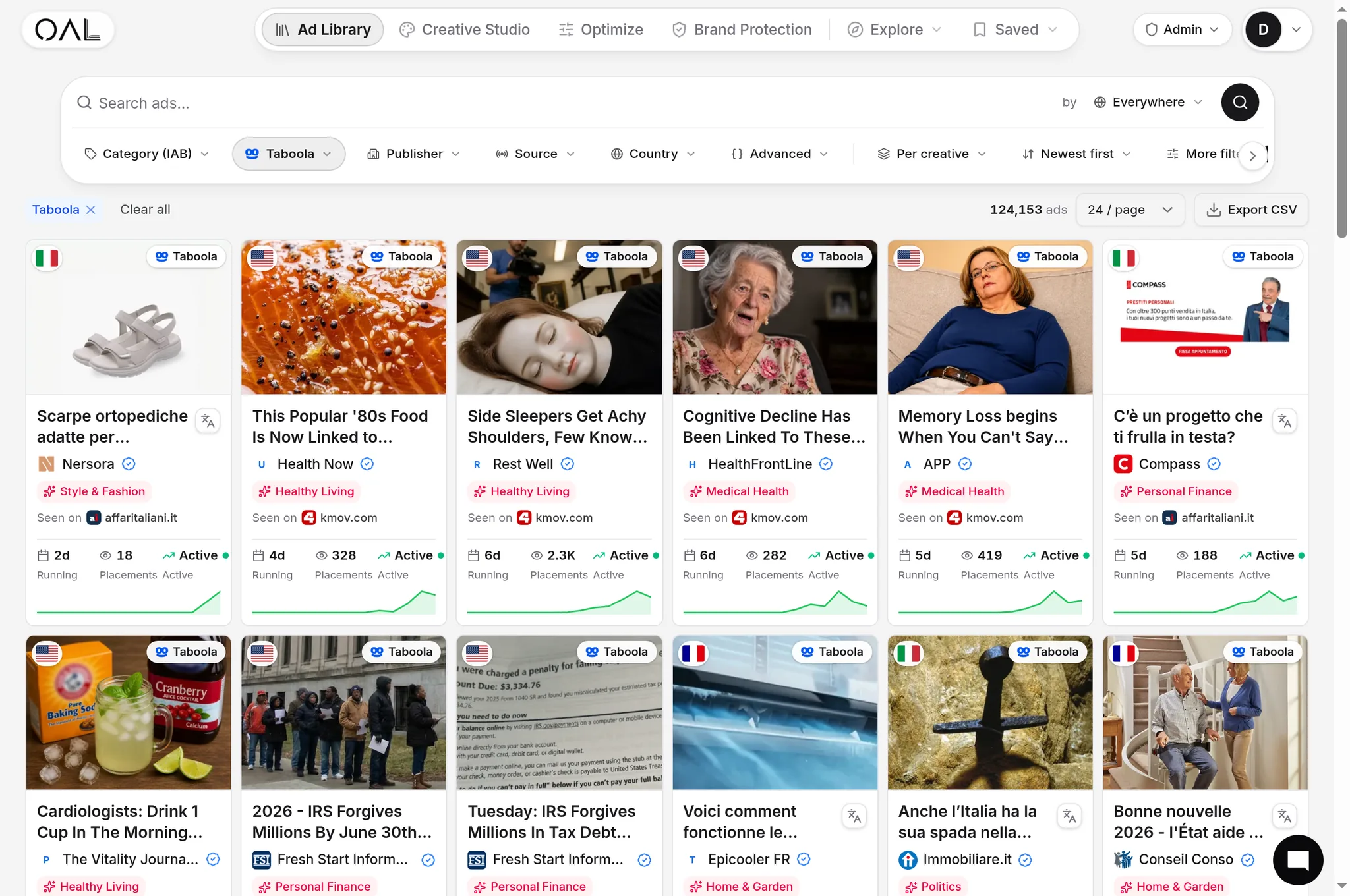
Native has no official equivalent — no native network publishes an ad library. The only way to see what's running is an independent index: OpenAdLibrary tracks 725,000+ live native creatives across 49 networks (June 2026), with advertiser resolution, observed run time and traced landing pages. Twenty minutes in the ad intelligence platform tells you which advertisers in your category sustain native spend, which angles they run, and what their funnels look like — the exact information that decides whether native deserves a slice of your display budget.
Bottom line#
GDN and native ads aren't substitutes. GDN is infrastructure for reaching and re-reaching known audiences cheaply; native is a discovery channel that converts cold readers through story-driven funnels. Buyers who assign each its actual job — and judge each on cost per conversion rather than cost per click — usually end up running both.