Español
 Português (Brasil)
 Français
 Deutsch
 Italiano
 Nederlands
 Polski
 Türkçe
 Русский
 日本語
日本語 한국어
한국어 简体中文
简体中文 Tiếng Việt
 Bahasa Indonesia
 繁體中文
繁體中文 Čeština
 Dansk
Dansk Norsk (bokmål)
 Suomi
Suomi Ελληνικά
 Română
 Magyar
 Українська
 ไทย
ไทย हिन्दी
 العربية
 עברית
עבריתNative Ads on Mobile vs Desktop: Where Your Offer Converts
Mobile owns native volume; desktop often owns conversion quality. How to split campaigns, bids, creative and landers by device — and read competitors' device strategy before spending.


On most native networks, mobile delivers the bulk of impressions and the cheaper clicks, while desktop delivers scarcer, usually costlier traffic that tends to convert better on considered offers — long advertorials, high-ticket lead forms, B2B and finance. Neither device "wins" native advertising in general; offers win on the device whose browsing context matches their funnel. The one rule that holds everywhere: never run a single blended campaign. Split by device from day one so each side gets its own bids, budget, creative and landing experience.
Same widget, different context#
A native placement is not one thing. On mobile, sponsored cards appear in-feed and mid-article on a small screen, met by a reader thumb-scrolling at speed, often in a queue or between tasks. On desktop, the classic under-article grid and sidebar recommendation widgets render larger thumbnails to a reader in longer, research-mode sessions — often with the tab parked next to work.
That context shapes the click before your funnel ever sees it:
- Mobile clicks are impulsive and cheap to trigger. Great for short funnels; fragile for anything requiring sustained attention or typing.
- Desktop clicks come from settled sessions. Long advertorials get read, multi-field forms get finished, and comparison research actually happens.
The in-feed format itself also renders differently: a thumbnail that reads clearly at desktop sizes can collapse into an unreadable smudge at mobile scale, which quietly changes which creatives win on each device.
Volume and cost: what buyers commonly see#
Publisher traffic on the open web skews heavily mobile, so most native networks serve far more mobile than desktop impressions. Deeper mobile supply generally means cheaper mobile clicks; scarcer desktop supply — chased by lead-gen and finance advertisers who want it — commonly prices higher. As a reference frame, media buyers commonly report Tier-1 desktop CPCs from roughly $0.20 to $0.90 on the major networks, with mobile clicks in the same markets often materially cheaper. These are practitioner-reported ranges, not official rate cards; niche and geo move them a lot. Our native CPC benchmarks and cost guide cover the ranges network by network.
The trap is reading cheap mobile CPCs as cheap conversions. Mobile's low prices partly reflect its lower average session quality — the discount exists for a reason. The only meaningful comparison is cost per conversion by device, measured separately.
Geo compounds the device question. In many Tier-2 and Tier-3 markets, desktop inventory is thin because the audience is effectively mobile-only; a desktop-skewed funnel that prints in the US or Germany may simply have no room to scale in mobile-first markets. Conversely, Tier-1 desktop supply, scarce as it is, carries some of the most valuable lead-gen traffic in the channel — which is precisely why it costs more. When you expand geos, re-test the device split rather than exporting it; the ratio that worked at home rarely survives the move intact.
Which offers lean which way#
Tendencies, not laws — the audience of a specific publisher matters more than the device average. But as starting priors:
| Offer type | Device tendency | Why |
|---|---|---|
| Low-ticket impulse ecommerce | Mobile | Short funnel survives short attention |
| Sweepstakes / email submits | Mobile | One-field forms, instant gratification |
| Insurance & finance lead forms | Test both | Older news-reading demos convert on both |
| High-ticket lead gen (solar, legal, annuities) | Desktop skew | Long forms, trust research, bigger commitment |
| B2B / SaaS | Desktop | Work-hours mindset, work machine |
| Long advertorial → purchase | Desktop skew | Reading time and typing tolerance |
| App installs | Mobile | The install is one tap away |
Treat the table as your hypothesis sheet: launch both devices where ambiguous, and let separated data decide within a week or two.
Set up the split properly#
Device separation is mechanical, but most first campaigns get it wrong by blending:
- Separate campaigns per device. A blended campaign reports one average that hides a profitable device inside a losing one. Separate campaigns give each device its own budget, bid and kill-switch.
- Separate publisher lists. A site that prints on desktop can lose money on mobile — different widget positions, different audience mix. Build device-specific whitelists rather than copying one list across.
- Bid from device economics. Work backward from each device's conversion rate and value to its own bid ceiling. Identical bids across devices is a silent subsidy from your winner to your loser.
- Use OS splits where offered. iOS and Android audiences behave differently on payment-heavy offers; where a network allows OS-level targeting, test it. Major platforms expose device and platform controls in campaign settings — see how Taboola ads work for how the biggest network structures this, and check each network's current documentation for specifics.
- Keep funnels device-consistent. Send mobile clicks to pages built for mobile, not shrunk from desktop. Obvious, widely violated.
One measurement note: make the device split visible end-to-end, not just in the network dashboard. Pass a device token through your tracking links so every downstream event — pre-lander clicks, form starts, sales, lead acceptance — can be cut by device. Plenty of campaigns look device-balanced at the click level and wildly lopsided at the revenue level; without the token you'll never see it.
Here's how the failure usually looks in practice: a lead offer tests evenly on clicks — plenty of cheap mobile traffic, a trickle of pricier desktop traffic — and the blended campaign reads marginal. Split, the picture inverts. Mobile floods the pre-lander but sheds readers at the four-field form; desktop's smaller click volume completes forms at several times the rate. The correct move — cutting mobile to a short-form variant while scaling desktop bids — is invisible in the blended view and obvious in the split one. Some version of this shows up in most device post-mortems; the buyers who catch it early are the ones who separated devices before spending, not after.
Creative and landing pages per device#
Device changes what wins creatively, not just what it costs:
- Thumbnails: mobile rewards single-subject, high-contrast images with no fine detail; busy lifestyle shots that work at desktop size become noise at feed scale. The principles in native creative best practices apply double at small sizes.
- Headlines: mobile widgets truncate earlier — front-load the hook so the curiosity survives the cut. Our headline formulas hold on both devices, but test truncation on real placements.
- Mobile landers: speed is a conversion lever, not an engineering nicety. Single column, sticky CTA, short first form screen, and click-to-call where a phone lead is the product.
- Desktop landers: denser advertorials with sidebar proof elements and longer forms are viable — the funnel patterns that feel heavy on mobile often outperform on desktop.
Read competitor device splits before you spend#
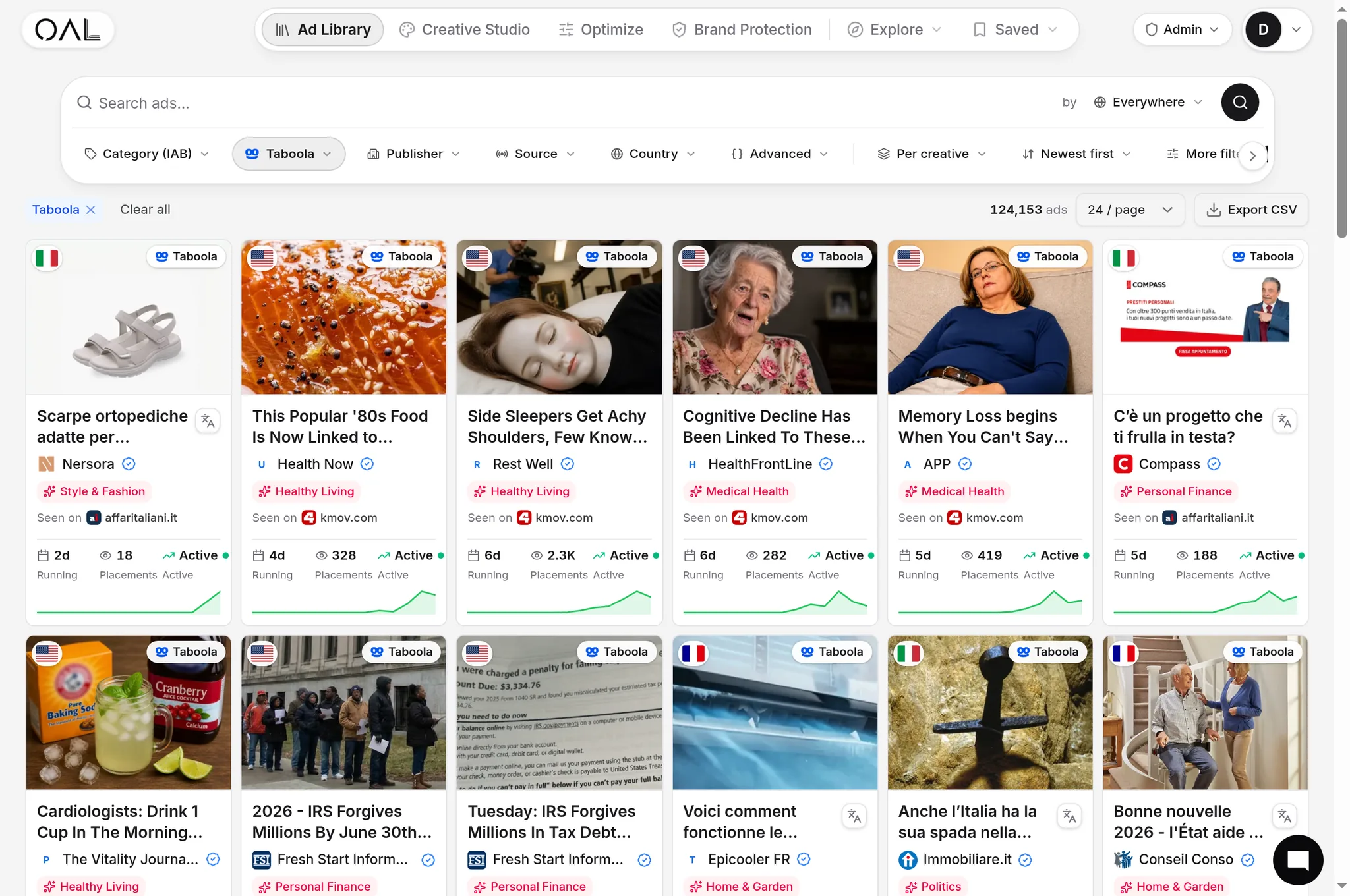
The fastest way to calibrate a device strategy is watching where proven advertisers already concentrate. OpenAdLibrary captures native ads across desktop and mobile device profiles and exposes device as a filterable facet — across an index of 725,000+ live creatives on 49 networks and nearly 6.9 million ad observations (June 2026). Pull your niche in the native ad spy tool, filter by device, and look at the ads with 30+ days of observed run time: if every long-running advertiser in your category sits on one device, that's the market telling you where its funnels pay out. The logic of that signal — sustained spend as revealed profitability — is unpacked in why longevity is the strongest signal in native.
Bottom line#
Mobile gives native advertising its scale; desktop gives it much of its conversion depth. The buyers who profit from both are the ones who refuse to let the two share a campaign, a bid or a landing page — and who choose devices per offer based on evidence, starting with what already-profitable competitors are doing on each screen.