Español
 Português (Brasil)
 Français
 Deutsch
 Italiano
 Nederlands
 Polski
 Svenska
 Türkçe
 Русский
 日本語
日本語 한국어
한국어 简体中文
简体中文 Tiếng Việt
 Bahasa Indonesia
 繁體中文
繁體中文 Čeština
 Dansk
Dansk Norsk (bokmål)
 Suomi
Suomi Ελληνικά
 Română
 Magyar
 Українська
 ไทย
ไทย हिन्दी
 العربية
 עברית
עבריתMGID Advertising Cost in 2026: CPC Rates by Geo & Minimum Deposit
MGID has no rate card — your CPC is set by auction, geo and creative CTR. Here are the ranges media buyers commonly report by tier, the deposit mechanics, and how to size a test budget that actually produces a verdict.


MGID is one of the cheapest ways to buy native traffic at meaningful scale. The network runs a CPC auction with no published rate card; media buyers commonly report clicks from under a cent in Tier-3 geos up to roughly $0.10–$0.40 for competitive Tier-1 desktop placements, and the self-serve minimum deposit is commonly cited around the $100 mark. None of those figures is official — MGID prices by auction, so your vertical, creative CTR and geo determine what you actually pay. This guide breaks down how MGID pricing works, the CPC ranges practitioners report by geo tier, deposit and budget mechanics, the costs nobody itemizes, and how to size a test that produces a real verdict instead of an expensive shrug.
How MGID pricing works#
MGID sells clicks. You set a CPC bid per campaign — adjustable by geo and placement — and the network ranks your teasers against competing ads on effective revenue to the publisher, which in practice means your bid multiplied by your click-through rate. Two consequences follow:
- CTR is money. A teaser that earns twice the CTR can win the same placement at a materially lower bid. Creative testing isn't a nice-to-have on MGID; it is the pricing mechanism.
- Competition sets your real cost, not a rate card. There is no rate card. The floor in a sleepy Tier-3 geo and the going rate in US health lead generation differ by two orders of magnitude.
MGID also offers automated bidding features that adjust CPCs toward a conversion target once your tracking feeds data back to the platform. They can help at scale, but they need real conversion volume to learn from — on a fresh account with thin data, manual CPC bidding with deliberate placement rules usually reads better. Feature names and mechanics change; check MGID's current documentation before building a strategy around any specific bidding product.
If you're new to the network, How MGID works covers formats, targeting and account setup. This article stays on cost.
MGID CPC rates by geo tier (commonly reported)#
MGID's footprint is unusually global — the live MGID creatives in OpenAdLibrary's index include ads running in Greek and a long tail of non-English markets — and Tier-2/Tier-3 reach is one of the network's genuine strengths. Practitioner-reported CPC ranges cluster like this:
| Geo tier | Commonly reported CPC range |
|---|---|
| Tier-1 desktop (US, UK, CA, AU, DE…) | ~$0.10 – $0.40 |
| Tier-1 mobile | ~$0.04 – $0.20 |
| Tier-2 (Eastern Europe, LATAM, SEA…) | ~$0.01 – $0.10 |
| Tier-3 | ~$0.003 – $0.03 |
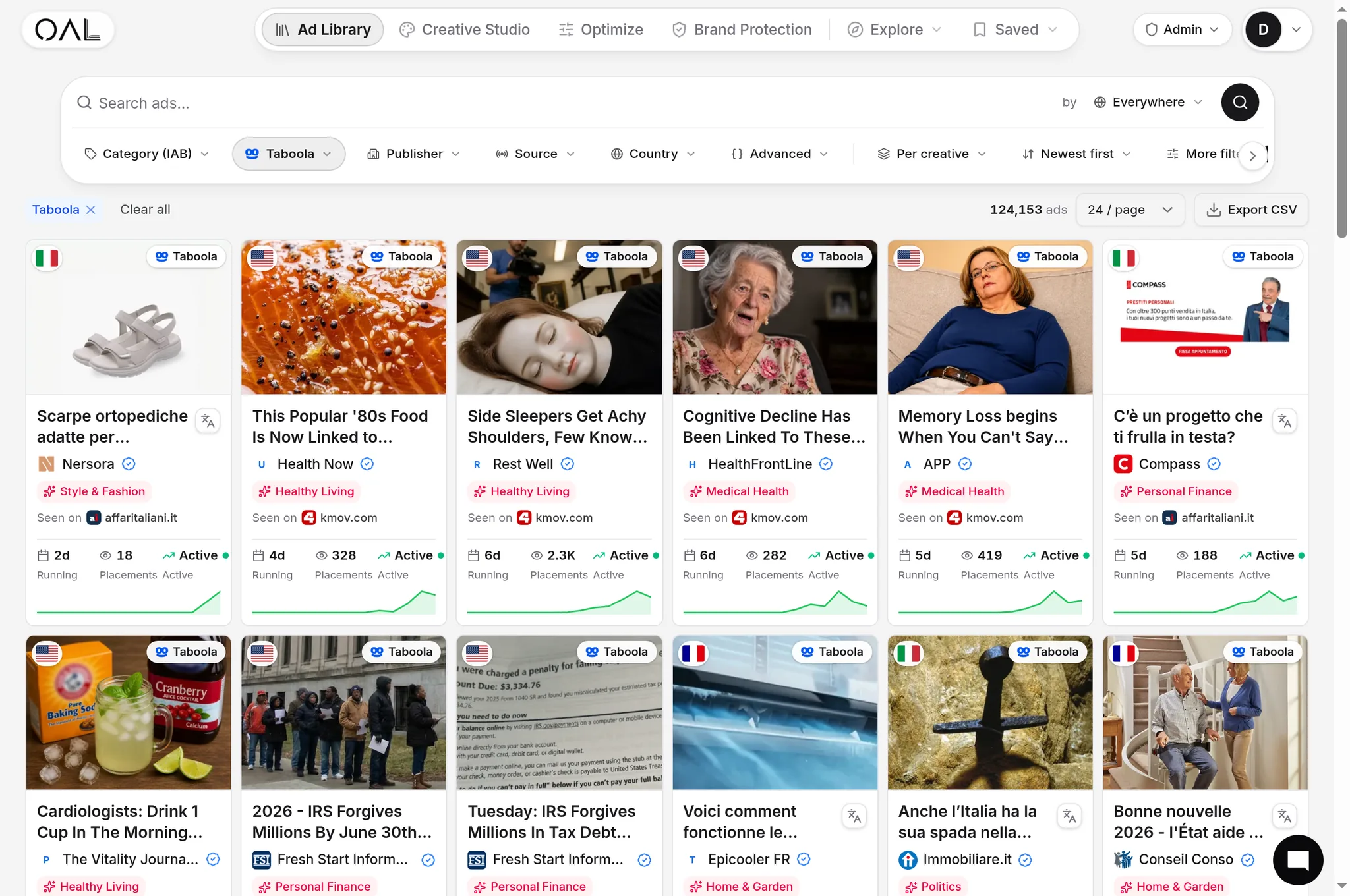
Treat this table as heuristic, not quotation: these are ranges media buyers commonly report, they drift over time, and hot verticals blow through the top of them. What the tiers mean — and why buyers structure campaigns around them — is covered in Tier 1 / Tier 2 / Tier 3 geos. For how MGID's pricing sits against Taboola, Teads and Revcontent, see the native ads CPC benchmarks.
Minimum deposit and daily budgets#
MGID's entry bar is among the lowest in native advertising. The self-serve minimum deposit has long been cited at around $100, and daily campaign budgets can start low enough that a single-geo test doesn't demand a big commitment. Confirm the current figures at signup — they vary by region, currency and account type, and managed accounts (which come with a dedicated rep) carry higher spend expectations.
The practical warning: a low entry cost makes disciplined budgeting more important, not less. It's easy to wander in undercapitalized, spread $100 across five geos and ten teasers, collect forty clicks per cell, and learn precisely nothing. Cheap traffic still requires statistically meaningful volume.
What actually moves your MGID CPC#
Four levers dominate:
- Geo and vertical competition. Of the 62,765 live MGID creatives in OpenAdLibrary's index (July 2026), entertainment-style content is by far the largest classified vertical at roughly 14,000 creatives — but the direct-response money verticals (health, insurance, finance) are where auctions actually heat up, because that's where advertisers with proven funnels keep raising bids.
- Teaser CTR. Because the auction effectively prices on bid × CTR, a stale or weak teaser pays a rising effective toll. When your CPC creeps up at constant bid, creative fatigue is the first suspect.
- Placement quality: whitelist vs run-of-network. RON clicks are cheap partly because they include weak placements. The standard playbook is to start RON to gather placement data, then whitelist the sites that convert — your average CPC rises, but your cost per conversion drops.
- Device and traffic type. Mobile inventory is more plentiful and cheaper; desktop clicks cost more but often convert better for considered offers. Test them as separate campaigns, never blended.
The costs the CPC table never shows#
Budgeting only for media is the classic MGID mistake. Real test budgets also absorb:
- Creative production volume. MGID rewards 10–20 teasers per campaign, refreshed as they fatigue. Whether that's design time or AI tooling, it's a real cost line.
- Tracking. A tracker or postback setup is non-negotiable for placement-level pruning; budget for the tooling and the setup hours.
- Discovery spend. The RON phase — paying for clicks from placements you'll later blacklist — is tuition. Whitelist discipline shrinks it; nothing eliminates it.
- Losing angles. Most angles lose. The winners must repay the graveyard, which is why per-angle click budgets matter.
- Time. Placement reviews, teaser refreshes and bid adjustments are a recurring operational load. MGID traffic is cheap partly because the optimization labor is yours.
Budgeting a realistic MGID test#
A test that can produce a verdict looks like this:
- One geo at a time. Blended-geo stats are unreadable; pick one market and let it conclude.
- 2–3 angles, 5–7 teasers each. Enough creative variance for the auction to find something it likes.
- A few hundred clicks per surviving angle before judging its CPA — as arithmetic, 400 clicks at a $0.05 mobile CPC is about $20 of media; the same clicks at a $0.30 Tier-1 desktop CPC is $120.
- A pruning cycle. Review placements every few days; blacklist non-converters, then re-read the numbers.
Put together, a single-geo Tier-2 test of three angles commonly lands in the low hundreds of dollars; the same test shape on Tier-1 desktop runs four figures. Whether MGID's cheap clicks convert is then a landing-page and offer question, not a traffic question — Media Buying for Native Ads covers the full test structure.
Don't pay auction prices for public information#
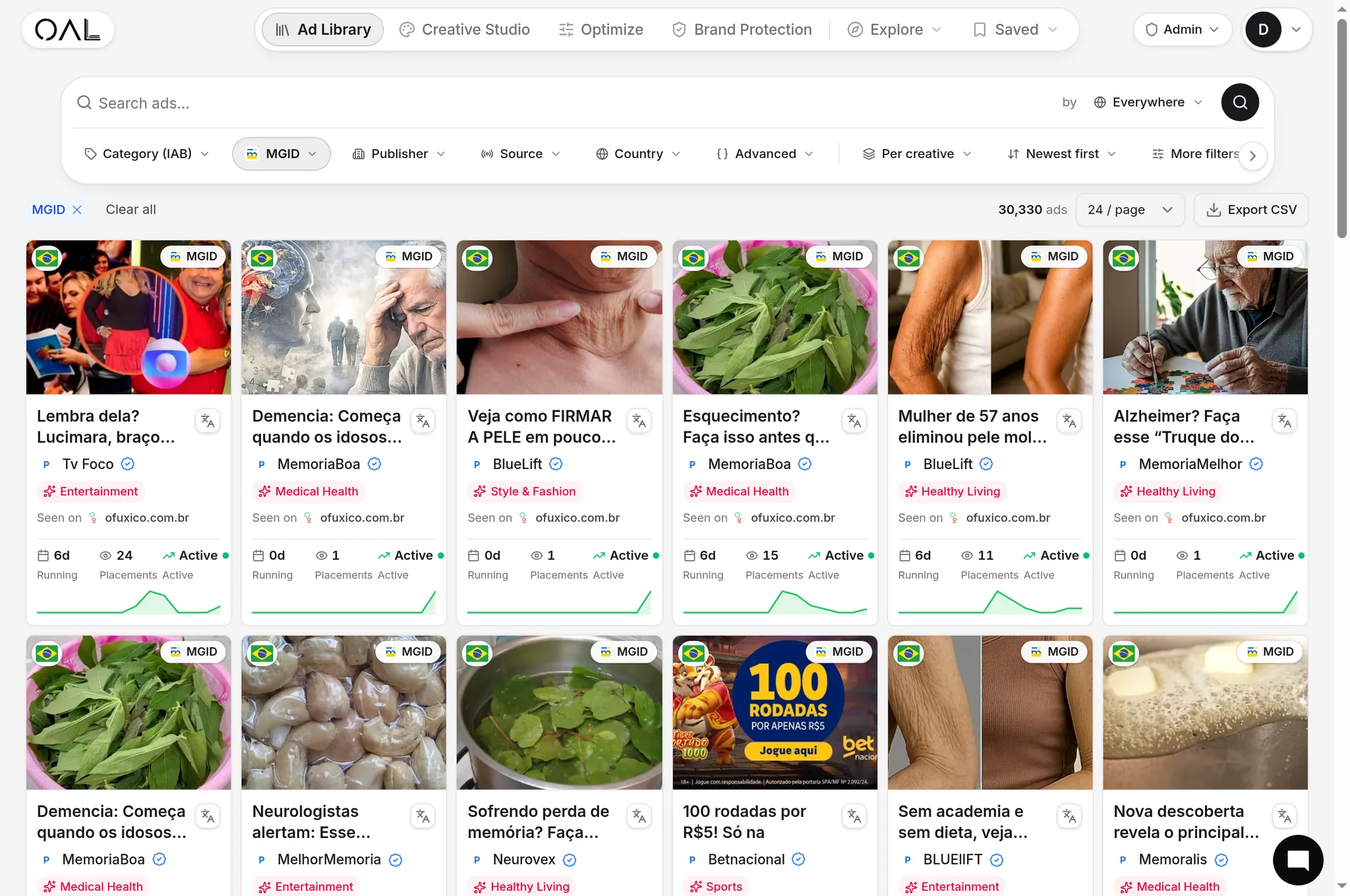
Half of a typical MGID test budget goes to rediscovering things the network's live output already shows: which angles dominate a vertical, which teasers survive for weeks, what competitors' funnels look like behind the click. OpenAdLibrary indexes 62,765 live MGID creatives with advertisers, observed run times, geo data and traced landing pages — browse them in the MGID ad library or through /spy/mgid. The highest-value filter is longevity: an ad that has run 30+ days is probably profitable, and modeling proven angles before your first deposit cuts the discovery spend that dominates most failed tests.
How MGID costs compare with other native networks#
MGID's clicks are cheaper than the premium networks (Taboola, Outbrain/Teads) and competitive with the rest of the mid-tier. That's not automatically an advantage: cheaper traffic carries more variance in placement quality, so effective CPA — not CPC — is the number to compare across networks. MGID vs Taboola and MGID vs Revcontent compare the networks head to head, and How much do native ads cost? puts the budgeting math for every major network side by side.
The bottom line: MGID advertising costs are low, controllable and unusually sensitive to creative quality. Buyers who arrive with teaser volume, a pruning routine and geo discipline commonly get Tier-1 clicks for tens of cents and Tier-2/3 clicks for pennies. Buyers who don't will discover that even cheap clicks add up fast.