Español
 Português (Brasil)
 Français
 Deutsch
 Italiano
 Nederlands
 Polski
 Svenska
 Türkçe
 Русский
 日本語
日本語 한국어
한국어 简体中文
简体中文 Tiếng Việt
 Bahasa Indonesia
 繁體中文
繁體中文 Čeština
 Dansk
Dansk Norsk (bokmål)
 Suomi
Suomi Ελληνικά
 Română
 Magyar
 Українська
 ไทย
ไทย हिन्दी
 العربية
 עברית
עבריתIs Your Brand Being Impersonated in Ads? How to Check Today
A practical 20-minute check across Meta, Google and the native ad networks that publish no libraries at all — plus how to monitor continuously and escalate.

To find out whether your brand is being impersonated in ads, search your brand name, product names, and founder names across every ad transparency surface that exists — the Meta Ad Library, the Google Ads Transparency Center — and then across an independent index for the channels that publish nothing, which is most of the open web. Native ad networks such as Taboola, Outbrain and MGID operate no official ad libraries, and they are precisely where impersonation campaigns concentrate, because nobody is watching. A thorough first pass takes about twenty minutes. This article gives you the exact sequence, what to search beyond the obvious brand string, and how to tell an impersonator from a legitimate affiliate.
What brand impersonation in ads looks like#
Impersonation campaigns cluster into four patterns:
- Fake storefronts. Your product photos, your brand name, prices 70–80% below retail, on a lookalike domain. The goal is card harvesting or shipping counterfeits.
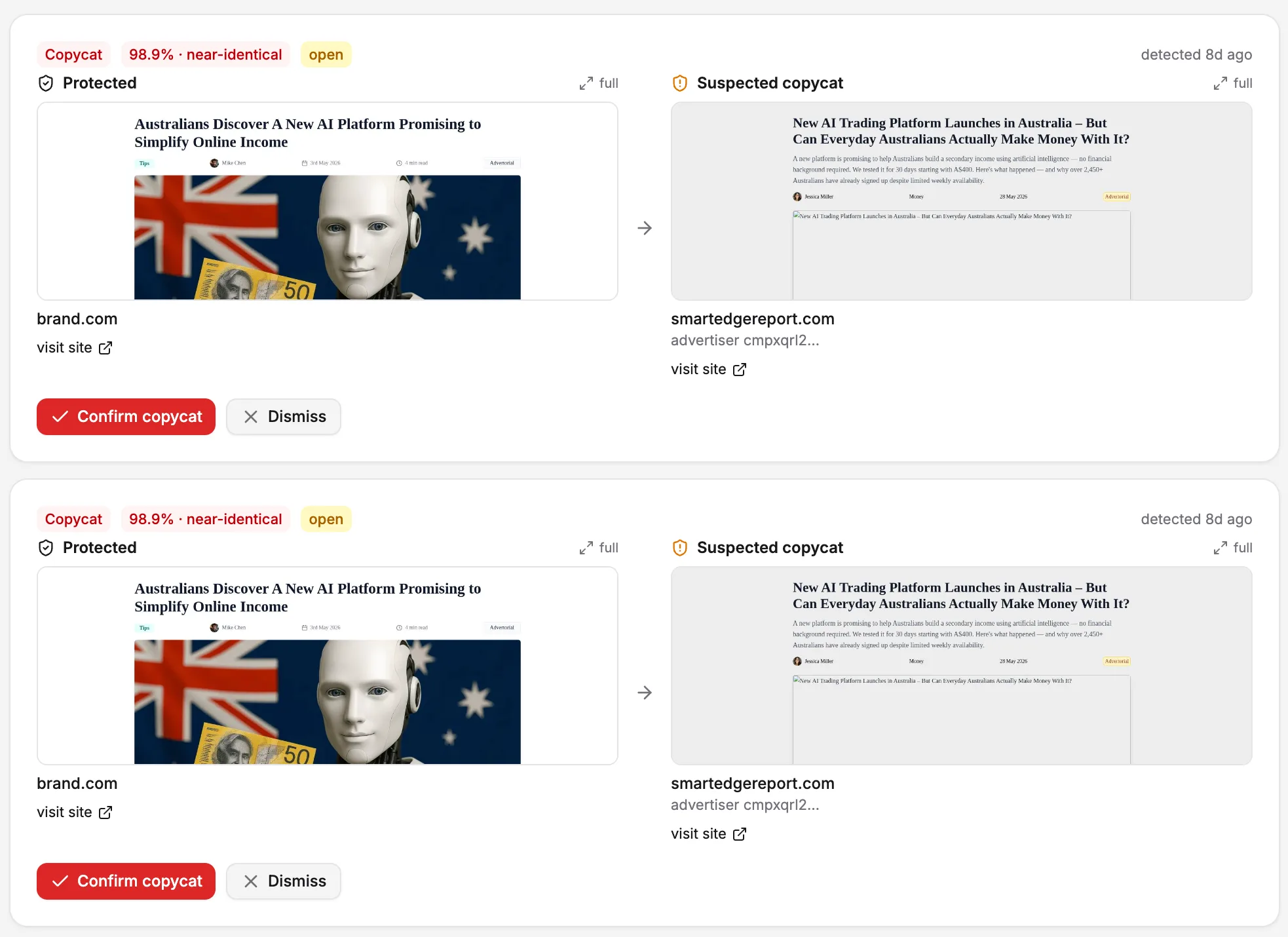
- Fabricated endorsements. An advertorial claiming your founder revealed a secret, got sued, or endorsed a product — usually wrapped around a supplement, crypto, or trading offer that has nothing to do with you.
- Copycat funnels. Pixel-close clones of your actual landing pages, capturing leads or payments meant for you. We dissect the mechanics in Copycat Landing Pages.
- Support and login phishing. Ads targeting your existing customers with fake "official support" or account-verification pages.
The damage is rarely just reputational. Impersonators generate chargebacks that trace back to confusion with your brand, flood your support queue, pollute your search and social results, and — in the meanest cases — compete against your own ads with fake versions of them.
Why impersonators pick channels without transparency#
Impersonation follows the path of least surveillance. Meta and Google run public, searchable ad archives — the Meta Ad Library and the Google Ads Transparency Center — so a brand-name search there exposes an impersonator in seconds, and takedown teams have an artifact to act on. The open-web native channel has no equivalent: no official library exists for the major native networks, ads rotate across thousands of publisher sites, and the advertorial format means a fabricated brand story blends into the feed's normal texture. (More on that gap in What Is Ad Transparency?)
That asymmetry shapes behavior. The crude, short-lived impersonations show up on social, where they are easy to find and easy to kill. The patient, profitable ones migrate to channels where a brand would need its own monitoring infrastructure to ever see them.
The 20-minute brand check#
Run these five searches in order. Save evidence as you go — URLs, screenshots, advertiser names, dates.
1. Meta Ad Library#
Search your brand name plus common misspellings and spacing variants. Look at which pages are running the ads: any page that is not yours, a known partner, or an authorized reseller deserves a closer look — open the page, check its history and its other ads.
2. Google Ads Transparency Center#
Search the same terms. Google shows ads grouped by verified advertiser, so pay attention to advertiser identities you don't recognize running creative that features your product or brand terms.
3. The native networks (the blind spot)#
This is where you need an independent index. OpenAdLibrary maintains a searchable index of 725,000+ live native ad creatives across 49 networks (June 2026), each with a resolved advertiser label and a captured landing page. Search your brand and product names in the ad intelligence library and review every advertiser label that is not you. The free tier covers brand-name searches, so the check itself costs nothing; continuous coverage is a paid-tier feature.
4. Search beyond the brand string#
Experienced impersonators avoid the exact brand name in ad text to dodge lazy monitoring. Search your flagship product names, your founder's name, and your best-known marketing phrases. Fabricated-endorsement campaigns almost always lead with a person, not a brand.
5. Check the landing domains#
For every suspicious ad, look at where the click actually lands. Lookalike domains follow predictable patterns: brand-outlet.shop, brand-sale.store, getbrand.co, the brand with a hyphen inserted or a letter swapped. Compare everything against the list of domains you actually own or authorize.
Bonus: search your images, not just your words#
Impersonators reuse your product photography and lifestyle shots because shooting their own would cost money. Run a reverse image search on your three or four most-used product photos and hero images. Ads and storefronts using your assets under someone else's name are impersonation by definition, and image reuse catches operations whose ad copy never mentions you at all.
One prioritization note: impersonation follows your demand. If most of your revenue is in two or three countries, weight the checks toward those geos, and expect spikes around your own promotional peaks — sale seasons are when a fake storefront's "80% off" framing is most believable and when your customers are least suspicious of it.
Impersonator or affiliate? How to read what you find#
Not every third-party ad using your brand is hostile. Affiliates, resellers, and comparison sites may legitimately reference you. Three questions separate them:
- Where does the click end? Follow the redirect chain. A legitimate affiliate's click ultimately lands on your domain or an authorized partner's. An impersonator's click never touches infrastructure you control.
- Are the claims yours? Affiliates exaggerate; impersonators fabricate. A fake founder quote or an invented lawsuit is impersonation regardless of where the click goes.
- Who collects the money or the lead? If a form or checkout on a domain you don't control is harvesting payments or emails under your name, you are done deliberating.
Document before you act: the creative, the advertiser label, the full landing URL, and the date. Takedown teams and legal counsel need artifacts, and impersonation campaigns rotate fast enough that evidence not captured today may be gone tomorrow.
Turn the check into continuous monitoring#
A one-time check tells you about today. Impersonation is a recurring event: campaigns get banned and relaunched under new accounts within days. A sustainable program looks like:
- A weekly manual sweep of the five searches above — twenty minutes on the calendar, same time every week.
- Saved searches and watchlists, so new creatives matching your brand terms surface without manual effort. The mechanics are identical to competitor monitoring — see how to build a watchlist for ad monitoring — just pointed at your own brand.
- Landing-page similarity monitoring for clones of your funnel pages, which catches copycats that avoid your brand terms entirely.
Native networks deserve the most frequent attention, precisely because there is no official library and impersonators know it. A standing program is cheap compared to one week of chargebacks from a successful fake storefront. For the organizational view — who owns this, what tooling, what escalation paths — see Brand Protection in Native Advertising and the brand protection glossary entry.
When you confirm impersonation: escalate in this order#
- Freeze the evidence. Screenshots, saved pages, URLs, WHOIS records, capture-tool records. Everything downstream depends on this.
- Report to the ad platform or network. This kills the traffic, which is what the impersonator is paying for. Include the full evidence package — our scam ad reporting guide covers the per-network routes.
- Attack the infrastructure. Abuse reports to the clone's host and registrar; Safe Browsing reports so browsers warn visitors away from the landing pages.
- Open the trademark track. Ad platforms run dedicated trademark complaint processes distinct from scam reports, and they move on different — often faster — rails. See Trademark Infringement in Ads.
- Tell your customers. A short notice ("we only sell at yourbrand.com") costs nothing and cuts the impersonator's conversion rate immediately.
The brands that get hurt worst by impersonation are the ones who find out from their customers. Twenty minutes a week means you find out first.