Español
 Português (Brasil)
 Français
 Deutsch
 Italiano
 Nederlands
 Polski
 Svenska
 Türkçe
 Русский
 日本語
日本語 한국어
한국어 简体中文
简体中文 Tiếng Việt
 Bahasa Indonesia
 繁體中文
繁體中文 Čeština
 Dansk
Dansk Norsk (bokmål)
 Suomi
Suomi Ελληνικά
 Română
 Magyar
 Українська
 ไทย
ไทย हिन्दी
 العربية
 עברית
עבריתIs Taboola Legit? Separating the Platform From the Ads It Runs
Taboola the company is real, public and embedded in major news sites. The ads are a mixed marketplace. Here is how to judge the platform, the ads, and whether your money is safe there.

Taboola is legit: it is a publicly traded advertising company (Nasdaq: TBLA) founded in 2007, and its sponsored-content widgets run on some of the largest news sites in the world. The question keeps getting asked because the platform's legitimacy and the trustworthiness of individual ads running on it are two different things. Taboola the company is real, pays publishers, and carries campaigns from mainstream brands. At the same time, some ads on the network use clickbait tactics or lead to low-quality advertorials — and a small minority are outright scams that slipped through review. This article separates the three questions people actually mean: is the company real, are the ads safe, and should you spend money there.
What Taboola actually is#
Taboola is a content-recommendation and native advertising network. Publishers embed its widget — the "You may like" or "Sponsored stories" grid below and inside articles — and receive a share of the ad revenue it generates. Advertisers bid cost-per-click for the traffic. The company was founded in 2007, listed on the Nasdaq in 2021, and powers native advertising for Yahoo under a long-term partnership, alongside thousands of other publisher integrations. The mechanics of placements, bidding and targeting are covered in our guide to how Taboola ads work.
That is the business: audited, publicly reported, contractually bound to major media companies. Whatever you conclude about individual ads, "Taboola is a scam company" is not a supportable claim. The real questions sit one level down, in the marketplace it operates.
Why Taboola ads look the way they do#
Taboola runs an open auction dominated by performance advertisers — businesses that pay for clicks and live or die on conversion economics. On cold readers, curiosity outperforms politeness, so the creative style converges on clickbait mechanics: withheld information, pattern interrupts, "doctors are baffled" framing.
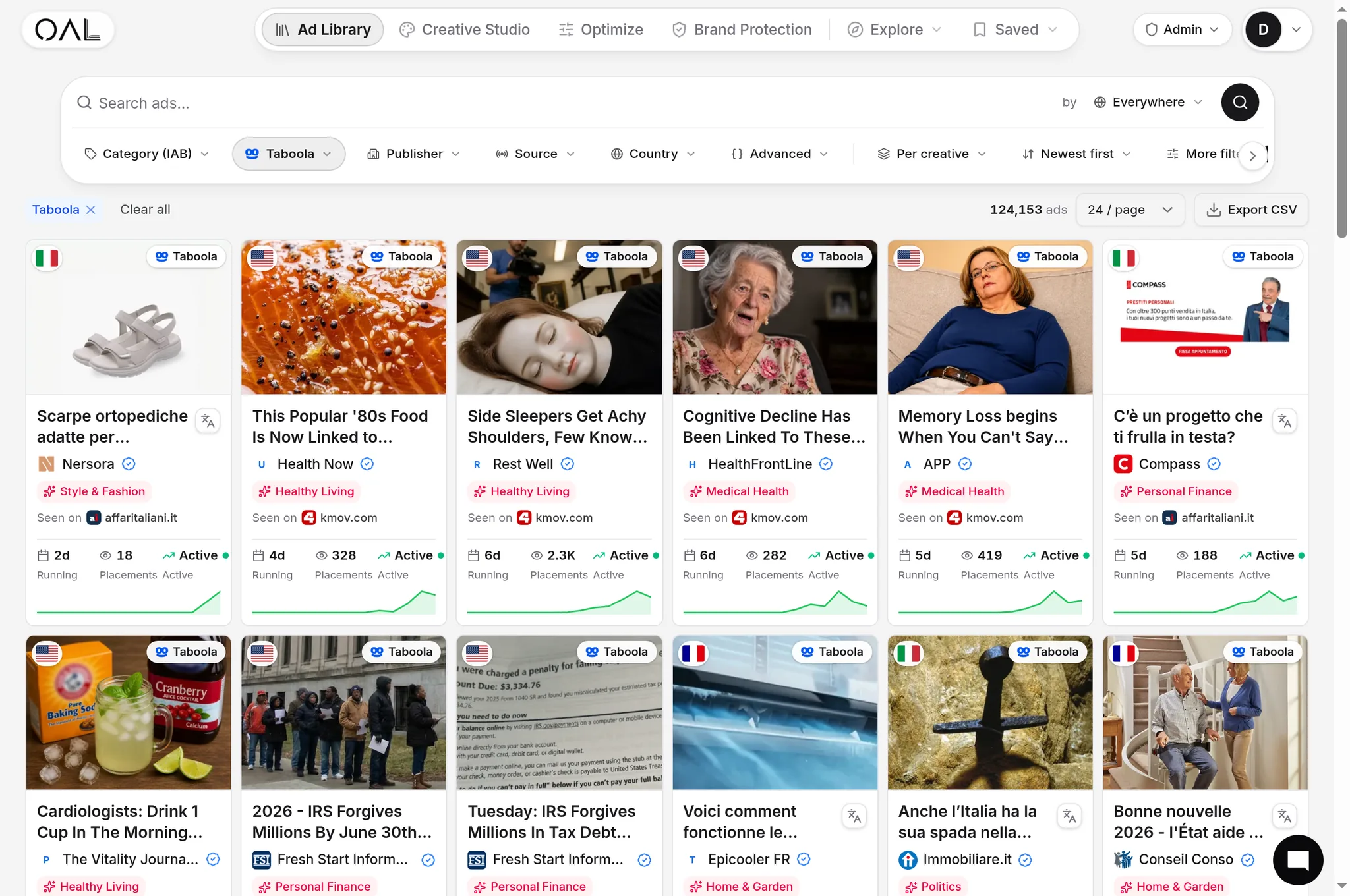
Two things are simultaneously true in our live capture of the network (June 2026):
- Mainstream brands run there. OpenAdLibrary's Taboola index includes campaigns from household advertisers — real-estate portal Domain.com.au promoting property stories, hearing-care brand Audika running product ads — captured live in the same feeds.
- So do aggressive advertorial funnels. Creatives like "Top 5 Shampoos To Avoid" — a classic fear-angle listicle — run alongside them, sometimes in the same widget load.
Both come out of the same auction. The widget doesn't visually distinguish a listed company's campaign from an affiliate's advertorial; the reader has to. That collision is most of why "is Taboola legit" gets searched. Our breakdown of the most common native ad angles shows how systematic these creative patterns are.
Advertorials themselves are legal when properly disclosed — the FTC publishes explicit native advertising guidance, and we summarize the practical rules in our guide to FTC disclosure rules for advertorials. The problems start where advertorials shade into fake endorsements, miracle claims, or cloaked pages that show the ad reviewer one thing and the user another. Networks review ads before they run, but at marketplace volume some bad actors get through — a dynamic we document across networks in ad fraud in native advertising.
Is it safe to click Taboola ads as a reader?#
Usually, yes — a Taboola click takes you to an advertiser's landing page, not to malware. The network's scale depends on mainstream publishers staying willing to embed the widget, which is a real commercial pressure toward policing the worst actors. The realistic risks for a reader are lower-grade than viruses: advertorials dressed up as news, subscription traps in the fine print, and impostor pages that borrow a real brand's name and design to sell something the brand never made. The red flags worth teaching anyone who asks:
- Celebrity images paired with products the celebrity has never mentioned anywhere else.
- Medical miracle claims — "ends knee pain", "reverses diabetes" — with a countdown timer.
- News-styled pages whose only outbound links go to a checkout.
- Prices and claims that appear nowhere on the brand's real website.
- Urgency theater: stock counters, "offer expires today" banners that reset on every visit.
A practical habit that defuses most of the risk: treat the ad as a discovery mechanism, not a checkout path. If a product interests you, search the brand directly and buy from its real site — the legitimate advertiser still gets the sale, and the impostor doesn't. Impostor pages are the most damaging variant, for readers and for the brands being cloned; we cover how they operate in copycat landing pages. If you hit one, reporting the scam ad with evidence — screenshots, URLs, timestamps — is what actually gets it pulled.
Is Taboola legit for advertisers?#
Yes — with eyes open. The traffic is real: clicks come from human readers on real publisher sites, and the network enforces an ad-review process (rejections are common enough to be a running complaint among buyers). The caveats that separate profitable accounts from burned ones:
- Placement quality varies enormously. A campaign sprayed across the whole network will include long-tail sites that never convert. Publisher-level review and blocking is not optional; it is the job.
- The clicks are cold. Buyers who send Taboola traffic to a search-style product page, judge it in three days, and conclude "scam" have misdiagnosed a funnel problem as a fraud problem. Cold traffic needs advertorial or pre-lander funnels.
- Bad neighbors exist. Your legitimate ad can appear near a low-quality one. That is an inherent property of open marketplaces, manageable but not removable.
None of this is unique to Taboola — it describes every large native network. The practical difference is scale: Taboola is the biggest single native index we track, which means both more opportunity and more noise.
Is Taboola legit for publishers?#
For publishers the calculus is revenue versus experience. Taboola pays reliably and integrates with major news organizations globally — that track record is long and public, and for many mid-sized publishers the widget is one of the few dependable revenue lines left. The trade-off is editorial adjacency: the widget will sometimes serve ads whose tone undercuts the publication's own. Category and advertiser blocks exist, but curating them takes ongoing effort most publishers under-invest in, which is why the same news site can carry rigorous journalism above the fold and "doctors are baffled" below it. A publisher deciding whether the widget is "worth it" is really pricing that reputational externality against a meaningful revenue line — a legitimate business decision, made with open eyes, on both sides of the contract.
The three-question verdict#
Collapsing the whole debate into the questions people actually mean:
- Is the company legit? Yes — public, audited, contracted to major media brands.
- Are all the ads trustworthy? No — it is an open marketplace, and a visible minority of ads range from misleading to fraudulent despite review.
- Is it safe to spend there? Yes, for advertisers who treat it as a cold-traffic channel with publisher curation, and for publishers who actively manage ad quality. Unsafe for anyone expecting the platform to do that curation for them.
How to see for yourself what runs on Taboola#
The clean way to answer "is Taboola legit" is to look at the network's actual inventory rather than screenshots in forum threads. Taboola publishes no official ad library — there is no equivalent of Meta's transparency surface. OpenAdLibrary fills that gap independently: our index holds 206,000+ live Taboola creatives among 725,000+ creatives across 49 networks (June 2026), each with an advertiser label, first-seen and last-seen dates, and a traced landing page. Start with the Taboola ad library overview, or go straight to the Taboola research tool and search any brand or vertical.
Ten minutes in the index gives you a calibrated answer no review thread can: you will find household brands running sustained campaigns, a thick middle of ordinary performance offers, and a visible fringe of junk — which is to say, a real, legitimate, imperfect advertising marketplace. Who advertises on Taboola is a good next read if you want the advertiser mix broken down by vertical.