
 Español
 Português (Brasil)
 Français
 Deutsch
 Italiano
 Nederlands
 Polski
 Svenska
 Türkçe
 Русский
 日本語
日本語 한국어
한국어 简体中文
简体中文 Tiếng Việt
 Bahasa Indonesia
 繁體中文
繁體中文 Čeština
 Dansk
Dansk Norsk (bokmål)
 Suomi
Suomi Ελληνικά
 Română
 Magyar
 Українська
 ไทย
ไทย हिन्दी
 العربية
 עברית
עבריתMGID CPC Rates: What Clicks Really Cost by Geo & Vertical
MGID has no rate card — geo floors, vertical competition and your CTR set the price. Commonly reported ranges by tier, plus the levers that actually move your click cost.


MGID has no rate card. Every click is priced by a CPC auction with geo- and device-specific minimum bids, so "what does MGID cost per click" only has honest answers as ranges. Media buyers commonly report clicks from low single-digit cents in Tier-3 geos, roughly $0.03–$0.15 in Tier-2, and roughly $0.10–$0.90 for Tier-1 desktop traffic depending on vertical and competition — figures that are practitioner folklore, not official pricing, and that your creative quality can move by half in either direction. This article explains what actually sets your MGID CPC and how to estimate yours before depositing.
How MGID prices clicks#
MGID runs a second-price-style auction across its publisher widgets. You set a maximum CPC per campaign (adjustable per placement), the network applies geo and device minimum bids underneath, and your effective click cost lands somewhere between the floor and your max depending on who else wants the same impression. Three mechanics matter more than the headline bid:
- Minimum bids are per geo and device. The floor for a US desktop click and a Philippines mobile click are different numbers, published inside the platform and changed over time — check the current values in your MGID dashboard rather than trusting any blog's snapshot, including this one.
- CTR is a pricing input. Like every widget network, MGID makes money per impression, so the auction favors ads that get clicked. A creative with double the CTR can win the same placement at a meaningfully lower CPC. Creative testing is bid management.
- Automated bidding exists. MGID offers rule-based and smart bidding options that adjust placement-level bids toward a target cost per conversion. Useful once you have conversion volume; noise before that.
For the wider campaign mechanics — formats, targeting, account structure — see how MGID works.
Commonly reported CPC ranges by geo tier#
Treat this table as what buyers report in practice, not a price list. Geo tiers are the standard affiliate grouping: Tier-1 is the expensive English-speaking and Western European markets, Tier-3 the cheapest developing markets.
| Geo tier | Commonly reported MGID CPC range | Notes |
|---|---|---|
| Tier-1 (US, UK, CA, AU, DE...) | ~$0.10–$0.90 desktop; mobile often lower | Vertical competition dominates; finance and health sit at the top of the range |
| Tier-2 (Eastern Europe, LATAM, SEA...) | ~$0.03–$0.15 | MGID's traditional strength; deepest inventory relative to competition |
| Tier-3 (developing markets) | ~$0.01–$0.05 | Volume is enormous, but so is junk-placement risk; whitelist aggressively |
Two caveats. First, these ranges drift with demand — a competitive quarter in one vertical can push the top of a range well past it. Second, the number that matters is never the average CPC but the CPC on the placements that convert, which is routinely 2–3x the campaign average once you cut the cheap junk.
What actually moves your MGID CPC#
- Vertical competition. OpenAdLibrary's index holds 62,765 live MGID creatives (June 2026), and the classified mix is dominated by entertainment/content demand (13,987 creatives) with health the largest commercial vertical (1,220). Practically: arbitrage buyers set the floor everywhere, while health, insurance and finance buyers bid the contested placements up. If you buy in a vertical where the index shows heavy live-creative density, budget for the top of the range.
- Creative CTR. The single biggest controllable lever. Higher CTR means cheaper clicks at the same position. Ten mediocre creatives will pay more per click than two great ones — test hooks systematically instead of guessing.
- Device split. Mobile clicks generally price below desktop in the same geo, but mobile traffic converts differently — a lower CPC is not automatically a better buy.
- Placement quality. Run-of-network campaigns blend premium widgets with junk. Your average CPC looks great until you segment by placement and discover the cheap clicks never convert. Whitelisting raises your average CPC and your profit simultaneously.
- Bidding discipline. Overbidding to "win volume" on day one mostly buys you the placements smarter buyers already cut. Start near the middle of the reported range for your geo, then adjust per placement based on conversion data.
CPC only matters next to EPC#
A $0.05 click is expensive if it never converts; a $0.80 click is cheap if your funnel earns $1.20 per visitor. The decision metric is EPC — earnings per click — against your real, all-in click cost. The arithmetic is unforgiving: if your offer pays $40 and your funnel converts one visitor in 200, you earn $0.20 per click and can only profit below that. Run that calculation before you set a single bid; it tells you which geo tiers are even arithmetically available to your offer. Our native ads budgeting guide walks through the full cost model including tracker, creative and testing overhead.
Scope the competition before you deposit#
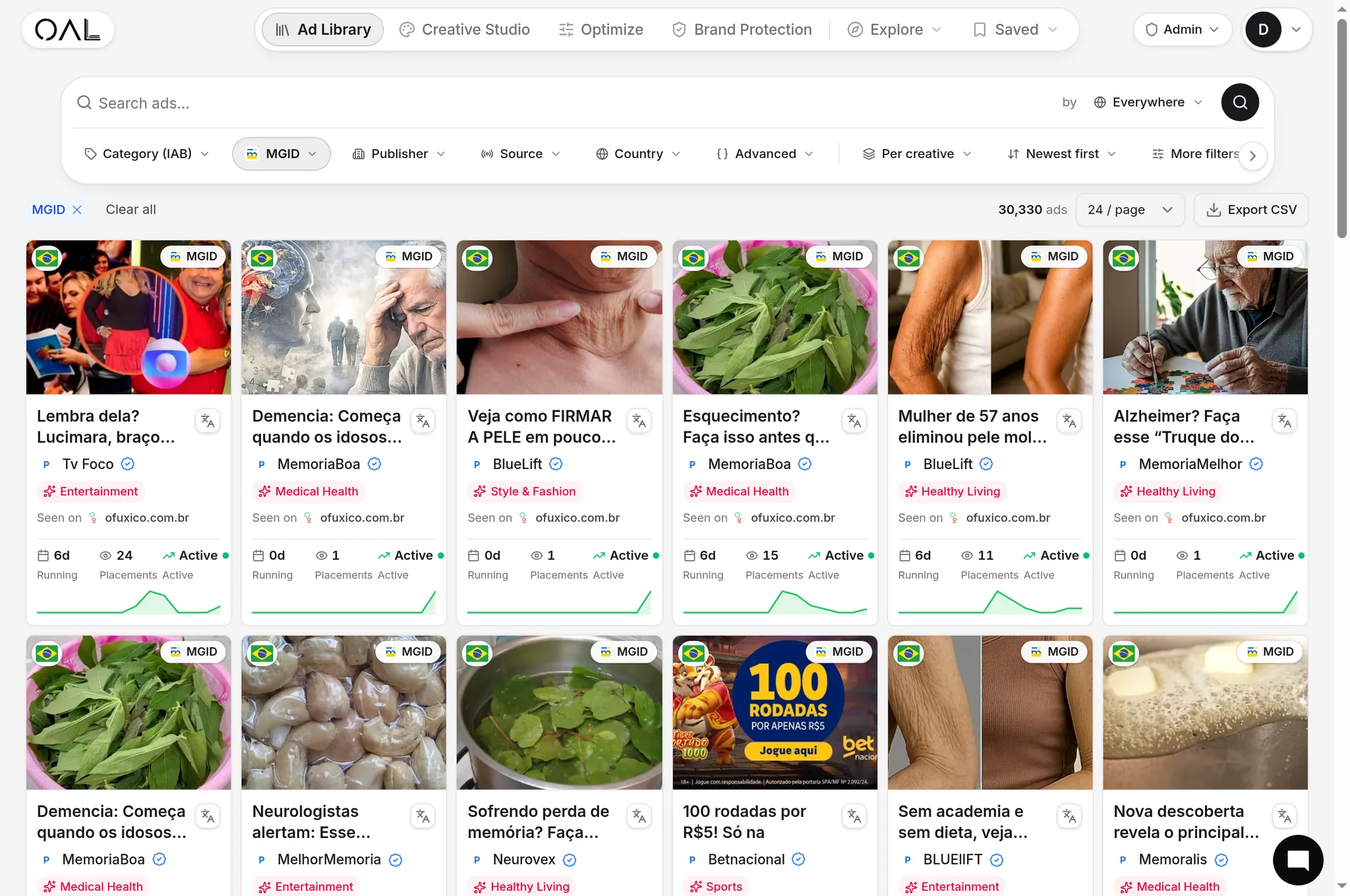
The cheapest MGID research is seeing what other buyers already pay to run. Browse the live MGID ad library filtered to your vertical and geo, or use the MGID spy tool to pull advertisers, creatives and landing pages from the current auction. What to extract:
- Creative density. Dozens of live advertisers in your vertical-geo combination means contested CPCs; a handful means you may have found cheap inventory — or a graveyard where the offer type does not convert.
- Longevity. Creatives running 30+ days are almost certainly profitable — ad longevity is the best public proxy for economics. If long-runners exist in your niche, the CPC math is provably solvable.
- Funnel structure. The pre-lander and offer type that survives tells you what EPC ceiling the winners are working with, which back-solves the CPC they can afford.
For a cross-network view of what clicks cost, our native CPC benchmarks put MGID next to Taboola, Teads and Revcontent.
Reading your first week of CPC data#
The mistakes that inflate MGID click costs are made in week one, after launch, not before it. Three habits keep the data honest:
- Never optimize on average CPC. Your campaign average blends a handful of quality placements with a long tail of cheap junk. Segment by placement before touching anything: the widgets that convert routinely cost 2–3x your average, and they are the ones worth paying for. Lowering your max CPC globally to "fix" the average starves exactly those placements first — you keep the junk and lose the winners.
- Adjust bids per placement, not per campaign. MGID lets you set placement-level bid coefficients. The correct move on an expensive converting widget is usually a bid increase to win more of its inventory; the correct move on a cheap non-converting widget is exclusion, not a lower bid. Campaign-level bid changes are a blunt instrument that makes both calls wrong at once.
- Give creatives enough impressions before judging CPC. The auction prices a new creative on limited CTR data, so early clicks often cost more than the same creative pays a week later. Killing a creative on day one because its CPC looks high truncates the auction's learning and biases your test toward whatever happened to get lucky early. Judge creatives on a fixed impression budget, then on EPC.
The compounding effect is real: a buyer who whitelists converting placements, bids them up individually and lets CTR data mature will typically end week two with a higher average CPC and materially better economics than the buyer who chased the cheapest possible click.
The bottom line#
MGID CPC is a function you influence, not a number you look up: geo tier sets the floor, vertical competition sets the ceiling, and your creative CTR decides where you land between them. Buyers who treat the reported ranges as budgeting inputs, verify the floors in-platform, and grind CTR through creative testing routinely buy clicks below the "going rate" for their vertical. Buyers who bid the maximum and hope, fund them.