Español
 Português (Brasil)
 Français
 Deutsch
 Italiano
 Nederlands
 Polski
 Svenska
 Türkçe
 Русский
 日本語
日本語 한국어
한국어 简体中文
简体中文 Bahasa Indonesia
 繁體中文
繁體中文 Dansk
Dansk Norsk (bokmål)
 Suomi
Suomi Ελληνικά
 Română
 Magyar
 Українська
 ไทย
ไทย हिन्दी
 العربية
 עברית
עבריתBest Native Ad Networks for Nutra Offers (Tolerance Ranked)
Every native network bans miracle cures on paper; they differ wildly in enforcement. A tolerance-ranked guide to choosing nutra networks, grounded in where live health creatives actually concentrate.


Ranked by how much nutra they will actually tolerate, the native networks stack up like this: Revcontent and MGID at the top (aggressive-but-legal angles survive, tests are cheap), Taboola and Outbrain in the middle (far more scale, far stricter review), and the Microsoft-adjacent feeds — the MSN feed and MediaGo — at the bottom, where only white-hat health offers clear. Health is the single largest vertical in OpenAdLibrary's index of 725,000+ live native creatives (24,472 classified health creatives as of June 2026), and where those creatives concentrate maps almost perfectly onto each network's review posture. This guide ranks the networks, shows the evidence, and lays out the testing sequence that uses the tolerance ladder instead of fighting it.
What "nutra tolerance" actually means#
Every network bans miracle cures on paper. Tolerance is not about policy documents — it is about enforcement posture across five practical axes:
- Claims aggressiveness. Does "Doctors are stunned" survive review, or does it bounce in an hour?
- Advertorial pre-landers. Some networks treat story-style pre-landers as standard practice; others audit them link by link.
- Imagery. Before/after photos, body close-ups, "gross-out" thumbnails — the classic nutra visual toolkit is restricted on strict feeds.
- Billing models. Trial-and-rebill offers get extra scrutiny (or blanket bans) on stricter networks.
- Enforcement style. Proactive review versus complaint-driven takedowns. Tolerant networks often approve fast and act only when someone complains; strict networks reject upfront.
Tolerance is emphatically not a synonym for "anything goes," either. The nutra offers that last on tolerant networks are aggressive in framing but defensible in substance — the operators who confuse the two lose accounts everywhere eventually. The vertical's full offer and compliance landscape is covered in our nutra native ads guide.
The tolerance ranking#
| Tier | Networks | What survives | The trade-off |
|---|---|---|---|
| 1 — Most tolerant | Revcontent, MGID | Advertorial funnels, authority-discovery angles, mechanism stories, punchy thumbnails | Smaller scale, variable publisher quality, complaint-driven takedowns |
| 2 — Middle | Taboola, Outbrain (Teads) | Softened claims, compliant supplements, health apps, telehealth | Slower review, account-level risk, claims must be dialed down |
| 3 — Strictest | MediaGo, MSN feed | Mainstream brands, devices, apps; little classic nutra | Most supplement angles rejected outright |
The index data lines up with the tiers. Revcontent is the only network we track where nutra appears as a distinct cluster in its top verticals — 440 explicitly nutra-classified creatives — and health is its number-one vertical overall (2,566 of 15,789 classified creatives, June 2026). That concentration on a small network is what tolerance looks like in data: the demand mix follows the review posture.
Tier 1: Revcontent and MGID — where angles are born#
Revcontent is the health-first network of the pair. Its live field reads like a nutra angle catalog: "Surgeons: This Simple Trick Will End Knee Pain & Arthritis Quickly (Try It)" and "Endocrinologist: If You Have Diabetes, Read This Before It's Removed!" were both live in our index at capture (June 2026), the latter running in multiple variants simultaneously — the signature of an advertiser scaling a proven angle. Approvals are commonly reported as fast, and the network's smaller size (15,789 live creatives in our index, roughly a thirteenth of Taboola's footprint) is the honest constraint: you will hit frequency and fatigue ceilings sooner. Platform mechanics are in how Revcontent works.
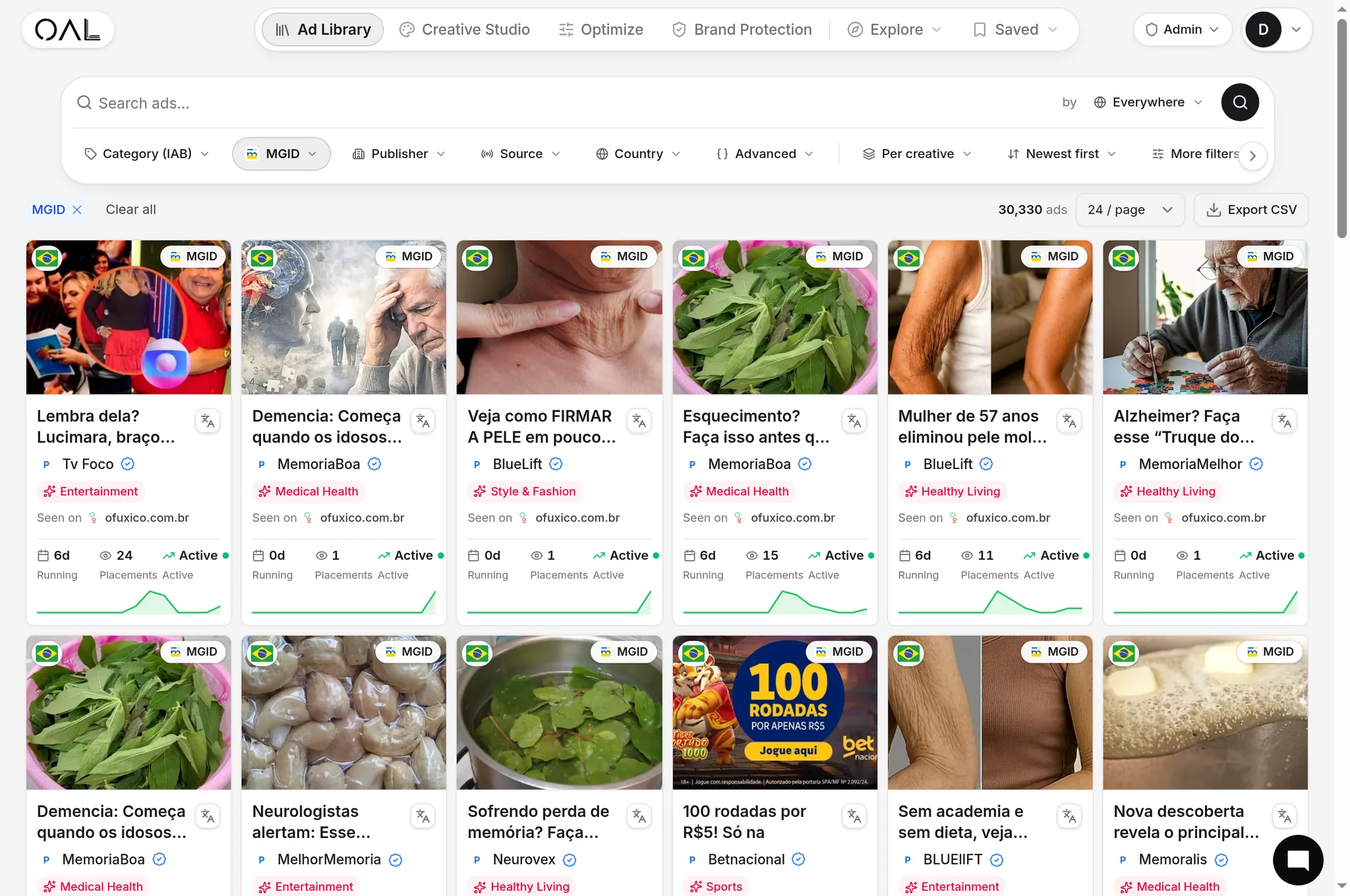
MGID brings the global reach Revcontent lacks — particularly Tier-2 and Tier-3 geos where nutra economics often work best — and a supply mix heavy on entertainment and curiosity traffic (13,987 entertainment creatives, its largest classified vertical). That audience suits advertorial funnels: cheap curiosity clicks into a strong pre-lander. Live examples from the index include "Doctors Call It 'Nature's Morphine' — Pain Relief Without A Prescription" and "Dentists Said Gums Can't Grow Back. Red Light Proves Them Wrong," both live 16 days at capture — long enough to signal the economics work. Setup details: how MGID native ads work.
Choosing between them is its own question — geo mix, minimums and audience differences are compared directly in MGID vs Revcontent. Many nutra buyers simply run both: Revcontent for US health traffic, MGID for international scale.
Tier 2: Taboola and Outbrain — where winners scale#
Why bother with stricter review? Volume. Taboola carries 11,982 live classified health creatives in our index — nearly five times Revcontent's count — and Outbrain another 3,102, across premium publisher inventory that Tier-1 networks cannot touch. The nutra that lives here is real but softened: compliant supplement brands, health apps, telehealth intake funnels, device offers, and advertorials whose claims have been rewritten from "cures" to "supports."
The porting discipline is the skill. A Tier-1 winner moves up the ladder by keeping its angle architecture — the curiosity gap, the mechanism story, the authority figure — while stripping claim language the strict queues reject: disease names, cure verbs, timelines, before/after imagery. The angle is the asset; the claims are the liability. Buyers who scale nutra on the majors are running rewritten versions of angles they proved cheaply downstream.
A concrete rewrite makes the discipline visible. Tier-1 version: "Doctors Call It 'Nature's Morphine' — Pain Relief Without A Prescription." The Tier-2 rewrite keeps the architecture — authority, mechanism, discovery — and drops the drug comparison and the outcome promise: "Why Doctors Are Studying This Traditional Root for Everyday Aches." Same curiosity engine, defensible on its face. If the softened version no longer pulls clicks, the original angle's appeal was the non-compliant claim, and it was never going to scale past Tier 1 anyway. That test — does the angle survive its own rewrite? — is the cheapest scalability check in nutra.
Account structure matters more here too: rejections accumulate against your account, so seasoned buyers test the softened creative in small batches rather than flooding review with twenty variants. Many also warm accounts with clean campaigns before introducing edgier health creative, on the theory that review outcomes are account-history-dependent. Whether or not that is formally true on a given network, the practice costs nothing and the failure mode of the alternative — a fresh account whose first submission is an aggressive supplement advertorial — is well documented in practitioner forums.
Tier 3: MediaGo and the MSN feed — mostly closed doors#
The Microsoft-adjacent feeds run strict, brand-safe review. Classic nutra — trial offers, advertorial funnels, aggressive supplement claims — mostly does not clear, and what health inventory exists there skews to mainstream brands, apps and devices. For a nutra operator these feeds are not a testing ground; they are a destination for the fully-white-hat version of an offer, if one exists. If your product line includes a genuinely compliant SKU with clean claims, the reward is inventory most nutra competitors never touch.
Billing models: what each tier will carry#
Nutra offers differ as much in billing as in claims, and the tolerance ladder applies to both.
- Straight sale (single purchase, clear price): clears everywhere the product itself clears. The safest structure, and the only one with a realistic path onto Tier-3 feeds.
- Subscription with disclosed terms: broadly acceptable on Tiers 1–2 when the pre-checkout disclosure is clean. The networks' concern is chargeback rates, which propagate back to them as advertiser-quality signals.
- Trial-and-rebill: the classic nutra structure and the most restricted. Tolerant networks accept it with disclosure; stricter networks ban or effectively ban it. If your offer depends on rebill economics, your network ceiling is Tier 1 plus, at best, a carefully structured Tier-2 presence.
- Listicle-to-store: an advertorial listicle ("5 supplements reviewed") feeding a standard ecommerce store. Increasingly popular precisely because it inherits ecommerce review treatment rather than health-offer treatment.
The strategic read: billing structure is a network-access decision, not just a M/LTV decision. An offer owner who builds a straight-sale SKU alongside the rebill flagship is buying distribution optionality.
Geo strategy: where nutra economics actually work#
Tier-1 English geos are where nutra is most saturated and clicks cost most; the vertical's quiet edge is often elsewhere. MGID's supply depth in Tier-2 and Tier-3 markets — Latin America, Eastern Europe, Southeast Asia — pairs with lower CPCs and thinner competition, and many evergreen angles that are exhausted in the US remain fresh in translation. Three practical rules for going international:
- Translate the angle, not the words. Authority figures, mechanism stories and avoid-lists all work across markets, but the authority archetype and the reference foods/objects must be local. A literal translation of a US advertorial reads as foreign and converts like it.
- Check payout parity. A cheap click is not an edge if the offer pays a fraction of the US CPA. The geo-tier economics have to work end-to-end.
- Mind local regulation. Health-claim rules vary by country and the FTC floor described below is a US floor; several markets are stricter. The network's geo-level policies are the first checkpoint.
Scaling geo-by-geo with a proven angle is one of the two standard nutra scaling motions (the other being the tier climb), and the two compound: angles proven cheaply in Tier-2 geos frequently port back into Tier-1 with softened claims.
What the live index shows about nutra demand#
Beyond the tier evidence, two patterns in the data are worth internalizing.
The same advertiser tunes aggressiveness per network. Health Weekly, for example, appears in our index on both Outbrain and Revcontent — with the harder-edged constructions on Revcontent. That is the tolerance ladder being used correctly, by advertisers who treat network policy as a targeting parameter.
Health demand is the largest single pool in native. At 24,472 classified creatives, health outranks finance, insurance and ecommerce in the index. For nutra buyers this cuts both ways: the demand proves the economics, and the saturation means angle differentiation — not media buying mechanics — is usually the binding constraint. Study the most common native ad angles before writing your own.
Multi-variant runs mark the winners. When the same advertiser runs several near-identical variants of one creative simultaneously — as the diabetes-angle advertiser above does on Revcontent — you are looking at the scale-out phase of a proven angle, not a test. Those clusters are the highest-value research targets in the vertical: the angle has survived both review and economics, and the variant set shows you which elements the advertiser considers worth iterating (image swaps versus headline swaps versus geo splits). Reverse-engineering a live cluster teaches more than any swipe file of dead ads.
The compliance floor that applies everywhere#
Network tolerance does not move the legal floor. The FTC's Health Products Compliance Guidance requires competent and reliable scientific evidence for health claims, treats disease-treatment claims from supplements as red-line territory, and holds affiliates and networks liable alongside offer owners. Advertorials must be disclosed as advertising at every step — the specifics are in our guide to FTC disclosure rules for advertorials and native ads.
The practical translation for nutra: aggressive framing of defensible facts survives scrutiny; confident framing of indefensible claims eventually does not, on any network. Build offers you can keep running.
A testing sequence that uses the ladder#
- Research before spend. Pull the live nutra field on Revcontent and MGID — filter by health vertical, your geo, and sort by longevity. Creatives running 30+ days are almost certainly profitable; they are your angle shortlist.
- Test on Tier 1. Launch angle variants on Revcontent or MGID. Media buyers commonly report Tier-2/3 clicks there from single-digit cents to roughly $0.30, and low-tens-of-cents Tier-1 mobile clicks — cheap enough to read signal on several hundred dollars per angle. (Unofficial, and your geo will move it a lot.)
- Kill on funnel metrics, not CTR. Nutra headlines buy curiosity too easily for CTR to mean anything. Judge pre-lander read-through and cart starts.
- Port winners up. Rewrite proven angles to Tier-2 claim standards and scale on Taboola/Outbrain volume.
- Wire conversion data back before scaling. Tier-1 networks optimize poorly on their own; a tracker with postbacks feeding conversions back to the platform, plus publisher/widget-level reporting, is what turns a tolerant network from a click hose into an optimizable channel. Build the whitelist of producing placements during the test phase — it is the most durable asset the test produces.
- Watch for fatigue and copycats. Winning nutra angles get cloned within weeks. Monitoring your own angle's spread across the index tells you when to rotate.
Picking your first network#
If you run one network: Revcontent for US-centric health offers, MGID if your offer's economics live in international geos. If you run two, run both and let the geo split decide. Move up the ladder only with angles that have already paid for themselves — the tolerance ranking is not a quality ranking, it is a sequencing tool. The networks at the top of it exist to make your mistakes cheap; the networks at the bottom exist to make your winners big. And whichever tier you start in, start with the research pass, not the launch button: in a vertical where the field is this crowded and this visible, spending before looking is a choice to pay for information your competitors published for free.