Español
 Português (Brasil)
 Français
 Deutsch
 Italiano
 Nederlands
 Polski
 Svenska
 Türkçe
 Русский
 日本語
日本語 한국어
한국어 简体中文
简体中文 Tiếng Việt
 Bahasa Indonesia
 繁體中文
繁體中文 Čeština
 Dansk
Dansk Norsk (bokmål)
 Suomi
Suomi Ελληνικά
 Română
 Magyar
 Українська
 ไทย
ไทย हिन्दी
 العربية
 עברית
עבריתWhere Do Taboola Ads Appear? The Publisher Network, Mapped
Taboola ads live in sponsored feeds on publisher sites — below articles, mid-article, on homepages — and extend into Yahoo and Apple supply. Here is the placement map, and how to see exactly where any advertiser runs.


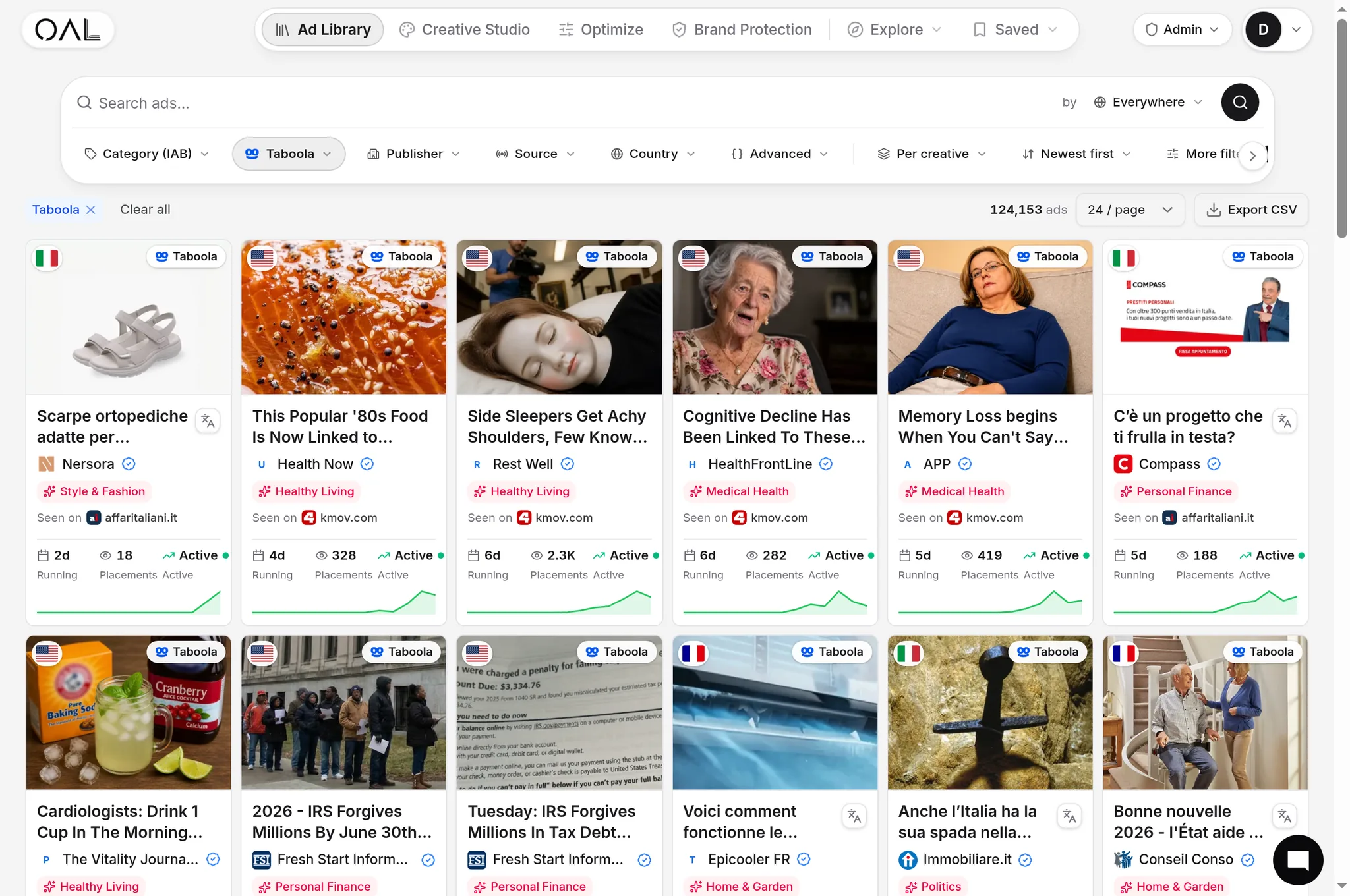
Taboola ads appear inside sponsored content feeds on publisher websites — most visibly the "You may like" grid below news articles, plus mid-article units, right-rail widgets, homepage feeds and in-app placements. The supply spans thousands of publisher sites worldwide, and through exclusive partnerships it extends to Yahoo's properties (a 30-year deal signed in 2022) and the native slots inside Apple News and Apple Stocks in several markets. If you have ever finished an article and met a grid of thumbnail stories marked "Sponsored," there is a good chance it was Taboola.
The placement types, one by one#
Taboola's inventory is a family of feed formats rather than one ad slot:
- Below-article feed. The flagship placement: a grid of recommended and sponsored stories at the end of editorial content. It captures readers at the exact moment they finish one piece and look for the next — which is why it converts curiosity-driven creatives so well.
- Mid-article units. Smaller in-feed blocks injected between paragraphs. Higher viewability, more intrusive, and increasingly common on mobile page templates.
- Right-rail widgets. Desktop sidebar recommendation stacks. Declining share as layouts go single-column, but still present on many news sites.
- Homepage and section feeds. Some publishers weave sponsored items directly into their homepage story rivers, where ads inherit maximum editorial credibility.
- In-app and syndicated placements. Publisher apps, plus the Yahoo and Apple placements noted above, which follow the same auction but live inside closed apps rather than the open web.
Every unit carries disclosure — "Sponsored," "Promoted stories," "Recommended by Taboola" or similar attribution near the widget. The content-recommendation widget glossary entry covers the format's anatomy, and how Taboola ads work explains the auction filling it.
For buyers, the units differ in ways that should shape creative and bidding:
| Placement | Reader mindset | Practical implication |
|---|---|---|
| Below-article feed | Finished reading, hunting for the next story | Curiosity-driven, story-style headlines win; the volume placement |
| Mid-article | Interrupted mid-read | Higher viewability, lower click intent; thumbnails matter more |
| Right rail (desktop) | Peripheral scanning | Cheap impressions, weakest engagement; watch it in placement reports |
| Homepage feeds | Browsing, no article context | Broadest audience, least contextual signal |
| Yahoo / Apple supply | In-app content consumption | Premium context, app-native behavior; arrives through the same auction |
Which publishers run Taboola#
Taboola's publisher network concentrates in news and content sites: national news brands, local TV station groups, tabloids and lifestyle magazines, weather and utility sites, and large portals. The named anchors are the Yahoo partnership and the Apple News / Apple Stocks deal; beyond those, specific rosters shift constantly as multi-year contracts renew, and big mastheads have moved between Taboola and Outbrain repeatedly over the years. Any static list you find in a blog post is stale by the time you read it — treat publisher claims as snapshots, not facts.
The structural point is stable, though: Taboola lives where editorial attention lives. Its readers are in content-consumption mode, not shopping mode. That is both the pitch (cheap attention at enormous scale) and the catch (nobody there is searching for you), and it shapes everything about which creatives work in these placements.
Why you see the same Taboola ads everywhere#
Three forces, usually in this order:
- Broad buys. Most Taboola campaigns target a geo and a device class, not a person. A well-funded advertiser targeting "US desktop" is eligible for feed slots on every US desktop pageview in the network, so you meet them on your news site, your weather app and your recipe blog in the same afternoon.
- Winning creatives saturate. Because the auction rewards click-through rate, a creative that out-clicks its competition wins a disproportionate share of impressions — which is exactly why the ads you keep seeing are worth studying, as ad longevity explains.
- Retargeting exists too. Advertisers can retarget site visitors across the network, so an ad following you after you visited its landing page is behaving as designed.
How to see exactly where a specific advertiser appears#
Taboola publishes no placement transparency: there is no official lookup for "which sites is this advertiser on." The network's feeds are public, though, which means they can be observed. OpenAdLibrary continuously captures live Taboola placements and stores each observation with the creative, the resolved advertiser, geo, device and capture context — 206,145 live Taboola creatives sit in the index as of June 2026, inside a corpus of 6.8 million+ ad observations across 49 networks.
That turns the question around: instead of wondering where a competitor's ads run, you pull their creatives and read the observation records. The workflow — search the advertiser, sort by longevity, trace the landing pages — is laid out in the Taboola ad spy guide, and you can run it free at /spy/taboola. For the reverse question — "who is buying the ad slots on this website?" — see who is buying ads on a website.
For advertisers: controlling where your ads appear#
You cannot hand-pick individual premium placements the way a direct buy would, but you have three real controls:
- Site blocking. The essential one. Taboola exposes per-site performance; the standard discipline is to let a new campaign run broad, then block sites that spend without converting once each has accumulated a fair sample of clicks. A whitelist/blacklist strategy built from data beats any assumption about which sites "look" premium.
- Geo, device, OS and browser splits. These decide placement mix more than most buyers expect — mobile web long-tail inventory behaves nothing like desktop news sites.
- Whitelisting mature campaigns. Once you know your converting sites, a whitelist campaign concentrates budget there, usually at a higher CPC and a better cost per acquisition.
One warning from the data: premium-looking placements are not automatically better. Plenty of long-tail sites convert cold traffic beautifully because their audiences match the offer. Block on numbers, not on brand snobbery — each publisher slot is identified in reporting by its site ID, and the numbers attach to that, not to your impression of the masthead.
What the placements mean for your creative#
Because every Taboola unit imitates editorial recommendations, the placement dictates the creative grammar. Ads that look like ads — product shots, logos, discount banners — fight the format; ads that look like the next story the reader was about to choose inherit the page's credibility. That is why the creatives that dominate these feeds read like headlines ("A Window Cleaner Explained Why Sprays Make Your Glass Worse" is a real 23-day runner from the index) and why the click usually lands on an advertorial or pre-lander rather than a product page: the story placement demands a story funnel. If your creative strategy was built for social or search, expect to rebuild it for the feed context rather than port it.
For publishers: what running Taboola means#
The other side of the marketplace: publishers embed Taboola's widget and earn from the clicks it generates, typically measured as RPM — revenue per thousand pageviews. Recommendation feeds monetize traffic that display often struggles with, especially end-of-article attention, which is why they are near-universal on ad-supported news sites. The trade-offs are editorial: the widget's content is algorithmically chosen, its advertisers change hourly, and readers do not always distinguish the sponsored grid from the newsroom's own recommendations. Publishers weighing it should assume their audience will treat everything in the feed as an editorial endorsement — because behaviorally, they do.
The map, not the list#
"Where do Taboola ads appear" has a structural answer — feeds on content sites, plus Yahoo and Apple supply — but never a stable list. Contracts move, sites join and churn, and campaigns target slices of the network that change daily. If the question behind your question is competitive ("where do my rival's ads run, and what's working for them?"), skip the static lists and read the live observations: the index at /spy/taboola is capturing the network's feeds while you read this.