Español
 Português (Brasil)
 Français
 Deutsch
 Italiano
 Nederlands
 Polski
 Svenska
 Türkçe
 Русский
 日本語
日本語 한국어
한국어 简体中文
简体中文 Tiếng Việt
 Bahasa Indonesia
 繁體中文
繁體中文 Čeština
 Dansk
Dansk Norsk (bokmål)
 Suomi
Suomi Ελληνικά
 Română
 Magyar
 Українська
 ไทย
ไทย हिन्दी
 العربية
 עברית
עבריתMGID vs Taboola: Which Native Network Wins for Your Budget?
MGID lets you test from $100; Taboola realistically needs ~$300/day to clear its learning phase, and our capture index shows Taboola running three times the creatives MGID does.

MGID and Taboola run the same kind of ad: the "recommended for you" widget bolted to the bottom of a news article. That is where the similarity stops. Taboola is the premium, brand-safe network with publisher inventory most affiliates will never touch. MGID is cheaper, looser, and built for performance buyers who want to test an angle without burning a month's budget first. Picking one is not about which is "better." It is about which one matches your budget, your offer, and the geos you actually want to buy.
This comparison leans on three things: real entry costs, observed geo reach, and the advertiser mix each network actually carries in our index. We capture live native ads all day, so instead of repeating vendor decks, I can show you what is really running. If you want the full field first, our pillar on the best native ad networks in 2026 ranks the category by real ad volume.
MGID vs Taboola at a glance#
MGID is the cheaper door in. A $100 minimum deposit gets you a live campaign. Taboola's self-serve technically opens lower, but you realistically need around $300/day to push a performance campaign out of its learning phase. Taboola wins on premium reach and brand safety, especially after the Yahoo deal. MGID wins on cheap testing and a more forgiving approval queue. Test on MGID, scale mainstream offers on Taboola.
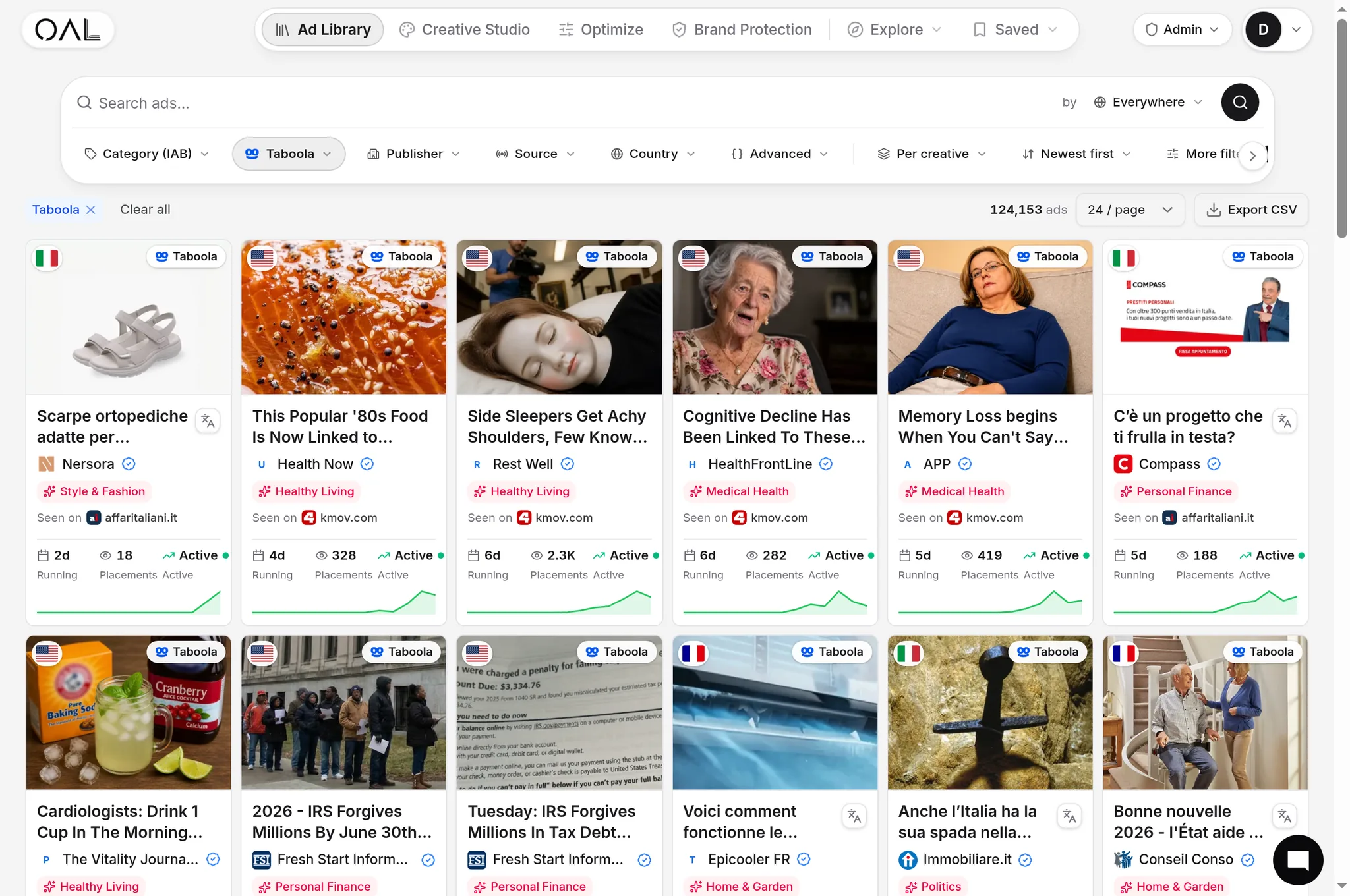
One number frames the whole matchup. Across the 589,000+ creatives we have captured (OpenAdLibrary index, June 2026), Taboola accounts for 157,727 of them. MGID accounts for 49,689. Taboola is roughly three times the captured footprint. If you want to know where the volume and the competition live, that ratio is your first answer.
| Factor | MGID | Taboola |
|---|---|---|
| Minimum to start | $100 deposit | ~$10/day self-serve; ~$50/day for useful data |
| Realistic test budget | $500 to $1,500 | $300/day to exit learning phase |
| Reported reach | 850M monthly uniques, 200+ countries | ~600M daily users plus ~900M monthly Yahoo users |
| Publisher count | 32,000+ sites | Premium publishers plus Yahoo properties |
| Captured creatives (our index) | 49,689 | 157,727 |
| Approval strictness | Looser | Stricter content policy |
| Platform / engine | Self-serve dashboard | Realize / Realize+ (agentic AI) |
Both are native ad networks in the classic sense. They push native advertising through the recommendation widgets you scroll past under news articles. The plumbing is nearly identical. The economics and the advertiser populations are not.
Entry cost: where your budget goes first#
This is the clearest line between them, and the one you feel on day one.
MGID has a $100 minimum deposit, and you can launch a real campaign on that balance. Most experienced buyers budget $500 to $1,500 for a test that actually means something, enough to run several angles and build blacklists and whitelists from the data. A dedicated account manager usually appears once you are sitting around the $1,000 mark. The low floor is the entire point. You can validate an offer and a few creatives before committing real money.
Taboola is wired differently. Self-serve campaigns can technically run near $10/day, but the platform itself recommends a minimum daily budget around $50 for statistically meaningful optimization, and most performance campaigns need roughly $300/day to clear the machine-learning "learning phase." Taboola's own guidance points to a daily budget of about 10x your target CPA. So the headline minimum looks tiny, but the effective minimum to get the algorithm working is far higher than MGID's.
The real entry cost is not the deposit minimum. It is the spend required before the algorithm hands you stable, optimizable performance. On that measure MGID is dramatically cheaper to test, and Taboola is built for buyers who can feed the learning phase from day one.
Here is what Taboola's bread-and-butter looks like in practice: a finance offer chasing a tax deadline, the kind of click-bait-adjacent creative that prints money in the right vertical.

For a full breakdown of what you actually pay per click and per test on each platform, see our native ads cost budgeting guide and the native CPC benchmarks for 2026.
Geo reach and audience footprint#
Both networks are genuinely global. They are strong in different places.
Taboola leans premium and Western-publisher-heavy. Its 30-year Yahoo partnership puts nearly 900 million monthly Yahoo users on top of an existing footprint of roughly 600 million daily active users across major news, lifestyle, and health publishers. If your offer needs tier-1 traffic (US, UK, Canada, Australia, Western Europe) sitting next to mainstream editorial, Taboola's inventory quality is hard to beat. You see it in the spread of what we capture there: AU life-insurance lead-gen, India auto launches, US home-improvement and solar offers all run side by side.

MGID reports 850 million monthly unique users across 32,000+ publisher sites in 200+ countries and 70+ languages. Its relative strength shows up in a broader geo mix. Alongside the US and UK, MGID carries serious volume in Vietnam, India, Indonesia, Mexico, and Italy. If you target emerging markets or run geo-arbitrage angles, that spread is an advantage. Those audiences are cheaper and less saturated than tier-1 Taboola placements.
The practical takeaway: if your offer converts on tier-1 mainstream traffic, Taboola's premium reach earns its cost. If you are hunting cheaper clicks in second- and third-tier geos, MGID gives you more room to find profitable pockets. This is the same dynamic we pull apart in MGID vs Revcontent, where two mid-tier networks fight over exactly these emerging-market geos.
Advertiser mix: who actually runs where#
Reach figures do not tell you what converts. The advertiser mix does, and this is where our data quietly contradicts the standard story.
The popular line is that MGID is the nutra-dating-gambling network and Taboola is the clean brand network. The capture data says the picture is muddier. On Taboola, the heaviest verticals in our index are Health (6,048 captured creatives), Finance (5,558), Insurance (4,303), Ecommerce (3,330), Home and Garden (2,630), and Software (2,206). That is a mainstream, regulated, lead-gen-heavy lineup, exactly what you would expect from a premium network. But "Health" on Taboola still means a flood of supplement, hearing-aid, and brain-health creatives that look every bit as aggressive as anything on a cheaper network.

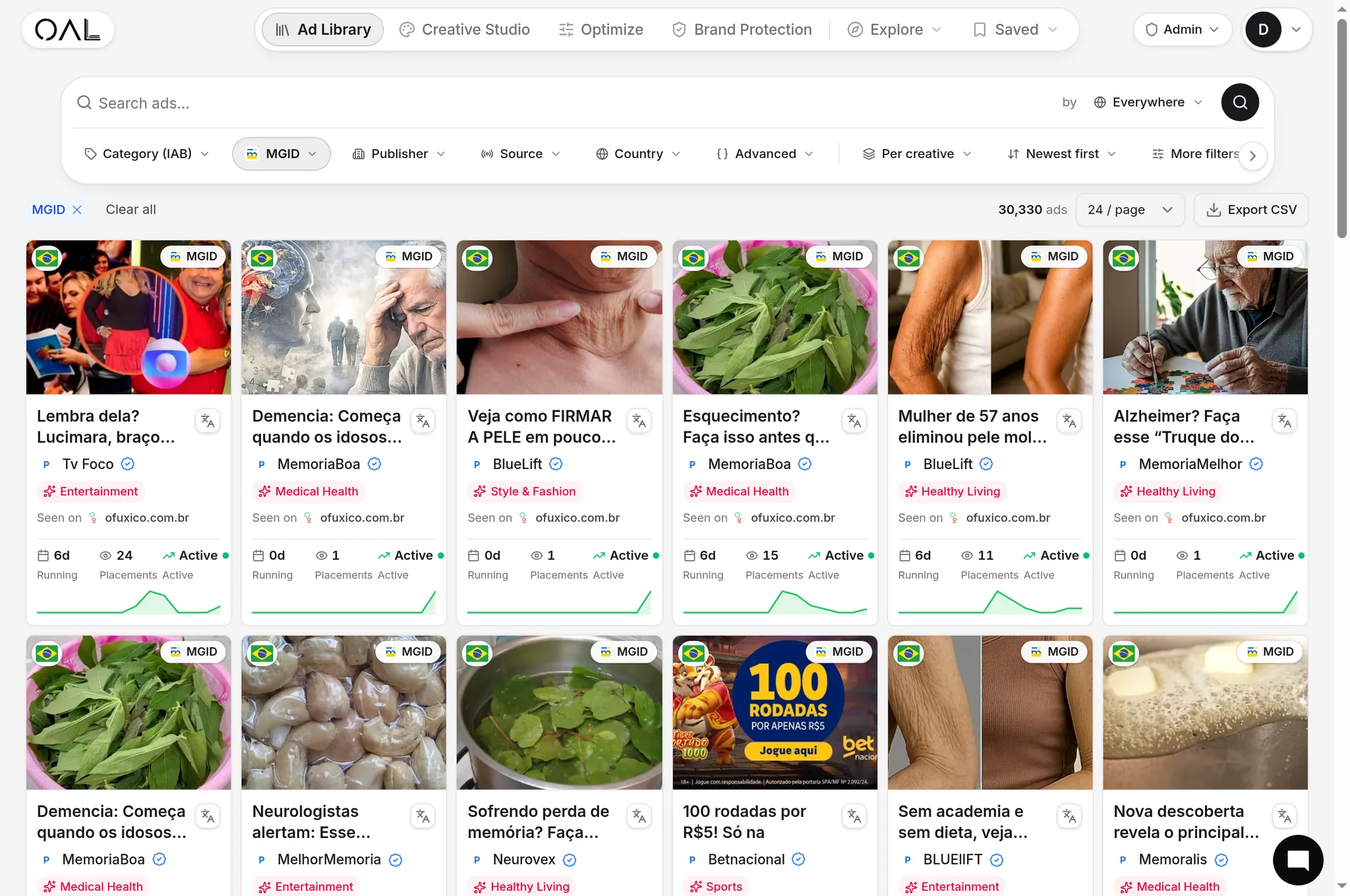
MGID is where the surprise is. The single largest captured vertical for MGID in our index is Entertainment, with 8,904 creatives, far ahead of its Health volume (615). That tracks with MGID's reputation for gaming, quiz, IQ-test, and "you won't believe what happened next" content, more than its reputation for nutra. The nutra and dating volume is real, but if you only know MGID from forum lore, the entertainment skew is worth sitting with before you assume your vertical is well-represented there.
For context on the whole field, the most-captured verticals across every network we track are Finance (17,232 creatives), Insurance (15,629), Health (14,895), and Ecommerce (13,872), in that order (OpenAdLibrary index, June 2026). Native is a direct-response medium first, and the captures make that obvious. Here is the kind of brain-health creative that dominates the Health column:

Taboola does enforce stricter content policy on paper, and its Realize platform (plus the newer agentic Realize+ layer) is built around outcome-based optimization for advertisers who can supply conversion data. That favors compliant, well-capitalized buyers over scrappy affiliates testing risky angles. MGID's looser approval queue is genuinely easier for grey-hat direct response. Just do not assume Taboola is squeaky clean or that MGID is wall-to-wall nutra. The captures say both networks carry more overlap than their reputations suggest.
Do not guess the advertiser mix, verify it#
Public reach figures describe the average network. They do not tell you which advertisers are live in your vertical and your geo this week. That gap is where native budgets leak: buyers pick a network on reputation, then find their niche barely exists on it.
This is where live ad-transparency data changes the call. OpenAdLibrary captures real native ads as they run across Taboola, MGID, their mid-tier peers, and the rest of the programmatic native ecosystem. For each captured ad it does three things a vendor brochure cannot:
- Identifies the real advertiser behind the creative, not just the affiliate network or tracker.
- Follows the click to the landing page (without clicking live ads), so you see the actual offer, pre-lander, and funnel.
- Tracks longevity and spread, how long an ad has been running and how widely it is distributed, which is the closest public proxy for "this is working."
A word on longevity, because it is easy to overclaim. Affiliate lore loves the "90-day winner." That is industry folklore, not our finding. What we can actually observe is continuous run time inside our own capture window, which currently tops out around 28 days per creative. The point is not the absolute number. It is the relative signal: a native ad that has been live for 26 or 27 straight days is almost certainly paying for itself, because nobody keeps losing money in front of a paywall for a month. The Nebroo hearing-aid ad above (26 days) and this solar-battery offer (27 days) are exactly the kind of survivors worth reverse-engineering.

So you can answer the questions that actually drive ROI. Are health advertisers heavier on Taboola or MGID in the US right now? Which finance offers have been running three-plus weeks? What landing pages are the top Taboola advertisers using? Browse the live data on the Taboola ad spy page, then compare it against MGID coverage to see which network really carries your competition.
The same verify-before-you-commit logic runs through every native matchup we cover, including Taboola vs Outbrain and Revcontent vs Taboola. The network that describes itself best is rarely the one that carries your offer best.
So which network wins for your budget?#
There is no single winner. There is a winner for your situation.
- Start with MGID if you have a small test budget ($100 to $1,500), you run affiliate or aggressive direct-response offers, or you target emerging-market geos where cheaper clicks let you find profit. The low entry cost and looser approval make it the better learning ground. Just check that your vertical actually has depth there first, since the captured mix skews more toward entertainment and gaming than most people expect.
- Start with Taboola if you can fund roughly $300/day per campaign, you are promoting a mainstream brand, ecommerce, or compliant lead-gen offer, and you want premium tier-1 placement next to quality editorial. Its Realize engine and Yahoo-scale reach reward buyers who can feed it conversion data, and at 157,727 captured creatives it is where the bulk of the native competition lives.
- Run both if your offer has legs. Plenty of seasoned buyers validate cheaply on MGID, then port proven creatives and landing pages to Taboola for premium-traffic scale. The networks are not mutually exclusive. They are stages of a funnel.
Whichever way you lean, decide on evidence, not reputation. Pull the live advertiser mix for your vertical and geo, see which offers have real longevity, and study the landing pages already winning before you spend a dollar. Start free and browse 200 live native ads with no card required, then decide which network actually carries your competition.