Español
 Português (Brasil)
 Français
 Deutsch
 Italiano
 Nederlands
 Polski
 Svenska
 Türkçe
 Русский
 日本語
日本語 한국어
한국어 简体中文
简体中文 Tiếng Việt
 Bahasa Indonesia
 繁體中文
繁體中文 Čeština
 Dansk
Dansk Norsk (bokmål)
 Suomi
Suomi Ελληνικά
 Română
 Magyar
 Українська
 ไทย
ไทย हिन्दी
 العربية
 עברית
עבריתOutbrain for Publishers: Requirements, RPM & Payment Terms
Outbrain monetizes publisher sites with sponsored-content feeds. Here is what it takes to get accepted, what actually drives RPM, and the contract terms to check before signing.


Outbrain — now part of Teads after the February 2025 merger — monetizes publisher sites by placing a feed of sponsored content recommendations below and inside articles. Publishers earn from clicks on the paid items in that feed. To get accepted you need a legitimate editorial site with original content and consistent traffic; revenue is reported as RPM (revenue per thousand pageviews) and moves with your geo mix, audience vertical, and placement quality; payment runs on net terms defined in your agreement. There is no published traffic minimum, but onboarding is sales-led in practice, and revenue guarantees are reserved for larger properties. This guide covers what Outbrain actually offers publishers, the acceptance bar, what drives RPM, the contract terms worth negotiating, and the due-diligence step most publishers skip: auditing the ads that will actually run on your pages.
What Outbrain offers publishers#
Outbrain's core publisher product is the recommendation feed — the grid of sponsored and editorial content cards that appears when a reader reaches the end of an article, historically branded Smartfeed. Each card is a content recommendation widget item: an image, a headline, and a source label. Some cards are paid recommendations from advertisers; some can be recirculation links back into your own content. Advertisers pay per click, and the publisher takes a share of that click revenue.
Since the merger, the combined company operates under the Teads name, and the publisher pitch has widened accordingly: the classic below-article feed now sits alongside Teads' outstream video demand, so a single partnership can monetize both the end-of-article slot and in-article video units. If you are catching up on the corporate history, the Outbrain–Teads merger explained covers what changed and what kept its name, and our overview of the Teads platform covers the combined product from the advertiser side.
In practical terms, a publisher integration usually includes some combination of:
- The below-article feed — the highest-volume unit, filling space that display ads historically monetized poorly.
- Mid-article units — smaller recommendation modules injected between paragraphs.
- Outstream video — in-article video players from the Teads side of the house, sold separately or bundled.
- Recirculation — organic cards pointing at your own articles, which cost you nothing and lift session depth.
The strategic appeal is simple: the space after an article ends is real estate most display setups fill badly, and a feed that mixes paid and organic recommendations monetizes it while keeping some readers on your site.
Requirements: what it takes to get accepted#
Outbrain does not publish a hard traffic minimum, and you will find no official "X pageviews per month" line to clear. In practice, acceptance is a business-development decision, and the bar looks like this:
- Real editorial content. Original articles, named authors or a credible masthead, working about and contact pages. Scraped content, spun AI content farms, and thin aggregator sites are the fastest route to a rejection.
- Meaningful, consistent traffic. Onboarding is sales-led, and the sales team prioritizes properties where the revenue opportunity justifies integration and support. Publishers too small for a direct deal are usually better served starting with a mid-tier feed provider and revisiting later.
- Clean traffic sources. Organic search, direct, newsletter, and social traffic read as healthy. Heavy reliance on bought traffic — the classic traffic arbitrage model — draws scrutiny, because advertisers are ultimately paying for the quality of your audience's engagement.
- Acceptable content categories. No pirated media, adult content, hate content, or medical misinformation. Ordinary news, lifestyle, sports, finance, and special-interest editorial are all standard fits.
- Sane article templates. The feed needs a stable end-of-article slot and reasonable page speed. A template cluttered with six competing ad units will depress feed CTR and weaken the deal you can negotiate.
Before you approach, assemble the numbers a partner manager will ask for: monthly pageviews, share of traffic on article pages, top geos, audience topics, and current monetization setup. A publisher who shows up with a clean traffic profile and a clear geo story gets a materially better first conversation.
How publisher revenue actually works#
Your earnings are a function of three variables: how often readers click the feed (feed CTR), what advertisers pay for those clicks (CPC), and your revenue share.
- Feed CTR is mostly a placement-quality question. An end-of-article feed that loads fast and sits directly under the conclusion outperforms one buried below three other ad units. Mobile layout matters disproportionately, because that is where most feed impressions happen for most publishers.
- Advertiser CPCs are set by auction, and they move with your audience. Tier-1 geos (US, UK, Canada, Australia, Western Europe) attract far deeper bid density than Tier-2/3 traffic. Vertical matters just as much: readers of finance, insurance, and health content attract advertisers with real unit economics behind each click, which shows up directly in your RPM.
- Deal shape. Straight revenue share is the standard arrangement. Larger publishers can negotiate guaranteed RPMs or flat monthly guarantees — usually conditioned on traffic floors and exclusivity for the feed slot. Hybrids (a floor plus upside share) exist for properties in between.
On actual numbers: publishers commonly report content-recommendation RPMs ranging from well under a dollar on general-interest, non-Tier-1 traffic to several dollars on Tier-1 audiences in commercial verticals. The spread is the story — any single benchmark figure you read is describing someone else's audience. Model your own case: estimated feed CTR × plausible CPC for your geo and vertical × revenue share, then validate with a trial period before committing to exclusivity.
One framing mistake to avoid: comparing feed RPM to your premium display CPM as if they compete. The feed monetizes post-content attention that display rarely captures well. Evaluate it as incremental revenue per session, alongside whatever recirculation lift the organic cards produce.
What actually runs in the feed: the demand behind your RPM#
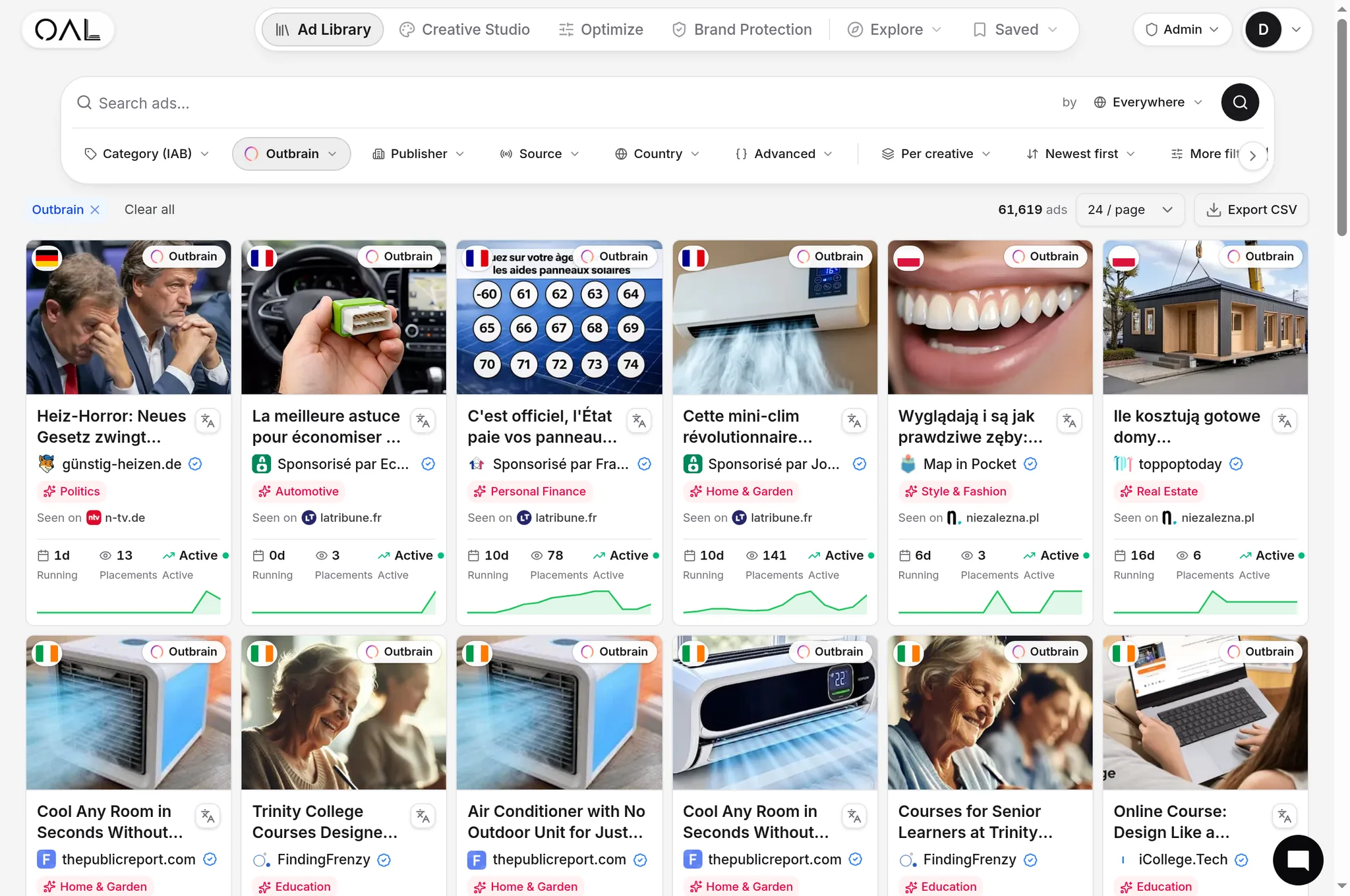
Your RPM is downstream of advertiser demand, and that demand is observable. OpenAdLibrary independently captures live Outbrain placements at scale — 108,573 live Outbrain creatives in the index as of June 2026. The vertical breakdown of that live demand tells a publisher two useful things: where the money is, and what the cards on your pages will look like.
| Vertical | Live Outbrain creatives (June 2026) |
|---|---|
| Insurance | 4,345 |
| Finance | 3,990 |
| Health | 3,102 |
| Ecommerce | 2,277 |
| Software | 1,932 |
| Home & garden | 1,545 |
Insurance, finance, and health lead the classified demand — these are the advertisers with strong per-click economics, and audiences aligned with those topics command the strongest bids. If your editorial calendar already covers money, coverage, or wellness topics, you are sitting on the demand-rich end of the network.
The mix is broader than performance offers, though. In our capture window, the same feed carried a corporate sustainability content series from an industrial brand that ran for over a month, a skincare advertorial creative that ran 30 days straight, and evergreen curiosity content — two of the longest-running Outbrain ads in the entire index, a pet-behavior story and a home-and-garden story, had each been live 38 days when measured. Brand content, direct response, and curiosity-driven advertorials coexist in the same widget.
Why this matters to you: those cards render on your pages, under your masthead. The register of what runs — from brand explainers to aggressive advertorials — is public and auditable. Review the Outbrain ad library for the geos and verticals your audience matches before you commit, not after readers start emailing you about the ads.
The RPM levers you actually control#
Once live, most publishers leave revenue on the table by treating the feed as set-and-forget. The levers worth working:
- Position and prominence. The feed should start immediately after the article body ends. Every ad unit or module you stack above it taxes its CTR.
- Paid density. More paid cards per screen means more revenue and more reader cost. Test density rather than accepting the default; the revenue-maximizing setting is rarely the reader-experience-maximizing one, and churn is a real cost.
- Mobile layout. Card size, image cropping, and scroll behavior on mobile drive the majority of feed clicks for most sites. A broken mobile feed is an invisible RPM leak.
- Category and advertiser blocks. You can block categories and specific advertisers. Every block removes demand and bid pressure, so block deliberately: measure the RPM cost of a block against the brand safety value. Blocking a handful of specific advertisers is usually cheaper than nuking whole categories.
- Audience mix, long term. Commercial-intent content (finance, insurance, home services, health) attracts the deepest feed demand. This is not a reason to distort your editorial strategy, but it is a reason to make sure your commercial-adjacent content is well-distributed and well-monetized.
- Page speed and viewability. The feed earns nothing when it loads after the reader leaves. Lazy-load images, not the feed container.
Payment terms and the contract points that matter#
Payment runs on net terms defined in your agreement. Publishers commonly report terms in the net-45 to net-90 range, with minimum payout thresholds before a payment is issued — confirm the current standard for your region and deal size rather than assuming, because terms differ between self-serve-style onboarding and negotiated contracts.
The contract points worth actual negotiation:
- Exclusivity scope. Feed deals commonly include exclusivity for the recommendation slot. Understand exactly which placements are exclusive and for how long — this determines whether you can test a competitor side-by-side later.
- Guarantee conditions. Guaranteed RPMs come with traffic floors and sometimes clawbacks. Know what happens in a soft traffic month.
- Term and termination. Shorter initial terms with renewal options beat long lock-ins while you validate real RPM against the pitch deck.
- Block rights. Confirm you can block categories and advertisers without penalty, and how fast blocks take effect.
- Reporting granularity. Per-placement, per-geo reporting is what lets you optimize; monthly lump-sum reporting is what lets problems hide.
- Widget control. Who can change the feed's design, density, and organic/paid mix — you, or the partner's optimization team?
How Outbrain compares with other feed monetization partners#
Outbrain is one of a small set of feed monetization options, and the right one depends mostly on your size and audience geography. Live creative volume in the OpenAdLibrary index (June 2026) is a useful proxy for the breadth of advertiser demand each network brings:
| Partner | Live creatives in index | Demand character | Publisher fit |
|---|---|---|---|
| Taboola | 206,145 | Largest feed demand pool; health, finance, insurance heavy | Premium and large mid-size publishers |
| Outbrain (Teads) | 108,573 | Premium demand plus Teads video; insurance and finance lead | Premium publishers; video upside |
| MGID | 62,765 | Mid-tier, strong in Tier-2/3 geos and entertainment-style content | Small to mid-size sites, non-Tier-1 audiences |
| Revcontent | 15,789 | Mid-tier, health and direct-response heavy | Smaller sites; aggressive-demand tolerance required |
Creative counts proxy demand breadth, not your revenue — a smaller network with demand concentrated in your exact geo and vertical can out-monetize a bigger one. The practical pattern: premium publishers choose between Taboola and Outbrain (the head-to-head comparison covers the advertiser-side differences, which drive the demand you will feel), while smaller sites usually start with MGID or Revcontent and graduate later.
Integration and the first month: what to expect#
Technical integration is light — a JavaScript tag in the article template plus feed configuration — and most publishers are live within days of signing. The work that determines whether the deal performs happens in the first month:
- Establish a clean baseline. Capture your pre-launch metrics: revenue per session on article pages, scroll depth, bounce rate, and pages per session. The feed's real contribution is measured against these, not against zero.
- Run a holdout if you can. Serving the feed to a percentage of traffic while holding the rest back for two weeks tells you the true incremental revenue and the true engagement cost. Publishers who skip this never learn whether the feed cannibalized an existing unit.
- Watch engagement metrics, not just revenue. A feed configured too aggressively lifts this month's RPM and quietly taxes return visits. If bounce rate on article pages moves more than noise, revisit density before revisiting nothing.
- Use the trial period deliberately. If you negotiated a trial before exclusivity hardens, treat it as an experiment with an end date and a decision rule — a target RPM at acceptable engagement cost — agreed internally before launch.
Expect reported RPM to move around in the first weeks as the optimization systems learn your audience; judge the deal on the settled level, not the launch week.
Audit the demand before you sign#
Most publishers sign a feed deal having never systematically looked at what runs in that feed. The data is public: use the Outbrain spy tool to browse live Outbrain creatives filtered by geo and vertical, and look specifically at the geos your audience actually lives in — demand quality varies sharply between Tier-1 and everywhere else. Ten minutes of scrolling what insurance, finance, and curiosity advertisers are running right now tells you more about what your readers will see than any sales deck. For the official partner-side process and current product names, check Outbrain's publisher documentation directly.
A publisher's decision checklist#
- Does your traffic profile (scale, geo mix, source quality) support a direct deal, or is a mid-tier network the realistic starting point?
- Have you browsed live Outbrain ads in your top geos and verticals, and are you comfortable with that register under your masthead?
- Have you modeled RPM from your own feed CTR and geo/vertical assumptions instead of a benchmark number?
- Do you understand the exclusivity scope, guarantee conditions, and termination terms in the draft agreement?
- Do you have block rights, per-placement reporting, and a defined trial period before exclusivity hardens?
- Is the feed positioned directly after the article body, with mobile layout tested?
Get those six answers right and Outbrain is one of the more reliable ways to monetize post-article attention. Get them wrong and you will spend a contract term discovering what the trial period should have told you.