
 Español
 Português (Brasil)
 Français
 Deutsch
 Italiano
 Nederlands
 Polski
 Svenska
 Türkçe
 Русский
 日本語
日本語 한국어
한국어 简体中文
简体中文 Tiếng Việt
 Bahasa Indonesia
 繁體中文
繁體中文 Čeština
 Dansk
Dansk Norsk (bokmål)
 Suomi
Suomi Ελληνικά
 Română
 Magyar
 Українська
 ไทย
ไทย हिन्दी
 العربية
 עברית
עבריתHow to Build a Competitor Watchlist for Ad Monitoring
A watchlist is only useful if it tiers competitors by threat and feeds continuous monitoring, so here is how to build one and wire every advertiser into native-ad tracking and alerts.


Most "competitor monitoring" fails for one boring reason: there is no list. Someone checks a rival's Facebook page once, screenshots an ad, drops it in Slack, and the thread dies by Tuesday. Real monitoring starts with a named, tiered set of advertisers and a system that watches them whether or not anyone remembers to look. That artifact is a watchlist. Build one well and you stop reacting to competitors months late. You start seeing their next move while it is still a test.
This guide is the operational layer beneath the broader playbook in How to Spy on Competitor Ads in 2026 (Native, Display & Social). That pillar covers the whole landscape. This page is the watchlist itself: how to set one up, how to tier the names so your attention lands where it matters, and how to wire each advertiser into continuous tracking and alerts across native networks so the monitoring runs on its own.
What a competitor ad watchlist actually is#
A competitor ad watchlist is a maintained list of specific advertisers you monitor continuously, sorted by how much threat each one poses, with every name wired into tracking and alerts so new creatives, scaled campaigns, and fresh landing pages surface automatically. It turns occasional spying into a standing early-warning system. One-off searches become background monitoring.
The load-bearing word is maintained. A watchlist is not a one-time research deliverable you file and forget. It is a living object you re-tier and prune on a schedule. Get that habit right and everything else hangs off it: the weekly research routine, the action workflow, the creative teardowns.
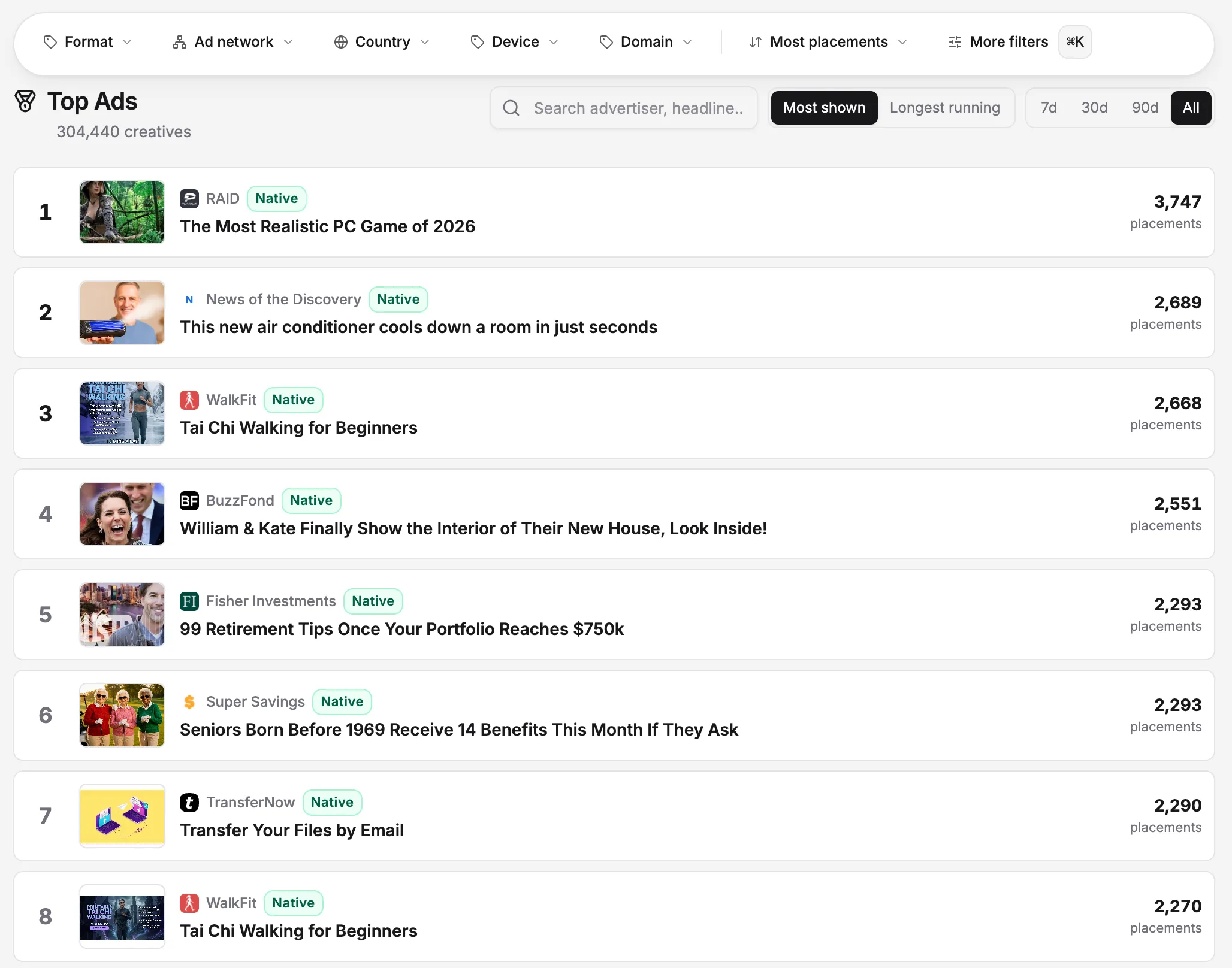
For scale, the public native channel is bigger than most people picture. The OpenAdLibrary index currently holds 589,000+ creatives from roughly 25,900 advertisers across 42 networks, with 926,000+ landing-page captures behind them (OpenAdLibrary index, June 2026). Your watchlist is a tiny, deliberate slice of that. The skill is choosing the right slice and watching it well.
Step 1: Decide what you are watching for#
Before you name a single competitor, name the signals. A watchlist that fires on every minor change becomes noise you train yourself to ignore inside a week. The signals that actually predict a competitor's moves are narrower than people assume:
- New creatives. A fresh angle, hook, or image entering rotation, especially one that breaks from their usual style.
- Scaling. The same creative spreading across more placements, more publishers, and more geos over time. Spread plus longevity is the closest public proxy for "this is working."
- New landing pages or pre-landers. A change in the post-click experience usually signals a new offer or funnel test before the creative even changes.
- New networks. A competitor who only ran Taboola suddenly turning up on MGID or Outbrain.
- Disappearance. A long-running ad going dark, which often means the offer broke or the budget got reallocated.
Write these down. They become the alert conditions you attach to every name on the list.
A word on longevity, because it is the single most useful signal in native. Nobody keeps paying to run a losing ad. So how long an ad has actually been live is a brutal honesty filter. Here is the catch that trips people up: the day-counts you can verify are bounded by how long a tracker has been watching. In our index, continuous-observation runs currently top out around 28 days per creative. A SmartAsset finance ad ("Ask a Pro: How Can I Avoid Paying Taxes on IRA Withdrawals?") has been observed live for 28 straight days on Outbrain.

Twenty-eight days of continuous observation is a verified floor, not a ceiling. The industry lore about "90-day winners" is a useful instinct, but treat it as lore: it is not something our index measures. What you can trust is the observed run. Sort a competitor's creatives by that and you are looking at their proven survivors, ranked by survival.
Step 2: Tier your competitors#
Not all rivals deserve equal attention, and a flat list quietly punishes you for it. You end up spending as much time on a brand you will never compete with as on the one eating your lunch. Sort every candidate into one of three tiers.
| Tier | Who belongs here | Review cadence | What you are watching for |
|---|---|---|---|
| Direct | Same offer, same audience, same networks. You bid against them. | Weekly | New winning creatives, scaling, landing-page tests, offer changes |
| Indirect | Adjacent offers or audiences; overlap on some keywords or placements | Monthly | Category trends, angle ideas, expansion into your lane |
| Aspirational | Bigger, more sophisticated advertisers you want to learn from | Monthly / ad hoc | Funnel structure, creative production quality, testing discipline |
Direct competitors are the core. These are the three to seven advertisers running essentially your offer to essentially your audience. When a direct competitor finds a winning angle, you feel it in your CPMs within weeks. Watch them closely enough that you could describe their current top creative from memory.
Indirect competitors are the early-warning layer. They are not fighting you head-on today, but they tell you where the category is drifting: a new compliance-safe angle, a seasonal hook, a fresh audience segment. They are also where you spot a future direct competitor before they pivot into your exact lane.
Aspirational advertisers are your teachers. Larger, better-resourced operators whose funnels and testing cadence you study to calibrate against, not to copy. Watching how a sophisticated advertiser builds a creative-to-landing-page funnel is one of the fastest ways to sharpen your own.
One more reason to tier by category, not gut feel: spend is wildly uneven across verticals. Finance leads the index with 17,232 creatives, insurance follows at 15,629, and health at 14,895 (OpenAdLibrary index, June 2026). If you operate in finance or insurance, your watchlist needs more headroom and tighter cadence than someone in a quieter niche, simply because more rivals are testing more aggressively around you.
A practical starting shape: five to seven direct, five to ten indirect, three or four aspirational. Resist the urge to inflate. A tight, tiered list of fifteen advertisers you actually monitor beats a list of fifty you skim once and abandon.
Step 3: Find the real advertiser behind each name#
Here is where most watchlists quietly break. You add "BrandX" to the list, but BrandX runs ads under three landing-page domains, two ad-account aliases, and an affiliate network's tracking template. On Taboola the card might say something else entirely. Match on the display name and you miss most of their activity.
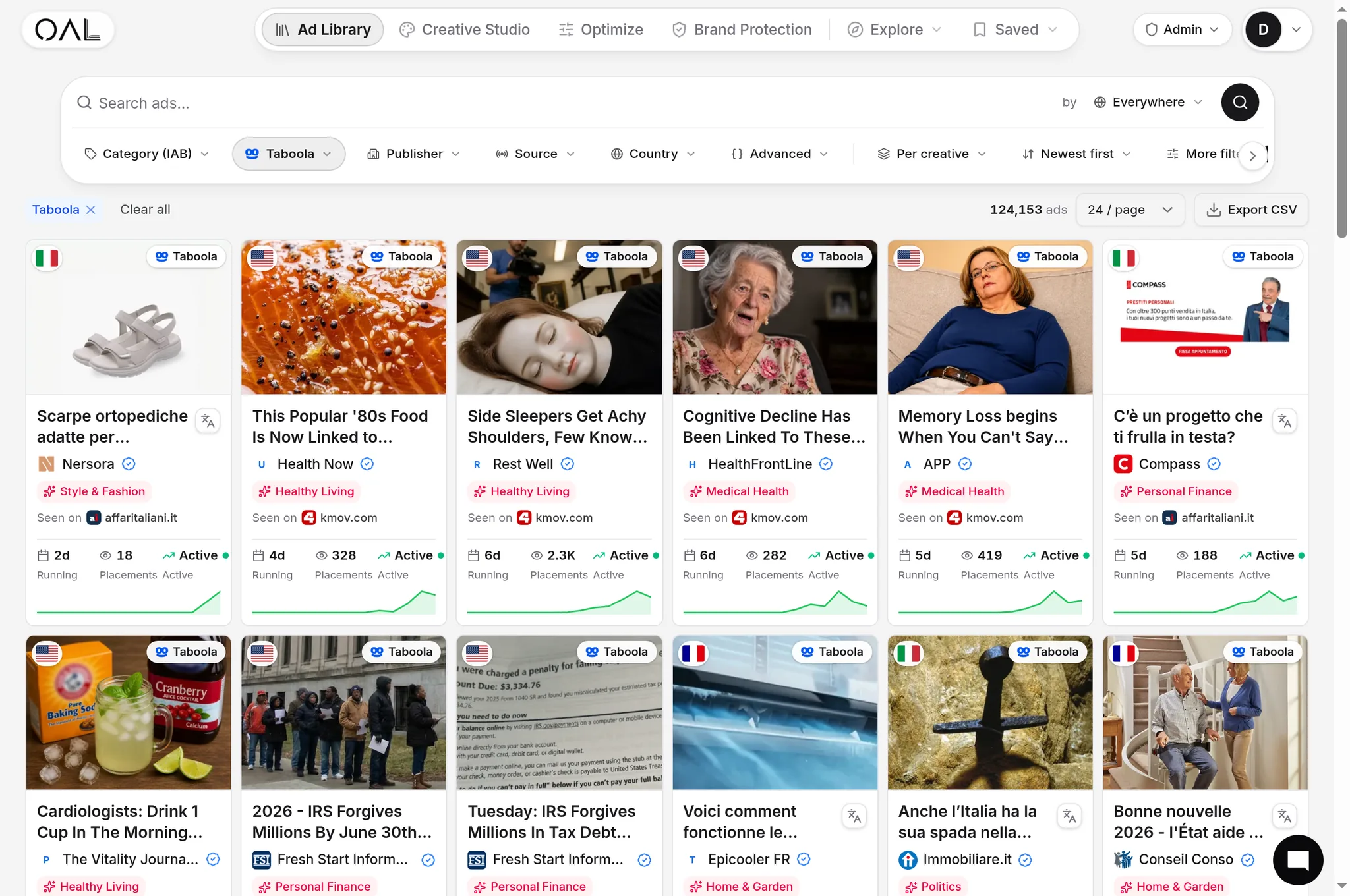
Look at the kind of branding native ads actually carry. A Taboola finance ad reading "2026 - IRS Forgives Millions By June 30th Tax Deadline" runs under the brand "Fresh Start Information." A health ad reading "Americans Are Ditching Hearing Aids for This New Device" runs as "Nebroo." Those on-card names are surface labels, not stable identities.

The fix is to anchor each entry on the destination, not the surface label. For each competitor, capture:
- The landing-page domains and pre-lander URLs the ads actually point to.
- The tracking and click-redirect domains in the supply chain. These persist even when creatives rotate.
- The networks they run on. A competitor's footprint is rarely confined to one.
This is exactly the problem a native ad spy tool that follows each click through to the landing page solves. It ties scattered creatives back to the same real advertiser even when the on-card name changes between networks. Once monitoring keys off the destination and the supply-chain fingerprint instead of a name string, a competitor cannot hide behind an agency, an alias, or a white-label brand. The mechanics of doing this by hand are in How to Find Out What Ads Your Competitor Is Running. The point for the watchlist is simple: record the durable identifiers, not the cosmetic ones.
Step 4: Wire each advertiser into continuous tracking#
A watchlist that lives in a spreadsheet is a to-do list you will not do. The goal is monitoring that runs without you. For each name, set up a saved, standing search instead of a manual one:
- Create a saved advertiser search for each entry, anchored on the durable identifiers from Step 3 (advertiser, landing domains, tracking domains) rather than a single keyword.
- Set the network scope to all native networks at once. Competitors rarely stay on one. In our index alone, Taboola carries 157,727 creatives, Outbrain 84,252, and MGID 49,689 (OpenAdLibrary index, June 2026), and the same advertiser routinely surfaces on more than one of them, plus Revcontent, MediaGo, Yahoo, MSN and others. After the Outbrain and Teads merger completed in early 2025, the combined entity sits in that mix too. Track the advertiser across the whole landscape, not one feed at a time. The network-specific tactics are in How to Spy on Competitor Native Ads (Taboola, Outbrain, MGID).
- Attach the alert conditions from Step 1 (new creative, new landing page, scaling, new network) so the system tells you when something changes instead of waiting for you to scroll.
- Pin the high-value entries (your direct tier) to a dashboard you actually open, so weekly review is a glance, not an investigation.
Why track live, public native ads continuously rather than leaning on platform-run ad libraries? Coverage. The EU's Digital Services Act forced ad repositories onto Very Large Online Platforms, which genuinely helps for those surfaces. But the open native web (Taboola, Outbrain, MGID and the rest) is not covered by those mandates. If you only watch official libraries, the entire native channel, where a lot of the most aggressive direct-response testing happens, is a blind spot. Capturing the live ads as they run is the only way to keep that channel on the watchlist at all.
Step 5: Capture creatives and landing pages, not just headlines#
When an alert fires, you want evidence you can study later, not a link that 404s next week. Native creatives rotate fast and landing pages get swapped or pulled, so your monitoring is only as good as what it preserves:
- The real creative image at full quality, not a thumbnail. You cannot judge a hook from a blurry crop.
- The landing page or pre-lander as it appeared, captured by following the click without interacting with the live ad, so you see the actual post-click experience tied to that creative.
- The supply-chain classification: which network, which placements, which publishers, so you can read spread and scale.
- First-seen and last-seen dates, which is how observed longevity (your best winner-signal) gets computed at all.
Look at the angle range a single archive surfaces. A home-and-garden ad ("Solar home batteries: Electricians agree about 1 thing") has been observed live for 27 days on Taboola, putting it right up against the 28-day ceiling. Sitting next to it is an insurance ad aimed at a completely different market ("Australians looking for life insurance should read this"), only seven days in.


This archive is what turns a watchlist from a notification feed into an asset. Six months of a direct competitor's captured creatives, sorted by observed run length, is a map of every angle they have validated. Across the whole index there are already 5.4 million+ individual ad observations behind those captures (OpenAdLibrary index, June 2026), which is what makes the first-seen and last-seen dates trustworthy in the first place.
Step 6: Turn the watchlist into a routine, then into action#
A wired-up watchlist still needs a human rhythm. Build a simple cadence around the tiers:
- Weekly (direct tier): scan for new creatives and scaling. Anything live more than a few weeks goes straight into a "proven angles" swipe file.
- Monthly (indirect + aspirational): look for category shifts, new entrants drifting into your lane, and funnel patterns worth borrowing.
- Quarterly (whole list): re-tier and prune. Promote indirect competitors now outspending your direct tier, demote brands gone dark, and remove anyone who has exited the niche.
The watchlist is the input. The output is decisions: which angles to test, which offers to counter, when to defend a placement. That hand-off from monitoring to action is its own discipline, mapped out in Building a Competitive Ad Intelligence Workflow (Watchlist to Action) and grounded in the broader idea of competitive intelligence in advertising. A watchlist that never changes a decision is just a hobby.
The fastest way to stand one up#
You can assemble all of this by hand: saved searches, screenshots, spreadsheets, calendar reminders. Plenty of people do. The friction is that native ads rotate faster than manual capture can keep up, and stitching one advertiser's footprint across eight networks by hand is genuinely tedious work nobody sustains for long.
A platform built for ad transparency collapses those six steps into a few clicks: search any advertiser across every major native network, see the real brand behind each card, follow the click to the landing page, read observed longevity and spread at a glance, and save the search so monitoring runs continuously. OpenAdLibrary does exactly that as an open, affordable alternative to the $80 to $400 per month incumbents. The free tier lets you browse 200 ads with no card, enough to draft your first watchlist before you commit a cent. Start free and tier your top competitors today.
The discipline matters more than the tool, though. Name your competitors. Sort them by threat. Anchor each on the real destination. Wire in the signals that predict moves. Review on a fixed cadence. Do that and you stop finding out what your competitors did, and start seeing what they are about to do.