Español
 Português (Brasil)
 Français
 Deutsch
 Italiano
 Nederlands
 Polski
 Svenska
 Türkçe
 Русский
 日本語
日本語 한국어
한국어 简体中文
简体中文 Tiếng Việt
 Bahasa Indonesia
 繁體中文
繁體中文 Čeština
 Dansk
Dansk Norsk (bokmål)
 Suomi
Suomi Ελληνικά
 Română
 Magyar
 Українська
 ไทย
ไทย हिन्दी
 العربية
 עברית
עבריתTaboola vs Facebook Ads: Cost, Intent & Creative Differences
Meta finds your buyer fast and burns creative in days; Taboola's cheaper clicks feed advertorial funnels that run for weeks. How the two channels differ on cost, intent, creative, and risk — and the playbook for running both.


Facebook Ads and Taboola are both cold-traffic acquisition channels, but they buy attention in opposite ways. Facebook interrupts a social feed with the deepest audience-targeting machine in advertising and charges by the impression; Taboola places a headline in an editorial feed where a reader chooses it as content, and charges by the click. In practice that produces predictable differences: Meta finds your buyer faster and supports richer creative, but costs more per impression, fatigues creative in days, and concentrates account risk on one platform. Taboola's clicks are commonly cheaper, its creatives live for weeks rather than days, and its advertorial funnels convert audiences Meta struggles with — at the price of slower learning, more manual optimization, and a smaller creative canvas. Most advertisers who scale on both use Meta to find winners fast and native to extend them cheaply and durably.
The fundamental difference: interruption vs discovery#
A Facebook ad interrupts. The user came to see friends, groups, or short video; your ad inserts itself, and Meta's algorithm earns that intrusion by predicting — from thousands of behavioral signals — who is likeliest to convert. The creative must stop a scroll that was never about you.
A Taboola ad is chosen. It renders as a recommended story below or beside the article someone just finished reading, on news and content sites across Taboola's publisher network. The user clicks because the headline promises something they want to read. That is why native clicks tolerate long-form advertorials and why the format is classed as content discovery rather than social interruption — the psychology of the click is closer to opening an article than responding to an ad.
Neither psychology is superior; they suit different offers. Impulse ecommerce with striking video demos wins on interruption. Offers that need explanation — a mechanism, an eligibility story, a health claim carefully walked through — win on discovery, where reading is the expected behavior. The DTC-specific version of this comparison, with vertical-level detail, lives in our companion piece on native ads vs Facebook ads for DTC brands.
Head-to-head comparison#
| Taboola | Facebook / Meta Ads | |
|---|---|---|
| Placement | Editorial feeds on publisher sites | Facebook/Instagram feeds, Stories, Reels, Audience Network |
| Pricing model | CPC — you pay per click | Auction CPM — you pay per impression |
| Targeting | Geo/device/OS, publisher context, retargeting, platform segments | Interests, lookalikes, engagement audiences, Advantage+ automation |
| Creative formats | Static image + headline | Image, video, carousel, UGC, Stories/Reels formats |
| Creative fatigue | Slow — winners run for weeks | Fast — winners often fatigue in days |
| Funnel convention | Ad → advertorial pre-lander → offer | Ad → product page or landing page |
| Learning speed | Slower; conversion data accrues per publisher | Fast; enormous signal density |
| Transparency | No official ad library | Meta Ad Library (all active ads public) |
Cost models: paying for clicks vs paying for impressions#
The pricing mechanics shape buyer behavior more than most comparisons admit.
Meta charges per impression through an auction, so your effective click price is CPM divided by CTR — creative that stops the scroll literally buys you cheaper traffic, and creative that fatigues quietly raises your costs even at stable CPMs. Practitioners have watched social CPMs trend upward for years as competition for the same feed attention intensifies, which is a large part of why "we need a second channel" conversations happen at all; our playbook on diversifying beyond Meta ads covers that reasoning in full.
Taboola charges per click. You bid a CPC, SmartBid adjusts it toward conversions, and impressions that nobody clicks cost you nothing. Media buyers commonly report Tier-1 desktop CPCs from roughly $0.20 to $0.90 on Taboola — with mobile below that range and competitive verticals above it — and the qualitative consensus is that native clicks price below what equivalent social traffic works out to for many offer types. Treat those figures as heuristics, not quotes; geo and vertical move them a lot, and our native ads CPC benchmarks guide explains how to reason about them properly.
The catch neither model advertises: cheap clicks are not cheap customers. Native traffic arrives colder and earlier in intent than a well-targeted Meta audience, so it usually needs a warming step — which brings us to funnels.
Creative and funnel: two different crafts#
Meta's creative canvas is rich and hungry. Video, carousels, UGC-style testimonials, Reels — and the platform rewards volume, with successful teams shipping dozens of variants weekly because fatigue arrives in days. The dominant funnel is short: ad straight to product page or a purpose-built landing page. Creative production is the standing cost of playing.
Taboola's canvas is one image and one headline. No video autoplay, no carousel, no social proof overlay. The craft compresses into angle and headline writing — the difference between losing and winning campaigns is usually the hook, a discipline we break down in hook vs angle vs claim and in our library of native ad headline formulas. The dominant funnel is longer: feed ad → advertorial pre-lander → offer. That intermediate page does the persuasion work Meta creative does in-feed, and skipping it is the single most common reason Meta-native buyers conclude "Taboola doesn't work."
The fatigue asymmetry deserves numbers. In OpenAdLibrary's June 2026 index, Taboola creatives routinely show multi-week continuous runs — a garden-decor ad observed for 37 straight days, a hearing-aid advertiser's creative at 37 days, a hair-regrowth angle at 31 — and across networks, ads that run for 30+ days are almost certainly profitable, because no professional renews a losing placement for a month. Meta buyers rarely see a single creative hold top spend for five weeks; native buyers see it constantly. One good advertorial funnel can anchor a Taboola account for a quarter, which changes the economics of creative production entirely.
One caution the other direction: Meta's creative formats let a great video do targeting work — the algorithm finds who responds. Taboola cannot rescue a weak angle with targeting, because the targeting is coarser. Your headline is the targeting.
Targeting and signal: the machine vs the context#
Meta's core advantage is unchanged: the densest conversion-prediction dataset in consumer advertising. Lookalikes, engagement audiences, and increasingly Advantage+ automation find converters with minimal explicit targeting. The system's weakness is also known: since iOS App Tracking Transparency degraded off-platform signal, measurement leans on modeled conversions and server-side events, and costs have crept as signal quality fell.
Taboola offers geo, device, OS, publisher-level context, its own audience segments, and retargeting. It is honest to call this coarser — you will not build a 1%-lookalike equivalent. What you get instead is context: your ad runs where people read about adjacent topics, and skilled buyers steer placements with site-level whitelists and per-publisher bids. You also get independence from a single platform's policy engine — a diversification argument that got more persuasive every year account bans and ad-account volatility stayed a normal cost of Meta buying.
For research and compliance, the transparency asymmetry matters: every active Meta ad is publicly inspectable in the Meta Ad Library, so your Facebook competitors can see your ads and you theirs. Taboola has no official equivalent — competitor research there runs through independent capture, which cuts both ways: harder for casual competitors to copy you, and you need a real tool to study them.
Compliance, policy, and account risk#
Both platforms police sensitive verticals, but the enforcement texture differs.
Meta's policy engine is automated, strict, and famously volatile at the edges: health claims, before/after imagery, financial promises, and anything personal-attribute-adjacent draw rejections and, at scale, account flags. For advertisers in gray-adjacent verticals, ad-account churn is a standing operational cost, and a single-platform dependency turns a ban into an existential event. This risk — more than any CPC arithmetic — is what pushes many performance teams toward channel diversification.
Taboola reviews campaigns with human-plus-automated moderation and enforces its own content policies, which also restrict health claims, misleading headlines, and prohibited categories — native is not an anything-goes zone, and network policies change, so check Taboola's current advertising policies before building a funnel around a sensitive claim. Two structural differences soften the risk profile, though: enforcement tends to land on individual campaigns and creatives rather than sudden whole-account destruction, and the advertorial format itself — when honestly labeled — gives compliant advertisers room to make a careful, referenced argument that would never fit in a Meta primary text. On disclosure specifically, advertorial funnels in the US must satisfy FTC native-advertising rules regardless of which network delivered the click; the requirements are summarized in our guide to FTC disclosure rules for advertorials.
The measurement asymmetry rounds out the risk picture. Meta attribution leans on modeled and aggregated conversions post-ATT; Taboola's CPC model with pixel or server-side postbacks gives you a click-level ledger. Neither is perfect, but a native program is unusually easy to audit — every dollar bought a click from an identifiable publisher, and the per-publisher report either converts or gets cut.
A 30-day plan for adding Taboola to a Meta account#
For a team already profitable on Meta, the porting playbook is standard enough to write down:
- Week 1 — mine your own data. Pull your three best-performing Meta angles of the last quarter. Strip each to its core claim and rewrite it as three native headlines — informational register, no social-proof crutches. Build or adapt one advertorial pre-lander per angle.
- Week 2 — launch narrow. One campaign, one Tier-1 geo, desktop first (cleaner signal), your best angle plus two variants. Install the pixel properly and pass a real conversion event, not a pre-lander view.
- Weeks 3–4 — prune and read. Cut non-converting publishers weekly, promote winning headlines, and let conversions mature before judging — native buyers convert on longer delays than warm social traffic. Judge the test on cost per matured conversion against your Meta marginal CPA, not your blended Meta account average.
Expectations matter: the goal of the first month is not beating Meta — it is proving the funnel mechanics work on reading traffic at all. Buyers who clear that bar then scale into native's real advantage: the long flat tail of a winner that runs for months, on inventory where nobody is bidding your lookalike audience against you, funded by clicks that keep getting cheaper as the publisher list tightens.
Where each channel wins#
Choose Meta first when:
- Your product sells on sight — visual, impulse-friendly, demo-able in video.
- You need fast validation; Meta's learning speed makes it the cheapest place to discover whether an offer converts at all.
- Your team already produces high-volume video/UGC creative.
- Precise audience construction (lookalikes off a buyer list, retargeting depth) is central to your economics.
Choose Taboola first when:
- Your offer needs explanation or an eligibility story — the advertorial funnel is the channel's home turf. It is no accident that health (11,982 live creatives), finance (8,200), and insurance (7,422) are the largest classified verticals in OpenAdLibrary's Taboola index (June 2026).
- Your Meta account economics are deteriorating — rising CPMs, fatigue treadmill, or policy friction in a sensitive vertical.
- Your audience skews older and desktop-heavy, where content feeds over-index.
- You want durable winners: slower testing in exchange for creatives that hold for weeks.
Run both when you can. The mature pattern among performance teams is Meta as the discovery engine — fast, expensive, signal-rich — and native as the extension layer where validated angles get rebuilt as advertorials and run cheaply for months. The angle that survived Meta's brutal testing loop usually has the raw material for a strong native headline; the funnel just needs rebuilding for a reading audience rather than a scrolling one.
The two channels also overlap less in audience than most buyers assume. Native feed inventory concentrates on news and content sites whose readership skews older and more desktop-heavy than Instagram's core; for offers targeting that demographic — retirement finance, hearing and mobility health, home services — Taboola is often not a Meta substitute but access to people Meta's auction reaches thinly or expensively. Incrementality, not arbitrage, is the stronger argument for the second channel.
Researching the competition on each channel#
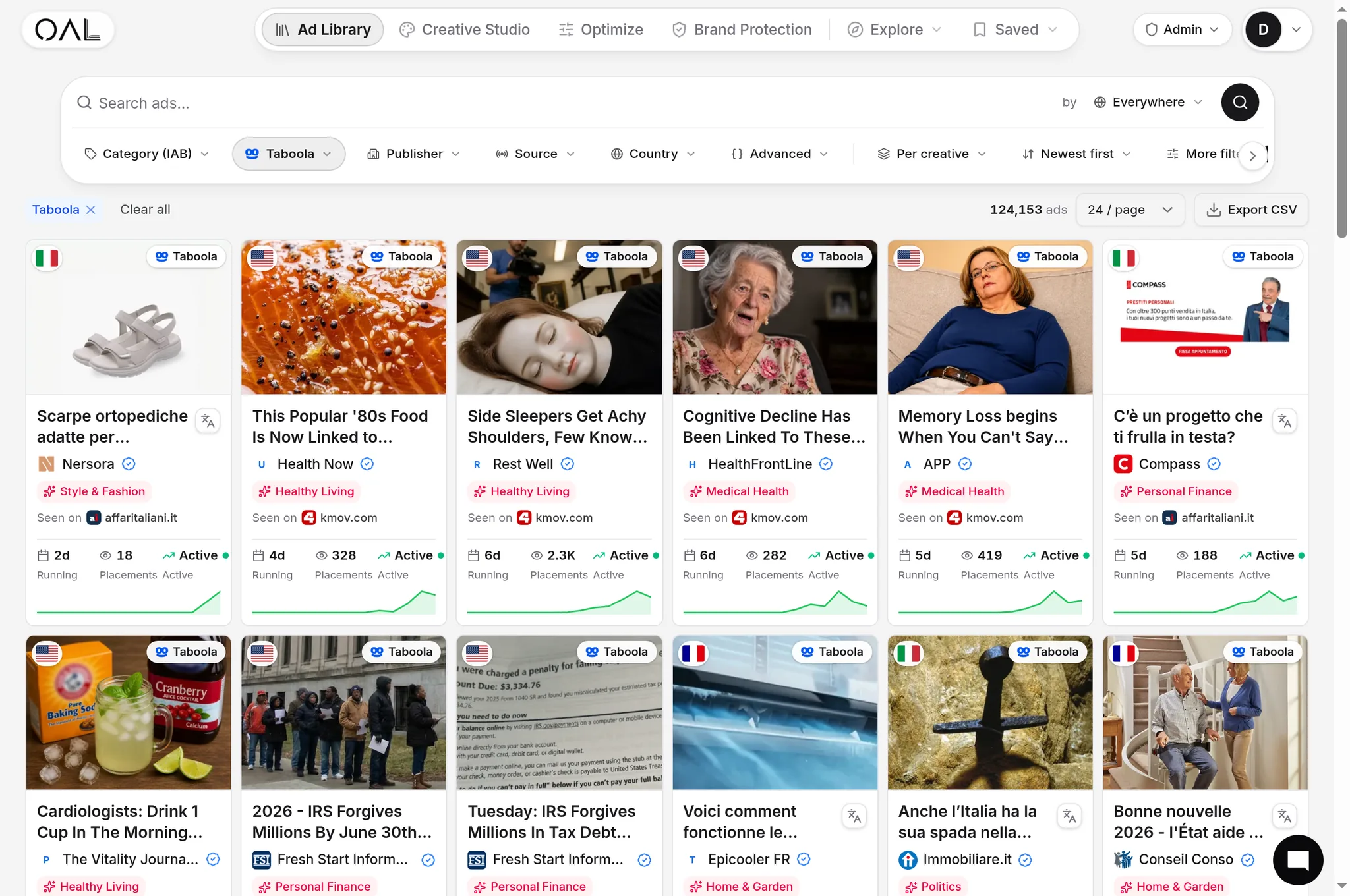
Due diligence looks different per channel because transparency does. For Meta, the Ad Library shows you any advertiser's active ads directly. For Taboola, use OpenAdLibrary's independent index: 206,000+ live Taboola creatives (June 2026) searchable by advertiser, vertical, and geo at /spy/taboola, each with observed run duration and the traced landing page — which means you can read a competitor's full advertorial funnel, not just their thumbnail. Before entering the channel, pull the advertisers already sustaining spend in your vertical and study their angles and pre-landers; the step-by-step method is in our guide to spying on competitor native ads. An afternoon of that research answers the question this whole comparison circles: is your kind of offer already paying its bills on native? If yes, the channel is validated. If you find nothing like your offer running for more than a week, that silence is data too.