Español
 Português (Brasil)
 Français
 Deutsch
 Italiano
 Nederlands
 Polski
 Svenska
 Türkçe
 Русский
 日本語
日本語 한국어
한국어 简体中文
简体中文 Tiếng Việt
 Bahasa Indonesia
 繁體中文
繁體中文 Čeština
 Dansk
Dansk Norsk (bokmål)
 Suomi
Suomi Ελληνικά
 Română
 Magyar
 Українська
 ไทย
ไทย हिन्दी
 العربية
 עברית
עבריתNative Ads Minimum Deposits & Budgets: Every Major Network Compared
What it really costs to start on each native ad network — entry models, commonly reported deposits and daily floors, and the test-budget math that actually matters.


Native ad networks use three entry models, and they determine what it actually costs to start: no-deposit self-serve accounts with minimum daily budgets (Taboola, Outbrain), prepaid deposits that media buyers commonly report at around $100 (MGID) to a few hundred dollars (Revcontent), and rep-assisted onboarding where minimums are discussed rather than published (MediaGo, Yahoo DSP). None of these figures are fixed constants — networks adjust them by region, currency and account type, so verify against each network's current signup flow before funding an account — but the three-tier pattern has been stable for years, and it should decide which network gets your first test.
The three entry models compared#
Each model shapes the first-week experience differently. Postpaid self-serve (Taboola, Outbrain) feels frictionless — create an account, attach a card, launch — but the network protects itself with per-campaign minimum daily budgets and stricter creative review, so the real gate is ongoing spend rather than an upfront payment. Prepaid self-serve (MGID, Revcontent) inverts that: you fund a balance before anything serves, the deposit is the gate, and the balance then drains against CPC with comparatively loose daily-budget constraints. Rep-assisted onboarding (MediaGo, and effectively Yahoo DSP) has no public number at all — access and minimums are a conversation, which filters for buyers who arrive with a credible monthly budget.
Here's how the major networks compare:
| Network | Entry model | Upfront deposit (commonly reported) | Practical entry notes |
|---|---|---|---|
| Taboola | Self-serve, billed to card | None | Minimum daily budget enforced per campaign; buyers commonly plan four figures for a meaningful test |
| Outbrain (Teads) | Self-serve, billed to card | None | Low technical daily minimums; the same real-world testing math as Taboola applies |
| MGID | Self-serve, prepaid balance | Around $100 | The lowest-friction entry among major networks; balance drains against CPC |
| Revcontent | Self-serve, prepaid balance | Low hundreds | Historically spend-gated; now broadly self-serve |
| MediaGo | Rep-assisted onboarding | Discussed with your rep | Come with a realistic monthly number; not built for $100 tests |
| Yahoo DSP | Managed / enterprise | Enterprise-level commitments | An omnichannel DSP, not a small-budget native network |
Everything in that table is what practitioners commonly report, not an official rate card. Networks change entry terms without announcements, and regional offices sometimes apply different rules — treat the table as a map of the terrain and confirm the current numbers in each network's documentation before committing money.
Two decisions follow directly from it. If your entire test budget is a few hundred dollars, the prepaid mid-tier (MGID or Revcontent) is where that money can actually buy a signal. If you can commit four figures a month, Taboola and Outbrain open up — how Taboola ads work covers what the higher floors buy you in inventory quality and volume ceiling.
Why networks set minimums at all#
Minimums aren't arbitrary gatekeeping. Prepaid deposits filter out fraud and card-testing abuse, reduce collections risk on networks whose advertiser base skews toward anonymous direct-response accounts, and cover the review cost of onboarding an advertiser who may never spend again. Daily budget floors exist because a campaign spending pennies per day generates no usable optimization data and still consumes serving and review resources. Understanding the why matters practically: the floors move with a network's fraud pressure and demand mix, which is why published third-party numbers go stale fast.
The minimums that are not on any pricing page#
The deposit is rarely the real constraint. Four hidden minimums bite harder:
- CPC floors by geo and device. Every network enforces bid floors that vary by country, device and placement quality, and Tier-1 desktop floors are commonly several multiples of Tier-3 mobile floors. Our native CPC benchmarks walk through the commonly reported ranges; the practical point is that the same $100 buys a few hundred clicks in one market and a few dozen in another.
- Algorithmic learning volume. Campaign optimizers need click and conversion volume before delivery stabilizes. Starve a campaign with a tiny daily budget and it never leaves the exploration phase — you pay for scattered clicks across low-quality placements and conclude, wrongly, that the network doesn't work.
- Statistical significance per creative. You cannot judge a creative on 20 clicks. Deciding between creatives requires a meaningful sample on each — practitioners commonly plan on the order of 100+ clicks per creative before killing or scaling it.
- Per-campaign versus per-account floors. Daily budget minimums typically apply per campaign. Split your test across three campaigns — say, by device — and your effective daily minimum triples.
How to size a real test budget#
The honest formula is arithmetic, not mystery: test budget ≈ expected CPC × clicks needed per creative × number of creatives, plus margin for landing-page iteration.
Worked through qualitatively: if buyers in your target geo commonly report mid-tier CPCs of roughly $0.10–$0.30 (unofficial, and your niche and geo will move this a lot), and you want about 100 clicks on each of six creatives, that's 600 clicks — roughly $60–$180 of pure creative-testing spend before you pay to validate the landing page and the offer behind it. Run the same math with Tier-1 desktop CPCs on premium networks, commonly reported several times higher, and you see why "budget four figures for a fair Taboola test" is standard advice rather than upselling. How much do native ads cost goes deeper on full-funnel budgeting, and the media buying beginner's guide covers structuring the test itself.
Match the network to the budget you actually have#
- A few hundred dollars. Fund MGID or Revcontent. One geo, one device, one offer — concentrate every click where it can reach significance instead of spreading thin. MGID vs Taboola explains what you give up (and what you don't) at this tier.
- Four figures a month. Taboola or Outbrain becomes a real option, and the audience quality and scale ceiling generally justify the higher effective floors. How to advertise on Taboola is the step-by-step setup walkthrough.
- Five figures a month. Talk to MediaGo, consider Yahoo DSP alongside the self-serve networks, and run creative learnings across networks in parallel.
One caution that applies at every tier: a minimum deposit is the price of entry, not a test plan. The most common failure mode we see is treating the minimum as the budget — funding $100, spraying it across placements, and reading noise as a verdict on the channel.
What happens after you deposit#
The deposit clears and three things immediately shape whether it converts into signal or evaporates:
- Creative review. Every network manually or semi-automatically reviews creatives, and first submissions from a new account get the most scrutiny. Rejections cost calendar time while your test window burns — read the network's creative policies before designing, and submit more creatives than you plan to run so rejections don't stall the test.
- Default targeting is wide open. Fresh campaigns commonly default to broad geo and device settings. On a prepaid balance this is how $100 disappears overnight into placements you never intended to buy. Set geo, device and any available placement controls before activating, and start bids near the floor rather than at the suggested value — suggestions optimize for the network's fill, not your test.
- Early data is placement-skewed. The first days of delivery concentrate on whatever placements accept your bid fastest, which are rarely the best ones. Judge placements individually and cut aggressively; don't average the first week into a verdict.
None of this is unique to any one network, which is why the discipline transfers: the buyers who make small deposits work treat the first spend as a placement-mapping exercise, not a profitability test.
Spend research before you spend budget#
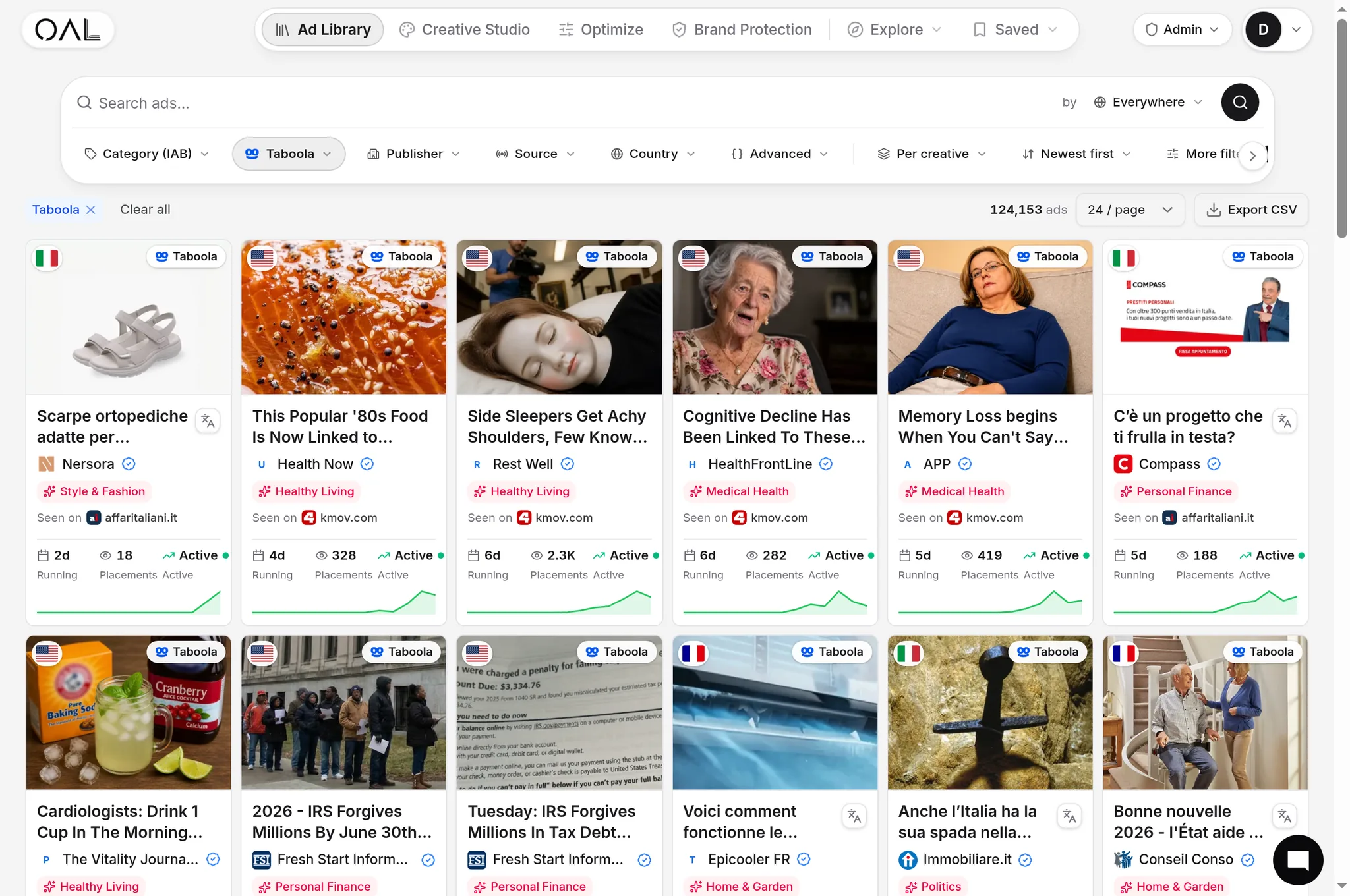
The cheapest clicks are the ones you don't buy. Before funding any account, study what already runs and survives on your target network: long-running ads are ads whose economics work, and a creative that has survived 30+ days of auction pressure has already run the test you're about to pay for. Browse live creatives, landing pages and advertiser histories in the native ad spy tool — the free tier covers network-by-network browsing, and premium unlocks full landing-page and longevity detail across OpenAdLibrary's index of 725,000+ native creatives on 49 networks. An afternoon of research routinely saves a first deposit's worth of dead-end clicks.