Español
 Português (Brasil)
 Français
 Deutsch
 Italiano
 Nederlands
 Polski
 Svenska
 Türkçe
 Русский
 日本語
日本語 한국어
한국어 简体中文
简体中文 Tiếng Việt
 Bahasa Indonesia
 繁體中文
繁體中文 Čeština
 Dansk
Dansk Norsk (bokmål)
 Suomi
Suomi Ελληνικά
 Română
 Magyar
 Українська
 ไทย
ไทย हिन्दी
 العربية
 עברית
עבריתHow to Scale Affiliate Campaigns Without Killing ROI
Scaling is where most affiliate ROI dies, so here's a disciplined framework (gentle budget steps, horizontal duplication, and new-geo expansion) plus how to use live native-ad spy data to find proven demand before you spend.


Most affiliate campaigns don't die in testing. They die in scaling. You find a winner, clean profit at $50 a day, push it to $500, and the margin is gone by Friday. The creative didn't change. The offer didn't change. What changed is that scaling, done wrong, is just a slower way of buying worse traffic.
Profitable scaling is a discipline, not a budget slider. You add volume where your economics still hold, and you refuse to add it where they don't. This guide lays out a concrete framework (gradual budget steps, horizontal duplication, geo expansion) and shows where competitive native advertising spy data tells you where to scale next, not just how to push harder on what you already run.
It builds on our pillar, the Native Advertising for Affiliate Marketing playbook, and assumes you already have at least one campaign printing positive ROI.
What scaling without killing ROI actually means#
Scaling without killing ROI means growing spend by replicating proven economics into new containers (more placements, more geos, more networks, fresh creative angles) instead of forcing one campaign past the budget level where its efficiency breaks. You expand the surface area of what works. You don't overload one winner until the algorithm and the inventory turn against you.
The trap is treating "scale" and "raise the budget" as the same thing. They aren't. Raising the budget is one tool, and it's the weakest one.
Vertical vs horizontal: pick the right axis#
Every scaling move sits on one of two axes. Confusing them is the single most common reason ROI collapses.
| Axis | What you change | Effect on ROI | When to use |
|---|---|---|---|
| Vertical | More budget/bid on the same campaign | High risk: resets learning, pulls in worse inventory | Sparingly, in small steps, on stable winners |
| Horizontal | Duplicate the winner into new containers | Lower risk: adds volume without overloading one auction | Your primary scaling engine |
Vertical scaling buys more of the same finite inventory. Eventually you're bidding against yourself and paying up for traffic that converts worse. Horizontal scaling opens new inventory at fresh efficiency. We cover the mechanics in Horizontal vs Vertical Scaling in Native Media Buying, but the rule of thumb is simple:
Scale vertically until it hurts, then stop. Scale horizontally for as long as you can find well-matched inventory. Almost all of your durable growth comes from the horizontal axis.
There's a reason horizontal works so well, and you can see it in the data. Across the 589,000+ creatives in the OpenAdLibrary index (June 2026), the same offer types show up again and again across different networks. Finance alone accounts for 17,232 creatives, insurance 15,629, and health 14,895. The supply is fragmented across 42 networks and 25,933 advertisers, which means there is almost always a fresh, uncongested place to run a proven angle.

Step 1: Earn the right to scale#
Before you touch anything, confirm the campaign is actually a winner and not a small-sample fluke. Scaling a borderline campaign just amplifies variance into a loss.
A campaign is ready to scale when:
- It has statistical weight. Enough conversions to trust the number. For most affiliate offers that's roughly 15 to 30 conversions at a stable cost, not three lucky ones.
- ROI sits above your scaling buffer. If you break even at 1.0x ROAS, don't scale at 1.1x. Scaling compresses margin, so build in headroom. Aim to scale things sitting at 1.4x or better so there's room to give some back.
- Performance is stable across days, not one spike. A single huge day usually means one placement caught a burst of cheap traffic that won't repeat.
- The affiliate offer can absorb volume. Check the cap, the payout stability, and whether the advertiser throttles or shaves at scale. Nothing kills a scale-up faster than scaling into a capped offer.
If those four boxes aren't ticked, you're not scaling. You're gambling with a bigger stake.
Step 2: Vertical scaling, done carefully#
When a campaign is a clear winner, you can take the budget up. Gently. Native algorithms re-optimize delivery against your budget and bid, and yank either one too hard and you blow up the learning the campaign has banked.
Here's the discipline:
- Increase budget in 20 to 30% steps. Not 2x, not 5x. A 25% bump from $200 to $250 is something the algorithm can re-stabilize around.
- Wait 2 to 3 days between moves. Let CPA settle before the next step. Patience here is literally money.
- Move budget, not bid, where possible. On networks like Taboola, aggressive bid changes shift you into different inventory tiers. Budget increases are usually gentler. (See our Taboola campaign setup guide for network-specific bid behavior.)
- Watch the placement mix, not just the topline. As budget rises, the network reaches for more inventory. If your best native ad widgets are already saturated, new spend lands on weaker sites and your blended CPA drifts up even though nothing "broke."
That last point is the ceiling. Every winning campaign has a budget level above which the marginal traffic costs more than it earns. Vertical scaling's job is to find that ceiling and stop just below it, then hand the baton to horizontal scaling.
Step 3: Horizontal scaling, duplicate what works#
This is where real scale lives, and it's mostly about containers. You take a proven angle, creative, and offer and give them new, uncongested places to run.
Duplicate across placements. Pull your winning sites and widgets into their own campaigns or ad sets so you can fund them directly instead of relying on the algorithm to keep choosing them. Block the chronic losers. This concentrates spend on inventory you've already validated.
Duplicate across creative angles. One winning angle means a theme is resonating, not that you've found the only hook. Spin three or four sibling angles off the winner: different headline framings, a new image direction, a fresh pre-lander narrative. Most will underperform the original. One occasionally beats it and becomes your next scaling engine. Anstrex-style libraries and OpenAdLibrary's Creative Studio and Copy DNA exist precisely to speed up this angle-generation loop.
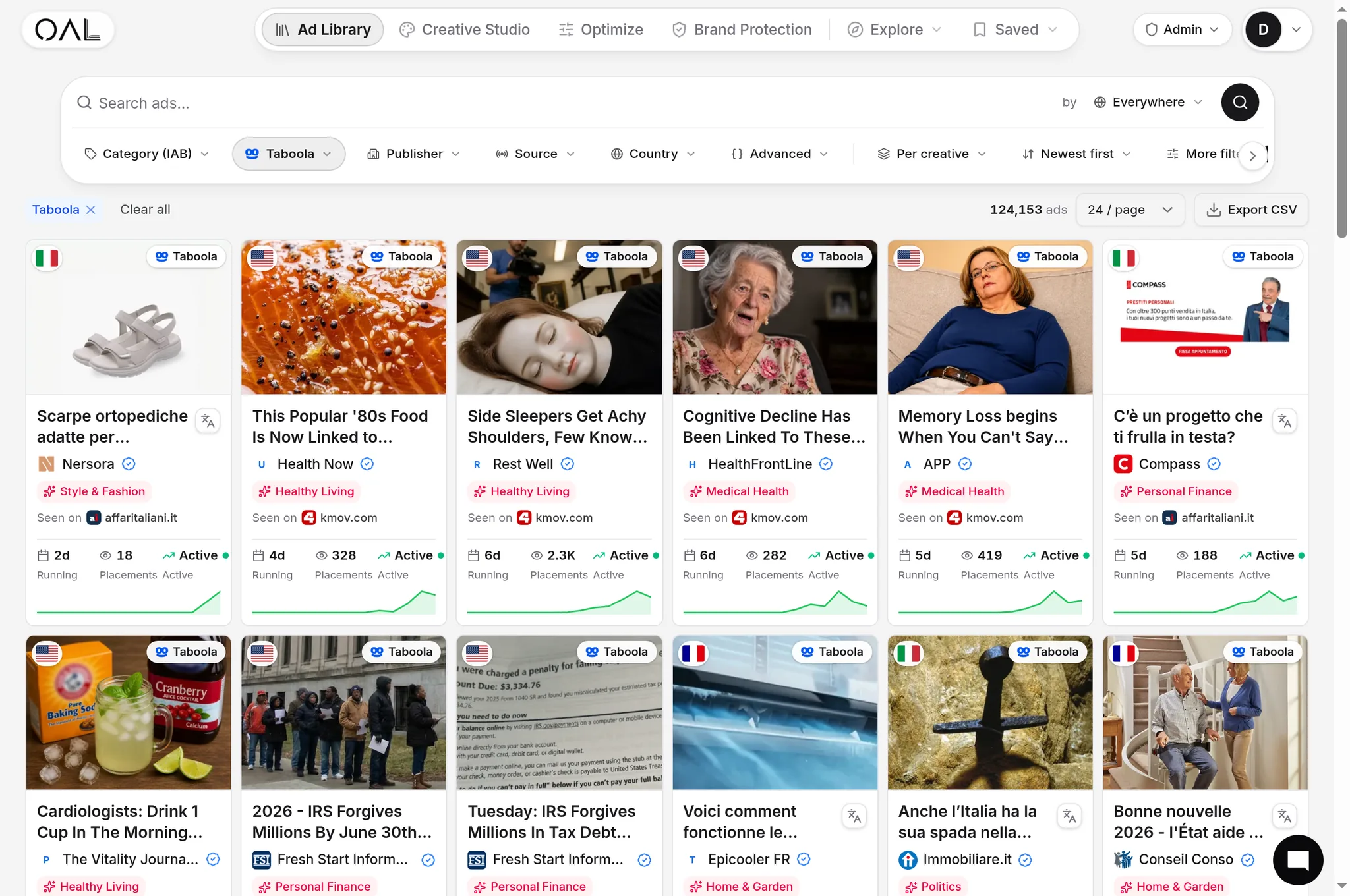
The health vertical is a masterclass in this. Look at how many ways advertisers reframe the same memory-and-aging hook in the index:


Same fear, two completely different hooks. That's sibling-angle thinking in the wild.
Duplicate across networks. A campaign that wins on one native ad network usually ports to others, because the widget formats and audiences are similar and the offer economics are identical. Moving a proven Taboola winner onto MGID, Outbrain, or Revcontent diversifies your traffic, reduces dependence on a single native ad auction, and frequently surfaces cheaper inventory. The numbers back this up. Taboola carries 157,727 creatives in our index, Outbrain 84,252, and MGID 49,689, and the top verticals overlap heavily. Finance, insurance, and health rank in the top three on both Taboola and Outbrain, so a finance offer that works on one is a low-risk bet on the other. The same logic underpins all of media buying for native ads: never let one auction own your business.
Duplicate across geos. Covered next, because it's the biggest lever and the one spy data unlocks most directly.
Step 4: Geo expansion, the highest-ceiling move#
Tier-1 markets (US, UK, CA, AU) are where everyone scales first, which is exactly why they're expensive and crowded. The same offer often runs profitably, sometimes more profitably, in Tier-2 and Tier-3 geos where CPCs are a fraction of the US rate and competition is thin. Geo expansion multiplies a single winning angle across many auctions instead of overheating one.
The sequence that protects ROI:
- Confirm the offer converts there. Ask the network or advertiser whether the offer is live and approved in the target country, what it pays, and whether there's a localized landing page. A great creative pointed at a payout-restricted geo is wasted spend.
- Localize, don't just translate. Currency, payment methods, cultural references, and the pre-lander all need to match the market. A literal translation reads as foreign and tanks conversion. Look at this Taboola insurance ad written specifically for the Australian market: the geo callout is in the headline itself.

- Re-test small, then apply the same step discipline. A new geo is a new campaign, not a settled one. Start at test budgets and scale it through Steps 2 and 3 from scratch.
Our deep-dive, Scaling to New Geos: Find Tier-2/Tier-3 Native Opportunities, walks through prioritizing markets and avoiding the geos that look cheap but never convert.
Where spy data tells you where to scale next#
Everything above answers how to scale. The harder question is where: which placements, which networks, which geos actually have proven demand for your offer type before you spend a dollar finding out. That's what live ad-transparency data answers, and it's why a native ad spy tool belongs in your scaling workflow, not just your research phase.
Here's how competitive data feeds each step:
- Find new geos with proven demand. Filter live native ads by country and network and see which markets comparable advertisers are running in right now. If three competitors are scaling your vertical in Poland and nobody's there in your account, that's a validated geo to enter, with their live creatives as a starting reference. OpenAdLibrary follows each ad's click through to the advertiser's landing page (without clicking live ads), so you see the real advertiser and the real funnel behind a geo, not just the headline.
- Find new placements. Spot which publisher sites and native ad widgets are carrying ads in your niche, so you can whitelist proven inventory instead of discovering it by burning budget.
- Read longevity and spread as a winner signal. This is the one most buyers underuse. Advertisers don't subsidize losers at scale, so an ad that keeps running is an ad that's working. Our index currently spans up to about 28 days of continuous observation per creative, and the ads pinned at that ceiling tell a story. SmartAsset's "Ask a Pro: How Can I Avoid Paying Taxes on IRA Withdrawals?" has been live on Outbrain for the full 28 days. So has Hidden Hearing's hearing-aid offer on the Microsoft Audience Network. When you see a creative holding for weeks across many placements, that's the closest thing to a public "this is profitable" signal, and it tells you which angles are safe to model before you commit budget.

- Confirm before you cross networks. Before porting a winner to a new native ad network, check whether the offer type already has traction there. Seeing live, long-running ads for similar offers on MGID or Outbrain de-risks the expansion.
Because much of native is bought through programmatic native advertising pipes, the same creative and offer surfaces across many publishers and networks, which is exactly why cross-network spy coverage maps so cleanly onto a horizontal-scaling plan. We've logged more than 5.4 million ad observations and 926,000+ landing-page captures (OpenAdLibrary index, June 2026), so the supply chain behind each ad is visible, not guessed at.
This is the gap most paid spy tools leave. They show you creatives, then charge $80 to $400 a month and stop at the ad. OpenAdLibrary is built open and affordable ($29.99/mo, or browse 200 live ads free with no card), captures the real creative at full quality, classifies the supply chain behind each ad, and traces the click to the landing page, so your scaling decisions rest on where demand actually exists.
Start free and pull the geos and placements your competitors are already scaling into.
A 30-day scaling cadence#
Put it together, and a disciplined month on a single validated winner looks like this:
| Phase | Days | Primary move | Guardrail |
|---|---|---|---|
| Stabilize | 1-5 | Confirm winner, split best placements into funded campaigns | Don't touch budget yet |
| Vertical | 6-14 | 20 to 30% budget steps every 2 to 3 days | Stop when blended CPA drifts up |
| Horizontal: angles | 10-20 | Launch 3 to 4 sibling creative angles | Each tested at base budget |
| Horizontal: networks | 15-25 | Port winner to 1 to 2 new networks | Re-validate before scaling |
| Horizontal: geos | 20-30 | Enter 1 to 2 spy-validated geos, localized | Treat as fresh tests |
The phases overlap on purpose. Once vertical scaling hits its ceiling around day 14, the horizontal tracks are already running and ready to absorb the growth.
How scaling usually kills ROI (and the fix)#
- Too-fast budget jumps reset learning. Fix: 20 to 30% steps, 2 to 3 days apart.
- Scaling into saturated inventory causes blended CPA creep. Fix: duplicate horizontally into fresh placements and geos instead of overspending one campaign.
- Scaling a capped or shaving offer gives you volume you can't monetize. Fix: confirm caps and payout stability in Step 1.
- Entering geos blind means spending before demand is proven. Fix: validate the geo in spy data and with the affiliate manager first.
- One angle, one network is fragile, single-auction dependence. Fix: sibling angles plus cross-network duplication.
- Skipping compliance at scale bites exactly when you can least afford it. Fix: keep disclosures clear and prominent. The FTC's guidance on native and affiliate disclosures applies to everyone in the chain, not just the advertiser.
The bottom line#
Scaling affiliate campaigns without killing ROI comes down to one mental shift: stop asking "how high can I push this budget?" and start asking "where else does this winner work?" Push the budget gently until it hits its ceiling, then spend the rest of your energy duplicating proven economics into new placements, networks, geos, and angles. Let live spy data tell you which of those containers already has demand, so every dollar of new spend lands somewhere the math has a real chance of holding.
For the strategic context around all of this, return to the Native Advertising for Affiliate Marketing playbook, and pair it with the deeper mechanics in Horizontal vs Vertical Scaling and Scaling to New Geos.