Español
 Português (Brasil)
 Français
 Deutsch
 Italiano
 Nederlands
 Polski
 Svenska
 Türkçe
 Русский
 日本語
日本語 한국어
한국어 简体中文
简体中文 Tiếng Việt
 Bahasa Indonesia
 繁體中文
繁體中文 Čeština
 Dansk
Dansk Norsk (bokmål)
 Suomi
Suomi Ελληνικά
 Română
 Magyar
 Українська
 ไทย
ไทย हिन्दी
 العربية
 עברית
עבריתRevcontent for Publishers: Requirements, RPM & Approval Reality
Revcontent is the selective mid-tier native network: harder to join than MGID, cleaner than the bottom tier. The requirements publishers actually report, RPM drivers, and the health-heavy demand mix from 15,789 live ads.


Revcontent pays publishers a share of click revenue from its content-recommendation widget, and it is deliberately harder to get into than most mid-tier native networks: sites are reviewed for original content and genuinely engaged audiences, and the traffic minimum publishers have most commonly cited over the years is around 50,000 visits per month — a folk number rather than published policy, so verify it against Revcontent's current documentation. In exchange, the network's pitch is cleaner demand than the bottom tier and unusually granular widget control. This guide covers what the approval process actually filters for, what moves RPM, and the health-heavy demand mix you would be running — grounded in the 15,789 live Revcontent ads in OpenAdLibrary's index (July 2026).
How Revcontent's publisher model works#
The unit is a content-recommendation widget: a grid of sponsored story cards, usually rendered at the end of articles. Advertisers bid per click in a real-time auction; you earn a contracted share of the click revenue, and everyone discusses the result as RPM — revenue per thousand pageviews. The arithmetic is unforgiving and worth keeping in view:
RPM = widget CTR × average advertiser CPC × your revenue share × 1,000
Two Revcontent-specific notes on top of the standard model:
- Widget control is the differentiator. Revcontent's widget is known for granular customization — card counts, layouts and styling that can be tuned to sit closer to your design than the default look of larger networks. Used well, that lifts CTR without lifting reader annoyance; used cynically, it blurs the ad/content line, so keep sponsored labeling unambiguous.
- Selectivity is the product. The network's smaller, reviewed supply base is its pitch to advertisers — engaged audiences rather than maximal reach. That positioning only holds if publishers like you keep clearing the bar, which is why approval is a real filter and not a formality.
The advertiser-side view — auction mechanics, targeting, what buyers optimize for — is in how Revcontent works. Read it even as a publisher: the buyers funding your RPM are paying for engagement, which tells you exactly what to improve on your side of the trade.
Approval: requirements and why sites get rejected#
What the review process consistently filters for, per common publisher reports:
- Traffic scale. The oft-cited bar is around 50,000 monthly visits. Treat it as folklore with a basis: engaged, Tier-1-weighted sites reportedly get in below it, and thin sites above it get declined. There is no published threshold; check the current publisher documentation.
- Audience quality over raw volume. US and Tier-1 heavy traffic that arrives via search, social and direct — and actually reads — is what Revcontent's advertisers pay for. Bought traffic that does not interact is the classic silent killer of applications.
- Original, article-style content. Scraped, spun or thin aggregated content is a standard rejection, as are unfinished sites and empty template pages.
- Policy compliance. Adult content, piracy and the usual prohibited categories are out; gray-area content invites extra scrutiny.
Rejected? The productive move is fixing the underlying signal — engagement depth, content originality, traffic provenance — before reapplying. Repeated identical applications go nowhere, and the same improvements that clear Revcontent's bar raise your earnings on whatever network you run meanwhile. Publishers below the bar usually start with MGID, whose lower threshold and trade-offs we compare directly in MGID vs Revcontent.
Preparing an application that passes#
Reviewers form an impression in minutes, so control what those minutes show:
- Finish the site. Working navigation, populated categories, an about page and a reachable contact — reviewers reject visible construction sites reflexively, and rightly: advertisers will see the same thing.
- Show engagement, not just volume. Have your analytics story ready: time on page, scroll behavior, returning visitors, and a traffic-source breakdown that shows search, social and direct rather than a wall of paid referrals.
- Clean up the current ad load. A site already stacked with aggressive units signals what you will do with theirs. Present the layout you intend to run, not the one you are trying to escape.
- Apply when traffic is stable, not spiking. A viral month followed by collapse is visible in any traffic review and reads as exactly what it is. A flat-but-real baseline beats a decaying peak.
- Never misrepresent. Traffic sources and ownership are checkable, and a rejection for thin content is recoverable in a way a ban for misrepresentation is not.
RPM reality: what moves the number#
No network can quote your rate in advance and no honest article will either. As orientation, publishers commonly report sub-$1 to low-single-digit RPMs on engaged Tier-1 traffic, with international traffic below that band — non-official figures that your layout and audience will move substantially. The levers, in order of leverage:
- Geo mix. Auction CPCs concentrate on US and Tier-1 audiences. The same placement can earn several times more on American traffic than on Tier-3 traffic.
- Engagement depth. Only sessions that reach the widget can monetize. Long-form content with real read-through outearns high-bounce traffic at identical pageview counts — this is also precisely what got you approved.
- Placement and density. End-of-article is the baseline unit. Additional units add revenue at a decreasing rate and a compounding UX cost; the traffic-arbitrage operators who live on native margins tune density obsessively because one unit too many flips the whole model negative.
- Content category. Contextual demand matters: health, finance and home-improvement pages attract deeper-pocketed bidders than general viral content.
- Seasonality. Q4 strengthens, early Q1 sags — an ad-market pattern, not a Revcontent quirk. Judge any test over at least a full month.
Measure like an operator, not a dashboard reader: track session RPM including second-order effects (pages per session, return visits), and run a two-week holdout template without the widget to learn its true incremental revenue. Anchor expectations on your own trial — every network's public case studies are top-decile by construction.
Design the trial before the widget goes live, not after the first payout surprises you. A clean version: pick one high-traffic template, serve the widget to a random half of sessions for a full month (long enough to smooth weekday and demand cycles), and compare total session revenue — display plus native plus recirculation — between arms. Watch the guardrail metrics alongside the money: pages per session, scroll completion and seven-day return rate in the widget arm. If revenue is up and the guardrails are flat, expand placement by placement. If the guardrails sag, you have learned the widget's real price before it compounded, which is the entire point of running the test.
The demand mix: what will actually run on your pages#
OpenAdLibrary's index holds 15,789 live Revcontent creatives as of July 2026, within a total index of 725,000+ creatives across 49 networks. The classified vertical mix:
| Vertical | Live classified creatives |
|---|---|
| Health | 2,566 |
| Finance | 816 |
| Home & garden | 789 |
| Insurance | 638 |
| Nutra | 440 |
| Fashion | 247 |
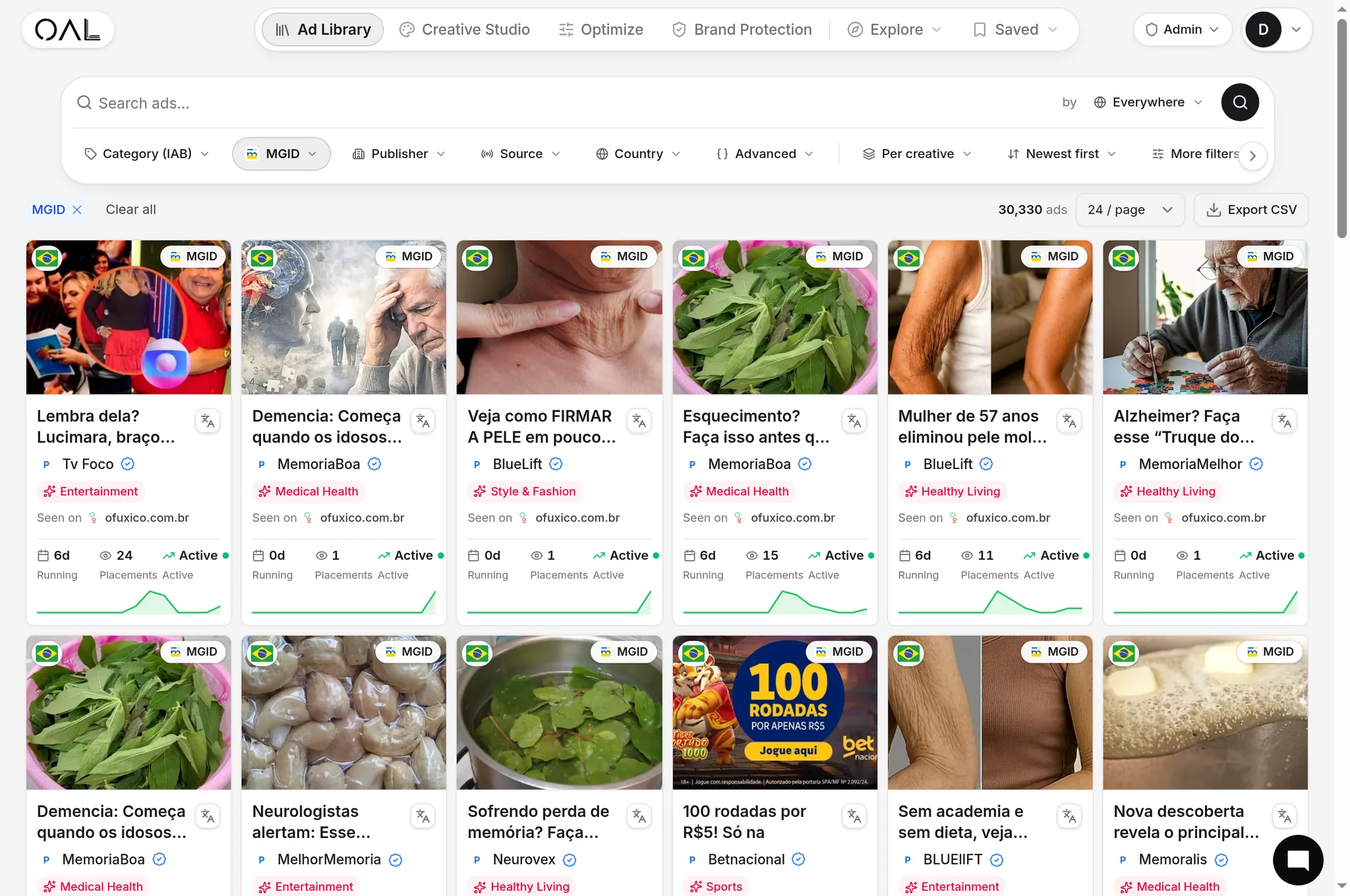
Health dominates — and combined with nutra, the health-adjacent share grows further. In practice that means advertorial-style health stories (joint-pain and blood-sugar angles recur across the live corpus, with the same advertisers rotating headline variants on stable funnels for weeks), listicle-format content plays from arbitrage publishers, and senior-targeted benefit and lead-gen offers. It is a more monetizable, offer-led mix than MGID's entertainment wall — closer to a small Taboola than to the bottom tier — but it is still advertorial country: if your editorial brand cannot sit above a card promising that a household item tightens skin, you need to configure blocks aggressively or reconsider the category.
Two second-order points publishers under-weigh. First, offer-led demand is seasonal and cyclical: health and insurance budgets surge and retreat with enrollment windows and quarterly cycles, so expect your RPM to breathe even at constant traffic. Second, demand concentration cuts both ways — a mix led by one vertical earns well while that vertical bids, and sags when a compliance wave or offer collapse thins it. Diversified demand is one genuine argument for the bigger networks; know which trade you are making.
Do the diligence before committing page real estate rather than after a reader complaint: browse the Revcontent ad library filtered to your geo to see the live cards, or start from the free Revcontent spy page — it takes minutes and no credit card, and it is exactly the audit most publishers skip. Then use category and advertiser blocking at onboarding, and recheck quarterly, because demand mixes drift.
Widget setup and optimization#
The sequence that captures the revenue without burning the audience:
- Start with one end-of-article unit styled to your typography — Revcontent's customization is the reason to be here, so use it. Keep sponsored labeling clear.
- Establish a clean baseline month before adding anything. You cannot attribute what you did not isolate.
- Add depth, not density. A mid-content unit on long-form templates is the highest-value second placement. Three stacked grids at the footer is how session quality dies.
- Mobile first. Most native volume is mobile; test load behavior on mid-range devices. A widget that shoves content around during load costs more engagement than it earns.
- Watch page weight and Core Web Vitals. Recommendation units add requests. If templates get measurably slower, the organic-traffic cost eventually swamps widget revenue.
- Change one variable per iteration. Card count, thumbnail ratio, placement — each is testable; simultaneous changes teach nothing.
On labeling: however closely you style the widget to your design, the sponsored disclosure has to stay unmistakable. The FTC's native advertising guidance applies to publisher implementations, not just advertisers — and beyond compliance, readers who feel tricked into an ad click punish the site, not the network.
Payment terms and the operational side#
The unglamorous items that decide whether the relationship works at month six:
- Payout thresholds and timing. Minimum thresholds and net payment schedules are industry-standard; the specifics change, so confirm the current terms and available payment methods before counting on the cash flow, and check transfer fees if you are paid internationally.
- Separate widget IDs per placement. Earnings you cannot attribute to a specific placement on a specific template are earnings you cannot optimize. Set the reporting structure up before launch.
- Keep independent counts. Log your own pageviews and widget clicks against the dashboard monthly. Small discrepancies are normal tracking noise; persistent or growing ones are a documented conversation with your account contact.
- Know your escalation path. A named contact who responds is worth real RPM when a bad creative slips through your blocks on a Friday. Test the support channel early with a low-stakes question.
Revcontent vs Taboola and MGID for publishers#
| Revcontent | Taboola | MGID | |
|---|---|---|---|
| Entry bar | Moderate — selective review; ~50k monthly visits commonly cited | High — several hundred thousand pageviews commonly reported | Low — mid-scale sites commonly accepted |
| Demand character | Health-led advertorial (2,566 of 15,789 classified) | Health, finance, insurance at premium scale | Entertainment-teaser-led |
| Contract posture | Standard terms at mid tier | Multi-year, often exclusive direct deals | No exclusivity at standard tiers |
| Best fit | Engaged Tier-1 audiences at mid scale | Premium-scale publishers negotiating guarantees | Global or mixed-geo sites below other bars |
The pattern: Revcontent is the middle path — more selective than MGID, more accessible than Taboola, with demand quality and RPM potential between the two. Head-to-head detail lives in Revcontent vs Taboola, and the wider field is ranked by real ad volume in best native ad networks.
Verdict: who should apply#
Apply if:
- Your audience is genuinely engaged and Tier-1-weighted, and you sit at or above the commonly cited mid-scale bar — Revcontent's auction is built to pay for exactly your traffic.
- You care about widget aesthetics and want styling control the bigger networks do not offer.
- You want a no-drama second network to benchmark against an existing monetization stack.
Hold off if:
- Your traffic is predominantly Tier-2/3 — MGID's demand base is built for that inventory and will likely out-earn a Revcontent widget on it.
- Your site is thin, new or running on bought traffic. The application will fail, and the fix is the same work that would raise your revenue everywhere else.
- Advertorial health cards under your journalism would corrode reader trust that took years to build. No RPM covers that cost.
And if you clear the bar later, reapply — sites grow into Revcontent all the time, and an earlier rejection for scale carries no lasting mark the way a policy ban does.
Whatever you decide, decide it from evidence: audit the live demand for your geo, run a real holdout, and measure sessions rather than widgets. The publishers who win with native are not the ones who found a secret network — they are the ones who treat every widget as a tenant that must keep paying rent in both revenue and reader trust.