 Español
 Português (Brasil)
 Français
 Deutsch
 Italiano
 Nederlands
 Polski
 Svenska
 Türkçe
 Русский
 日本語
日本語 한국어
한국어 简体中文
简体中文 Tiếng Việt
 Bahasa Indonesia
 繁體中文
繁體中文 Dansk
Dansk Norsk (bokmål)
 Suomi
Suomi Ελληνικά
 Română
 Magyar
 Українська
 ไทย
ไทย हिन्दी
 العربية
 עברית
עבריתNative Ads for SaaS: B2B Pipelines Outside LinkedIn
Live campaigns — from enterprise content programs to $950-audit lead gen — show how software companies make native feeds produce B2B pipeline without LinkedIn's CPCs.


Native ads work for SaaS when they are treated as a pipeline channel rather than a brand channel — and live data shows software companies already operating that way at scale. OpenAdLibrary's index holds 14,871 live software-vertical creatives across 49 tracked networks (June 2026), spanning enterprise content programs on Outbrain to blunt direct-response lead generation on MGID. The underlying pitch is simple: the same professionals LinkedIn charges premium CPCs to reach spend most of their day reading news feeds, where clicks commonly cost a fraction as much. This guide covers where software advertisers actually run, the two distinct strategies visible in live campaigns, how to build a B2B funnel that survives contextual (rather than firmographic) targeting, and the math that decides whether native pencils for your deal size.
Why SaaS teams look past LinkedIn#
LinkedIn earns its place in every B2B plan for one reason: firmographic targeting. Job title, seniority, company size — no other channel selects an audience that precisely. The problems are the price of that precision and the ceiling on it. B2B buyers routinely describe LinkedIn CPCs as multiples of any other channel they run, the professional audience is finite so frequency climbs fast, and every competitor in your category is bidding on the same job titles with the same intent data.
The native argument is not that feeds replace that precision — they cannot. It is that your buyers do not stop existing when they leave LinkedIn. A VP of operations reads morning news on MSN, checks industry coverage at lunch, scrolls a portal feed in the evening. Native reaches the identical human in those contexts at open-web prices, and accepts a targeting trade: you select context and geo instead of job title, and let the creative qualify the reader. For teams already diversifying beyond the walled gardens, native is the B2B-viable slice of the open web.
Two structural bonuses sharpen the case. Native clicks land on your infrastructure — your advertorial, your tracking — so a click becomes a first-party relationship instead of an in-platform impression. And feed audiences skew toward exactly the decision-maker demographics (older, desktop, business-hours) that most B2B creative struggles to find cheaply anywhere else.
Where software advertisers actually run#
Live software-vertical creative counts from the index (June 2026):
| Network | Software creatives | Read for SaaS buyers |
|---|---|---|
| Microsoft Audience Network | 7,909 | The single largest pool of software natives — over half the vertical's indexed volume. Desktop, Windows, business-hours inventory: office workers at work. Guide: MSN native ads |
| Taboola | 3,665 | Scale across premium publishers; software is a top-six Taboola vertical |
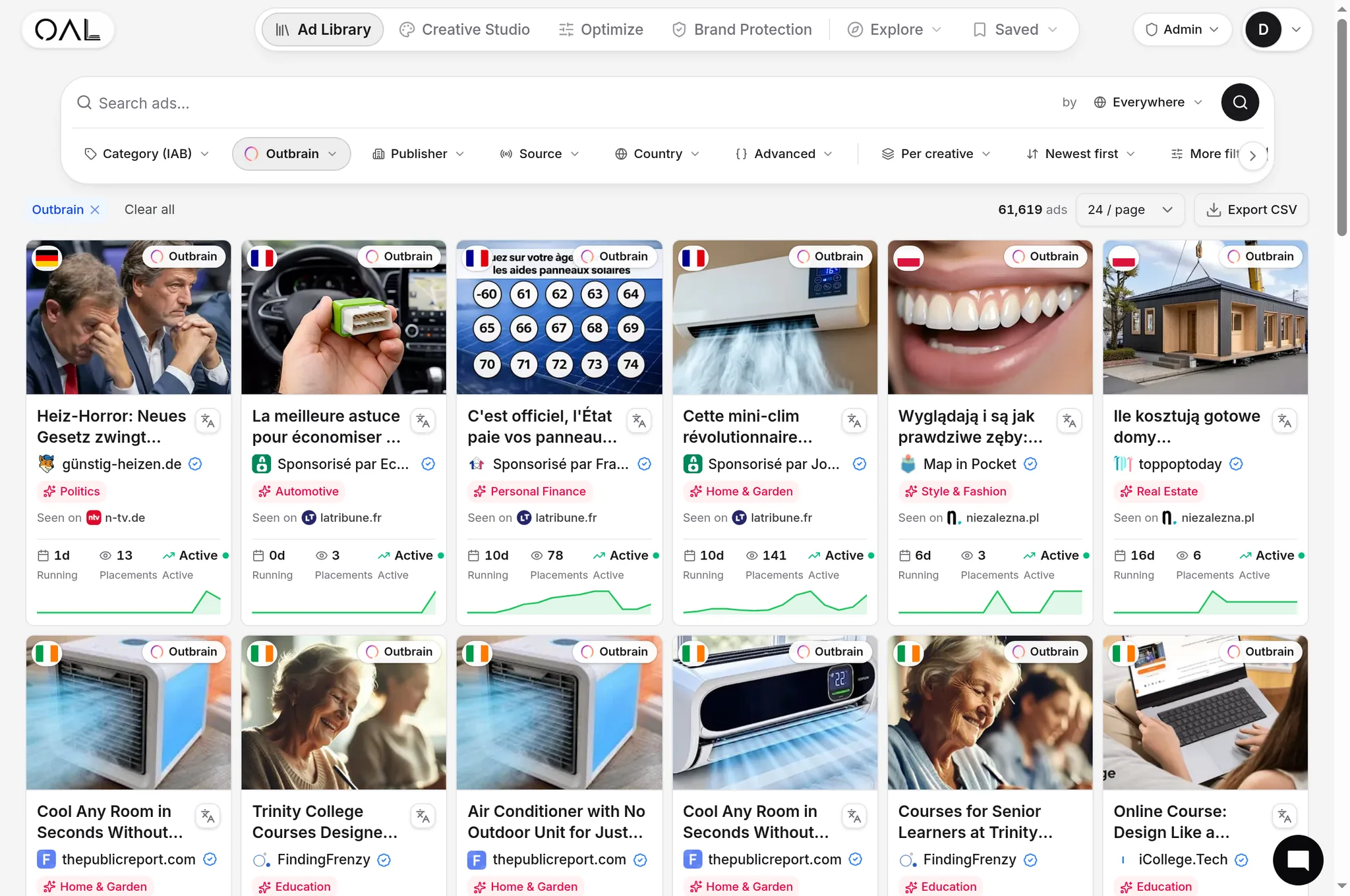
| Outbrain (Teads) | 1,932 | Premium editorial context; the natural home for content-led B2B programs. Background: how Outbrain works |
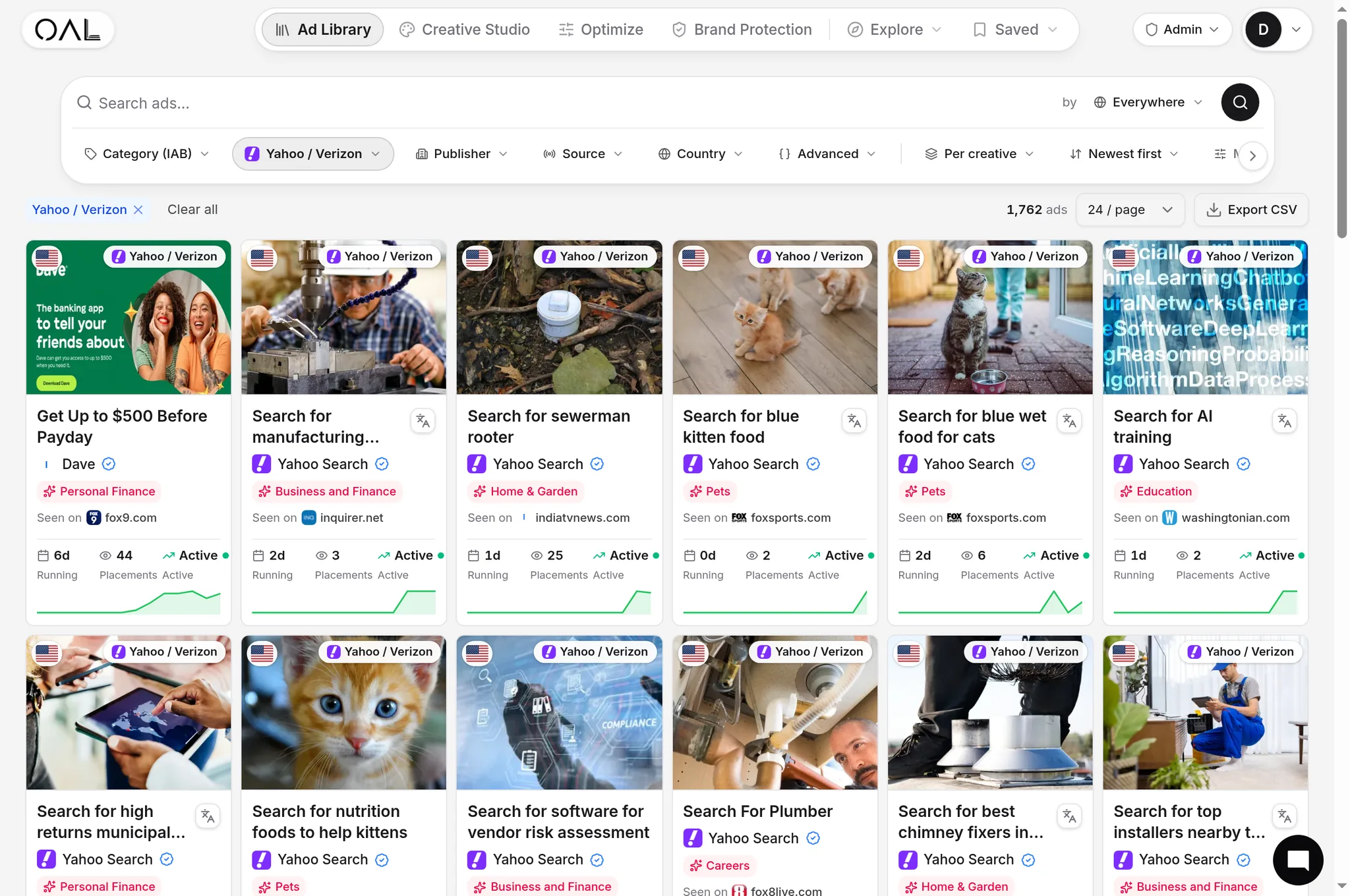
| Yahoo | 466 | Small in absolute terms, but software is Yahoo's single biggest vertical in the index — a finance-and-news audience worth testing for B2B. Background: how Yahoo native ads work |
The Microsoft concentration is the headline. If your ICP works at a desk on a Windows machine, the feed built into their operating system and browser new-tab page is the largest native surface pointed at them — and it is where the majority of your software-category competitors already are.
Two SaaS strategies visible in live campaigns#
The index shows software and B2B advertisers splitting into two clearly different playbooks. Most failed SaaS native tests come from mixing them up.
Strategy one: content distribution#
SPECTRA by MHI — Mitsubishi Heavy Industries' editorial brand — runs creatives on Outbrain like "From trash to treasure: Waste to energy explained" and "Methane: Tackling a rising climate priority," with individual creatives observed running for more than a month. Nothing about these is direct response: no offer, no form, no trial. They distribute thought-leadership content to a business audience, and success is measured in engaged reads and audience building, not leads.
This is the enterprise pattern: use native as a subsidized distribution arm for the content your team already produces. It suits long sales cycles, seven-figure deals and category-education plays where the buying committee needs to encounter your ideas repeatedly before any salesperson calls. The discipline it demands is honest measurement — engaged time and return visits, tracked against the pipeline that eventually forms — and the patience not to bolt a lead form onto content that was never designed to convert one.
Strategy two: direct-response pipeline#
At the other pole, Perpetual Ad Tech — a marketing-automation seller — runs MGID creatives that read like a masterclass in B2B feed copy:
- "The $950 Audit That Shows Where Your Marketing Loses Money"
- "Paying An Agency $3k/Month? A Machine Does It For A Flat Fee"
- "See Exactly Where Your Business Bleeds 12 Hours Every Week"
Three mechanics do the work. Quantified pain: every headline contains a number — dollars or hours — that converts an abstract problem into a felt cost. An enemy: the $3k/month agency, the leaky budget. Positioning against a status quo the reader already resents outperforms positioning against a feature list. A diagnostic offer: an audit, not a demo. Low-commitment diagnostic offers are the B2B feed's best-performing first ask, because a cold reader who will not book a demo will accept a mirror held up to their problem. These are the same headline structures cataloged in our native headline formulas, tuned for a business reader.
Note who this advertiser is: not an enterprise giant, but a small B2B vendor using cheap mid-tier clicks to build pipeline against SMB owners. That is the profile for whom direct-response native most reliably pencils.
One more live example worth a line: MONOBUNT, an Austrian digital agency, ran "Professionelle Onlineshops" on the Microsoft Audience Network for a month — German-language B2B creative for a German-speaking market. B2B native inventory is global; localized copy is an easy edge most SaaS advertisers never bother to take.
The SaaS native funnel#
Cold feed traffic sent straight to a signup form is the classic first-test mistake — the reader was mid-article thirty seconds ago and has no idea who you are. The funnel that works inserts one qualification step:
- Feed ad with a quantified-pain or diagnostic hook.
- Advertorial or educational lander that names the problem, quantifies its cost, and introduces your approach — an editorial page, not a product page. Comparison-style landers ("the real cost of doing X manually") work the same slot.
- Conversion asset: the audit, calculator, benchmark report or template — a diagnostic lead magnet gated by a short form. Demos and trials come after, in nurture.
- Nurture: email sequence plus retargeting. B2B native leads close on sales-cycle timelines, not session timelines.
The math has to respect that lag. Track cost per lead daily, but judge the channel on cost per qualified opportunity monthly — and set your attribution window to match your sales cycle, or native will be graded on a test it was never sitting. Deal size sets the tolerance: a product with a four-figure annual contract value can absorb single-digit lead costs and low close rates comfortably; a $15/month tool needs self-serve conversion and much tighter funnel efficiency to make feed traffic work.
Illustrative arithmetic, not a benchmark: a $0.50 CPC with a 4% click-to-lead rate is a $12.50 lead; if one lead in twenty becomes a sales conversation and one conversation in five closes on a $6,000 ACV, the channel is acquiring customers at $1,250 — the kind of ratio only your own funnel data can confirm, but the kind of check worth running before the first dollar.
Targeting without job titles#
The honest constraint: native networks do not sell "VP of Engineering." What they sell instead can be composed into a serviceable B2B filter:
- Context. Business, finance and technology publisher categories — and, once data accrues, an explicit publisher whitelist of the sites that produce converting leads. Site-level performance in B2B native is brutally uneven; whitelisting is where accounts become profitable.
- Schedule and device. Desktop, business hours, weekdays — a crude but effective proxy for "at work."
- Geo. Precise everywhere, and the backbone of localized plays like the MONOBUNT example.
- The creative itself. "Paying an agency $3k/month?" is a targeting parameter. Headlines that name the reader's role, stack or problem qualify clicks before you pay for the wrong ones — accept lower CTR as the cost of higher lead quality.
Some networks offer audience segments layered on top; treat availability and quality as network-specific and check current documentation rather than assuming parity with social platforms. The strategic posture stays the same: you are paying a fraction of walled-garden CPCs precisely because the targeting is coarser. Waste is priced in; the creative's job is to keep it from compounding.
What B2B clicks cost on native#
Heuristics as practitioners report them, not rate cards: business-context native clicks in Tier-1 geos commonly land in the rough range of $0.30–$1.00 on desktop, with premium editorial placements and competitive categories running higher and mid-tier networks like MGID often lower — the venue where the Perpetual Ad Tech campaigns above run. Buyers moving spend from LinkedIn consistently describe native CPCs as a small fraction of what they pay there for nominally the same humans. The catch is symmetrical: a smaller share of those cheaper clicks is your ICP, so the honest comparison is cost per qualified lead after the creative and lander have filtered, not cost per click. Run both channels against the same lead-scoring rules for a quarter before concluding anything.
Measurement plumbing that B2B native needs#
Because native leads mature over weeks, the tracking setup decides whether the channel can ever prove itself:
- Tag everything to the creative level. UTM parameters carrying network, campaign and creative IDs into your CRM, so a closed deal six weeks out still traces back to the headline that sourced it.
- Score leads at the CRM, not the form. Feed traffic produces more unqualified form-fills than search; the channel verdict lives in the qualified-lead column.
- Feed conversions back to the network where supported — most major native platforms accept server-side or pixel-based conversion events, and their bid optimization is materially better when trained on qualified leads rather than raw clicks. Check each network's current conversion-API documentation for what it accepts.
- Retarget the readers who did not convert. An advertorial visit is a warm audience; a retargeting layer across native and other channels typically closes the loop the first click opened.
None of this is exotic, but B2B teams arriving from LinkedIn often under-instrument the open web and then blame the channel for the resulting fog.
Creative playbook for B2B native#
- Put a number in the headline — dollars lost, hours wasted, percentage gained. Quantified beats clever in every B2B swipe file worth studying.
- Name the villain: the agency retainer, the spreadsheet, the legacy vendor. Enemies focus attention; features do not.
- Offer a diagnostic, not a demo, as the first conversion.
- Design thumbnails for feed size. A native thumbnail is small; dense UI screenshots turn to noise. One face, one object or one bold graphic reads at a glance — save the product tour for the lander.
- Localize when you expand. Language plus currency plus market references, not machine translation.
- Watch survivors, not launches. A B2B creative still running after weeks is generating economics its advertiser likes — the read-through logic of ad longevity.
Watch competing software advertisers before you build#
Every question this guide answers in general, the index answers for your specific category. Search your competitors and category keywords, filter to the software vertical, and read what comes back: which networks each rival runs, which headline angles they keep renewing, and — via captured landing pages — which lead magnets and funnel architectures sit behind the ads. Sorting by run duration separates their working campaigns from their experiments, and a watchlist surfaces new market entrants as they start spending. Start with the Outbrain index if your category leans enterprise-content, or the full ad intelligence platform to sweep all 49 networks at once.
Verdict: who should run SaaS natives#
Native earns a budget line for SaaS teams in three situations: SMB-focused products whose economics need cheap top-of-funnel volume (the Perpetual Ad Tech pattern), content-rich enterprise brands that want distribution beyond their owned audience (the SPECTRA pattern), and any B2B marketer whose LinkedIn costs have crossed the pain threshold and who needs a second demand source that is not another walled garden. It is the wrong first channel for products that depend on precise title-level targeting with no tolerance for waste, and for teams unwilling to produce the advertorial and lead-magnet assets the funnel requires — a bare demo page pointed at feed traffic fails predictably, then gets blamed on the channel.
Come with a diagnostic offer, an advertorial lander, a whitelisting plan and a sales-cycle-length measurement window — and let the 14,871 software creatives already running tell you what your category has figured out. The buyers you are paying LinkedIn premiums to reach are reading the feed right now, next to an ad from your competitor that has been running for a month.