Español
 Português (Brasil)
 Français
 Deutsch
 Italiano
 Nederlands
 Polski
 Svenska
 Türkçe
 Русский
 日本語
日本語 한국어
한국어 简体中文
简体中文 Tiếng Việt
 Bahasa Indonesia
 Čeština
 Dansk
Dansk Norsk (bokmål)
 Suomi
Suomi Ελληνικά
 Română
 Magyar
 Українська
 ไทย
ไทย हिन्दी
 العربية
 עברית
עבריתHow Yahoo Native Ads Work After Gemini: Yahoo DSP Explained
Yahoo Gemini is gone, but "Yahoo native" still trips up buyers: here is who really serves the ads in 2026, how to buy them, where MSN fits, and how to study live creatives.

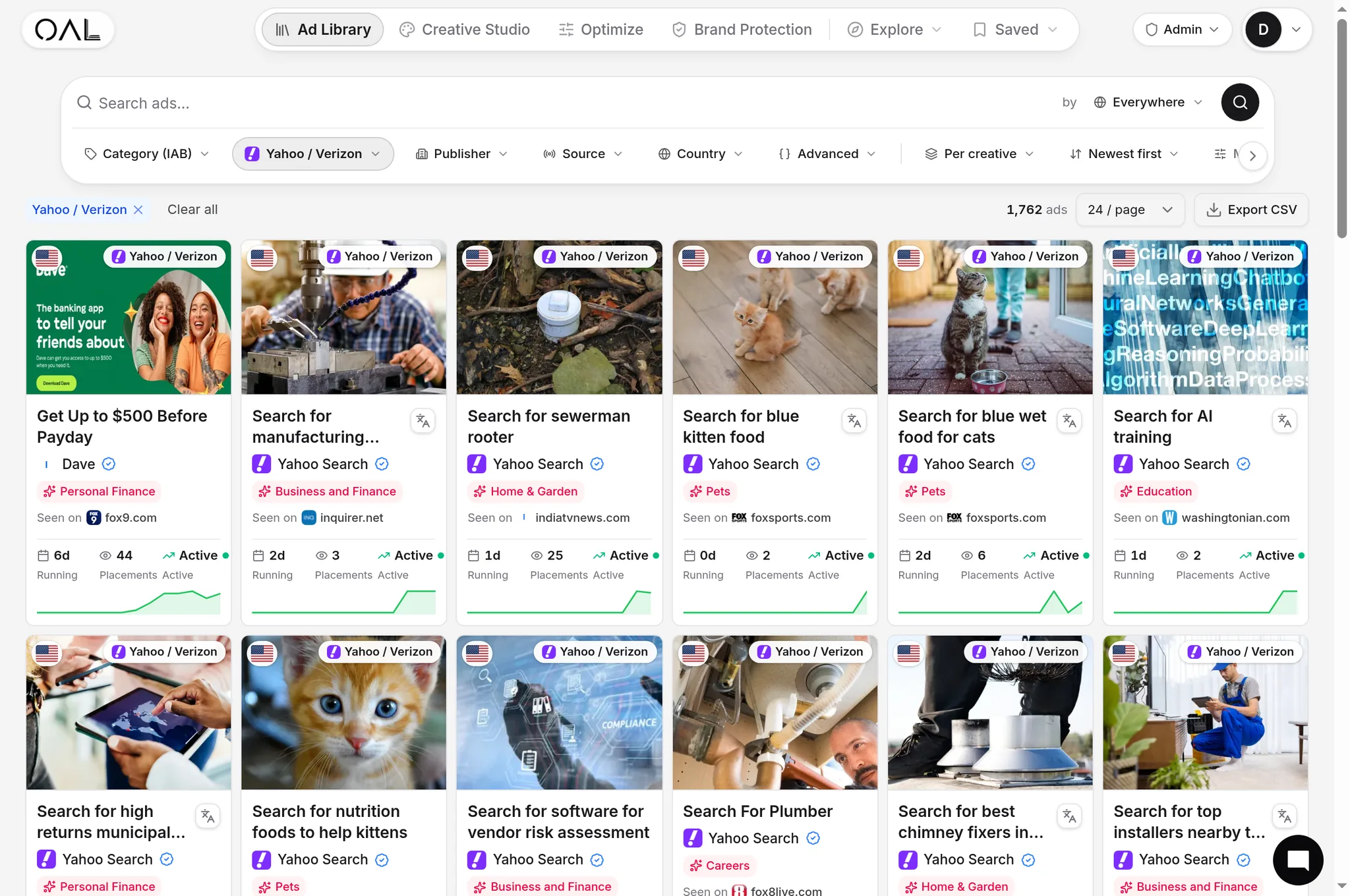
"Yahoo native" might be the most mislabeled term in performance marketing. Buyers still ask for "Gemini placements." Agencies still build decks around a self-serve console that was switched off years ago. And half the confusion comes from MSN ads getting filed under "Yahoo" because the two have shared search and inventory deals for over a decade.
If you run native and you want Yahoo's audience, the only question that matters is: what actually serves the ad today? Because the buying surface changed, the auction changed, and the reporting changed. Get the plumbing wrong and you waste a media plan chasing a console that no longer exists.
Here is the real layout in 2026, plus how to study live Yahoo and MSN native creatives instead of guessing.
How Yahoo native advertising works in 2026#
Yahoo native runs on two separate engines. Recommendation-style native (the "Around the Web" widgets on Yahoo Finance, News, Sports and Mail) is powered exclusively by Taboola under a 30-year commercial agreement. Audience-targeted programmatic native is bought through the Yahoo DSP, which reaches Yahoo's premium native marketplace plus open-exchange inventory. The old Gemini self-serve platform is gone.
That is the short answer. The rest of this page is the detail you need to act on it.
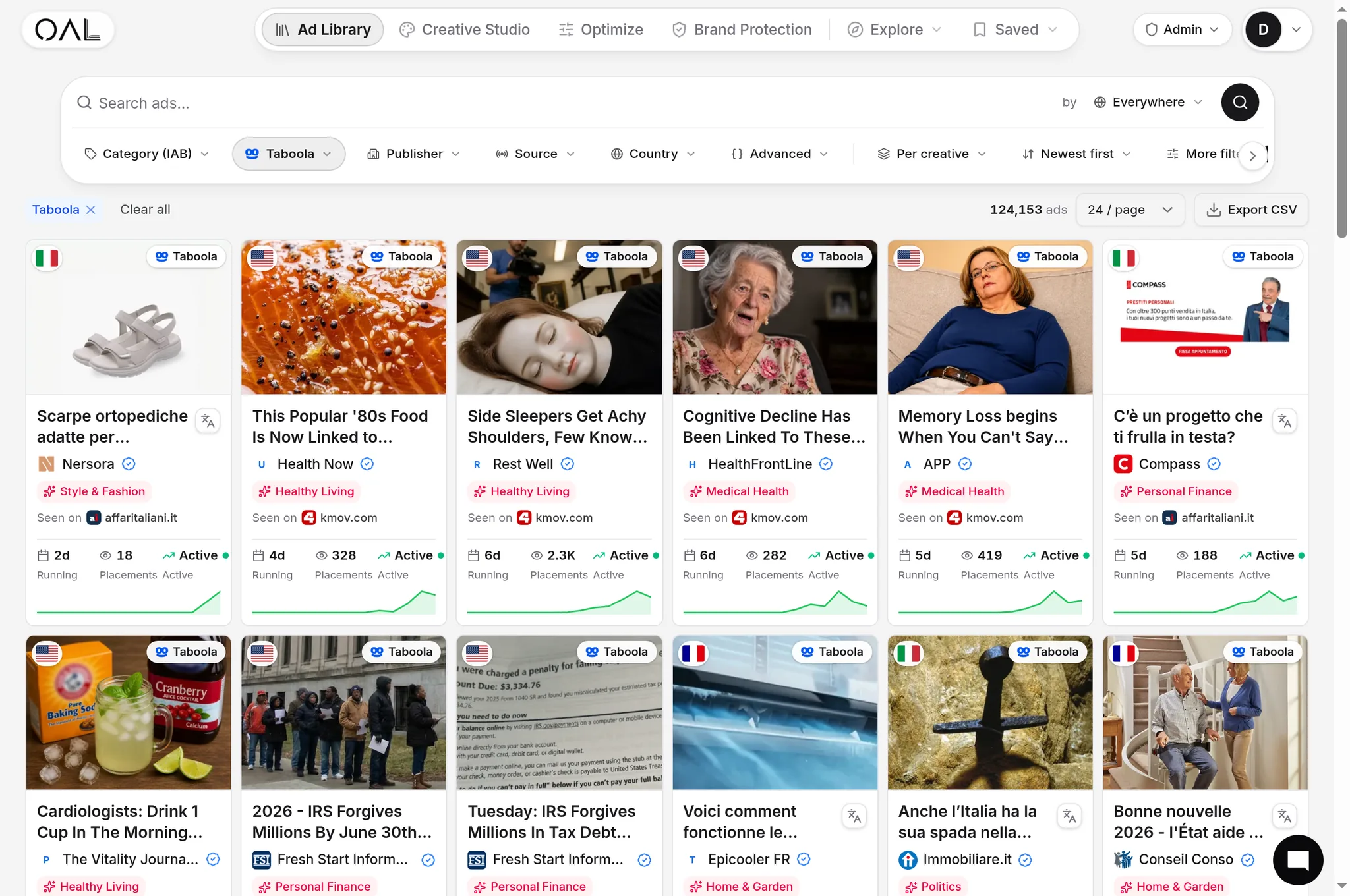
It helps to see the scale of the supply you are buying into. Taboola, the engine behind Yahoo's native footprint, accounts for 157,727 of the live creatives in the OpenAdLibrary index (June 2026), the single largest network in our data. Across all 42 networks we track, that is part of 589,036 captured creatives from 25,933 advertisers, observed 5.4 million times. Yahoo native is not a niche corner. It is a slice of the biggest discovery marketplace on the open web.
What actually happened to Yahoo Gemini#
Yahoo Gemini launched in 2014 as a unified marketplace for search and native. You uploaded creatives, set bids, and targeted Yahoo's owned properties plus a syndicated partner network. For a while it was a genuine fourth option next to Taboola, Outbrain and the search engines, especially for affiliate and direct-response buyers who liked the cheap clicks and the loose policy posture.
In early 2023, during a company-wide restructuring of around 20%, Yahoo wound down its homegrown ad-tech stack. It shut its supply-side platform and retired the Gemini native platform. The decision was strategic: stop competing as a full-stack ad-tech vendor, concentrate on the buy side, and hand the native business to a partner.
The logic was sound. Rather than maintain a thin-demand native marketplace, Yahoo plugged its enormous audience into Taboola's advertiser pool. More advertisers bidding on the same inventory is exactly what native needs to monetize.
Our glossary entry on Yahoo Gemini / Yahoo Native traces the full timeline if you want the historical specifics. The practical takeaway is blunt: there is no "Gemini" to log into. Anyone still chasing that console is chasing a redirect.
The two ways Yahoo native is served today#
After Gemini, "Yahoo native" splits into two buying surfaces. Confusing them is the single most common mistake I see buyers make.
1. Taboola powers Yahoo's native recommendations#
Yahoo and Taboola signed a 30-year deal under which Taboola exclusively powers the native recommendation widgets across Yahoo's owned-and-operated properties worldwide. It went live in late 2023, rolled out fully through the following year, and Yahoo took a meaningful equity stake in Taboola as part of the structure.
In plain terms: the "content you may like" and end-of-article recommendation units on Yahoo Finance, Yahoo News, Yahoo Sports and Yahoo Mail are Taboola placements. To run that classic native-discovery format on Yahoo's audience, you buy it the way you buy any other Taboola inventory. Everything in our breakdown of how Taboola ads work (the bidding model, the creative policy, the native ad widget mechanics) applies directly to Yahoo's native footprint. Yahoo is, effectively, one of Taboola's largest premium publishers.
This is also why the thumbnail and headline carry the whole campaign. Here is a live Taboola finance creative from our index, the exact kind of unit that runs across Yahoo Finance:

Finance is the dominant vertical in the whole index (17,232 creatives across networks), and it is one of Taboola's heaviest categories too, with 5,558 finance creatives and 4,303 in insurance (OpenAdLibrary, June 2026). Taboola's top vertical is actually health, at 6,048 creatives, which tells you something about who is buying this audience: tax relief, insurance comparison, and supplement offers, not luxury brand awareness.
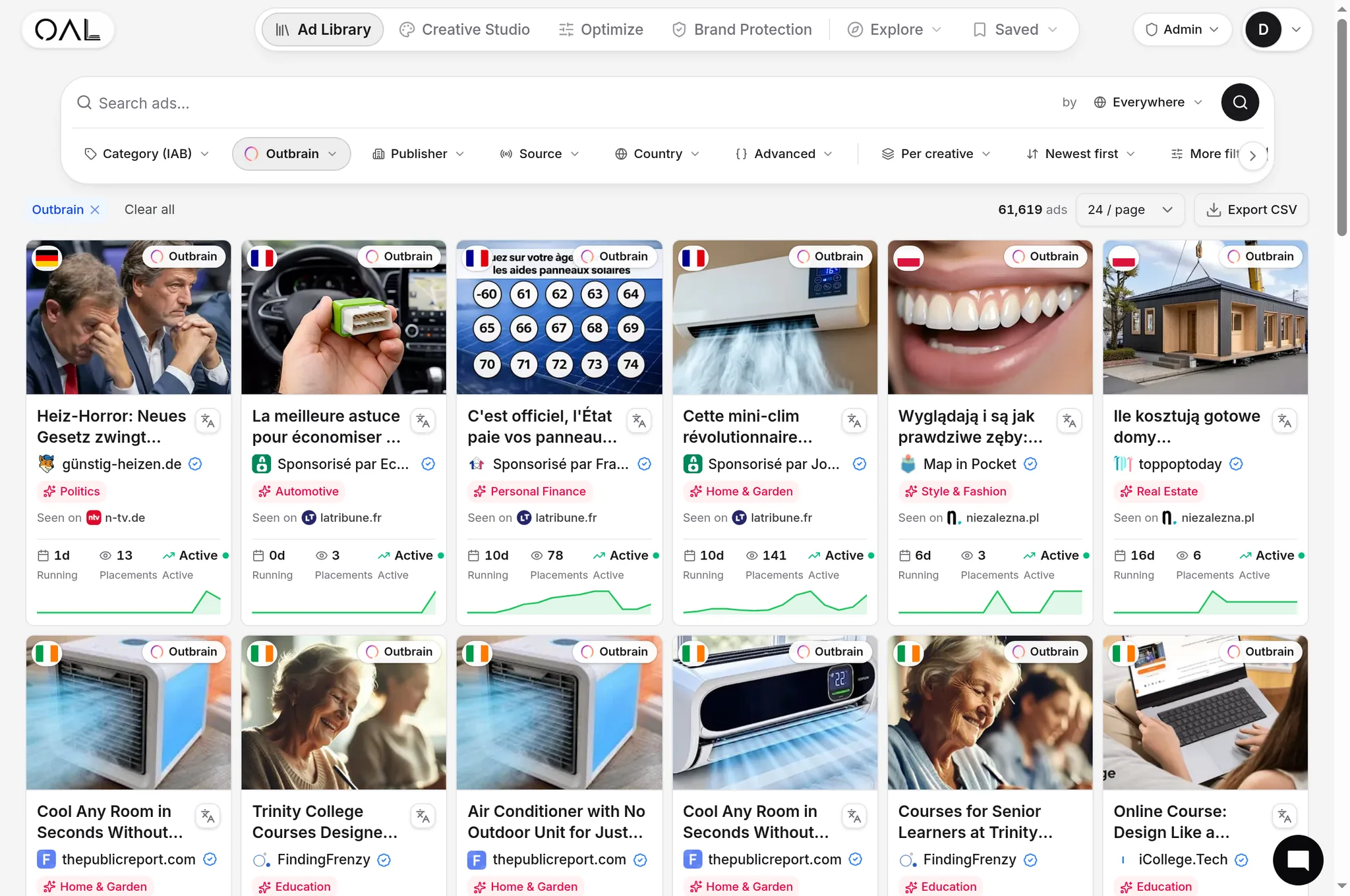
Because the same offer often runs across the whole discovery set at once, Yahoo native now sits in one competitive bucket with Outbrain (now part of Teads), MGID and Revcontent. If you are deciding where to spend, the pillar guide to native advertising with real examples lays out how to read that whole landscape.
2. Yahoo DSP buys native programmatically#
The Yahoo DSP is the buy-side platform Yahoo kept and bet on. It is a full omnichannel demand-side platform: native, display, video, connected TV, audio, DOOH and commerce in one seat. It gives advertisers access to Yahoo's premium native marketplace alongside open-exchange inventory.
This is programmatic native advertising in the strict sense. You are not uploading to one publisher's self-serve tool. You are bidding into a native ad auction with audience targeting, frequency caps, and DCO (dynamic creative optimization) that assembles title, description and image combinations on the fly. It fits brand and mid-funnel buyers who want native bundled with video and CTV more than it fits a solo affiliate hunting the cheapest clicks.
Here is the clean split:
| Taboola (Yahoo native) | Yahoo DSP | |
|---|---|---|
| What you buy | Recommendation widgets on Yahoo properties + Taboola's network | Programmatic native + display, video, CTV, audio, DOOH |
| Buying model | Self-serve / managed, CPC-led discovery | Omnichannel DSP, auction-based, audience-first |
| Best fit | Direct-response, affiliate, content marketers | Brand, mid-funnel, omnichannel media plans |
| Creative style | Native feed unit (title + thumbnail) | Native unit + DCO, plus other formats |
| Reach | Yahoo O&O + Taboola publishers | Yahoo premium marketplace + open exchange |
The MSN question, answered precisely#
Because Yahoo and Microsoft have shared search results and inventory for years, people routinely lump "MSN native" under "Yahoo." That is wrong, and the distinction matters for both buying and competitive research.
MSN is a Microsoft property. The bulk of MSN's native and display inventory is sold by the Microsoft Audience Network through Microsoft's in-house Monetize SSP, the same audience-ads system behind Outlook, Microsoft Edge and Microsoft's casual-games surfaces. That is a Microsoft Advertising product, not a Yahoo one.
You can see how active that network is in our own data. Of the ten longest-running native ads in the OpenAdLibrary index right now, seven are served by Microsoft Audience Network, each observed continuously for 28 days. Here is one of them, a hearing-aid ad that has been live for the full span of our window:

For context, 28 days is the current ceiling of continuous observation in our index, not the true lifespan of the ad. Industry lore loves to talk about "90-day winners," and those exist, but what we can prove is that this creative has run uninterrupted across every day we have watched it. That is a strong durability signal on its own. An ad an advertiser refuses to turn off is usually one that is paying for itself.
Where do Yahoo and Microsoft actually touch? Only at the exchange layer. A demand-side platform, including the Yahoo DSP, can bid on MSN impressions that Microsoft exposes on the open exchange. So a given native ad on MSN might be bought through Microsoft Audience Network, or won by a DSP bidding into open inventory. But "MSN native" as a sales channel belongs to Microsoft. If a vendor offers to "place your Yahoo ads on MSN," ask them to name the exact platform and supply path. The answer tells you whether they understand the stack or are guessing.
The cleaner mental model:
- Yahoo native = Taboola-powered widgets on Yahoo O&O, plus programmatic native via the Yahoo DSP.
- MSN native = Microsoft Audience Network / Monetize SSP, reachable in part by DSPs on the open exchange.
Formats, limits, and what a Yahoo native unit looks like#
Whichever path you take, the creative itself is recognizable. A standard Yahoo native unit is built from a small set of parts:
- Title: a short, punchy line, around 50 characters.
- Description: one or two sentences with a clear call to action, up to roughly 200 characters.
- Brand / advertiser name: shown alongside the unit.
- Thumbnail image: the recommended mobile creative is at least 200x200 pixels. High-quality, non-deceptive imagery wins.
Through the Yahoo DSP you can layer DCO on top, letting the platform test title, description and image permutations automatically. Through Taboola you get the full recommendation-widget treatment that blends into the article feed. Either way, the creative is the only real lever. In discovery native advertising, the thumbnail and headline do almost all the work, and a small image swap can move click-through more than any targeting tweak.
The winning formula is rarely subtle. Curiosity-gap headlines, "experts/doctors agree" framing, and a benefit you have to click to understand. Here is a health creative doing exactly that:

Health and insurance sit second and third in the overall index (14,895 and 15,629 creatives), right behind finance, and the headline patterns repeat across all three. Once you have looked at a few hundred of these, you can predict the structure before you read the words.
Targeting and measurement#
The Yahoo DSP's pitch rests on identity and first-party data from Yahoo's large logged-in audience across mail, finance, sports and news. You target by audience segments, demographics, contextual signals and behavioral data, with the frequency and pacing controls of a modern DSP. On the Taboola side, targeting leans on the predictive engine and contextual signals of the recommendation network, optimized toward conversions you report back via pixel or server-side events.
For measurement, both report clicks, conversions and spend, but the unit of analysis differs. On Taboola you optimize at the campaign, site and creative level, like any discovery buy. On the DSP you get cross-channel, audience-level reporting that ties native into the rest of the media plan. If you run native alongside Outbrain/Teads, the Teads platform explainer is worth reading to compare measurement philosophies across the discovery networks.
How to study live Yahoo and MSN native creatives#
Here is the part competitive intel rarely solves: native ads are personalized and ephemeral. The unit you see on Yahoo Finance is targeted to you, in your geo, on your device, at that moment. Refresh and it is gone. You cannot reverse-engineer a competitor's Yahoo or MSN native strategy by browsing manually. You would need to be thousands of people in dozens of countries at the same instant.
That is the gap OpenAdLibrary was built to close. It continuously captures live public native ads across Yahoo, MSN, Taboola, Outbrain, MGID, Revcontent, Teads and more, and it does the things a screenshot cannot:
- Captures the real creative image at full quality, not a blurry crop, so you can study the exact thumbnail and headline that is working.
- Labels the ad-tech supply chain behind each impression, which network and SSP actually served it, so the "is this Yahoo or Microsoft?" question answers itself.
- Follows the click to the landing page without touching the live ad, revealing the real advertiser and the funnel behind the unit.
- Surfaces longevity and spread signals, so a creative that has run for weeks across many placements (like that 28-day Hidden Hearing ad) flags itself as a winner worth modeling.
Here is one more, an insurance offer geo-targeted to Australia, the kind of localized buy you would never stumble onto from a single US desktop:

From there, tools like Copy DNA, Creative Studio and the Optimize workspace turn observation into action, and an API plus MCP endpoint let you pull the same data into your own stack. It is an open, affordable alternative to the $80 to $400/month incumbents: browse 200 ads free, no card required.
Start free and pull up live Yahoo and MSN native creatives to see who is actually buying that audience today.
The bottom line#
Yahoo native did not die with Gemini. It changed hands. Recommendation native on Yahoo's properties is Taboola's. Programmatic native is the Yahoo DSP's. MSN native is Microsoft's. Keep those three boundaries straight and the decisions get simple: pick the surface that matches your funnel, build the creative around the thumbnail and headline, and watch what live competitors are running before you commit a dollar."