 Español
 Português (Brasil)
 Français
 Deutsch
 Italiano
 Nederlands
 Polski
 Svenska
 Türkçe
 Русский
 日本語
日本語 한국어
한국어 简体中文
简体中文 Tiếng Việt
 Bahasa Indonesia
 繁體中文
繁體中文 Čeština
 Dansk
Dansk Norsk (bokmål)
 Suomi
Suomi Ελληνικά
 Română
 Magyar
 Українська
 ไทย
ไทย हिन्दी
 العربية
 עברית
עבריתHow to Advertise on Teads: Ad Manager Setup & Formats
Since the Outbrain merger, Teads is one buying point for outstream video, display and the native feed. Here is how access, formats, targeting, pricing and your first campaign actually work.

Advertising on Teads means buying through Teads Ad Manager — the platform's self-serve console — or through a managed insertion order with the sales team, and since the February 2025 Outbrain–Teads merger it gives you one buying point for outstream video, in-article display, native feed placements and CTV. The setup sequence: get platform access, pick a branding or performance objective, choose formats, build contextual and audience targeting, load creatives cut for sound-off feeds, and measure on viewability and attention rather than clicks alone. This guide walks through each step, plus what the live corpus says about who actually buys Teads and what they run.
Teads in 2026: one platform, two ad systems#
First, orientation, because the company you are buying from changed shape recently. Teads was the French adtech firm that invented outstream video — the player that spawns between paragraphs of an article, plays muted, and collapses when finished. Outbrain was one of the two big native content-recommendation networks. Outbrain acquired Teads and completed the deal in February 2025, and the combined company took the Teads name. We cover the corporate history in Did Outbrain become Teads? and the platform detail in What is Teads?.
For a buyer, the merger means one platform spanning two historically separate ad systems:
- The Teads side: premium-publisher outstream video and display, sold on viewable impressions and attention, direct relationships with large news publishers, brand-lift measurement. Branding DNA.
- The Outbrain side: the native recommendation feed — sponsored content slots on publisher pages — sold mostly on CPC with performance optimization. Direct-response DNA. How Outbrain works covers that engine in depth.
You can now buy both through one account, which is genuinely useful: brand video for reach, native feed for clicks and conversions, one reporting spine across them.
Getting access: Teads Ad Manager vs managed service#
There are two doors in:
- Teads Ad Manager (TAM). The self-serve console, aimed at agencies and in-house teams. You get campaign creation, targeting, creative management and reporting without a human in the loop. Access typically starts with a request on the official teads.com site followed by onboarding; it is not an instant credit-card signup like Google Ads.
- Managed service / insertion order. The sales-supported route: you brief the team, they build and run. This is where premium sponsorships, guaranteed placements and custom formats live. IO minimums are materially higher than self-serve — exact numbers vary by market and season, so get them from your Teads contact rather than a blog post.
Practitioner guidance: if you are an agency or a brand with an in-house trader, push for TAM access — the learning loop is faster and you keep the optimization levers. If you are testing the channel once for a brand campaign, managed service is less overhead. Either way, come to the first call with target geos, a budget bracket and a KPI (viewability, completion, traffic or conversions); the conversation goes better when you frame it in their vocabulary.
The formats you can buy#
| Format | What it is | Typical buying model | Best for |
|---|---|---|---|
| Outstream / inRead video | Video player inserted between article paragraphs, sound-off autoplay | Viewable or completed-view CPM | Reach, brand awareness |
| In-article display | Image/rich display units in the same premium article slots | Viewable CPM | Mid-funnel, consideration |
| Native feed | Sponsored content recommendations (the Outbrain engine) | CPC | Traffic, direct response |
| CTV / online video extensions | Video across connected-TV and premium video supply | CPM | Incremental reach |
The outstream video glossary entry explains why the inRead unit mattered historically: it unlocked video inventory on publishers that had no video content, which is why Teads' supply skews toward quality text journalism — and why your ad appears in genuinely premium editorial context rather than in a content-farm widget.
Two format-strategy notes from buyers who run both sides of the platform:
- Do not buy outstream video and judge it on last-click conversions. Muted, skippable in-article video is a reach product. It moves searches, direct traffic and brand queries; it rarely wins a last-click report against feed placements.
- The native feed side behaves like classic Outbrain. Everything you know about native CPC buying — headline testing, pre-lander funnels, placement pruning — applies unchanged there.
Your first campaign in Teads Ad Manager, step by step#
Once you have TAM access, the build follows a conventional sequence. The interface details shift with releases, but the decision order does not:
- Objective. Awareness, consideration or performance-oriented paths — the choice gates which optimization goals and formats the platform offers you, so pick for the KPI you actually report on, not the one that sounds ambitious.
- Flight and budget. Set start/end dates and total or daily budget. Give brand flights at least two to four weeks; attention effects need time to read. Front-loading a seven-day "test" is how outstream video gets unfairly killed.
- Supply and brand-safety settings. Choose market/publisher tiers and category exclusions. The default premium supply is the point of the platform — resist the urge to chase cheaper reach here; that is what the native feed side is for.
- Targeting. Contextual categories first, then geo, device and any demographic or audience layers (next section). Start with fewer layers than you think you need.
- Creative upload. Video cuts and companion display/native assets, with click-through URLs carrying your tracking parameters.
- Measurement hookup. Pixel for site actions if there is any performance component; brand-lift or attention measurement arranged before launch on bigger flights — neither can be bolted on retroactively.
- Review pacing daily for the first week, then manage weekly. Outstream campaigns rarely need daily intervention the way native CPC campaigns do.
If you brief a managed-service team instead, walk through the same seven decisions in the brief — you will get a materially better proposal than teams who send only a budget and a logo.
Targeting: contextual-first, audience-capable#
Teads built its targeting stack for a cookieless premium-web world, which shows in what works best:
- Contextual targeting is the platform's home turf: category, keyword and semantic targeting against the article your ad sits inside. It needs no user IDs and pairs naturally with premium editorial supply — see the contextual targeting glossary entry for the general mechanics. If your product maps cleanly to content categories (travel offers inside travel journalism, B2B software inside business coverage), start here.
- Audience and demographic targeting — interest segments, age/gender modeling, and advertiser data where available — layers on top for buyers who need people-based reach.
- Geo and device controls work as you would expect: country and finer-grained market targeting, desktop/mobile/tablet splits, plus CTV where bought.
- Brand safety and viewability are effectively native to the buy: premium publisher supply, pre-bid category filters, and buying models denominated in viewable impressions. The viewability glossary entry covers the measurement standard if you need it.
The honest trade-off versus a social platform: you lose person-level interest micro-targeting; you gain editorial context and inventory quality. Campaigns that accept that trade — contextual relevance over hyper-targeting — are the ones that renew.
Pricing and budgets#
Teads-side inventory (video, display) is sold on CPM-family models — impression, viewable-impression and completed-view variants — while the Outbrain-side native feed is predominantly CPC. The CPM glossary entry covers the math. There are no public rate cards; pricing moves with format, geo, seasonality and the publisher tier you insist on. Qualitatively: premium outstream video CPMs sit well above native-feed effective CPMs — that is the price of guaranteed editorial context and viewability — while media buyers commonly report native-feed CPCs on the merged platform in the same broad range as classic Outbrain buying, from tens of cents in tier-1 geos with wide variance by vertical. Treat both statements as heuristics, not quotes, and price your test through the platform itself.
Budget structure advice: split the test budget by objective, not evenly by format. If the KPI is awareness, put the weight into inRead video with a viewability/completion goal and a two-to-four-week flight. If the KPI is conversions, weight the native feed and treat video as a support layer. Running one blended budget across both produces a report nobody can act on.
Creative: what to build#
For the video side:
- Cut for sound-off. Outstream autoplays muted. Supers, captions or visual storytelling carry the message; audio is a bonus layer.
- Front-load the brand. The unit is skippable/collapsible and often viewed partially — logo and product in the first seconds, not a cinematic slow reveal.
- Bring 6–15 second cuts alongside any 30-second hero asset. Shorter cuts routinely win completion metrics in-feed. Exact accepted specs and file requirements: check Teads' current documentation.
For the native feed side, standard native creative discipline applies — editorial-style images, curiosity-with-substance headlines, angle variety. Our winning native ad creative analysis is the deeper playbook.
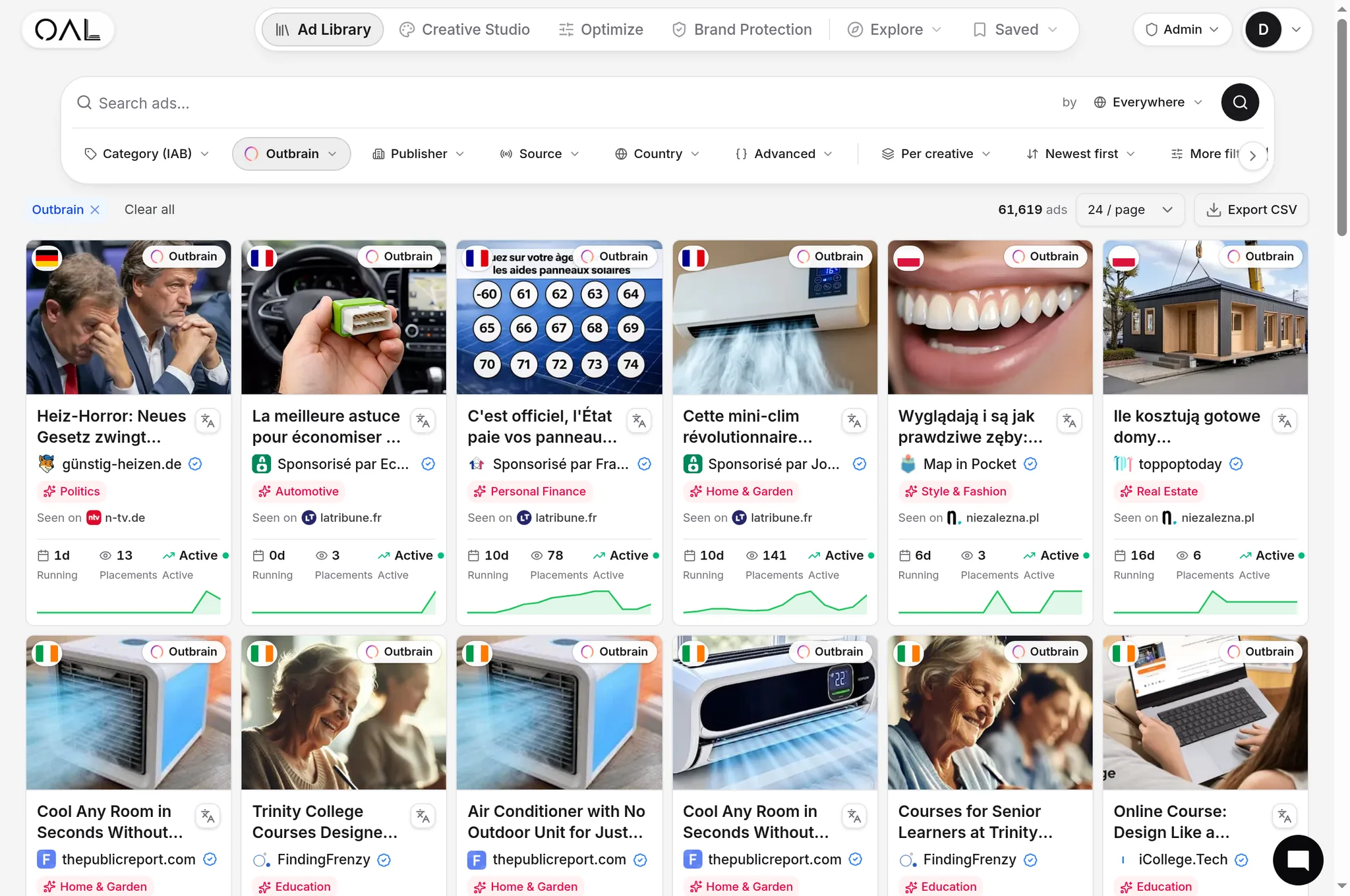
What does the live corpus show? OpenAdLibrary's index of 725,882 live creatives across 49 networks (July 2026) holds 113 creatives attributed to Teads placements — small against Outbrain's 108,573, exactly what you would expect given Teads' video-first inventory (our capture indexes image-creative units, not video players). The image units we do capture skew heavily brand: travel leads with 22 live creatives, then ecommerce (9), finance and education (4 each). The advertiser names tell the story — Flight Centre running package-holiday creatives, Georgetown University recruiting for graduate programs, home brands buying consideration. This Moon Valley Nursery unit had been live for 17 days at capture:

Universities, national travel agencies, home-services brands — that is a branding-buyer profile, not an affiliate profile, and it should calibrate your expectations about who you are bidding against.
Measurement: judge the buy on what it sells#
Teads sells attention, so measure attention — then connect it to business outcomes:
- Delivery-layer metrics: viewability rate, video completion rate, attention metrics where offered. These validate you got what the CPM promised.
- Mid-layer: brand-lift studies on larger flights; branded-search and direct-traffic movement during the flight window for smaller ones.
- Performance-layer: for native-feed buys, standard conversion tracking with the platform pixel plus your analytics — the same discipline as any native CPC channel, including post-click quality checks (bounce, depth, conversion rate by placement).
The classic failure mode is measuring an outstream video flight like a performance campaign in week one, declaring it dead, and never seeing the branded-search lift that lands in week three. Decide the success metric before the flight starts, and hold to it. A simple discipline that works: write down, pre-launch, the three numbers that would make you renew — say, a completion-rate floor, a branded-search delta over the flight window, and a blended CPA ceiling across video plus feed — and review only those three at wrap. It keeps the post-mortem honest on both sides: the channel does not get credit for vanity impressions, and it does not get executed for missing a KPI it was never bought to hit.
Who Teads is right for (and who it isn't)#
A fair filter, before you spend setup effort:
- Good fit: brands and agencies with a real awareness or consideration KPI; advertisers whose customers read mainstream journalism (finance, travel, education, auto, B2B); performance advertisers who want the Outbrain feed with consolidated access; anyone whose brand team requires premium editorial adjacency.
- Poor fit: pure arbitrage and aggressive affiliate funnels (the premium supply and policy posture work against you — mid-tier native networks fit that model better); tiny test budgets that cannot fund a readable flight; teams with no measurement beyond last-click.
The corpus supports this: the advertiser mix we observe on Teads placements is national brands and institutions, not the sweepstakes-and-nutra profile you see on downstream native networks. You will be judged in that company — creative quality included.
Research the platform before you brief it#
Before you commit a test budget, look at what is already running. Browse live Outbrain-side creatives in the Outbrain ad library and track the merged platform's feed inventory through the Teads spy tool — advertiser mix, creative angles, and how long specific campaigns have stayed live, which is the closest public signal to "this is working." If you are choosing between the merged platform and its main rival, Taboola vs Outbrain lays out the comparison with live numbers, and the Outbrain spy tool covers the feed side by advertiser and geo.
Launch checklist#
- Access secured — TAM for hands-on teams, managed IO for one-off brand flights.
- Objective declared first (reach vs conversions); formats weighted to match.
- Contextual categories mapped to your product before interest layers are added.
- Geo and device splits mirror where your customers actually are.
- Video cut for sound-off, brand in the first seconds, short variants included.
- Native-feed creatives follow standard native discipline: editorial images, tested headlines.
- Success metric fixed before launch: viewability/completion/lift for video, CPA for feed.
- Conversion tracking live and test-fired for any performance component.
- Flight long enough to read (brand effects lag); no verdicts in week one.
- Competitor creatives and longevity checked in the live index before the brief is final.