Español
 Português (Brasil)
 Français
 Deutsch
 Italiano
 Nederlands
 Polski
 Svenska
 Türkçe
 Русский
 日本語
日本語 한국어
한국어 简体中文
简体中文 Tiếng Việt
 Bahasa Indonesia
 繁體中文
繁體中文 Čeština
 Dansk
Dansk Norsk (bokmål)
 Suomi
Suomi Ελληνικά
 Română
 Magyar
 Українська
 ไทย
ไทย हिन्दी
 العربية
 עברית
עבריתTaboola Campaign Optimization: What 30-Day Advertisers Do Differently
The five levers that actually move Taboola performance — structure, creative rotation, site pruning, bidding and conversion feedback — benchmarked against what 30-day advertisers visibly do.

Taboola campaign optimization comes down to five levers: campaign structure that isolates one variable at a time, creative rotation that outruns fatigue, site-level blocks and bid adjustments, a bid strategy matched to your conversion volume, and clean conversion feedback so the algorithm learns from events that matter. Everything else — dayparting tweaks, obscure console settings — is a rounding error until those five are handled. This playbook works through each lever in order of impact, and benchmarks the advice against observable behavior: what advertisers whose ads stay live for 30+ days actually do, drawn from OpenAdLibrary's index of 206,000+ live Taboola creatives (July 2026).
Longevity is the ground truth of Taboola optimization#
You cannot see a competitor's dashboard. You can see how long their ads keep running — and on a self-serve auction network where every click is billed, nobody keeps paying for a losing ad for a month. That makes ad longevity the closest thing to public ROI data that exists for Taboola, and it is the yardstick this guide optimizes toward: an ad that earns its budget for 30 days and beyond.
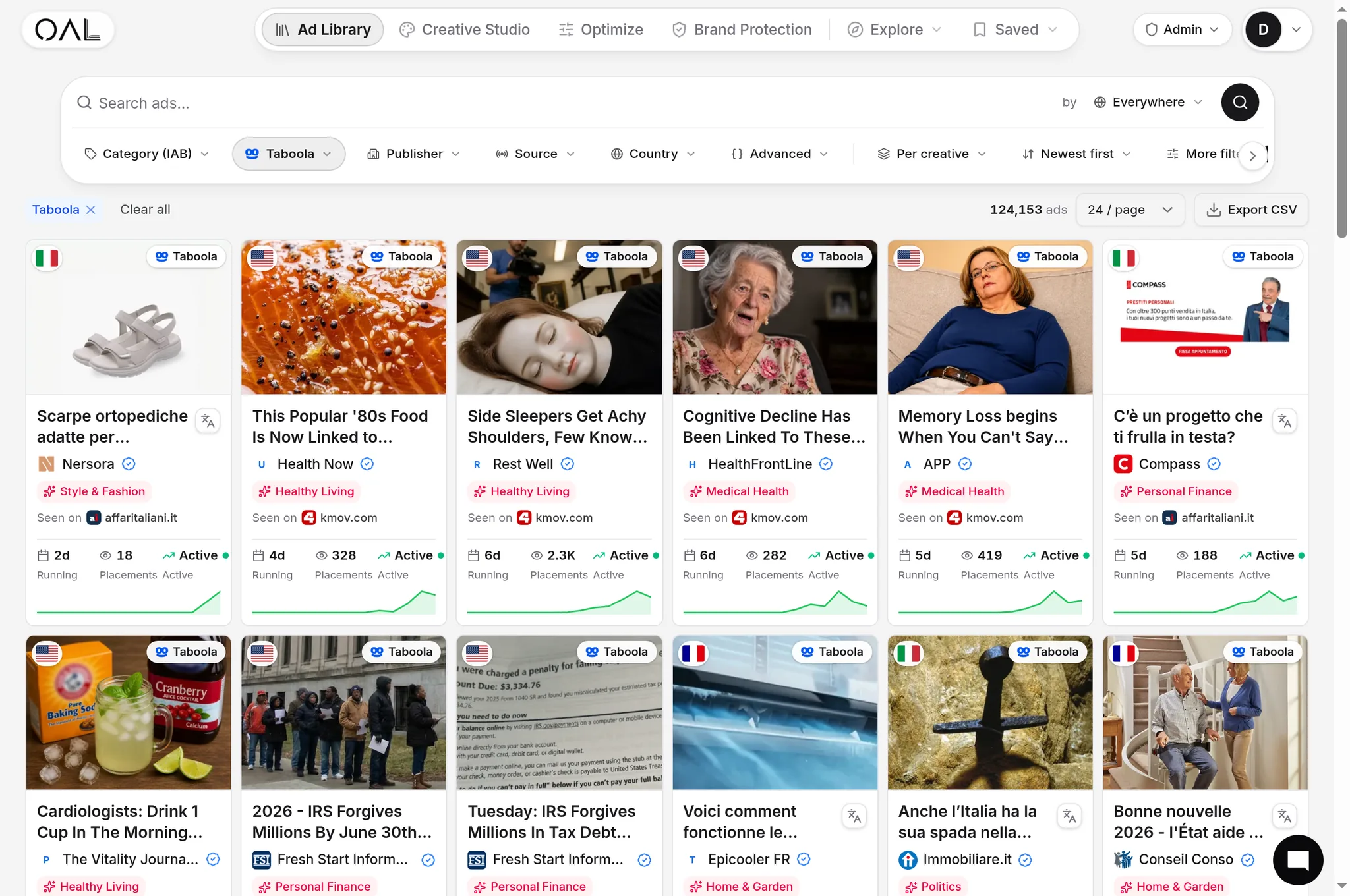
The index makes that yardstick concrete. Among live Taboola creatives right now: a hearing-device ad from Audika at 37 days running ("Struggling to Hear Clearly? Discover a Device Transforming Lives"), a home-and-garden curiosity ad at 37 days ("My garden had no butterflies for years — then I hung one of these up"), and a Halogrow hair-regrowth advertorial at 31 days ("The Surprising Household Item People Are Using for Hair Regrowth"). None of those survived by accident. They are the visible output of the loop described below, run week after week.
Structure campaigns to isolate one variable#
Taboola reports performance at the campaign, creative and site level. If a single campaign mixes desktop and mobile traffic, five geos and two funnels, every one of those reports is an average of unlike things, and no optimization decision made from it is safe. The structure long-term buyers converge on:
- One platform per campaign. Desktop, smartphone and tablet behave like different networks — different CPCs, different CTRs, different conversion rates. Split them on day one, not after the blended campaign disappoints.
- One geo tier per campaign. Cheap Tier-2 clicks will quietly eat the budget of a mixed campaign before your Tier-1 test collects data. Group geos only within the same pricing tier and language, and break out any single geo that starts dominating spend.
- One funnel per campaign. A direct-to-offer page and an advertorial pre-lander have different unit economics, and mixing them hides which one is working. If you are still choosing between the two, the native landing page funnel guide covers the tradeoffs.
If the account itself is new — pixel, conversion definitions, tracking parameters — run through the Taboola campaign setup walkthrough first. Everything below assumes that plumbing exists and fires reliably.
Creative rotation: the lever that moves your CPC#
Taboola's auction prices on expected yield per impression, so a higher CTR does not just buy more clicks — it lets you win the same placements at lower CPCs. Creative is therefore the highest-leverage variable you control directly:
- Launch with volume. Five to ten variants per campaign is the common practice: two or three distinct angles, each in two or three headline-and-image executions. If you need headline raw material, the patterns that recur across winning native ads are catalogued in 12 native headline formulas that get clicks.
- Cut early, on the right metric. Pause clear losers once each variant has a meaningful click sample — but judge the survivors on downstream conversion, not CTR alone. Native advertising is full of headlines that win clicks and lose money.
- Refresh before fatigue bites. Creative fatigue on native feeds shows up as a steady CTR decline at constant bids. The fix long-running advertisers use is refreshing the execution while keeping the proven angle. The Tri-Lift "Wrinkles: Most People Use Lotions. Koreans Do This Instead" creative in our index is a textbook case: the same angle appears recut with fresh imagery and phrasing on more than one network simultaneously.
Site-level optimization: blocks, adjustments, and the road to a whitelist#
Taboola inventory spans thousands of publisher placements, and per-site performance is brutally uneven: a handful of sites will drive most of your conversions while a long tail burns budget. The weekly loop that handles it:
- Pull the per-site report once meaningful spend has accumulated — not on day two.
- Block the bleeders. A common heuristic among media buyers: a site that has spent two to three times your target CPA with zero conversions gets blocked. Resist blocking on tiny samples; early over-blocking throttles discovery and can collapse delivery entirely.
- Bid-adjust the middle. Sites that convert but at bad math get a downward adjustment before they get cut. Sites converting comfortably under target earn a positive one.
- Graduate the winners. Proven sites eventually move into dedicated whitelist campaigns with their own bids and budgets — the end-state of site-level optimization. The mechanics and vocabulary are in the whitelist/blacklist glossary entry.
Bidding: manual CPC first, Smart Bid when conversions flow#
Start on manual CPC. For the opening bid, anchor to your vertical's range — our native CPC benchmarks map the network-level picture — and treat any specific number as a bracket, not gospel: media buyers commonly report Tier-1 desktop Taboola CPCs from roughly $0.20 to $0.90, with mobile lower, and your niche and geo will move this a lot.
Smart Bid, Taboola's automated bidding, is genuinely useful — once it has data. Hand it a campaign with thin conversion volume and it wanders. The pattern that works in practice: stay manual while you prune sites and creatives, switch a campaign to Smart Bid once it converts consistently (double-digit weekly conversions is a common comfort threshold), and expect a learning wobble before judging the result.
Bid moves themselves should be small and patient: nudges of 10–15% with a few days between them. Halving or doubling a bid resets delivery in ways that destroy your read on everything else.
Feed the algorithm real conversions#
Optimization quality is capped by feedback quality. Three rules keep the signal clean:
- Optimize to an event with volume. If purchases are rare, point the campaign at a qualified upstream event — a lead, a booked call, an add-to-cart — and hold the purchase math offline. An algorithm fed three conversions a week learns nothing.
- One primary conversion per campaign. Multiple simultaneously optimized events blur the signal and make Smart Bid's behavior impossible to interpret.
- Instrument the middle of the funnel. Ad CTR tells you the hook works; pre-lander clickthrough tells you the story holds. When a campaign converts poorly, that split tells you whether to fix the creative or the funnel — two very different jobs.
What 30-day advertisers do differently#
Scan the long-running Taboola advertisers across the index and the same behaviors repeat:
| Pattern | What it looks like live |
|---|---|
| One angle, many executions | The same proven claim recut across images, headlines and even networks for weeks |
| Geo-matched creative | An Australian cleaning-tips ad written unmistakably for its local audience, live 23 days |
| Advertorial funnels | Listicle and story-style pre-landers rather than direct offer pages, especially in health and beauty |
| Constant refresh | New crops and phrasings appearing under the same advertiser, week after week |
| Boring consistency | The 30-day survivors rarely run the flashiest creative — they run the most systematic iteration |
This is also the cheapest optimization research available. Filter Taboola creatives to 30+ days running in OpenAdLibrary's Taboola spy tool and you are looking at a curriculum of proven angles, funnels and structures for your vertical — the full research workflow is in the Taboola ad spy guide.
A weekly cadence that holds it together#
Week one of any campaign: check daily, act slowly. Block only egregious site bleeders, pause only obvious creative losers, leave bids alone.
From week two onward:
- Monday: per-site report → blocks and bid adjustments.
- Midweek: creative review → pause fatigued variants, queue two or three fresh executions of the winning angle.
- Friday: bid nudges based on margin, 10–15% maximum.
- Monthly: a competitive sweep — which new angles entered your vertical, whose funnels changed, and whose ads just crossed the 30-day line.
Taboola optimization is not a bag of tricks. It is this loop, run without skipping weeks. The advertisers whose ads you keep seeing for a month straight are simply the ones who never stopped running it.