Español
 Português (Brasil)
 Français
 Deutsch
 Italiano
 Nederlands
 Polski
 Svenska
 Türkçe
 Русский
 日本語
日本語 한국어
한국어 简体中文
简体中文 Tiếng Việt
 Bahasa Indonesia
 繁體中文
繁體中文 Čeština
 Dansk
Dansk Norsk (bokmål)
 Suomi
Suomi Ελληνικά
 Română
 Magyar
 Українська
 ไทย
ไทย हिन्दी
 العربية
 עברית
עבריתMGID Review 2026: What 62,000+ Live MGID Ads Reveal
MGID is the definitive mid-tier native network: cheap, global and tolerant — with traffic quality that demands active management. We grade it against the 62,765 live MGID creatives in our index.


MGID is a legitimate, long-established native ad network — one of the oldest still operating — and in 2026 it remains the definitive mid-tier choice: low minimums, enormous global reach, tolerant creative policies, and traffic quality that varies enough to demand active management. OpenAdLibrary's index holds 62,765 live MGID creatives (July 2026), and what they show shapes this review's verdict: MGID is a strong network for affiliates and lead-gen buyers who whitelist aggressively and refresh creatives constantly, a workable one for value-priced ecommerce, and a poor match for premium brands that need pristine adjacency.
What MGID is#
MGID has been selling native placements since 2008, which makes it a genuine veteran in a category where networks come and go. It operates content-recommendation widgets and in-feed units across a very long tail of publishers worldwide, with particular depth outside the English-speaking Tier-1 markets. Accounts run self-serve or managed, entry costs are low, and the buying model is a straightforward CPC auction where creative click-through rate effectively discounts your bid. The mechanics — formats, targeting, campaign setup — are covered in How MGID works; this review is about whether the network deserves your budget.
Scale context matters for expectations. In our same-methodology index, Taboola's live corpus is 206,145 creatives and Outbrain's 108,573, against MGID's 62,765. MGID is big — but its supply skews different: less premium English-language editorial, more global long-tail, which is precisely why its clicks cost less.
A word on method: this review is graded against observable output — the ads advertisers actually run and keep running on the network — rather than feature checklists or affiliate-forum sentiment. Live creative volume, vertical mix, advertiser behavior and creative longevity are all measurable from continuous capture, and they tell you more about a network's economics than any feature tour can.
What 62,765 live MGID ads reveal#
The classified portion of the live MGID corpus breaks down like this (July 2026):
| Vertical | Live classified creatives |
|---|---|
| Entertainment | 13,987 |
| Health | 1,220 |
| Insurance | 663 |
| Real estate | 309 |
| Ecommerce | 265 |
| Food & beverage | 219 |
Three observations follow from the data:
Entertainment-style content dominates the feed. Nearly 14,000 classified creatives — more than the next five verticals combined — are entertainment-flavored teasers: story content, curiosity galleries, arbitrage-adjacent material. That's the adjacency your ad will live in on many placements. It doesn't stop direct-response offers from converting, but premium brand managers should understand what the neighborhood looks like before moving in.
The advertiser base is direct-response to its bones. The live corpus shows the same advertisers running multiple teaser variants simultaneously — a collectibles seller testing near-duplicate coin headlines, a B2B ad-tech shop running three distinct pain-point angles at once. You can also watch advertisers replicate a proven angle across networks: one skincare brand runs its "Koreans do this instead" creative on both Taboola and MGID in near-identical form. This is a network where serious buyers test in public.
The footprint is genuinely global. Live captures include ads in Greek and other non-English languages — MGID's Tier-2/Tier-3 depth is real, and it's the main reason buyers scaling proven offers into new geos put the network on their shortlist.
One more note on reading that vertical table honestly: classification covers the portion of the corpus our models can label confidently, so the absolute numbers understate each vertical — but the proportions are the story. A feed where entertainment-style teasers outnumber health, insurance, real estate, ecommerce and food combined behaves differently from Outbrain's insurance-and-finance-led mix, both in what users expect to see and in what the review team is calibrated to allow.
Where MGID is strong#
- Entry cost. Minimum deposits commonly cited around $100 and low daily budgets make MGID one of the cheapest native networks to test — full cost mechanics are framed qualitatively in How much do native ads cost?.
- Global reach. Depth in Eastern Europe, LATAM, SEA and other Tier-2/3 markets that premium networks serve thinly.
- Creative tolerance. Advertorial-style angles that stall in Outbrain's review queue generally run here, within MGID's published policies. For affiliates in nutra and adjacent verticals, that flexibility is the point.
- Account management at modest spend. Reps are accessible earlier than on premium networks, useful for policy questions and placement guidance.
- CTR-priced auction. Strong teasers are directly rewarded with cheaper traffic, so a good creative team is a structural cost advantage.
Where MGID demands caution#
- Placement variance. Run-of-network buys include weak placements — misclick-prone layouts, low-intent audiences. The fix is procedural, not optional: track at placement level, prune every few days, converge on a whitelist. Buyers who skip this step write the negative reviews.
- Adjacency. As the vertical data shows, entertainment-style teasers dominate many feeds. Know your brand's tolerance.
- Fraud-adjacent fringes. Every open native network carries some junk traffic at the edges; ad fraud in native advertising covers the patterns to watch. Postback-verified conversion tracking is your defense — never optimize on clicks alone.
- Compliance swings. Policy enforcement tightens and loosens over time. What ran last quarter may bounce this quarter; keep an eye on the network's current guidelines rather than folklore.
- Reporting depth. The analytics are serviceable rather than luxurious. Serious buyers run their own tracker as the source of truth and treat the MGID dashboard as a bidding console, not a measurement system.
A useful way to frame all four cautions: MGID externalizes quality control to the buyer. Premium networks charge more partly because they do this filtering for you; MGID charges less and hands you the placement report. Whether that trade is good depends entirely on whether you'll actually work the report.
Who MGID is for — and who it isn't#
Good fit:
- Affiliates and lead-gen buyers with tracker discipline and creative volume
- Buyers scaling proven offers into Tier-2/3 geos where premium networks are thin
- Value-priced ecommerce and impulse offers that thrive on cheap, broad reach
Poor fit:
- Premium DTC and brand advertisers who need clean editorial adjacency
- Compliance-heavy categories that require conservative, stable review standards
- Anyone unwilling to do placement-level pruning — MGID without a whitelist routine is a slow leak
For the wider landscape and where MGID sits in it, see the best native ad networks ranked by real ad volume; for head-to-head comparisons, MGID vs Taboola and MGID vs Revcontent.
Do this before you deposit#
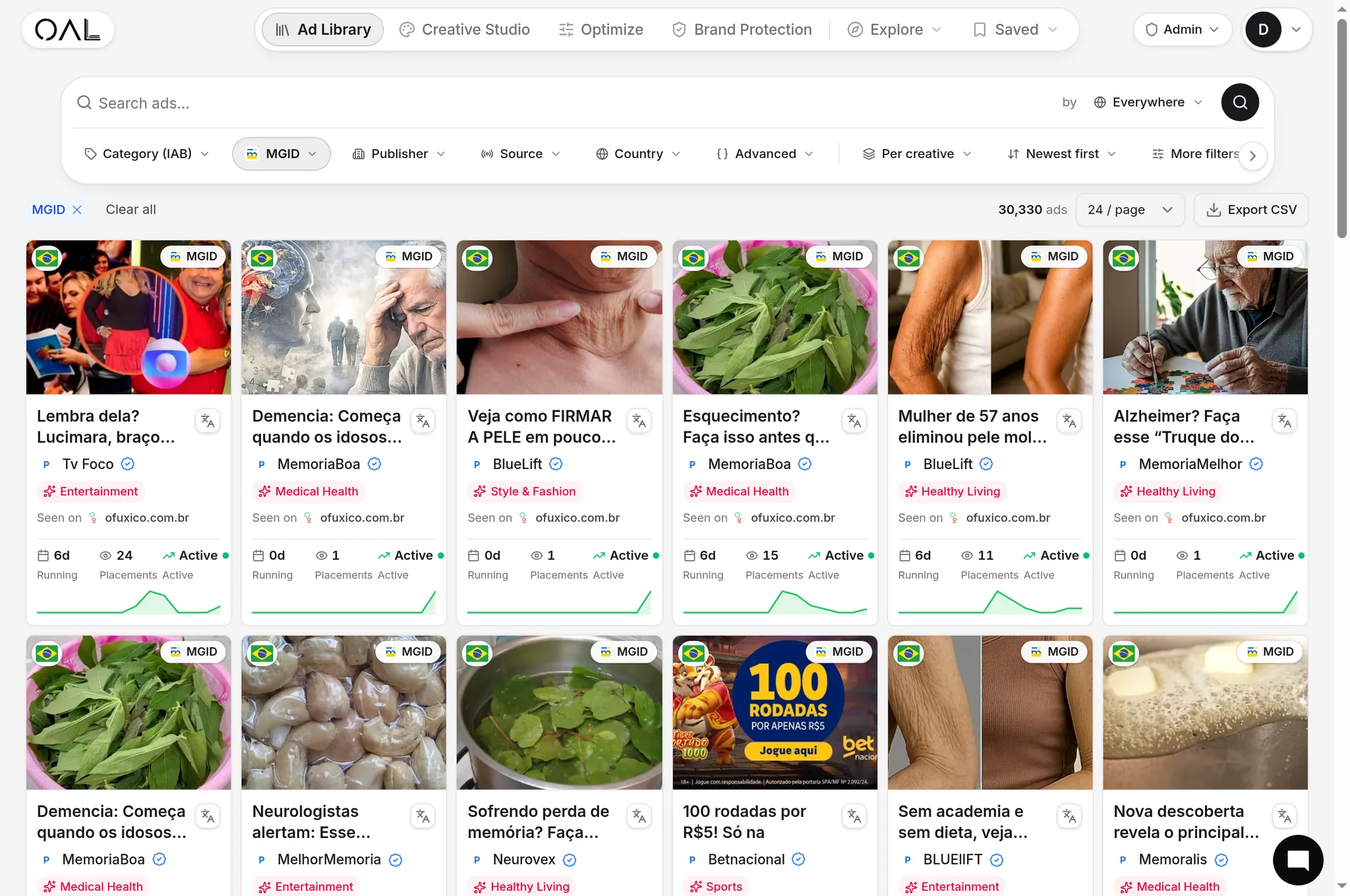
MGID's low entry cost tempts buyers to "just test it" — but the network's live output is public, and studying it first is free. OpenAdLibrary's MGID ad library holds every live MGID creative we capture, searchable by advertiser, vertical and geo, with observed run times and traced landing pages; /spy/mgid is the working tool. Filter your vertical for creatives that have run 30+ days — those are the network's proven winners — and walk their funnels before building yours. The MGID & Revcontent ad spy guide lays out the full workflow.
Verdict: is MGID worth it in 2026?#
| Criterion | Assessment |
|---|---|
| Scale | 62,765 live creatives in our index — solidly mid-tier, globally spread |
| Cost | Among the cheapest native networks; CPC auction rewards strong teasers |
| Traffic quality | Variable; whitelist discipline is mandatory, not optional |
| Creative policy | Tolerant relative to premium networks; enforcement fluctuates |
| Best for | Affiliates, lead gen, Tier-2/3 scaling, value ecommerce |
| Skip if | You need premium adjacency or hands-off campaign management |
MGID earns its place in the mid-tier: real scale, real geographic depth, and clicks cheap enough to make marginal offers viable. The network hands you the levers — placement data, geo granularity, a CTR-rewarding auction — and assumes you'll pull them. Buyers who work those levers commonly do well here. Buyers who fund an account, upload two teasers and wait are the ones who conclude MGID "doesn't work" — usually right before a competitor with a pruning routine scales the same offer profitably.