Español
 Português (Brasil)
 Français
 Deutsch
 Italiano
 Nederlands
 Polski
 Svenska
 Türkçe
 Русский
 日本語
日本語 한국어
한국어 简体中文
简体中文 Tiếng Việt
 Bahasa Indonesia
 繁體中文
繁體中文 Čeština
 Dansk
Dansk Suomi
Suomi Ελληνικά
 Română
 Magyar
 Українська
 ไทย
ไทย हिन्दी
 العربية
 עברית
עבריתThe Best-Performing Verticals on Taboola (Live Ad Data)
Health, finance and insurance carry Taboola's demand — the live creative counts prove it. The full ranking, what actually runs in each vertical, and how to pick your lane.


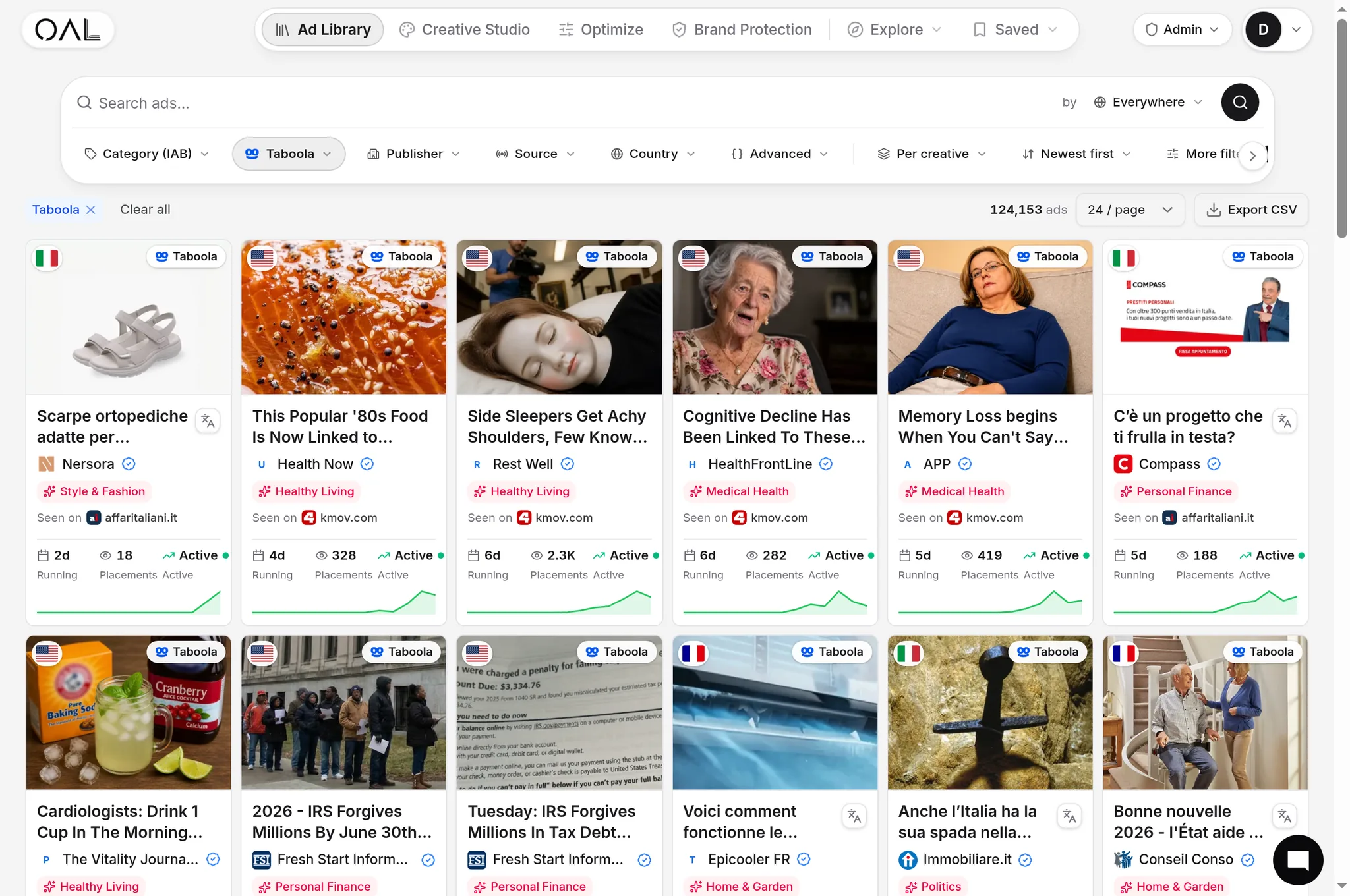
The best-performing verticals on Taboola, measured by live ad volume, are health, finance and insurance — in that order. In OpenAdLibrary's index of 206,000+ live Taboola creatives (July 2026), health leads the classified set with roughly 12,000 live creatives, followed by finance (8,200), insurance (7,400), ecommerce (5,200), home & garden (4,400) and software (~3,700). Creative volume is a survivorship signal: sustained ad counts mean advertisers keep funding those campaigns week after week, which is the closest thing to a public profitability measure the native ecosystem has.
What "best-performing" actually means here#
No network publishes vertical-level ROAS, and any article quoting precise conversion benchmarks for "the health vertical" is guessing. What can be measured honestly is what is running right now, at what scale, and for how long — because native advertisers are overwhelmingly performance buyers who kill losing campaigns within days. When a vertical holds thousands of live creatives month after month, that spend is voting with its wallet.
Two caveats so you read the numbers correctly. First, these counts come from the classified portion of the Taboola corpus — vertical classification covers a subset of all captured creatives, so treat figures as relative shares, not censuses. Second, volume measures where money flows, which also means where competition concentrates. "Best-performing" and "easiest to enter" are opposites here.
The ranking: Taboola's top verticals by live creatives#
| Rank | Vertical | Live Taboola creatives (July 2026) |
|---|---|---|
| 1 | Health | 11,982 |
| 2 | Finance | 8,200 |
| 3 | Insurance | 7,422 |
| 4 | Ecommerce | 5,185 |
| 5 | Home & garden | 4,414 |
| 6 | Software | 3,665 |
Health, finance and insurance together carry more classified creatives than the next three verticals combined. That trio is the spine of Taboola's demand — and it maps cleanly onto the network's audience: mainstream news and portal readers skewing older and desktop-heavy, exactly the demographic that buys hearing aids, compares insurance quotes and worries about retirement.
Vertical by vertical: what's actually running#
Health: the volume king#
Hearing solutions, joint and pain relief, skin and anti-aging, supplements. The creative formula is problem-agitation with a curiosity gap, and the winners run for weeks: a hearing-device ad from Audika ("Struggling to Hear Clearly? Discover a Device Transforming Lives") had been live for 37 days at capture — on a network where losers die in days, that is a loud signal. Health on native is also the vertical with the sharpest compliance edge; if you play here, read the nutra compliance realities first and keep the FTC's health-claims guidance within reach.
Finance: retirement money meets curiosity headlines#
Retirement planning, annuities, benefit-eligibility angles and alternative-living cost plays (a "Granny Pods in 2026: Options That May Surprise You" creative from Visionary Echo is a representative live example). Finance advertisers on Taboola range from major asset managers to lead-gen arbitrageurs, and the vertical's economics — high customer lifetime values — support the CPCs that mainstream news placements command. See live finance native ad examples for teardowns.
Insurance: the quiet giant#
Quote-comparison funnels for auto, life and health cover. Insurance is arguably native's most industrialized vertical: a small number of comparison brands run enormous creative libraries, testing headline variants at scale. Payouts per lead are high enough to absorb premium placement costs, which is why insurance sits top-three on nearly every native network, not just Taboola.
Ecommerce: problem-solution products#
Gadgets, apparel and home products with a demonstrable "aha" — posture bras, cleaning tools, garden gear. Native ecommerce works when the product carries a story; catalog retargeting does not belong here. A Butterfly Lovers garden creative ("My garden had no butterflies for years — then I hung one of these up") logged 37 days live — narrative product marketing at its purest, and a pattern covered in depth in the native ads for ecommerce guide.
Home & garden and software: the mid-table#
Home & garden rides seasonal cycles (gutter guards, landscaping, energy retrofits) and pairs naturally with an older homeowner audience. Software skews toward consumer utilities, antivirus and mobile apps. Both are meaningfully less crowded than the top trio while still holding thousands of live creatives — a reasonable compromise between validation and saturation.
The adjacent category worth naming: beauty#
Beauty does not crack the top six as a classified vertical, but it behaves like health's younger sibling in the live data — skincare and hair creatives running the same "common product is wrong, do this instead" formula. Current examples from the index: a Tri-Lift creative ("Wrinkles: Most People Use Lotions. Koreans Do This Instead") at 12 days live, a Halogrow hair-regrowth angle at 31 days, and a negative-framing listicle ("Top 5 Shampoos To Avoid") at 21 days. If you run beauty offers, study health's creative patterns — they transfer almost one to one.
How Taboola's mix compares to the wider native market#
Across OpenAdLibrary's full index — 725,000+ creatives spanning 49 networks — the overall top verticals are health (24,500 classified creatives), finance (24,100) and insurance (22,400). Taboola's mix mirrors the market's spine, but the contrast with other networks is instructive: MGID's classified corpus is dominated by entertainment content (14,000 creatives), reflecting its different publisher base and geo mix. The network you pick shapes the vertical mix you compete inside; the 2026 vertical-by-the-numbers study breaks this out across networks, and MGID vs Taboola covers that specific trade-off.
Two more contrasts worth having in your head. Outbrain's classified mix runs insurance-first (insurance ~4,300 live creatives, then finance ~4,000, health ~3,100) — same money trio, different ordering, consistent with its more editorial publisher base. Revcontent's smaller corpus is proportionally the most health-heavy of the majors, with nutra as a named top-six vertical — a category that barely registers in Taboola's classified counts because Taboola's review is tighter. Same offers, different network tolerances: where a vertical ranks is partly a policy artifact, not just a demand signal.
Picking your lane: three ways to use this data#
- Enter a top vertical only with a differentiated angle. Health, finance and insurance are validated — and saturated. The volume means proven demand, but you will be bidding against advertisers with years of creative learning. Study the most common native ad angles in your niche first and enter with one the incumbents are not running.
- Use mid-table verticals for cheaper learning. Home & garden, software and ecommerce give you real demand with fewer industrialized competitors — a better place to learn placement and funnel mechanics before graduating to the expensive verticals.
- Let longevity, not volume alone, pick your models. Within any vertical, filter for creatives that have run for 3+ weeks — the ad longevity signal — and reverse-engineer those funnels specifically. Volume tells you where the money is; longevity tells you which specific campaigns are keeping it.
If you are choosing between verticals as an affiliate, cross-reference this ranking with payout data from your networks — the best affiliate verticals for native analysis walks through that matching exercise. And remember that geo cuts across all of it: the vertical counts above aggregate every market, but health skews differently in the US than in Australia, and insurance comparison is a different competitive landscape in every country. Filter the index by your actual target geo before drawing conclusions — a vertical that looks saturated globally can be wide open in your market, and vice versa.
Check the live data yourself#
Vertical mixes drift — seasonality, regulation and network policy all move the numbers — so the ranking above is a snapshot, not scripture. The underlying index updates continuously: browse live Taboola creatives filtered by vertical, advertiser, geo and longevity at /spy/taboola, and see who advertises on Taboola for the advertiser-level view of the same data. Ten minutes of scrolling what is actually running in your candidate vertical will teach you more than any static ranking.